First released in June 2003, the Power Mac G5 marked a huge step forward for Apple’s Mac desktop line. Here’s a bit from the press release:
Apple today unleashed the world’s fastest personal computer — the Power Mac G5 — featuring the world’s first 64-bit desktop processor and the industry’s first 1 GHz front-side bus. Powered by the revolutionary PowerPC G5 processor designed by IBM and Apple, the Power Mac G5 is the first personal computer to utilize 64-bit processing technology for unprecedented memory expansion (up to 8GB) and advanced 64-bit computation, while running existing 32-bit applications natively.
“The 64-bit revolution has begun and the personal computer will never be the same again,” said Steve Jobs, Apple’s CEO. “The new Power Mac G5 combines the world’s first 64-bit desktop processor, the industry’s first 1 GHz front-side bus, and up to 8GB of memory to beat the fastest Pentium 4 and dual Xeon-based systems in industry-standard benchmarks and real-world professional applications.”
Delivering the industry’s highest system bandwidth, the Power Mac G5 line offers dual 2.0 GHz PowerPC G5 processors, each with an independent 1 GHz front-side bus, for an astounding 16 GBps of bandwidth. The line also features the industry’s highest bandwidth memory (400 MHz 128-bit DDR SDRAM with throughput up to 6.4 GBps); the industry’s fastest PCI interface available on a desktop (133 MHz PCI-X); and cutting-edge AGP 8X Pro graphics capabilities, all within a stunning new professional aluminum enclosure featuring innovative computer-controlled cooling for quiet operation.
The video of the introduction is available on YouTube, and starts with a pretty funny story in which the specs for the G5 were released on Apple.com early. The whole thing is worth a watch.
At the heart of the tower was the “G5 System Controller,” which was designed by Apple and produced by IBM. This custom ASIC was the backbone G5 system, letting the machine move data internally as fast as possible, which was especially key for dual-processor systems.
The initial offering comprised of three options:
| Price: | CPU: | RAM: | GPU: | HDD: | PCI Slots: |
|---|---|---|---|---|---|
| $1,999 | 1.6 GHz G5 w/ 800 MHz front-side bus | 256 MB | NVIDIA GeForce FX 5200 (64 MB) | 80 GB | 3 PCI slots (64-bit, 33 MHz) |
| $2,399 | 1.8 GHz G5 w/ 900 MHz front-side bus | 512 MB | NVIDIA GeForce FX 5200 (64 MB) | 160 GB | 3 PCI-X slots (one 64-bit 133 MHz, two 64-bit 100 MHz) |
| $2,999 | Dual 2.0 GHz G5s w/ dual 1 GHz front-side buses | 512 MB | RADEON 9600 Pro (64 MB) | 160 GB | 3 PCI-X slots (one 64-bit 133 MHz, two 64-bit 100 MHz) |
(For some reference, those price points equate to $3,474, $4,170, and $5,212 in 2025 dollars.)
All of that power made developers very happy, but it came with a cost in terms of both the power required to run the machine, as well as the heat it generated. As such, the computer came in an all-new case, with separate cooling zones for various major components. There was an adorable GIF on Apple’s website showing the zones:
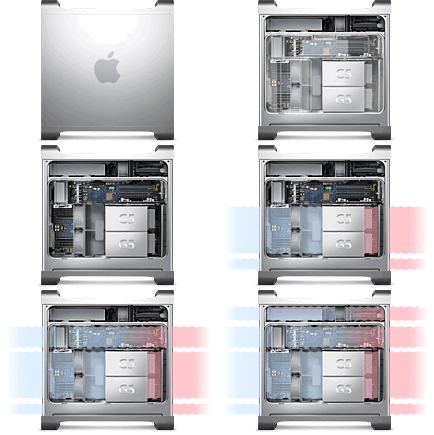
The whole “cheese grater” look was designed for as much air as possible to make its way into the front of the machine:

Jason Snell1 addressed this in his review of the Power Mac G5 in Macworld back in September 2003:
Cooling is vital in the G5; there are nine fans inside the box, which is split into four independent thermal zones. The reason? Apple knows that cooling components only while they’re in use is more efficient than cooling every component at once. With a single thermal zone in a traditional machine, “everyone pays the price for cooling,” says Jon Rubinstein, Apple’s senior vice president of hardware engineering.
You might think that nine fans would make this Mac sound like a power blower (like the Xserve or the “Wind Tunnel” Power Mac G4s), but it’s much quieter. The G5’s intelligent fan management varies the fans’ speed and cranks up the airflow in the appropriate zone only when things are heating up. The system is even smart enough to anticipate heat-generating work—it can increase cooling before components get a chance to warm up.
If you’re doing a lot of processing work, or if you’re in a warm room, the inside of the G5 tower will definitely heat up faster, so the fans will crank up. But in normal operation, this system should be acceptably quiet. Apple claims that the Power Mac G5 runs at 35 decibels, compared with the mirrored-drive-door G4’s 65 decibels, which created quite a ruckus. (To put those noise levels in context, a 70-square-foot office with lights, air conditioning, and a computer turned on registers at about 40 decibels.)
The heat generated by the G5 would become an issue later on, but first we need to talk about Steve Jobs broke a fundamental rule of Apple:
We don’t comment on future products.
A Promise
As captured by the Macworld liveblog, in his keynote address announcing the G5, Jobs promised that even faster machines were coming. Here’s what he said:
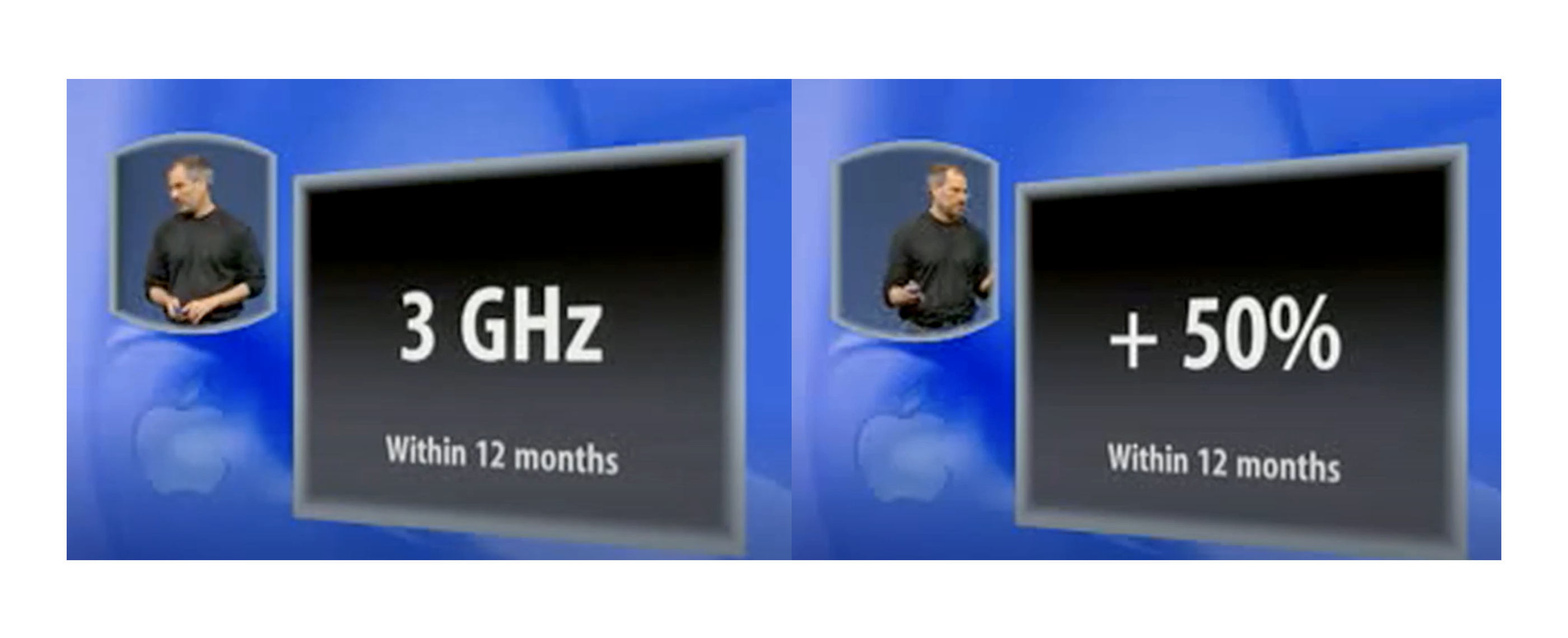
“We’re at 2 GHz today. IBM and Apple are today announcing that within 12 months, we’ll be at 3 GHz. 3 GHz processor clock. That’s up 50 percent within 12 months. Believe me, this architecture has legs.
The promise even made it on screen:
At Apple Expo Paris in September 2003, Jobs doubled down. This was reported at the time by Arnold Kim at MacRumors, who wrote:
One of the most interesting comments from Steve Jobs’ Paris Keynote is the promise that PowerMac G5s will reach 3GHz “before the end of next summer”.
Jobs first claimed that PowerMacs would hit 3GHz “in 12 months” during his WWDC Keynote on June 23, 2003.
The end of summer timeline brings us to August 2004 — 11 months away. With an average product-life of 6 months between PowerMac releases (historically), users can expect another PowerMac revision in the first half of 2004.
Eric Bangeman at Ars Technica also reported on this at the time:
It was also heartening to hear Steve Jobs reaffirm Apple’s (and thus IBM’s) commitment to ship a 3 GHz G5 by the end of next summer. As I have said before, it is highly unusual for Apple to give such insight into product plans, especially committing to certain speeds in a specific timeframe. Doing so signals to the market that Apple will be competitive with the CPUs powering its high-end line for some time. It invites speculation as to the timing of product refreshes on the G5 line. Apple generally goes around 6 months between speed bumps (the recent PowerBook drought being the exception), so there should be one iteration of the G5 between now and the 3 GHz models (MacWorld San Francisco anybody?). This Apple-IBM partnership will definitely bear more fruit than Kaleida and Taligent.
Sadly, it would never happen, and that last prediction would age poorly.
A Promise Broken
In June 2004, Apple revised the Power Mac G5. Here’s part of the press release:
Apple today unveiled its new Power Mac G5 desktop line with every model featuring dual 64-bit PowerPC G5 processors. The top model, featuring two 2.5 GHz processors, the industry’s fastest front-side bus running at 1.25 GHz per processor, and advanced liquid cooling starts at $2,999. The entry model, featuring dual 1.8 GHz processors, starts at just $1,999.
“Our professional customers, across many creative and scientific markets, have been impressed with the extraordinary performance of the dual processor Power Mac G5 running Apple’s Unix-based Mac OS X,” said Philip Schiller, Apple’s senior vice president of Worldwide Product Marketing. “This new Power Mac G5 line has dual processors in every model to deliver even higher performance for our pro customers who need it.”
That made the lineup look like this:
| Price: | CPU: | RAM: | GPU: | HDD: | PCI Slots: |
|---|---|---|---|---|---|
| $1,999 | Dual 1.8 GHz G5 | 256 MB | NVIDIA GeForce FX 5200 Ultra (64 MB) | 80 GB | 3 PCI slots (64-bit, 33 MHz) |
| $2,499 | Dual 2.0 GHz G5 | 512 MB | NVIDIA GeForce FX 5200 Ultra (64 MB) | 160 GB | 3 PCI-X slots (one 64-bit 133 MHz, two 64-bit 100 MHz) |
| $2,999 | Dual 2.5 GHz G5 | 512 MB | RADEON 9600 XT (128 MB) | 160 GB | 3 PCI-X slots (one 64-bit 133 MHz, two 64-bit 100 MHz) |
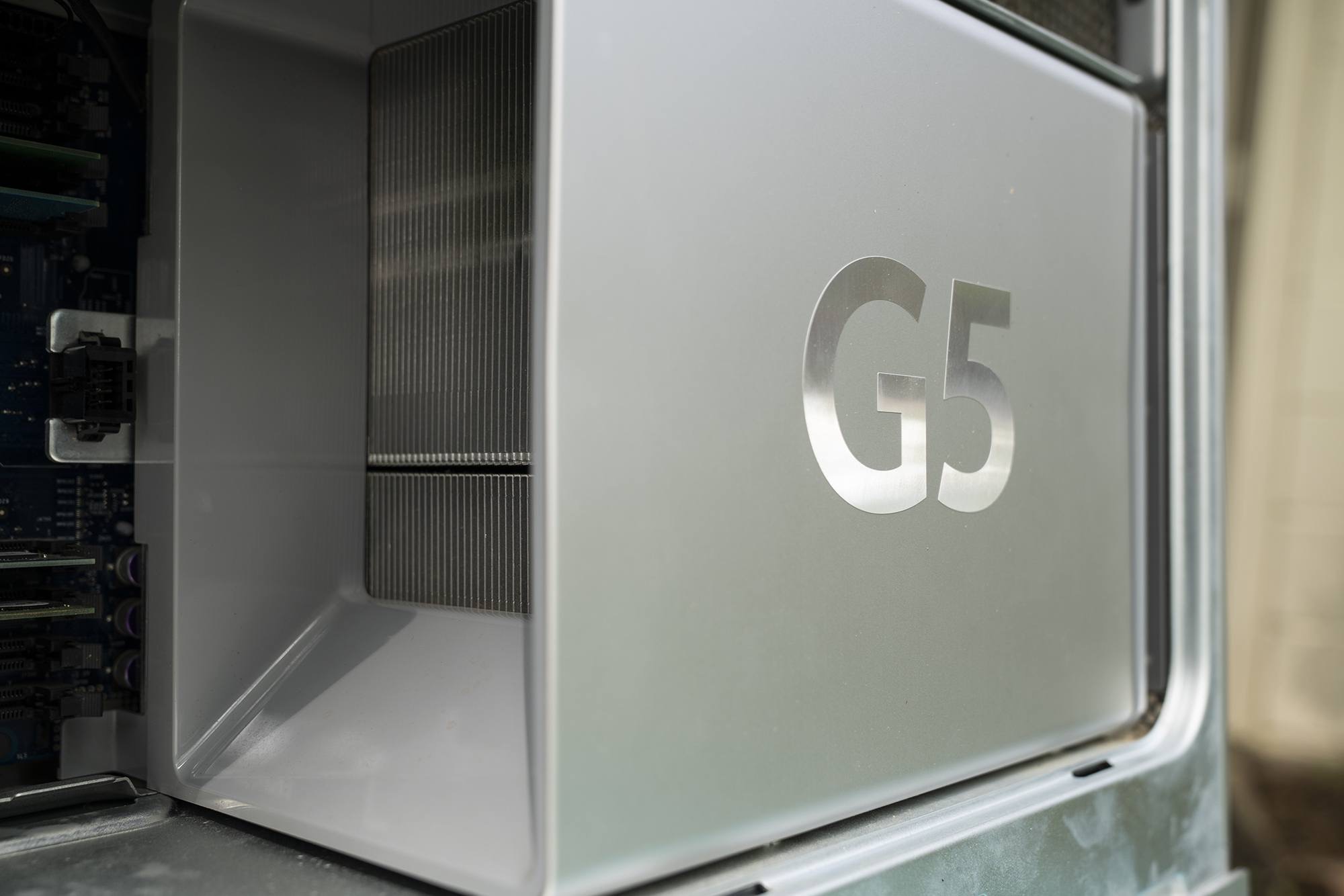
The big news was that dual 2.5 GHz model, which ran so hot that Apple had to swap the air cooling found on other models for a liquid-cooling system:

Here’s a closer look:
This announcement took place a few weeks before WWDC that year, and Jobs used the stage to address the lack of a 3 GHz option:
Now, I want to talk about 2.5 GHz because I stood up here a year ago and said we’d have 3 GHz within a year. What happened?
The G5, as you know, is a very complex chip. And in the semiconductor industry to make things run faster, they traditionally shrank the geometries. The PowerPC was being made in 130 nanometer geometries. And in the last year, the semiconductor industry has gone from 130 nanometer to 90 nanometer expecting everything would just get faster. No problem.
It hit the wall. The whole industry hit the wall at 90 nanometer. And it’s been a lot harder than people thought.
And so the speed increases have been very small compared with what we’ve been used to for the last five years. And IBM’s done really well relative to the rest of the industry, but less than we all hope.
[…]
Intel’s gone up 12.5% [in performance] in a year and IBM’s gone up 25. So we’re not thrilled about missing 3 GHz. But we are pleased that the PowerPC has increased its performance twice as fast as Intel as the entire semiconductor industry has had a tough time with 90 nanometers. Now, in addition to going up twice the level of performance that Intel has over the last year, we give you two of them.
We think the Power Mac is an incredibly high performance system… the highest performance system that you can buy. We’ll keep striving for that three gigahertz. One of these days we’ll make it. But we’re doing pretty well relative to the rest of the industry.
The G5 never made it to 3 GHz. In early 2005, Apple shipped a dual 2.7 GHz system, followed up by a SKU with two 2.5 GHz G5s, each with a dual-core design, giving Mac users the option for a quad-core system for the first time. The high-end systems continued to use liquid cooling to keep the G5’s thermals under control.
IBM was just proved unable to ship a 3 GHz G5 for the Mac, and it put additional strain on what was already a partnership in decline. No matter how fast the G5 could make the Power Mac, it was never going to fit into a PowerBook.
The Upside of Switching
When Apple announced it was switching to Intel at WWDC 2005, many folks wondered what it would mean for the Power Mac, and in August of the next year, Apple unveiled the Mac Pro. The biggest news was right at the top of the press release:
Apple today unveiled the new Mac Pro, a quad Xeon, 64-bit desktop workstation featuring two new Dual-Core Intel Xeon processors running up to 3.0 GHz and a new system architecture that delivers up to twice the performance of the Power Mac G5 Quad. With advanced performance, greater expansion, higher performance graphics options and unprecedented customization, the newly designed Mac Pro is the ideal system for the most demanding user. The introduction of the Mac Pro marks the completion of a rapid and seamless transition for Apple, with the entire Mac family now using Intel’s latest processors.
It went on:
The new Mac Pro features the new Dual-Core Intel Xeon 5100 series processor based on the revolutionary Intel Core microarchitecture, delivering breakthrough performance and power efficiency. The new Mac Pro is up to twice as fast as the Power Mac G5 Quad running industry standard benchmarks and features two Dual-Core Intel Xeon processors running up to 3.0 GHz, each with 4MB of shared L2 cache and independent 1.33 GHz front-side buses. With 667 MHz DDR2 fully-buffered memory, the Mac Pro also boasts a 256-bit wide memory architecture for amazing bandwidth.
The Mac did end up at 3 GHz, just a few years and a processor transition later than planned.
- Don’t miss Jason’s lovely commentary about this story on Six Colors. ↩