Earlier this evening, an 80-page document was released by the U.S. District Court in California, hitting Apple hard for its anti-competitive strategies concerning the App Store. The Verge’s Jay Peter’s has a great breakdown, but the gist of the ruling is that Apple can no longer charge commission on purchases made outside of the App Store or put block or limit developers who wish to link to purchases outside of Apple’s App Store system.
For over a year, developers in the U.S. App Store have been able to link to outside payment methods, but the company had strict rules on how such links had to appear. That included this gem of a screen that made the rounds last January that developers had to include in their apps:
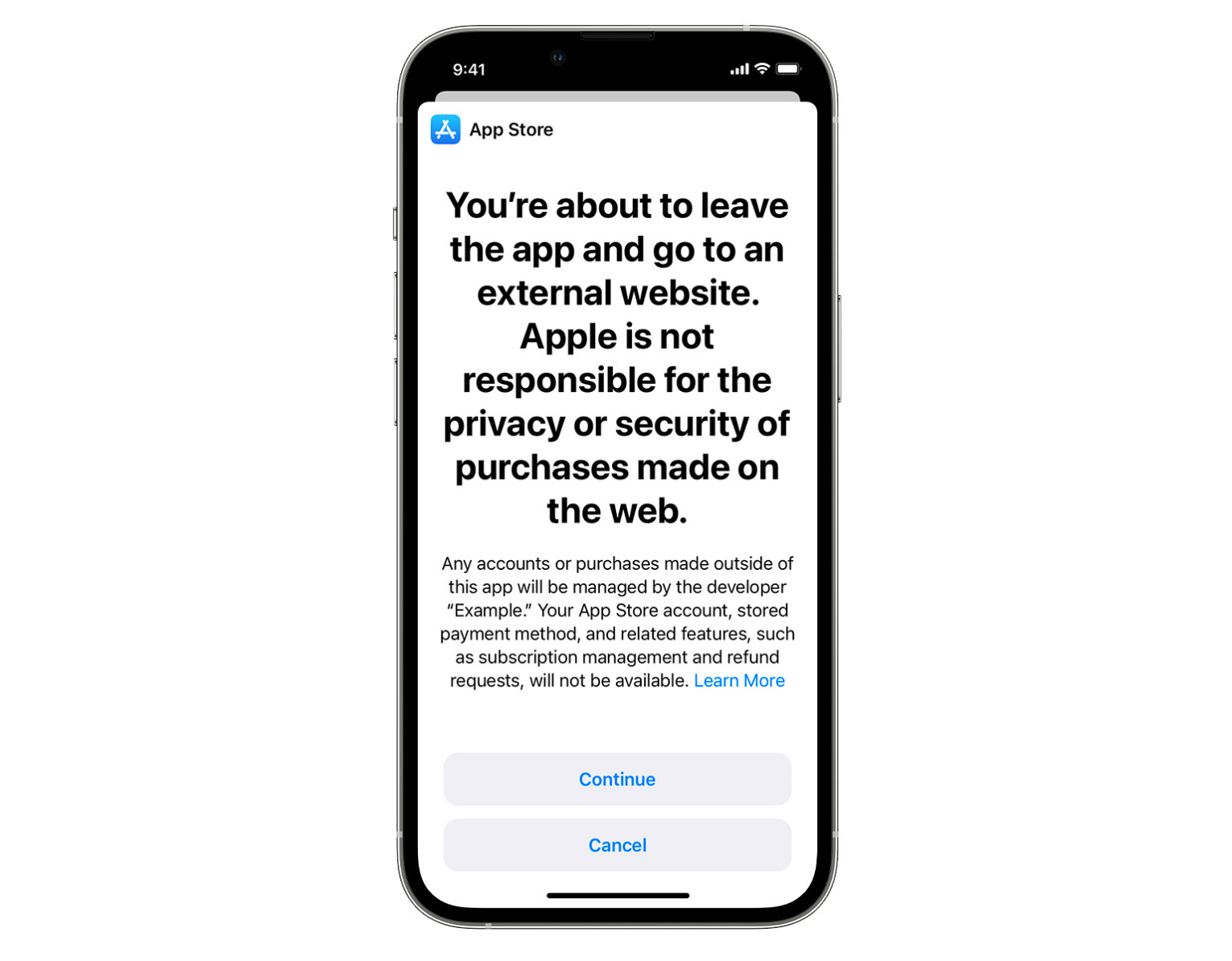
As bad as that screen was, what was worse is that Apple required developers report their revenue and pay Apple 27% of what they earned through those links. This ruling strikes that down, and I think it was the right call. That scare screen and 27% fee came after Apple was told to open up its App Store to outside payment methods. The company’s response was far from gracious.
Time will tell how this shakes out, but this is a huge blow to Apple’s control over the money that flows through its platforms. The ruling is also a huge blow to Apple itself. Some of the language in the 80-page PDF is breathtaking. Forgive the long block quote, but this passage gets to the heart of the matter:
In stark contrast to Apple’s initial in-court testimony, contemporaneous business documents reveal that Apple knew exactly what it was doing and at every turn chose the most anticompetitive option. To hide the truth, Vice-President of Finance, Alex Roman, outright lied under oath. Internally, Phillip Schiller had advocated that Apple comply with the Injunction, but Tim Cook ignored Schiller and instead allowed Chief Financial Officer Luca Maestri and his finance team to convince him otherwise. Cook chose poorly. The real evidence, detailed herein, more than meets the clear and convincing standard to find a violation. The Court refers the matter to the United States Attorney for the Northern District of California to investigate whether criminal contempt proceedings are appropriate.
This is an injunction, not a negotiation. There are no do-overs once a party willfully disregards a court order. Time is of the essence. The Court will not tolerate further delays. As previously ordered, Apple will not impede competition. The Court enjoins Apple from implementing its new anticompetitive acts to avoid compliance with the Injunction. Effective immediately Apple will no longer impede developers’ ability to communicate with users nor will they levy or impose a new commission on off-app purchases.
The document directly addresses Apple’s tight control over how links to external payment methods appear. When I read this part of the injunction, I whistled out loud, to the surprise of my wife who was in the room with me:
For button styles, Apple limits developers to what Apple calls the “plain” button style — essentially just a hyperlink — because Apple does not want the developers to use the more effective “button.” A more effective button would increase competition. Similarly, Apple limits calls to action to five, narrowly cabined templates. Nowhere does the Court authorize those limitations. At a minimum, the Court need not decide whether these restrictions alone violate the Injunction, because Apple has violated the central mandate of this Court’s orders: that Apple not foreclose competitive alternatives to IAP.
The document reveals that those screens were at the behest of Tim Cook:
After the June 20, 2023 meeting regarding this Court’s Injunction, Apple decided that it would implement a full screen warning after users click on an external link, regardless of which commission option was ultimately selected. At the meeting, Mr. Cook “asked the team to revise the customer warning screen . . . to reference the fact that Apple’s privacy and security standards do not apply to purchases made on the web.” The team updated the warning screen, sent it to Mr. Schiller for approval, and returned the revised copy to Mr. Cook on June 23, 2023. The updated warning screen changed a sentence from “You will no longer be transacting with Apple” to “Apple is not responsible for the privacy or security of purchases made on the web.” As Ms. Goldberg’s notes reflect, the idea discussed was that this “[i]nterstitial . . . tells ppl its dangerous and they are leaving the app store.”
I guess he’s a product guy after all.
Apple has already said it will appeal. That’s not surprising, but sitting here in my kitchen at my laptop tonight, I don’t see how this ends well for Apple unless the Trump administration steps in.