It’s a big day for Mac laptop buyers. Let’s start with the simplest of the updates, the MacBook Air:
M5 features a faster CPU and next-generation GPU with a Neural Accelerator in each core, enabling MacBook Air to power through a variety of workflows, from creative projects to complex AI tasks. MacBook Air now comes standard with double the starting storage at 512GB with faster SSD technology, and is configurable up to 4TB, so customers can keep their most important work on hand. Apple’s N1 wireless chip delivers Wi-Fi 7 and Bluetooth 6 for seamless connectivity on the go.
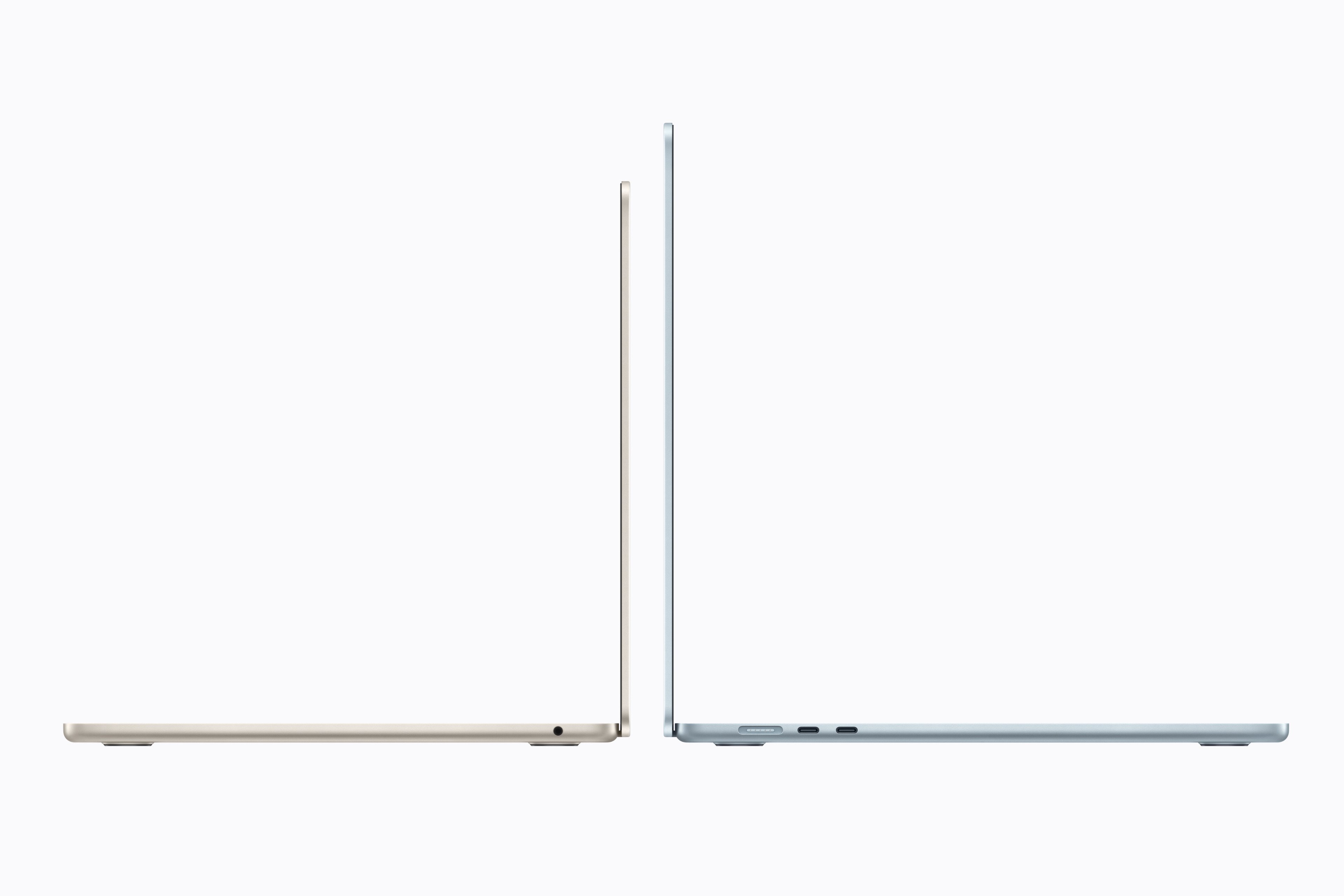
The new MacBook Air starts with 512 GB of storage, which is up from the M4’s 256 GB entry point, and can be upgraded to a full 4 TB for the first time. Apple says the SSD is twice as fast as before. The Air features the same great chassis — and colors — as before, and now starts at $1,099, a hundred bucks more than before, thanks to that bump in SSD size.
Moving upstream, things get much more interesting with two new chips: the M5 Pro and M5 Max.
These use a new design Apple is calling its “Fusion Architecture,” as the press release explains:
This innovative design combines two dies into a single system on a chip (SoC), which includes a powerful CPU, scalable GPU, Media Engine, unified memory controller, Neural Engine, and Thunderbolt 5 capabilities.
[…]
This brings together two third-generation 3-nanometer dies with high bandwidth and low latency using advanced packaging. The two dies include a powerful new CPU, scalable GPU, Media Engine, unified memory controller, Neural Engine, and Thunderbolt 5 capabilities.
With this new chiplet design comes a new silly Apple marketing move:
M5 Pro and M5 Max feature a new 18-core CPU with 6 super cores and 12 all-new performance cores.
The industry-leading super core was first introduced as performance cores in M5, which also adopts the super core name for all M5-based products — MacBook Air, the 14-inch MacBook Pro, iPad Pro, and Apple Vision Pro. This core is the highest-performance core design with the world’s fastest single-threaded performance, driven in part by increased front-end bandwidth, a new cache hierarchy, and enhanced branch prediction.
There three levels of cores now, as John Gruber writes:
There are now three core types in M5-series CPUs. Efficiency cores are still “efficiency”, but they’re only in the base M5. What used to be called “performance” cores are now called “super” cores, and they’re present in all M5 chips. The new core type — more power-efficient than super cores, more performant than efficiency cores — are taking the old name “performance”.
He’s put them in chart form:
| Chip: | Efficiency: | Performance: | Super: |
|---|---|---|---|
| M5 | 6 cores | — | 4 cores |
| M5 Pro | — | 10 cores | 5 cores |
| M5 Pro | — | 12 cores | 6 cores |
| M5 Max | — | 12 cores | 6 cores |
My word.
All M5 Pro and Max systems come with:
- A faster 16-core Neural Engine
- Support for hardware-accelerated H.264 and HEVC, AV1 decode, and ProRes encode and decode engines
- Memory Integrity Enforcement, which Apple describes in this security research blog post
- A Thunderbolt 5 setup that includes a custom-designed controller for each port
The MacBook Pro itself still comes in 14- and 16-inch sizes. The smaller machine can be purchased with an M5, M5 Pro, or M5 Max, while the 16-inch can only be ordered with the latter two options.
The M5 Pro starts with a 15-core CPU and 16-core GPU variant, 24 GB of unified memory, and a 1 TB SSD.
The M5 Max can be topped out with an 18-core CPU and 40-core GPU with 128 GB of unified memory, and an 8 TB SSD.
These machines are available in the previous silver and space black finishes, and ship next week.