
The most obvious features of Jupiter are its bands of light and dark clouds. These are bordered by jet streams blowing east and west. The light areas are called zones. The air inside zones is circulating anti-cyclonically, making them a broad area of higher air pressure. The increased pressure supports the formation of high-altitude clouds of white ammonia ice, which mostly obscure the deeper, more colorful clouds. The dark areas are called belts, and inside these the air circulates cyclonically. In the belts, the ammonia ice clouds aren’t thick enough to obscure the view, allowing us to see a deeper cloud deck of ammonium sulfide and ammonium hydrosulfide, as well as a rich brew of organic compounds. These chemicals could be giving the belts their brownish color.
Category: Space
Apollo 11 Guidance Computer Source Code on GitHub⇢
Chris Garry has put the Apollo 11 guidance computer source code (in assembly) on GitHub, which is amazing.
This Issue is like the cherry on top.
STS-135⇢
Bart Leahy, writing about the last space shuttle launch:
Five years ago today, the Space Shuttle Atlantis and the Space Shuttle program itself took its last flight into space on mission STS-135 to service the International Space Station (ISS). Since that last flight in 2011, the Shuttle orbiters have been flown off to museums across the country and NASA’s human spaceflight program has shifted to other missions and other vehicles. No other American human-rated spacecraft has been flown so often or accomplished so much.
Juno powered by a PowerPC chip⇢
Like many past spacecraft, Jupiter’s new orbiter is powered by a PPC chip:
When you want radiation-hardened CPU designs (to guard against naughty things like cosmic rays flipping bits and zapping traces), you want BAE’s RAD series, and that means you want … PowerPC. Yes, Juno’s brain is a lowly RAD750 running at 200MHz, essentially a beige Power Mac G3 with cojones of pure lead. It has 128MB of the baddest, meanest, toughest DRAM there is and 256MB of flash on board with a system bus providing 100Mbps of instrument bandwidth for pure awesome.
Juno in Jupiter’s orbit⇢
Last night was an exciting one for space fans. Five years after launch, NASA’s Juno spacecraft entered orbit around Jupiter.
That isn’t a simple thing to accomplish. The spacecraft had to slow down enough to be captured by the planet’s gravity to swing around the gas giant. Slow down too much and the orbit would be too wide; miss the mark and the spacecraft could have met an early demise.
Juno to enter Jupiter’s orbit today⇢
Loren Grush has the details on how to watch.
Juno⇢
On July 4, NASA’s Juno spacecraft will be inserted into orbit around Jupiter, the largest planet in our solar system.
For the first time, scientists will be able to see below the thick clouds that surround the gas giant. The craft is the farthest from Earth a solar-powered spacecraft has been used, and will travel around Jupiter in a polar orbit (as opposed to going around its equator) at 130,000 MPH. It’s orbit is elliptical, and is designed to allow the craft to image the entirety of Jupiter over its lifecycle.
Terrifying mission patches⇢
Loren Grush, writing about National Reconnaissance Office’s mission patches for various rocket launches to put … secret things … into orbit:
Well it turns out that releasing creepy AF mission patches is a long-standing tradition for the NRO. It’s a far cry from the cheery NASA mission patches we’re used to. Instead, many of the NRO patches follow a specific formula: large scary animal grasps Earth.
Seriously, go look at these things. Yikes.
NASA halts BEAM expansion⇢
BEAM — the Bigelow Expandable Activity Module — is an expandable module that’s in testing at the International Space Station. As opposed to being built out of rigid material like other components on the Station, BEAM is designed to “inflate” once installed.
The upsides of this tech are huge. Currently, the size of any one structure in space is limited to what can be carried to orbit on the top of a rocket. In flight, BEAM was much smaller than it’s size will be once it’s fully expanded in space.
Kepler team validates 1,284 new planets⇢
Analysis was performed on the Kepler space telescope’s July 2015 planet candidate catalog, which identified 4,302 potential planets. For 1,284 of the candidates, the probability of being a planet is greater than 99 percent – the minimum required to earn the status of “planet.” An additional 1,327 candidates are more likely than not to be actual planets, but they do not meet the 99 percent threshold and will require additional study. The remaining 707 are more likely to be some other astrophysical phenomena. This analysis also validated 984 candidates previously verified by other techniques.
Mercury’s transit underway⇢
Today, the inner-most planet of our Solar System is making a transit across the sun. http://www.nasa.gov/feature/goddard/2016/satellites-to-see-mercury-enter-spotlight-on-may-9 The small planet cross the front of the sun (from our viewpoint) a dozen or some times a century, and it really is a thing of beauty.
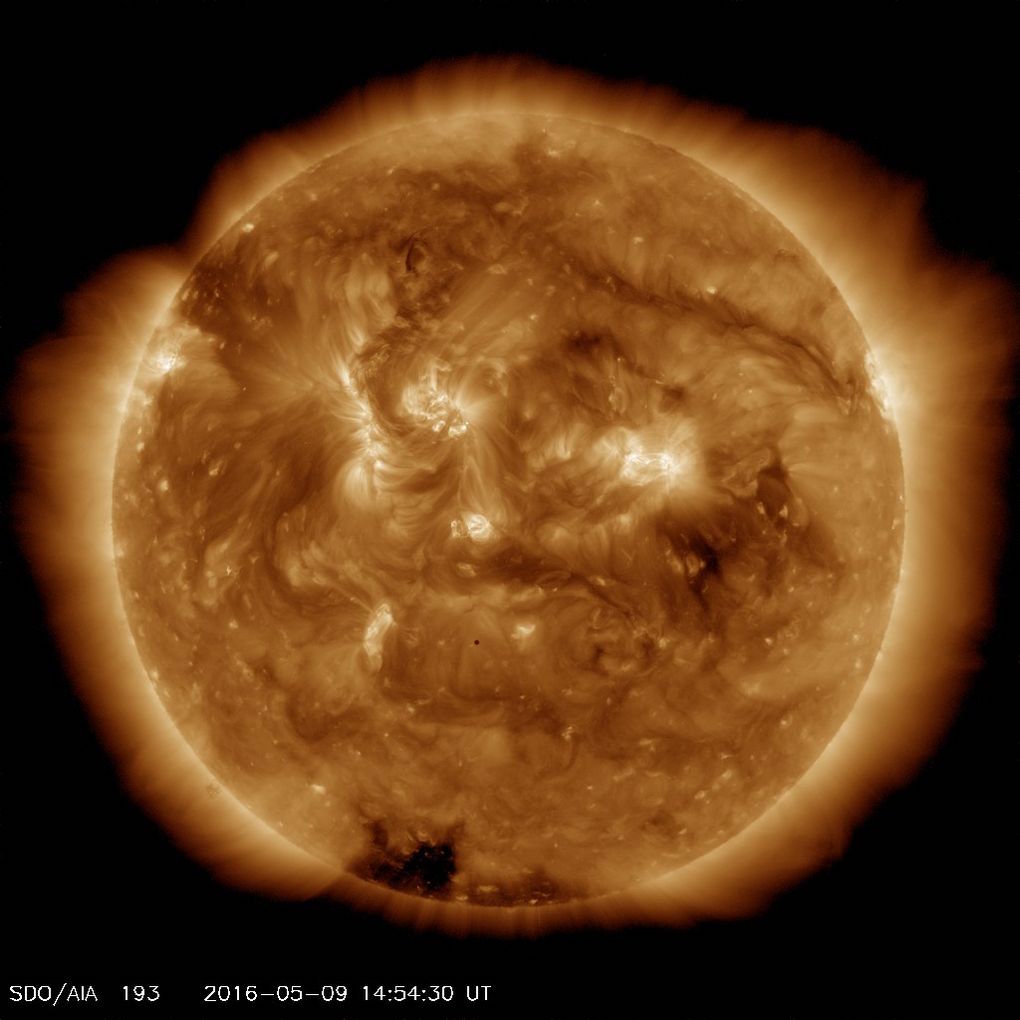
The seven and a half hour event is being covered extensively on NASA’s website, and can be watched on YouTube.
SpaceX planning Mars missions⇢
SpaceX plans to send its Dragon spacecraft to Mars as early as 2018, the company announced today — marking a major first step toward CEO Elon Musk’s goal of sending humans to the Red Planet. The company didn’t say how many spacecraft it will send, but hinted it would conduct a series of these Dragon missions and that it would release more details soon. In a tweet, the company indicated that the capsules would fly on SpaceX’s Falcon Heavy rocket, a bigger version of its Falcon 9; the rocket will launch the capsules to the planet to test out how to land heavy payloads on Mars. If successful, the endeavor would make SpaceX the first private spaceflight company to land a vehicle on another planet.