The NASA Design Program

Michael Bierut:

The National Aeronautics and Space Administration Design Program is a modernist vision for an optimistic future. The logo (often referred to as the “worm”) evokes qualities of unity, technical precision, scientific capabilities and uniqueness. Reduced to its simplest form; the one width, continuous-stroke letters are as contemporary today as when the logo was first introduced by Richard Danne (Design Director) and Bruce Blackburn (Designer) at Danne & Blackburn, New York, NY) more than 37 years ago. How then, in 1992, after 19 years, did such an emblematic design program for a future-oriented Federal Agency be dropped for it’s previous (now current) Insignia (the “meatball”)? What follows is a heartfelt personal account from Mr. Danne on the obstacles and achievements of one of the century’s most important and widely published design programs.

This is a fascinating read, whether not you’re into space stuff or not.

Announcing Liftoff, a new podcast about space from Relay FM

Over the past six months or so, I’ve been writing, talking and thinking a lot more about space and how we get there.

That’s led — somewhat inevitably — to a new podcast on Relay FM. We’ve named it Liftoff.

Here’s the fancy description my cohost Jason Snell came up with:

Liftoff is a fortnightly podcast about space, the universe, and everything. You don’t need to be a rocket scientist to understand the latest developments as explained by enthusiastic space fans Stephen Hackett and Jason Snell.

Jason’s a huge space nerd, and it’s been a ton of fun working with him on this project. As the description says, we’ll be keeping things casual on the science end. We believe these topics should be approachable by anyone.

Episode 1 is out today, and we’ll be publishing every other week. Go subscribe to hear us talk about space lettuce (!) and the Curiosity rover on Mars.

I owe a huge thanks to our talented and mysterious designer for the Liftoff art. All I said was “it should look like a mission patch,” and I think it’s my new favorite art on the network.

‘That’s one small bite for a man, one giant leaf for mankind’

Today, astronauts on the International Space Station sampled space-grown lettuce:

The red lettuce eaten Monday – accompanied by a dash of vinaigrette dressing – was grown in a specialized canister aboard the International Space Station during recent weeks and had sprouted from seeds that were glued into place on Earth. Astronauts placed the seeds and their pouches in a system that provided the water and light needed to make the plants grow. Half of the landmark crop was eaten while the other half will be returned to researchers at NASA’s Kennedy Space Center in Florida for closer study.

While at NASA this summer, I got an up-close look at a duplicate of the rig used to grow these space veggies. While this may not seem like the most exciting science experiment, growing food in space will be critical on manned missions to Mars.

Three years of Curiosity

Ashwin Vasavada, project scientist for the Mars Science Laboratory mission:

It’s a summer of milestones for Mars Exploration. Fifty years ago, Mariner 4 became the first spacecraft to take close-up pictures of Mars. Thirty-nine years ago, the Viking 1 Lander became the first spacecraft to successfully land on the Red Planet. And now, Curiosity celebrates 3 years on Mars — operating well over a thousand Martian days.

In three years, the 1-ton rover has made some significant findings, including encouraging information about radiation levels on the Martian surface, the presence of methane, and — of course — water on the Red planet.

About Apollo 15’s lunar rover

Mika McKinnon:

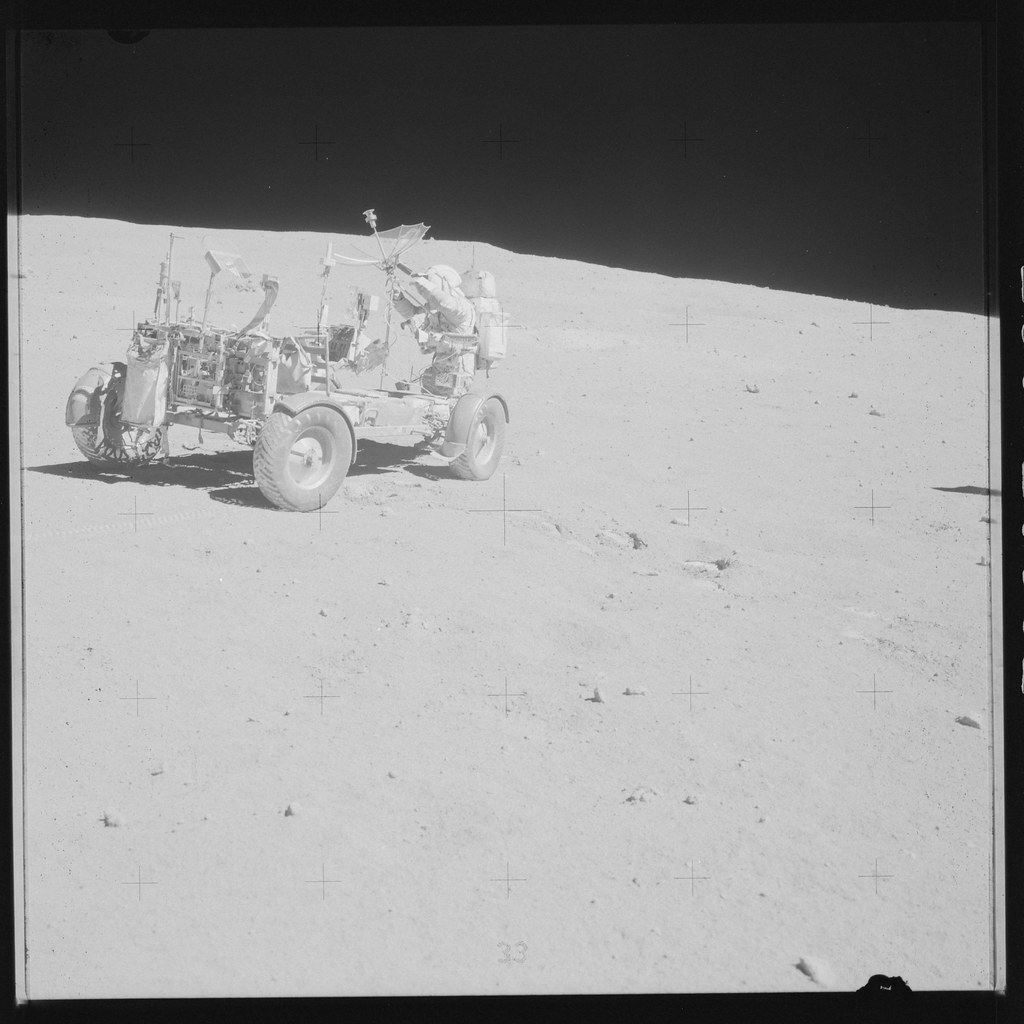
Apollo 15 was the first lunar landing mission to use a rover, allowing astronauts Jim Irwin and Dave Scott to explore farther from their landing site while still having time to conduct scientific research. Al Worden stayed in orbit, photographing a quarter of the moon’s surface during his three solitary days in a spacecraft in July 30 to August 2, 1971.

The lunar rover is one crazy peice of hardware.

Talking space

Earlier this afternoon, Jason Snell and I sat down to talk about New Horizon’s Pluto discoveries, a newly-discovered Earth-like planet and why space is back in the news.

NASA’s Kepler mission discovers Earth-like planet

Huge news from the Kepler mission:

NASA’s Kepler mission has confirmed the first near-Earth-size planet in the “habitable zone” around a sun-like star. This discovery and the introduction of 11 other new small habitable zone candidate planets mark another milestone in the journey to finding another “Earth.”

The newly discovered Kepler-452b is the smallest planet to date discovered orbiting in the habitable zone — the area around a star where liquid water could pool on the surface of an orbiting planet — of a G2-type star, like our sun. The confirmation of Kepler-452b brings the total number of confirmed planets to 1,030.

Kepler-452b is older and bigger than Earth and is 1,400 light-years away. What a crazy universe we live in.

SpaceX discusses CRS-7 failure

Last month, Space X’s CRS-7 exploded after take-off. I was 4 miles from the launchpad that morning, but there wasn’t much news that day as to what had failed on the Falcon 9 rocket. Today, there’s more news. Here’s Loren Grush’s at The Verge:

The SpaceX explosion on June 28th was caused by a failed strut in the rocket’s upper stage liquid oxygen tank, SpaceX chief executive officer Elon Musk said today. The strut was one of several hundred used to hold together the helium pressure vessels in the tank, which help to pressurize and maintain the buoyancy of the rocket. According to Musk, the strut was designed to handle 10,000 pounds of force, but failed at just 2,000 pounds of force.

“This is the best of what we know thus far,” said Musk during a press conference. “We emphasize this is an initial assessment, and further investigation may reveal more over time.”

Musk said that the company has since tested thousands of struts from the supplier, with “several” failing. SpaceX will no longer be using these components, and will beging to individually test struts for future rockets.

SpaceX’s flight was unmanned, but the California company is one of the groups on track to fly US astronauts upon private vehicles. That said, NASA commented last month that vehicle loss at this stage of development was to be expected. Commercial crew test flights are on track for 2017. The next Falcon 9 launch is now slated for September.

Update: SpaceX has published a blog post with additional details.

Good morning, Pluto

This morning, NASA released this image of Pluto, as part of its on-going New Horizons mission.

Currently, the piano-sized spacecraft is in radio silence, collecting data as it flies by Pluto and its moons. Tomorrow marks the start of a 16-month data download about the dwarf planetary system as the space craft flies into the Kuiper belt. For today, however, this image is an amazing gift from the countless scientists and engineers who have been working for over a decade on this project.