xAI Gathering Turbines for Second Memphis Site, One Mile Outside of City

In May, it was reported that xAI was looking to use gas turbines to power its second Memphis location, in part through a partnership named Stateline Power Solutions. Part of the deal was some property just south of the Tennessee/Mississippi state line, which was being used to store the gas turbines that xAI will rely on to help power the new data center. According to Samuel Hardiman, the rate at which equipment is being delivered to the site has picked up steam:

On Wednesday, June 18, a Daily Memphian reporter observed dozens of natural gas turbines and energy equipment stockpiled in a field at 2979 Stateline Road West in Southaven [Mississippi]. None of the equipment appeared to be running, but it does seem to be multiplying. Two weeks ago, the reporter saw only six or seven turbines on the same lot.

According to filings with the Securities and Exchange Commission, the equipment in the field was delivered as part of a joint venture between Elon Musk’s xAI and Solaris Energy Infrastructure LLC, in line with the venture’s plans to build up to 900 megawatts of off-site capacity for xAI’s second Memphis data center.

The company is building that data center about a mile to the north at 5420 Tulane Road in Memphis.

Hardiman continues:

About a half-mile south of the field where the equipment is stationed is a 100-plus-acre Southaven site that was once a Duke Energy natural gas plant. For more than two months, The Daily Memphian has observed workers move between xAI’s 5420 Tulane Road property and the former plant at 2875 Stanton Road, raising the question of whether that site is where xAI will generate the power needed for its second Memphis data center.

Both of those Mississippi addresses are linked to Solaris Energy Infrastructure, Inc., the company who sourced the turbines in use at xAI’s first Memphis site.

This map shows how close these locations are to the new data center:

xAI Second Sites

This reporting comes the same week where the NAACP and the Southern Environmental Law Center announced their intent to sue xAI over their use of gas turbines at the company’s first Memphis site. In my article covering that development, I quoted from a recent editorial written by Memphis Mayor Paul Young. I’m going to quote the exact same section of that article today:

Claim #1: xAI plans to install 45 to 90 turbines in Memphis

False. Their permit outlines 15 temporary-use turbines for their first facility. That’s it. There’s no plan, permit or proposal for anything more. The power solution for their second site hasn’t been determined.

Young would be proven right if the turbines that are being delivered are technically run in Southaven and not Memphis, but air pollution doesn’t care about state lines.

xAI Looking to Raise Billions

Amanda Silberling at TechCrunch:

Elon Musk’s startup xAI is trying to raise a $4.3 billion equity investment, according to a report from Bloomberg. This equity funding would be in addition to the $5 billion that Musk is allegedly trying to raise in debt funding for the combined entity of X and xAI.

The company appears to be raising money again after landing a $6 billion cash infusion in December, because it has already spent much of its money.

NAACP Looks to Sue xAI Over Clean Air Act as Turbines Spin in Memphis

Samuel Hardiman writing, for The Daily Memphian reporting that the NAACP plans to sue xAI for alleged violations of the federal Clean Air Act:

The notice of intent provides the entity that could be sued with 60 days’ notice of the lawsuit, allowing it or the regulator (the Environmental Protection Agency or another government entity) to correct the actions outlined in the notice.

“By installing and operating 35 combustion turbines and other sources of air pollution, xAI has illegally constructed and continues to operate a major source without obtaining a preconstruction PSD permit. In addition to failing to obtain a PSD permit, xAI has operated and continues to operate these turbines without utilizing Best Available Control Technology, a distinct and ongoing violation of Section 165 of the Act,” the notice of intent to sue states.

The lawsuit is in conjunction with the Southern Environmental Law Center. In a press release, the group said:

“xAI’s decision to install and operate dozens of polluting gas turbines without any permits or public oversight is a clear violation of the Clean Air Act,” SELC Senior Attorney Patrick Anderson said. “Over the last year, these turbines have pumped out pollution that threatens the health of Memphis families. This notice paves the way for a lawsuit that can hold xAI accountable for its unlawful refusal to get permits for its gas turbines.”

xAI began operations at its South Memphis data center in June of 2024. To meet the facility’s massive power demands, the company began installing dozens of polluting methane gas turbines without any permits. Aerial images obtained by SELC revealed 35 turbines at the site in March, and follow-up thermal images obtained in April showed that nearly all of the turbines were emitting significant amounts of heat, indicating they were running. New satellite images show that, while the company has removed some smaller-sized turbines, it has recently installed three larger turbines.

The full notice can be read here. A lot of the disagreement hinges on how many turbines are in use. As recently as last week, Memphis Mayor Paul Young claimed the turbines in use are legal, saying that 21 are now in use.

There’s been a lot of noise about the xAI project. A lot of shouting. A lot of misinformation. What there hasn’t been enough of is truth.

Let’s be clear, this isn’t a debate between the environment and economics. It’s about putting people before politics. It’s about building something better for communities that have waited far too long for real investment.

On behalf of our city, I’m choosing Memphis. I’m choosing facts over fear, solutions over soundbites, and progress over performative outrage.

I’m all for choosing Memphis, but that means caring for all of our citizens, especially the most vulnerable. Young seems like a guy who understands that, which makes this all the more frustrating as a Memphian who voted for the guy.1

He goes on:

Claim #1: xAI plans to install 45 to 90 turbines in Memphis

False. Their permit outlines 15 temporary-use turbines for their first facility. That’s it. There’s no plan, permit or proposal for anything more. The power solution for their second site hasn’t been determined.

He is not wrong that there is no permit for more turbines, but it’s clear that xAI and its partners plan more turbines in Memphis, as reported last month. Construction is already underway at the second site, and it’s clear that our utility company is not going to be ready in time.


  1. I really like part of his editorial from June 12:

    “We’re introducing Memphis’ first-ever Community Benefit Ordinance, which mandates that 25% of xAI’s city property tax revenue be reinvested directly into neighborhoods within five miles of the facility. That means more than $3 million this year alone. Over the next decade, as additional project phases come online, this could total more than $100 million for infrastructure upgrades, home repairs and quality-of-life improvements in communities that too often get talked about, but not truly invested in.”

    I just wish he — and our other local leaders — would be more honest about what’s going on here. 

The Promise of a ‘Digital Delta’

Holly Bailey, writing for The Washington Post about xAI in Memphis:

In late April, hundreds of people gathered at a South Memphis high school to speak out about xAI’s turbines. Dozens of Shelby County sheriff’s deputies along with Tennessee National Guard members were there to provide security, a surprising show of force for a public health hearing.

“What do they think we are going to do?” a woman asked in the parking lot, eyeing the massive security presence.

Inside, [longtime Musk associate and xAI boss Brent] Mayo, dressed in an xAI hat and shirt, was surrounded by deputies. It was his third public appearance on behalf of the company in a year, and he was shouted down almost immediately as he read from a statement defending the company’s commitment to being a good partner to Memphis.

“We are here to create jobs and support Memphis in being a leader in future technology,” Mayo said, his words barely audible. Visibly frustrated, he left the lectern and soon exited the meeting, trailed by officers. “Did he just leave?” someone shouted.

What a coward.

Bailey continues:

Young, the mayor, stands by the project, pointing to new announcements from other technology companies that plan to expand operations here. Supporters say it is part of Memphis’s transformation into the “Digital Delta,” a nod to the city’s location atop the Mississippi River delta where cotton production and manufacturing once reigned.

Young said he is constantly meeting people “crying out for help,” leaving him determined to find ways to revive the city. “Because as mad as y’all are, I am, too,” the mayor recently told a room of xAI critics, speaking to the frustration he has felt seeing his hometown in decline.

“I know y’all feel like it’s us getting exploited, but we need to speak from a place of strength,” he said. “We need to exploit this project for our good.”

What naivety.

Musk Confirms Second Memphis xAI Site Could Use One Gigawatt of Power

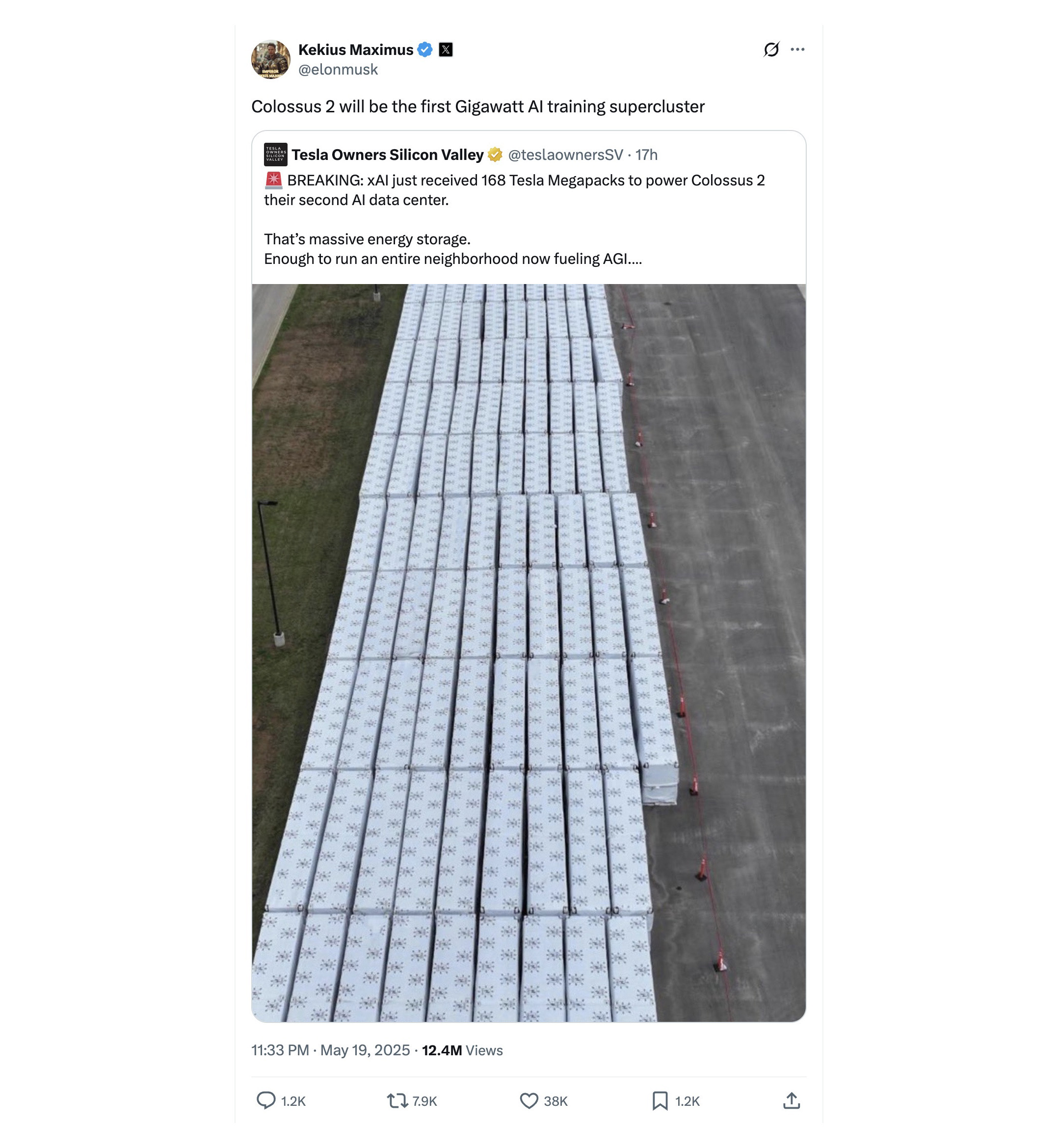
Yesterday, in a late-night post on X, the billionaire wrote:

Colossus 2 will be the first Gigawatt AI training supercluster

X embeds don't seem to be working for me so here's a screenshot

Samuel Hardiman, at The Daily Memphian earlier today:

MLGW’s maximum electricity demand of all time is about 3,500 megawatts, or three-and-a-half gigawatts. Its power use is weather dependent: In the summer, MLGW uses 2,800 to 3,000 megawatts, while during the winter, it’s 1,700 to 1,800.

It remains to be seen whether MLGW and the Tennessee Valley Authority, which provides energy to the region, have enough electricity to serve the new xAI investments. It is also not clear how many semiconductors, known as graphics processing units, or GPUs, the site would use to run the data center.

It’s unlikely that MLGW and TVA will have that sort of power available by the time the second site is operational, and there’s plenty of evidence to back that up.

‘Our Health Was Never Considered’

Laura Paddison and Rene Marsh for CNN:

Last summer, an abandoned factory in southwest Memphis got a new life courtesy of the world’s richest man. Elon Musk’s artificial intelligence company xAI moved in to transform this unprepossessing building into the “world’s largest supercomputer.”

Musk named it Colossus and said it was the “most powerful AI training system in the world.” It was sold locally as a source of jobs, tax dollars and a key addition to the “Digital Delta” — the move to make Memphis a hotspot for advanced technology.

“This is just the beginning,” xAI said on its website; the company already has plans for a second facility in the city.

But for some residents in nearby Boxtown, a majority Black, economically-disadvantaged community that has long endured industrial pollution, xAI’s facility represents yet another threat to their health.

xAI Reports ‘An Unauthorized Modification’ Leading to Grok Being Obsessed with ‘White Genocide’

Kyle Orland, writing at Ars:

On Wednesday, the world was a bit perplexed by the Grok LLM’s sudden insistence on turning practically every response toward the topic of alleged “white genocide” in South Africa. xAI now says that odd behavior was the result of “an unauthorized modification” to the Grok system prompt—the core set of directions for how the LLM should behave.

That prompt modification “directed Grok to provide a specific response on a political topic” and “violated xAI’s internal policies and core values,” xAI wrote on social media. The code review process in place for such changes was “circumvented in this incident,” it continued, without providing further details on how such circumvention could occur.

Seems like some super normal and chill people are working at xAI. I wonder if any of them are my neighbors. I mean, just look at this:

Grok

Orland goes on:

To prevent similar problems from happening in the future, xAI says it has now implemented “additional checks and measures to ensure that xAI employees can’t modify the prompt without review” as well as putting in place “a 24/7 monitoring team” to respond to any widespread issues with Grok’s responses.

That open-source part sure sounds… familiar.

Shelby County Health Department to Address xAI Turbines and Public Complaints

As I’ve previously written, xAI has a permit to run 15 gas turbines at its first site, but more than 30 have been spotted running. Those additional turbines are operating under an emergency-use exemption that is good for one year, and were initially slated to provide backup power when the utility company couldn’t keep up. Our county Health Department will be weighing in on the matter later this summer, according to a press release:

The Shelby County Health Department’s Pollution Control Branch has received more than 1,700 public comments regarding the xAI CTC Property LLC application for an air pollution permit for natural gas turbines located at the company’s site at 3231 Paul R. Lowry Road, Memphis, TN.

Each comment will be addressed before any decision is made regarding the permit application. The SCHD Pollution Control Branch expects to complete the permit review process in approximately sixty (60) days.

Meanwhile, the story continues to garner national attention:

Shelby County Commission Proposes Monthly Air Quality Tests in South Memphis Near xAI Site

Desmond Nugent at ABC24:

In response to growing environmental concerns in South Memphis, the Shelby County Commission has proposed a resolution that would require the Shelby County Health Department to provide monthly — rather than quarterly — updates on local air quality in South Memphis.

The proposal stems from rising tensions surrounding emissions linked to xAI, the world’s largest supercomputer facility, which began operations in South Memphis last year. Community members and environmental groups say xAI and other related facilities have contributed to a noticeable decline in air quality.

KeShaun Pearson, president of Memphis Community Against Pollution (MCAP), told ABC24 the proposed resolution is long overdue.

“It’s a huge step forward because it brings us out of the dark,” Pearson said. “We continue to be closed out of the information that we are owed from our public institution, especially the folks who are supposed to protect us, like our Shelby County Health Department.”

Currently, air quality testing takes place some 20 miles away from the running xAI site, as Pearson pointed out to ABC24:

“This our everyday life growing up out here in South Memphis. So the air we breathing in, it’s definitely important because it’s causing people to get sick,” Mr. Bash said.

Pearson also highlighted the unequal distribution of air quality monitors across the county.

“It’s ridiculous when you have [a monitor] in Shelby Farms, but you don’t have one where the concentration of pollution is. And why is that?” he asked.

ABC24 reached out to Shelby County Health Director Dr. Michelle Taylor, who declined an on-camera interview but stated that the department will respond to questions about monthly reporting if and when the County Commission approves the resolution.

The vote is slated for Monday.

xAI May Turn to North Mississippi for Powering Second Memphis Site

Once again, Samuel Hardiman for The Daily Memphian, writing about xAI’s power needs:

Elon Musk’s artificial intelligence company, xAI, appears to be exploring how to generate electricity for its second data center in Memphis. And those plans could cross the Tennessee-Mississippi border.

The plans could involve a former natural gas plant in Southaven, Mississippi, just over a mile from xAI’s second data center, which is being built at 5420 Tulane Road in Whitehaven.

xAI and Solaris Energy Infrastructure (the company who seems to have sourced the turbines spinning at xAI’s first Memphis site) have a new partnership named Stateline Power Solutions.

Hardiman quotes — but doesn’t link to1 — a Securities and Exchange Commission filing in which the new company says it is looking to supply up to 900 megawatts of power to the Tulane project.

In addition to the amount of power the new venture intends to make, the filing explains how that power will be generated:

We estimate that the net proceeds to us from this offering will be approximately $129.0 million (or approximately $148.4 million if the underwriters fully exercise their option to purchase additional notes), after deducting the underwriting discounts and commissions and our estimated offering expenses. We expect to use the net proceeds to purchase from Solaris LLC, our operating subsidiary, a subordinated convertible note to be issued by Solaris LLC with substantially similar economic terms as the notes, and Solaris LLC expects to use such net proceeds to fund growth capital for additional power generation equipment, including new natural gas turbines and complementary “balance of plant” electrical equipment, to support customer activity.

(Emphasis mine.)

Hardiman goes on:

Recently, a reporter observed a handful of natural gas turbines along Tulane Road in Southaven, tucked behind some trees in the parking lot of a self-storage facility. The machines could not be heard running, and no plume of fumes was visible.

And:

The same brand of turbines has been used as a temporary power source at xAI’s first Memphis data center, 3231 Paul R. Lowry Road. The turbines have been used there alongside Tesla Megapacks, massive batteries that store energy.

Last week, The Daily Memphian observed Megapacks being trucked into 5420 Tulane Road.

What a surprise.


  1. I’ve linked to that filing here. The Daily Memphian is an online-only publication, and I know the guys who worked on the CMS that powers it. It’s totally possible to link to things with it! 

xAI Has Failed to Publish Final Version of Its Safety Policy

Kyle Wiggers, writing at TechCrunch:

Elon Musk’s AI company, xAI, has missed a self-imposed deadline to publish a finalized AI safety framework, as noted by watchdog group The Midas Project.

xAI isn’t exactly known for its strong commitments to AI safety as it’s commonly understood. A recent report found that the company’s AI chatbot, Grok, would undress photos of women when asked. Grok can also be considerably more crass than chatbots like Gemini and ChatGPT, cursing without much restraint to speak of.

Nonetheless, in February at the AI Seoul Summit, a global gathering of AI leaders and stakeholders, xAI published a draft framework outlining the company’s approach to AI safety. The eight-page document laid out xAI’s safety priorities and philosophy, including the company’s benchmarking protocols and AI model deployment considerations.

The three month deadline given in the draft passed earlier this week… and that draft only applied to “not currently in development” future AI models the company may work on in the future.

I’m just thrilled that xAI calls Memphis home.