Bono, on ‘Songs of Innocence’ Being Given to All iTunes Customers

The Guardian has an excerpt from Bono’s memoir, and the excerpt includes a bit on the time Apple and U2 added the band’s newest album to everyone’s iTunes music libraries:

If just getting our music to people who like our music was the idea, that was a good idea. But if the idea was getting our music to people who might not have had a remote interest in our music, maybe there might be some pushback. But what was the worst that could happen? It would be like junk mail. Wouldn’t it? Like taking our bottle of milk and leaving it on the doorstep of every house in the neighbourhood.

Not. Quite. True.

On 9 September 2014, we didn’t just put our bottle of milk at the door but in every fridge in every house in town. In some cases we poured it on to the good people’s cornflakes. And some people like to pour their own milk. And others are lactose intolerant.

I take full responsibility. Not Guy O, not Edge, not Adam, not Larry, not Tim Cook, not Eddy Cue. I’d thought if we could just put our music within reach of people, they might choose to reach out toward it. Not quite. As one social media wisecracker put it, “Woke up this morning to find Bono in my kitchen, drinking my coffee, wearing my dressing gown, reading my paper.” Or, less kind, “The free U2 album is overpriced.” Mea culpa.

[…]

For all the custard pies it brought Apple – who swiftly provided a way to delete the album – Tim Cook never blinked. “You talked us into an experiment,” he said. “We ran with it. It may not have worked, but we have to experiment, because the music business in its present form is not working for everyone.”

Evans Hankey Leaving Apple

Evans Hankey has been in charge of Apple’s hardware design for three years, but she is now leaving the company according to a new report from Mark Gurman:

The departure was announced inside the Cupertino, California-based technology giant this week, with Hankey telling colleagues that she will remain at Apple for the next six months. The company hasn’t named a replacement. Hankey oversees dozens of industrial designers.

Her pending exit marks the first time that Apple will be without a de facto design chief since Apple co-founder Steve Jobs retook control of the company in the late 1990s and appointed Ive to the job. Richard Howarth, a key designer on both Ive and Hankey’s teams, briefly held the role of head of industrial design, reporting to Ive, between 2015 and 2017.

“Apple’s design team brings together expert creatives from around the world and across many disciplines to imagine products that are undeniably Apple,” a spokesman said in a statement. “The senior design team has strong leaders with decades of experience. Evans plans to stay on as we work through the transition, and we’d like to thank her for her leadership and contributions.”

With the timelines and collaboration at Apple, it’s always a bit tricky to place responsibility for a decision on any one person, but for whatever input Hankey had in the design of the Apple silicon Mac line up, I’m thankful for.

Musk Reportedly Wants to Layoff 75% of Twitter Staff

Taylor Hatmaker at TechCrunch, writing about a pretty tough story:

Musk has previously gestured at plans for layoffs if he were to buy Twitter, but those cuts could go even deeper than previously imagined.

According to a new report from the Washington Post, Musk plans to purge 75% of Twitter’s workforce, or around 5,600 employees. If Musk’s vision for a much leaner platform comes to fruition, Twitter would be forced to operate with a sliver of its current staff.

Between broader economic factors and ongoing criticisms that Twitter has failed to deliver on its promise (at least as far as investors are concerned), Twitter was always going to trim its workforce. But cutting the staff down by three quarters isn’t what most people had in mind. The Post noted that Twitter already planned to cut around a quarter of its workforce — but leaving a quarter of the workforce is a different situation altogether.

I know people who have already resigned from Twitter over the whole Musk situation, but I didn’t think this sort of thing was going to be in the cards.

New iPads

Alex Guyot at MacStories:

This morning Apple announced their all-new iPad and iPad Pro lineups via press release and a short announcement video. The new iPad (non-Pro) features new colors and an updated square-edge design that brings it in line with the rest of Apple’s modern iPads and iPhones. The iPad Pro has been upgraded to Apple’s M2 chip, and supports a new “hover” mode on the Apple Pencil. Apple also unveiled a new Magic Keyboard Folio accessory, which includes a detachable keyboard with a trackpad and function keys.

There’s a lot to like about each of these new products, but the details reveal some very strange decisions on Apple’s part.

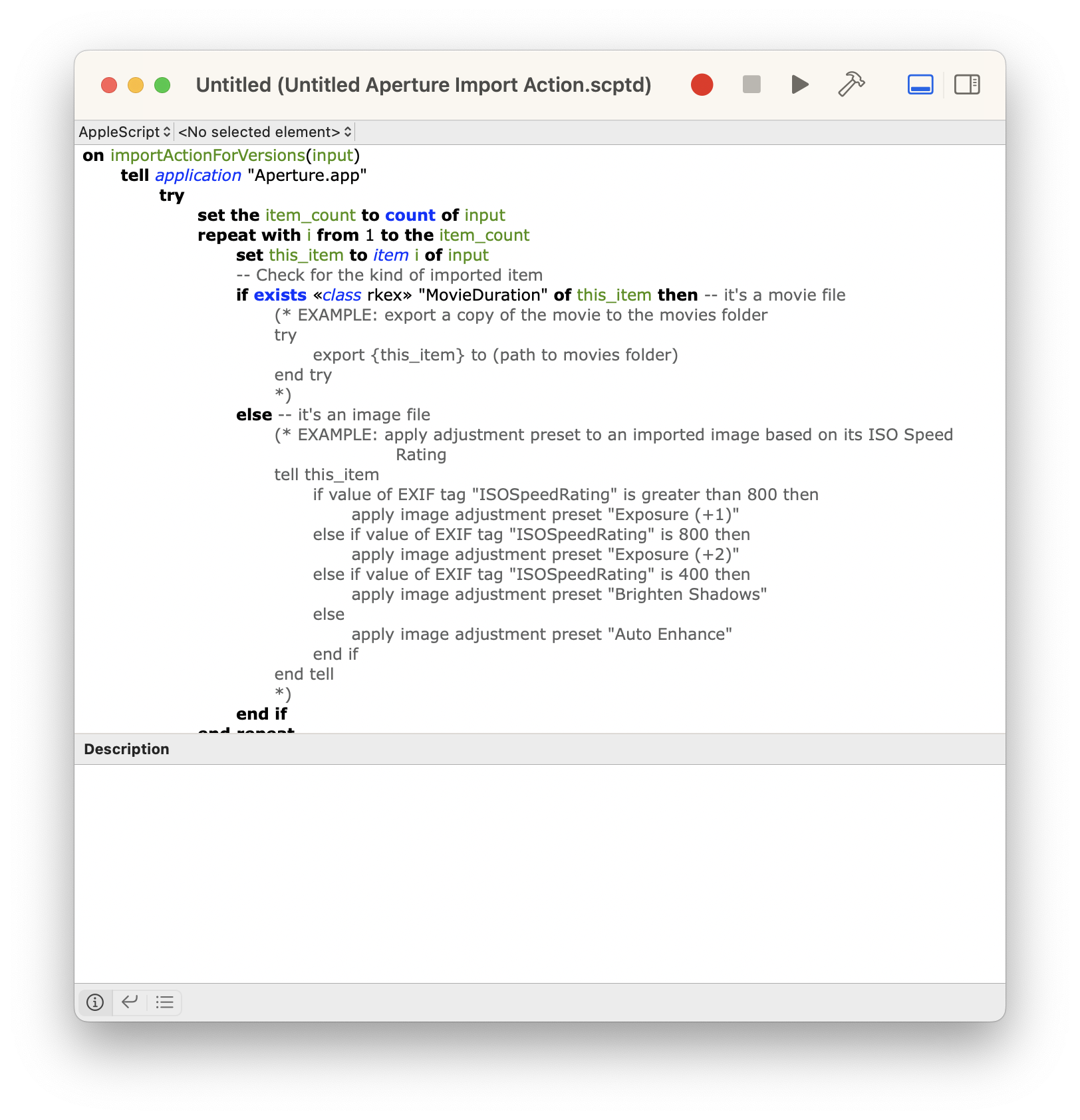
Kbase Article of the Week: Mac OS X: Script Editor Has Two Choices for Saving Compiled Script

Speaking of weird bugs and scripts, here’s Apple Support on a weird bug that was present in an early version of Mac OS X 10.2:

When using Script Editor to save a new file, there are two choices for compiled script.

When you choose Save As or save a script for the first time, you see two choices for the format:

  • compiled script
  • Compiled Script

The choices produce identical scripts. It does not matter which format you choose; they only differ in the capitalization. This is to expected [sic] to be corrected in a future version of Script Editor.

Here is John Gruber, writing about the issue on Daring Fireball:

Sounds good. Too bad it’s completely wrong.

It ends up that the two formats are very different indeed. The lowercase “compiled script” writes the compiled script in the resource fork of the file (which is the traditional format, used since AppleScript’s inception); the uppercase “Compiled Script” writes the compiled script in the file’s data fork (a new format, introduced with Mac OS X).

Both choices write the same script data, but the resulting files are very different indeed. Most apps that read compiled script files only understand the traditional resource fork format. (Notably, this includes BBEdit and Mailsmith; I first saw this bug referenced on the Mailsmith-Talk mailing list over a month ago.)

If you save a script using the “Compiled Script” data fork format, then try to execute it in an app which doesn’t understand the format, you get an error message complaining about an “unexpected end-of-file”.

The bug in Script Editor is excusable; the Knowledge Base article, however, is not. It’s just plain wrong, and it’s been up for over three weeks.

Now it’s been up for over 20 years, but I guess it’s not as critical of an issue as it once was.

The Terrible Tale of iTunes 2

A tweet from Mr. Macintosh over the weekend reminded me of one of the worst bugs Apple shipped in an application update.
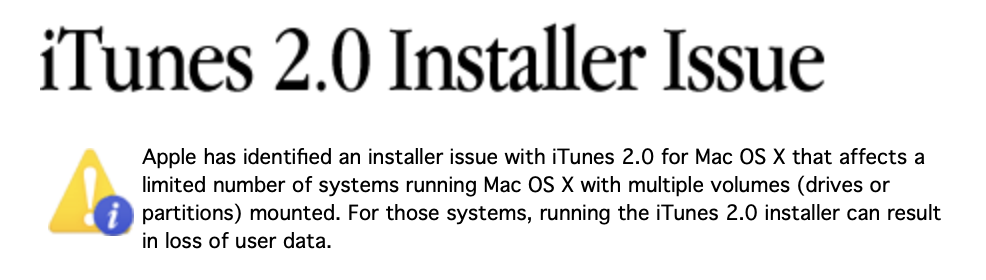
iTunes 2 warning

Version 2 of iTunes was going to be a big deal, including support for the just-announced iPod and the addition of an equalizer with cross-fading.

Things did not go well. Here’s a bit from Adam Engst, dated November 12, 2001:

After releasing the new version late Friday night, Apple hastily pulled the Mac OS X installer Saturday morning due to a problem where, in some situations involving multiple volumes named in specific ways, the installer could delete a large number of files. Needless to say, this is a bad thing, and there have been reports of Apple quietly offering to buy file recovery software or even pay for DriveSavers recovery of affected hard disks. A revised installer, with the designation iTunes 2.0.1, was released before the end of the weekend.

Apple put up a support page just about the issue:

Apple has identified an installer issue with iTunes 2.0 for Mac OS X that affects a limited number of systems running Mac OS X with multiple volumes (drives or partitions) mounted. For those systems, running the iTunes 2.0 installer can result in loss of user data.

While this error is highly unlikely to affect most users, Apple strongly advises that anyone who has downloaded the 2.0 version of iTunes for Mac OS X, as well as anyone who has a beta version of iTunes 2.0 for Mac OS X, immediately remove the iTunes.pkg installer file from their system.

The reason this issue happened is pretty interesting. Here’s Engst again:

The specifics of how this happened have been discussed at length in TidBITS Talk and similar forums, but roughly speaking, the installer Apple used to install iTunes in Mac OS X apparently relied on a shell script that assumed the previous version of iTunes would be in the Applications folder. Since everyone’s disks have different names, the script figured out the name of the disk, appended the path to the iTunes application, and then deleted all the files in the iTunes folder. Unfortunately, the script didn’t take into account the fact that people might put spaces in their disk names, particularly that they could put spaces at the beginning of the disk name. Since the space separates arguments in Unix commands, a command that would delete a single file is suddenly broken in the middle, transforming it into a command that can delete an entire disk. The problem can be avoided in Unix merely by enclosing the command in quotes, but that didn’t happen initially.

I wasn’t using OS X very much in the fall of 2001, but even six years later when I became a Mac Genius, I heard horror stories about this. Just check out this blog post from the time for a look at some of the carnage.