On iTunes, Marzipan and Expectations

With Marzipan expected to bring new apps to the Mac to replace venerable programs like iTunes, I think now is the time to talk about our expectations of what these new apps may be like. My thoughts break down into a few different areas:

Quality

There’s no denying that the four Marzipan apps in macOS Mojave — News, Home, Stocks and Voice Memos are bad. They don’t act or look like Mac apps, and in some places, barely function at all with a cursor.

I am sure that Apple is well aware of this, but I think that hoping that the “for realsies this time” version of Marzipan is going to make iPad apps feel more at home on the Mac is probably foolish.

I hope for some improvements,1 but I think the truth is that these apps are going to feel weird compared to old-fashioned AppKit ones. My expectation is that Apple is working as hard as it can to improve things, but I think we may be in a “minimal viable product” situation here; just getting the tools in the hands of developers seems like a massive amount of work to ship this year.

Hoping that these new apps will be good may be too big a dream for 2019.

Features

There have been a lot of conversations about the differences between iTunes and Music.app as we know it on iOS 12.

Zac Hall did a great job contrasting the two, and Dan Moren pointed out some of iTunes’ power features that are nowhere to be found on the iPad.

When Music.app shows up in our Docks this fall after installing macOS 10.152 I expect it to be way closer to the iPad version than many are hoping for. There will be features that go down on the burning S.S. iTunes.

Here’s Michael Tsai on the matter:

I’m not looking forward to this because, while I agree that iTunes needs work, I don’t have confidence that Apple will preserve its functionality (or even its desktop-optimized design) in the new apps. I expect that iTunes will remain the only way to sync music that you didn’t buy from the iTunes Store. Apple’s track record is to remove features from AirPort Utility and QuickTime Player 7 and let the dead versions hang around for years until eventually sunsetting them, without ever reimplementing what was lost.

I hope he isn’t right, but I am afraid he may be.

Future Development

If I’m right, and these new Mac apps are more or less clones of what we see on the iPad today, than we have to look beyond iOS 13 and macOS 10.15 to the future.

Here’s the question I keep rolling around in my mind:

Will Apple go the Final Cut Pro X route with all of this, slowly adding features back over time, making the new app as powerful — but also more approachable — than the old?

I would love to see this happen with Music.app. It could adopt the best parts of iTunes, and leave the cruft behind, especially if Podcasts.app and TV.app are there to share the load.

If this year is all about porting iPad apps to the Mac, without massive changes, that will be a bummer, but I will not be surprised. If that comes to pass, making these apps better over time won’t only benefit the Mac, but the iPad and iPhone as well, and that’s good for everyone.

At least until things get so good on the iPad they can replace the Mac with it and move us all over to iOS.

(Just kidding.)3

  1. I’m looking at you, date and time picker in Home.app. 
  2. For once, I’d like a macOS name reveal to happen on the WWDC stage without a “macOS Weed” joke, Craig… 
  3. Probably. 

Snell, on the 2019 iMac

Jason Snell, writing at Six Colors:

The 2019 iMacs are a contradiction. They are brand-new computers that somehow feel like the last members of a dying order. They are shells designed in 2012 that somehow contain 8th- and 9th-generation Intel processors. They represent Apple’s broad-appeal entry-level Mac desktop, but can also offer power to rival the performance of the base-model iMac Pro. They are part of a legacy that once represented the core of the Mac market, but now fills specific niches in a world devoured by mobile technology.

I had a chance to spend a couple of weeks with a top-of-the line 5K iMac with a 9th-generation Intel processor, and its performance was impressive. There’s no denying that the iMacs is better than ever, just as there’s no denying that this is a product line that’s in need of reinvention after years of stasis.

Connected #238: Weird Plex, But Okay

This week on Connected, we cover a lot of ground:

Federico has discovered something terrible about his childhood, Stephen had an accident and Myke wants a new TV. After all of that is taken care of, the trio talk about a new iPad case that uses the Magic Keyboard and using macOS as an iPad app.

I’m not sure what is more shattered, Federico’s innocence or my Apple Watch.

My thanks to our sponsors:

  • Freshbooks: Online invoicing made easy.
  • Squarespace: Make your next move. Enter offer code CONNECTED at checkout to get 10% off your first purchase.
  • Warby Parker: Quality eyewear at a fraction of the usual price. Order your FREE Home Try-On kit today.

Moving Black Hole Data

Jason Snell has written about today’s black hole news:

To capture this image, the EHT used seven different radio telescopes all around the world in order to use something called interferometry, which combines data from telescopes spread out over a wide distance to essentially create a virtual telescope the size of the distance between the telescopes. The result is a telescope that’s basically the size of Earth. (Among the telescopes used is one at the South Pole, which needed to be retrofitted to make these measurements.)

Then the telescopes have to capture data simultaneously, which means the weather needs to be good in Hawaii and Spain and Chile and the South Pole and other places simultaneously. And when that data is captured, it needs to be brought back to a correlation facility to process it and generate a single data set.

He quotes Dan Marrone, Associate Professor of Astronomy at the University of Arizona:

At the end of that, we had five petabytes of data recorded… it amounts to more than half a ton of hard drives. Five petabytes is a lot of data. It’s equivalent to 5,000 years of MP3 files, or according to one study I read, the entire selfie collection over a lifetime for 40,000 people.

The image you saw, though, isn’t five petabytes in size, it’s a few hundred kilobytes. So our data analysis has to collapse this five petabytes of data into an image that’s more than a billion times smaller. We do that in many steps. The first of those steps is to get [hard drive modules] to our correlators in western Massachusetts and Bonn, Germany. The fastest way to do that is not over the Internet, it’s to put them on planes. There’s no Internet that can compete with petabytes of data on a plane.

This is the ultimate sneakernet.

Scientists Share First Photo of a Black Hole

This morning, the National Science Foundation and the team behind the Event Horizon Telescope project announced a things-will-never-be-the-same bit of news:

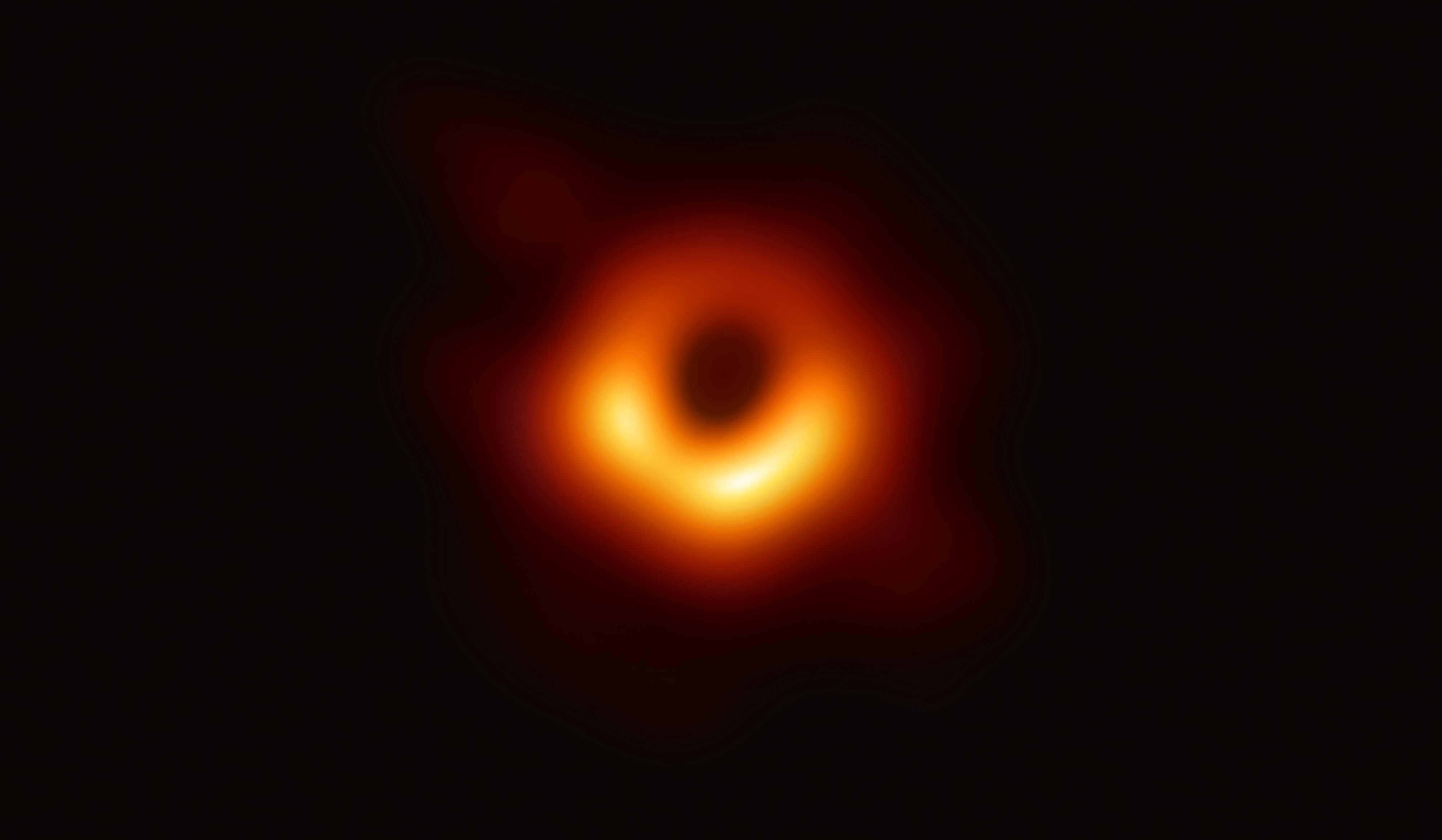
Today, in coordinated press conferences across the globe, EHT researchers reveal that they have succeeded, unveiling the first direct visual evidence of a supermassive black hole and its shadow.

This breakthrough was announced in a series of six papers published in a special issue of The Astrophysical Journal Letters. The image reveals the black hole at the center of Messier 87, a massive galaxy in the nearby Virgo galaxy cluster. This black hole resides 55 million light-years from Earth and has a mass 6.5-billion times that of the Sun.

“This is a huge day in astrophysics,” said NSF Director France Córdova. “We’re seeing the unseeable. Black holes have sparked imaginations for decades. They have exotic properties and are mysterious to us. Yet with more observations like this one they are yielding their secrets. This is why NSF exists. We enable scientists and engineers to illuminate the unknown, to reveal the subtle and complex majesty of our universe.”

Just look at this image:

Here’s a bit more from the NSF on what is going on in this photo:

“If immersed in a bright region, like a disc of glowing gas, we expect a black hole to create a dark region similar to a shadow — something predicted by Einstein’s general relativity that we’ve never seen before,” explained chair of the EHT Science Council Heino Falcke of Radboud University, the Netherlands. “This shadow, caused by the gravitational bending and capture of light by the event horizon, reveals a lot about the nature of these fascinating objects and allowed us to measure the enormous mass of M87’s black hole.”

Multiple calibration and imaging methods have revealed a ring-like structure with a dark central region — the black hole’s shadow — that persisted over multiple independent EHT observations.

Guilherme Rambo: With Marzipan, Apple Bringing Music, Podcasts and TV Apps to macOS

Mr. Rambo, writing at 9to5Mac:

Fellow developer Steve Troughton-Smith recently expressed confidence about some evidence found indicating that Apple is working on new Music, Podcasts, and perhaps Books apps for macOS, to join the new TV app.

I’ve been able to independently confirm that this is true. On top of that, I’ve been able to confirm with sources familiar with the development of the next major version of macOS – likely 10.15 – that the system will include standalone Music, Podcasts, and TV apps, but it will also include a major redesign of the Books app. We also got an exclusive look at the icons for the new Podcasts and TV apps on macOS.

Enjoy your new life in the Utilities folder, iTunes.

Apple’s W.A.L.T. Prototype: Wizzy Active Lifestyle Telephone

I know a lot about Apple history, and I’ve never come across this device until today. Juli Clover writes:

Unsurprisingly, the W.A.L.T. takes a while to start up given its age, but it’s functional, running Mac System 6. The W.A.L.T. featured a touchscreen, fax functionality, on-display caller ID, a built-in address book, customizable ringtones, and online banking access.

As shown in the video, it had a series of hardware buttons for activating various functions, and it worked with a connected stylus that could be used for navigation and writing. There’s a ton of lag when using the stylus, though, so writing doesn’t look great.

Amazing.

Liftoff #96: Probably Not Space Cows

This time on Liftoff:

Rocket Lab has a new satellite platform, while methane cycles have been measured on Mars. Elsewhere, NASA continues to work through the details of its new 2024 lunar goal and 2007 OR10 needs a name.

Landing Americans on the moon within five years will require incredible funding and detailed plans. So far, NASA hasn’t produced either, but details should be coming soon. I’m looking forward to seeing the agency rise to meet this goal, assuming Congress agrees to fund it.

My thanks to our sponsors:

  • KiwiCo: Hands on learning and experienced based play. Get your first crate free.
  • Squarespace: Make your next move. Enter offer code LIFTOFF at checkout to get 10% off your first purchase.