Sponsor: Simple Scan: Paper to PDF to Anywhere!

Do you love the Apple Notes document scanner, but would you like more flexibility in sending the scans to email, messages, files, or other apps? Then Simple Scan is for you. Simple Scan is the quick, easy way to scan paper documents to optimized, searchable PDF documents (or images) and send them almost anywhere.

Features include:

  • Same great scanning functionality as Apple Notes, but no need to clutter your notes data with one-off scans.
  • Creates high-resolution multi-page PDFs from your paper documents.
  • PDFs are searchable thanks to automatic Optical Character Recognition (OCR).
  • Built for simplicity. Just scan and send – no document library, no overly complicated array of settings
  • Send scans via email and messages. Or save to a file, or “Share” to send to other apps via the system share sheet.
  • Set up custom destinations with pre-filled recipients for easy “Email to Myself” and other common uses
  • Custom file destinations allow configuration of the file name and pre-selection of a destination folder to save the scan
  • Save scans directly to Photos.
  • Launches fast.
  • Never any ads or tracking. Ever.
  • Simple pricing. Choose a low-cost annual subscription or a one-time lifetime unlock!

Download and try Simple Scan for free today.

More on Those New App Review Guidelines

John Gruber:

This does not mean apps can now use alternative payment processing in-app. It doesn’t even mean apps are no longer required to offer Apple’s IAP in-app for purchases and subscriptions. All it means is that apps (in the US for now, but Apple really ought to make this worldwide, but I suspect Tim Cook wants to fight this on appeal in federal court) are free to inform users about offers available on the web, and to link to those offers on the web. Those links must open outside the app, in the user’s default web browser.

Apple Updates App Review Guidelines

After yesterday’s injunction, Apple has updated its U.S. App Review Guidelines concerning buttons and links to external payment providers. Here are the key changes:

  • 3.1.1: Apps on the United States storefront are not prohibited from including buttons, external links, or other calls to action when allowing users to browse NFT collections owned by others.
  • 3.1.1(a): On the United States storefront, there is no prohibition on an app including buttons, external links, or other calls to action, and no entitlement is required to do so.
  • 3.1.3: The prohibition on encouraging users to use a purchasing method other than in-app purchase does not apply on the United States storefront.
  • 3.1.3(a): The External Link Account entitlement is not required for apps on the United States storefront to include buttons, external links, or other calls to action.

NASA Swapped RS-25 on Next SLS

NASA’s new moon rocket uses a lot of components from the shuttle program, including the venerable RS-25 engine. Three were mounted to the shuttle itself, and the core stage of the SLS is powered by four of them. The next rocket — slated to take astronauts Reid Wiseman, Victor Glover, Christina Koch, and Jeremy Hansen to the far side of the moon — has seen a change of plans when it comes to those engines, as Stephen Clark reports:

The engine removed from the Artemis II rocket—serial number E2063—was built at NASA’s Stennis Space Center by Aerojet Rocketdyne, now part of L3Harris, a Florida-based tech company and defense contractor. Technicians finished constructing the engine in 2015. It was the last RS-25 built using leftover parts, such as turbopumps, that flew on the Space Shuttle, but the fully assembled engine has never flown before.

In its place, NASA installed E2061 into the Engine 4 position on the Artemis II core stage. This engine was the final one built for the shuttle. NASA certified the engine for flight in 2008, and it flew twice in 2010 and 2011.

While the RS-25 traces its roots back to the 1960s, it has proven to be remarkably reliable, with very few failures over the decades. Sadly, while they were reusable in the shuttle era, in the age of the SLS, they are one-and-done, which is decidedly old-fashioned in the era of launch vehicles like the Falcon 9.

Judge Yvonne Gonzalez Rogers Hands Down Epic Ruling in App Store Case

Earlier this evening, an 80-page document was released by the U.S. District Court in California, hitting Apple hard for its anti-competitive strategies concerning the App Store. The Verge’s Jay Peter’s has a great breakdown, but the gist of the ruling is that Apple can no longer charge commission on purchases made outside of the App Store or put block or limit developers who wish to link to purchases outside of Apple’s App Store system.

For over a year, developers in the U.S. App Store have been able to link to outside payment methods, but the company had strict rules on how such links had to appear. That included this gem of a screen that made the rounds last January that developers had to include in their apps:
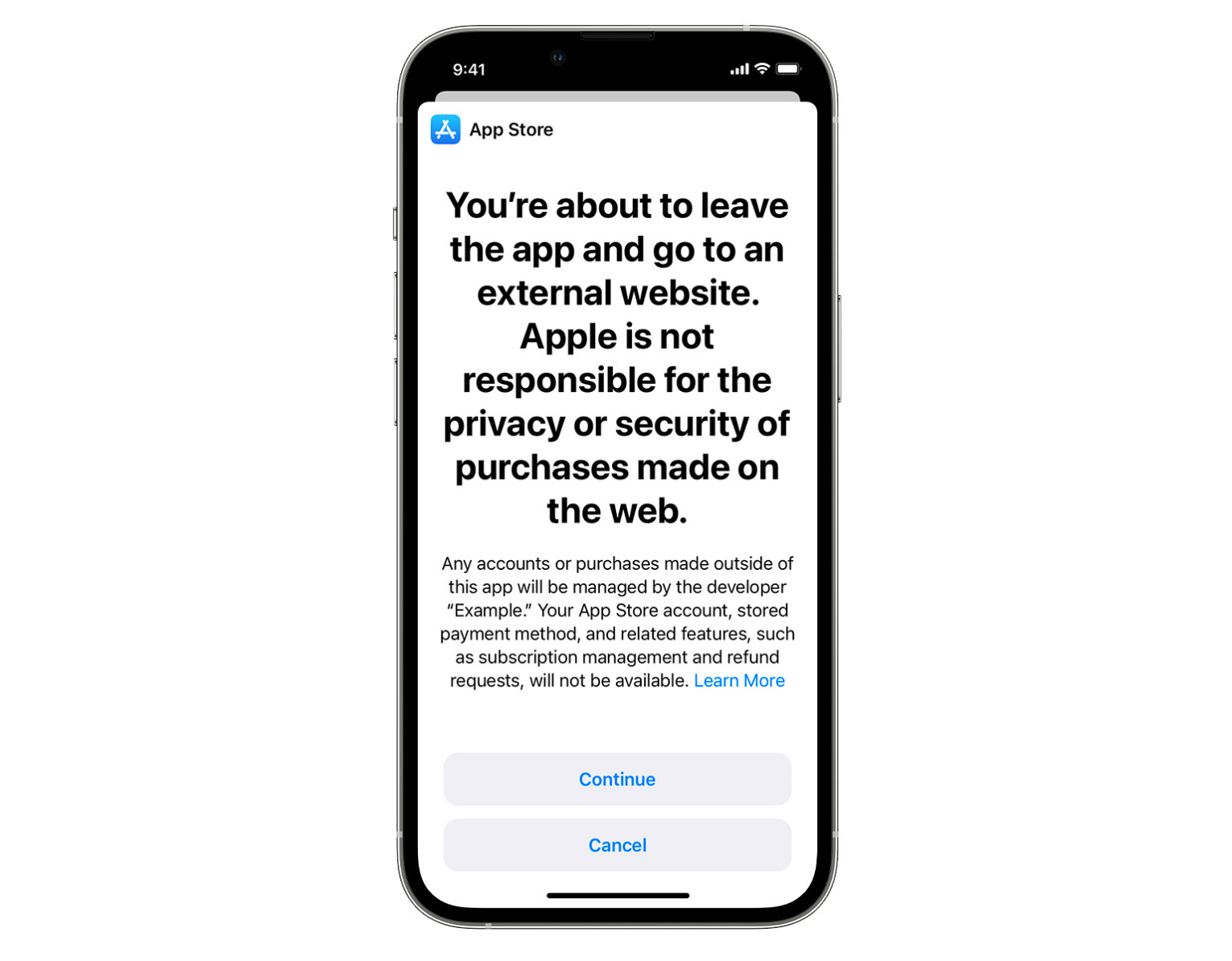
System Disclousure

As bad as that screen was, what was worse is that Apple required developers report their revenue and pay Apple 27% of what they earned through those links. This ruling strikes that down, and I think it was the right call. That scare screen and 27% fee came after Apple was told to open up its App Store to outside payment methods. The company’s response was far from gracious.

Time will tell how this shakes out, but this is a huge blow to Apple’s control over the money that flows through its platforms. The ruling is also a huge blow to Apple itself. Some of the language in the 80-page PDF is breathtaking. Forgive the long block quote, but this passage gets to the heart of the matter:

In stark contrast to Apple’s initial in-court testimony, contemporaneous business documents reveal that Apple knew exactly what it was doing and at every turn chose the most anticompetitive option. To hide the truth, Vice-President of Finance, Alex Roman, outright lied under oath. Internally, Phillip Schiller had advocated that Apple comply with the Injunction, but Tim Cook ignored Schiller and instead allowed Chief Financial Officer Luca Maestri and his finance team to convince him otherwise. Cook chose poorly. The real evidence, detailed herein, more than meets the clear and convincing standard to find a violation. The Court refers the matter to the United States Attorney for the Northern District of California to investigate whether criminal contempt proceedings are appropriate.

This is an injunction, not a negotiation. There are no do-overs once a party willfully disregards a court order. Time is of the essence. The Court will not tolerate further delays. As previously ordered, Apple will not impede competition. The Court enjoins Apple from implementing its new anticompetitive acts to avoid compliance with the Injunction. Effective immediately Apple will no longer impede developers’ ability to communicate with users nor will they levy or impose a new commission on off-app purchases.

The document directly addresses Apple’s tight control over how links to external payment methods appear. When I read this part of the injunction, I whistled out loud, to the surprise of my wife who was in the room with me:

For button styles, Apple limits developers to what Apple calls the “plain” button style — essentially just a hyperlink — because Apple does not want the developers to use the more effective “button.” A more effective button would increase competition. Similarly, Apple limits calls to action to five, narrowly cabined templates. Nowhere does the Court authorize those limitations. At a minimum, the Court need not decide whether these restrictions alone violate the Injunction, because Apple has violated the central mandate of this Court’s orders: that Apple not foreclose competitive alternatives to IAP.

The document reveals that those screens were at the behest of Tim Cook:

After the June 20, 2023 meeting regarding this Court’s Injunction, Apple decided that it would implement a full screen warning after users click on an external link, regardless of which commission option was ultimately selected. At the meeting, Mr. Cook “asked the team to revise the customer warning screen . . . to reference the fact that Apple’s privacy and security standards do not apply to purchases made on the web.” The team updated the warning screen, sent it to Mr. Schiller for approval, and returned the revised copy to Mr. Cook on June 23, 2023. The updated warning screen changed a sentence from “You will no longer be transacting with Apple” to “Apple is not responsible for the privacy or security of purchases made on the web.” As Ms. Goldberg’s notes reflect, the idea discussed was that this “[i]nterstitial . . . tells ppl its dangerous and they are leaving the app store.”

I guess he’s a product guy after all.

Apple has already said it will appeal. That’s not surprising, but sitting here in my kitchen at my laptop tonight, I don’t see how this ends well for Apple unless the Trump administration steps in.

Rumors Suggest the iPhone 17 Air’s USB-C Port Will Be Off-Centered

Rumors continue to point toward Apple having a thin phone in this fall’s lineup. I am fascinated by this, and think it could be my next iPhone, even if it comes with compromises. Tim Hardwick reports on one such trade-off:

Achieving this level of thinness is unlikely to come without compromise. Dummy models shared by AppleTrack suggest that Apple has made some subtle adjustments to accommodate internal components in the tighter chassis. Most notably, the USB-C port on the bottom edge is no longer centered front-to-back. Instead, it appears shifted closer to the rear of the device, which is likely to accommodate display components within the enclosure.

I’m old enough to remember when Apple fans made fun of Samsung phone for just this sort of thing, even if I don’t really see that on these dummy models.

Sponsor: Magic Lasso Adblock: YouTube Ad Blocker for Safari

Do you want to block all YouTube ads in Safari on your iPhone, iPad and Mac?

Then download Magic Lasso Adblock – the ad blocker designed for you.

As an efficient, high performance and native Safari ad blocker, Magic Lasso blocks all intrusive ads, trackers and annoyances – delivering a faster, cleaner and more secure web browsing experience.

Magic Lasso - Adblock

Magic Lasso Adblock is easy to setup, doubles the speed at which Safari loads and also blocks all YouTube ads; including all:

  • video ads
  • pop up banner ads
  • search ads
  • plus many more

With over 5,000 five star reviews; it’s simply the best ad blocker for your iPhone, iPad and Mac.

And unlike some other ad blockers, Magic Lasso Adblock respects your privacy, doesn’t accept payment from advertisers and is 100% supported by its community of users. 

So, join over 350,000 users and download Magic Lasso Adblock from the App Store, Mac App Store or via the Magic Lasso website.

University of Memphis Professor Weighs in on Possible xAI Air Pollution

Samuel Hardiman, at The Daily Memphian, writing about the on-going concern here in Memphis over xAI’s use of gas turbines to help power its AI supercomputer:

Chunrong Jia, a professor in the U of M’s division of epidemiology, biostatistics and environmental health, modeled the impact of what xAI’s turbines would have on air quality in Southwest Memphis. He used information from xAI’s Shelby County Health Department application to make 15 of its 30-plus turbines permanent.

Jia modeled the air-quality impact at the request of Memphis Mayor Paul Young’s administration. The city did not pay Jia for the modeling work.

Jia highlighted that his work is based on xAI’s own claims:

“I just took the emission rates that have been provided by the pollution-control board (SCHD). How accurate are these emission rates, I’m not sure,” Jia said.

Jia’s model, however, shows if xAI’s claims it uses technology to reduce emissions are true, the turbines will not meaningfully contribute to the city’s air-quality issues.

Data used in the model was taken from some 20 miles away, as there are no air-monitoring stations in the industrial area where xAI is located, however Jia pointed out that this isn’t a issue, as the air-monitoring station used is near a busy highway that cuts through the heart of the city.

All of that said, taking the company’s word at face value on this seems rather short-sighted.

Slate Auto Unveils Its EV Truck

There’s a new EV truck on the scene, and it’s not even a pointy stainless steel triangle! Sean O’Kane has details at TechCrunch:

It’s affordable, deeply customizable, and very analog. It has manual windows and it doesn’t come with a main infotainment screen. Heck, it isn’t even painted. It can also transform from a two-seater pickup to a five-seater SUV.

The three-year-old startup revealed its vehicle during an event Thursday night in Long Beach, California, and promised the first trucks would be available to customers for under $20,000 with the federal EV tax credit by the end of 2026.

I know it’s not for everyone, but I love vehicle that are designed with customization in mind. It’s one reason I’m such a fan of my Tacoma, and even lesser vehicles like the Ford Bronco and Jeep Wrangler. Slate is leaning into this, as O’Kane explains:

The company said Thursday it will launch with more than 100 different accessories that buyers can use to personalize the truck to their liking. If that’s overwhelming, Slate has curated a number of different “starter packs” that interested buyers can choose from.

The truck doesn’t even come painted. Slate is instead playing up the idea of wrapping its vehicles, something executives said they will sell in kits. Buyers can either have Slate do that work for them, or put the wraps on themselves.

There’s a long way to go before this thing can hit the market, but I’m rooting for this little truck. Here is how I would spec mine:

My Slate