No, you did not read that wrong. Better late than never?
iOS 18.3.2 Re-Enables Apple Intelligence ⇢
With new iOS software updates, Apple has been automatically turning Apple Intelligence on again even for users who have disabled it, a decision that has become increasingly frustrating for those that don’t want to use Apple Intelligence .
This is gross.
Update: Chance Miller reports that this is happening with today’s macOS release, not iOS. Also gross.
Sponsor: Magic Lasso Adblock: 2.0x Faster Web Browsing in Safari ⇢
Want to experience twice as fast load times in Safari on your iPhone, iPad and Mac?
Then download Magic Lasso Adblock – the ad blocker designed for you.
As an efficient, high performance and native Safari ad blocker, Magic Lasso blocks all intrusive ads, trackers and annoyances – delivering a faster, cleaner and more secure web browsing experience.

By cutting down on ads and trackers, common news websites load 2x faster and browsing uses less data while saving energy and battery life.
Rely on Magic Lasso Adblock to:
- Improve your privacy and security by removing ad trackers
- Block all YouTube ads, including pre-roll video ads
- Block annoying cookie notices and privacy prompts
- Double battery life during heavy web browsing
- Lower data usage when on the go
With over 5,000 five star reviews; it’s simply the best ad blocker for your iPhone, iPad and Mac.
And unlike some other ad blockers, Magic Lasso Adblock respects your privacy, doesn’t accept payment from advertisers and is 100% supported by its community of users.
Join over 350,000 users and download Magic Lasso Adblock from the App Store, Mac App Store or via the Magic Lasso website.
Mac Power Users 787: Revisiting Our Mac Menu Bars ⇢
It’s been a while, so on this week’s episode, David and I share what is in our Macs’ menu bars, touching on some all-time great macOS apps.
Siri’s Future Has Been Delayed ⇢
In a comment to John Gruber, Apple spokeswoman Jacqueline Roy said:
Siri helps our users find what they need and get things done quickly, and in just the past six months, we’ve made Siri more conversational, introduced new features like type to Siri and product knowledge, and added an integration with ChatGPT. We’ve also been working on a more personalized Siri, giving it more awareness of your personal context, as well as the ability to take action for you within and across your apps. It’s going to take us longer than we thought to deliver on these features and we anticipate rolling them out in the coming year.
I don’t think many people who have paid attention to Apple Intelligence will be shocked by this, but it does underline something I’ve believed for months: shipping the new colorful Siri UI early was a mistake. I love the new UI, but it is tied to the same old, bad Siri. The UI change was a moment for Apple to reset expectations for the technology, and it whiffed on the chance.
Phoenix
There’s a new social app on the horizon: Here’s The Iconfactory:
Twitterrific for Mac was the very first Twitter client, but it has fallen out of date. Help us bring it back to the future!
STATIC BREAKS INTO MY AIRPODS
Oh, I’m being told that this blog post is supposed to be about another Phoenix. The folks at Tapbots are building a Bluesky client. From their FAQ:
What about Ivory? Are you leaving Mastodon?
Of course not! Mastodon is our home on the social web and we will continue to invest our time there. Since the incredible growth of Bluesky in the past year, our customer base has become split between the two services and for us to continue to thrive as a company, we must support both. Unfortunately, we can’t survive on Mastodon alone.
It’s easy for people in our corner of the Internet to think Mastodon is a huge success, but in terms of raw user numbers, it just … isn’t. I am sure Phoenix will bring the polish Tapbots is known for to Bluesky, which is great. The official app is so close to a Twitter/X clone that if you took the labels off, I’m not sure most people could tell the difference.
Connected 542: face with tired ⇢
This week on the podcast, there are new iPads and Macs to discuss, as well as new emoji whose names are unknown to one particular host.
It Seems Like There’s Never Gonna Be an M4 Ultra ⇢
Joe Rossignol, writing at MacRumors:
A spokesperson for Apple has told French technology website Numerama that its M4 Max chip lacks an UltraFusion connector, which would have paved the way for the release of a doubled-up M4 Ultra chip in the future.
As we recently covered, Apple told Ars Technica that not every generation of M-series chips for Macs will include an “Ultra” chip. That seems like Apple indirectly confirming that it has no plans to release an M4 Ultra chip, and the M4 Max’s lack of UltraFusion technology makes it even more likely there won’t be an M4 Ultra chip.
Mac Studio Updated with the M4 Max and … M3 Ultra
In addition to the new MacBook Air, Apple also updated the Mac Studio today:
Apple today announced the new Mac Studio, the most powerful Mac ever made, featuring M4 Max and the new M3 Ultra chip. The ultimate pro desktop delivers groundbreaking pro performance, extensive connectivity now with Thunderbolt 5, and new capabilities in its compact and quiet design that can live right on a desk. Mac Studio can tackle the most intense workloads with its powerful CPU, Apple’s advanced graphics architecture, higher unified memory capacity, ultrafast SSD storage, and a faster and more efficient Neural Engine. It provides a big boost in performance compared to the previous generation, and a massive leap for users coming from older Macs.

That’s right… these are the chips that ship in the updated Mac Studio:

When this leaked yesterday, part of me didn’t believe it, but here we are.
So, what is an M3 Ultra? Apple explains:
Apple today announced M3 Ultra, the highest-performing chip it has ever created, offering the most powerful CPU and GPU in a Mac, double the Neural Engine cores, and the most unified memory ever in a personal computer. M3 Ultra also features Thunderbolt 5 with more than 2x the bandwidth per port for faster connectivity and robust expansion. M3 Ultra is built using Apple’s innovative UltraFusion packaging architecture, which links two M3 Max dies over 10,000 high-speed connections that offer low latency and high bandwidth. This allows the system to treat the combined dies as a single, unified chip for massive performance while maintaining Apple’s industry-leading power efficiency. UltraFusion brings together a total of 184 billion transistors to take the industry-leading capabilities of the new Mac Studio to new heights.
“M3 Ultra is the pinnacle of our scalable system-on-a-chip architecture, aimed specifically at users who run the most heavily threaded and bandwidth-intensive applications,” said Johny Srouji, Apple’s senior vice president of Hardware Technologies. “Thanks to its 32-core CPU, massive GPU, support for the most unified memory ever in a personal computer, Thunderbolt 5 connectivity, and industry-leading power efficiency, there’s no other chip like M3 Ultra.”
The M4 Max version starts at $1,999 with the M3 Ultra starting at $3,999. The latter can be specced to $14,099 with these options:
- Apple M3 Ultra chip with 32-core CPU, 80-core GPU, and 32-core Neural Engine
- 512 GB unified memory
- 16 TB SSD storage
The M4 Max tops out at 128 GB of memory and 8 TB of storage with 14 CPU cores, 40 GPU cores, and a 16-core Neural Engine.
Even though I am not a Mac Studio user anymore, I am glad to see the machine get updated. I have lots of questions about why the top-of-the-line chip is based on an M3 and not an M4, though. Perhaps we’ll see an M4 Ultra this summer in an updated Mac Pro, in an attempt by Apple to separate its two high-end desktop Macs a little more. (Or not.)
M4 MacBook Air Introduced
As foretold, there’s a new MacBook Air out today, powered by the M4. Apple:
Apple today announced the new MacBook Air, featuring the blazing-fast performance of the M4 chip, up to 18 hours of battery life, a new 12MP Center Stage camera, and a lower starting price. It also offers support for up to two external displays in addition to the built-in display, 16GB of starting unified memory, and the incredible capabilities of macOS Sequoia with Apple Intelligence — all packed into its strikingly thin and light design that’s built to last. The new MacBook Air now comes in an all-new color — sky blue, a metallic light blue that joins midnight, starlight, and silver — giving MacBook Air its most beautiful array of colors ever. It also now starts at just $999 — $100 less than before — and $899 for education, making it an incredible value for students, business professionals, or anyone looking for a phenomenal combination of world-class performance, portability, design, and durability. With two sizes to choose from, the new 13- and 15-inch MacBook Air are available to pre-order today, with availability beginning Wednesday, March 12.
Like the other MacBook Air colors, the sky blue is pretty subtle, but I think it looks nice:

Here are all four colors side by side — silver, starlight, sky blue, and midnight:

RIP, space gray MacBook Air.
With that aside, let’s talk about some other things:
- Getting the starting price of the newest 13-inch MacBook Air down to $999 is huge. Previously, the M3 model was $1,099 with the M2 sticking around at $999.
- Related: It appears that the M2 and M3 models are both gone.
- The M4 Air can be topped out with 32 GB of unified memory and 2 TB of storage, in both the 13- and 15-inch models.
- The only differences in the M4 chips across the MacBook Air line comes down to the number of GPU cores. All models come with a 10‑core CPU with 4 performance cores and 6 efficiency cores. GPUs can be had in 8 or 10 cores.
- The optional 70 watt USB-C charger enables fast charging, which is pretty cool.
- Wi-Fi 6E remains. Wi-Fi 7 is becoming more available in the world, and I hope Apple catches up with the M5.
- The new Center Stage camera supports that cool-but-kinda-weird Desk View mode, where it can show what’s in front of the laptop.
- The M4 MacBook Air now supports up to two 6K external displays in addition to its built-in display.
The new MacBook Air is available for pre-order today and ships March 12. If you have an Intel MacBook Air — or even an M1 — this seems like a great upgrade, particularly if you like blue.
Apple Updates iPad & iPad Air ⇢
Apple Newsroom, a day after Tim Cook posted his “There’s Something in the Air” tweet:
Apple today introduced the faster, more powerful iPad Air with the M3 chip and built for Apple Intelligence. iPad Air with M3 brings Apple’s advanced graphics architecture to iPad Air for the first time — taking its incredible combination of power-efficient performance and portability to a new level. iPad Air with M3 is nearly 2x faster compared to iPad Air with M1, and up to 3.5x faster than iPad Air with A14 Bionic.
The 11-inch iPad Air still starts at $599, the 13-inch still starting at $799, and the colors are still super muted:

As has been widely discussed, the M3 is a bit of a dead-end chip, leading some to assume Apple would skip it on the iPad Air and instead going right to the M4. Apple hasn’t done that, though. Maybe the company wanted to give the iPad Pro a little breathing room, but it’s not like the M3 is a slouch.
In addition to the iPad Air itself, Apple has also updated its keyboard:
The all-new Magic Keyboard for iPad Air expands what users can do at an even lower price. The larger built-in trackpad brings greater precision for detail-oriented tasks, and a new 14-key function row allows easy access to features like screen brightness and volume controls. The new Magic Keyboard attaches magnetically, and the Smart Connector immediately connects power and data without the need for Bluetooth; a machined aluminum hinge also includes a USB-C connector for charging. Now starting at just $269 for the 11-inch model and $319 for the 13-inch model, the new Magic Keyboard for iPad Air features the magical floating design customers love and comes in white.
That new Magic Keyboard is compatible with these models:
- iPad Air 13‑inch (M2 and M3)
- iPad Air 11‑inch (M2 and M3)
- iPad Air (4th and 5th generation)
Waaaaaay at the bottom of the press release, Apple announced the 11th generation iPad:
Apple today also updated iPad with double the starting storage and the A16 chip, bringing even more value to customers. The A16 chip provides a jump in performance for everyday tasks and experiences in iPadOS, while still providing all-day battery life. Compared to the previous generation, the updated iPad with A16 is nearly 30 percent faster. In fact, compared to iPad with A13 Bionic, users will see up to a 50 percent improvement in overall performance, and A16 makes the updated iPad up to 6x faster than the best-selling Android tablet.
This model supports the same Apple Pencil and Magic Keyboard Folio as the 10th generation model.
Like the iPad mini (A17 Pro), Apple has put the SoC name into the name of the product, referring to it as the iPad (A16) on places like the Tech Specs page. Unlike the newest iPad mini, this iPad is not capable of supporting Apple Intelligence. If the use of the M3 in the iPad Air is a surprise, this is a bit of a shock, given how important Apple thinks these features are.
That said, this iPad starts at $349, and a huge percentage of these tablets end up in the hands of kids, both at home and at school, where Apple Intelligence isn’t going to see wide usage.
There’s Something in the Air
Tim Cook teased a product release coming this week with an old — but perfectly clear — reference to an old Apple event, saying on X — ugh — that “There’s something in the air.”
That tagline was used way back in 2008 when the first MacBook Air was introduced:
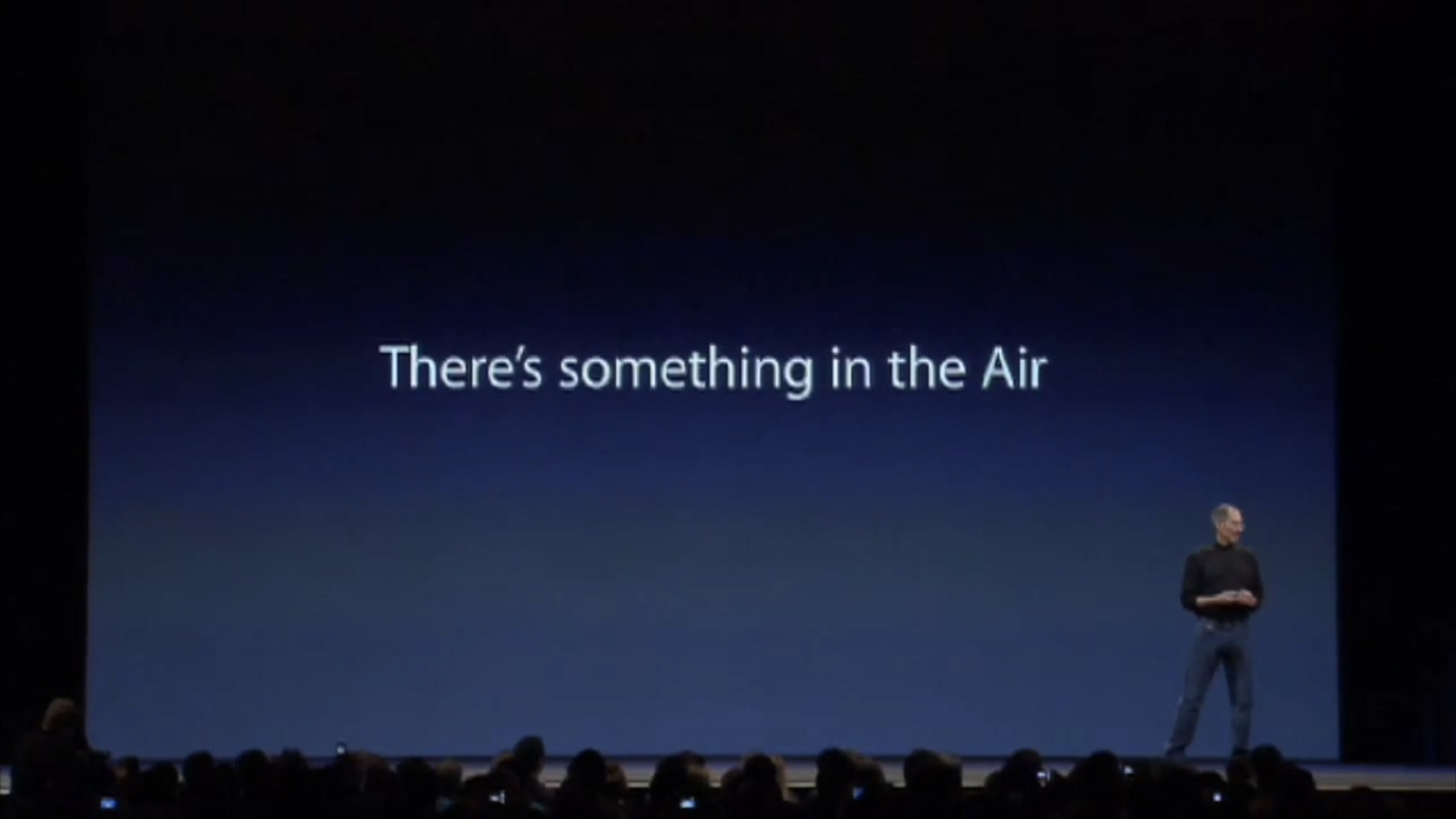
Rumor has it that the M4 MacBook Air is ready to go. I’m sure it’ll be a great machine, but I’m not sure it’s worthy of such a great reference. While we wait to see if this is more exciting than a mere spec bump,1 let’s revisit that old announcement:
- Bring the iMac colors to the MacBook Air, you cowards. Daddy needs an orange laptop real bad. ↩