As soon as I felt it vibrate, I pulled my phone out of my pocket.
It was just after 4 a.m. on Monday, October 7, and I was walking across the University of Memphis’ main campus with my college newspaper’s managing editor, lugging a box of papers and a tape gun, thinking about the body I had seen pulled out of a car just a few hours earlier. I shifted the weight of the box to look at my phone.
The text read, “Classes canceled. Main campus only. All offices open. Tune to local media or call 678–0888 for more information.”
I told the editor I was walking with.
“Huh,” he replied, as we continued to put up flyers few students would actually see later that day.
* * *
The night before, I had just gotten home from a long bike ride and dinner with some friends when my phone started ringing.
“Who is it?” asked my wife of (then) just four months.
“It’s Candy,” I replied, wondering why the general manager of The Daily Helmsman, our college newspaper, was calling me from her home.
Even though I had been the paper’s News Editor for three years, this call seemed odd.
“Where are you?” she asked, before I could even get a “Hello” out.
“You need to be on campus.”
We lived just five blocks from school, and I could hear sirens in the background. The most exciting (to use the word loosely) thing I could think about was a dorm fire.
“There’s been a shooting,” she said.
* * *
The newsroom was a disaster. Trey Heath — our editor-and-chief — had been in Nashville, testifying before the state legislature about alleged violations by the university of the state’s open records law. He was driving back to Memphis to be interviewed on several news networks when the Associated Press called.
“We’d like some of your photos,” the voice on the other end of the phone said.
Any other time I’d be blown away that I was talking to someone with the AP. But at this point on Tuesday, all I could say was okay, and hand the phone off to our general manager for her to take down details. Their request went on the stack.
I drank some more Pepsi (the proud on-campus beverage at the time) and settled back in front of my PowerMac, laying out pages for the next day.
* * *
I drove the mile to campus as fast as I could, my muddy bike still strapped to the back of my SUV, which I parked across the street from a wash of blue and red flashing lights. I had never seen so many cops in one place before.
As I jogged across the street, fiddling with my camera and making sure I had a pen and my notepad, I really wasn’t ready for what I was going to see.
Against a tree was a crumpled car, its rear tires still on the road that wrapped around the east end of campus.
Just past the yellow tape, campus police officers had been assigned the glorious task of keeping press at bay, while the “real” cops from the Memphis police department were taking photos and walking around the crash scene, as paramedics were pulling someone out of the car.
I couldn’t see his face, but I could tell he wasn’t moving. He would later be pronounced dead in the trauma unit at a local hospital.
“He’s on the football team,” I heard one of the students who was gathered gasp.
“I think he’s in Kappa Alpha Psi,” someone else responded. Thankfully, about that time, a few Helsman reporters showed up, so I could keep shooting photos and not have to take quotes from students and police at the scene.
I would later find out that the victim was Taylor Bradford, a junior defensive lineman from Nashville, TN. He had been shot across the street, outside the on-campus student apartment complex, where I had lived just a year before. The whole thing was an armed robbery gone bad,
As he fled the scene, Bradford lost conscious and wrapped his Lincoln around the tree, a few dozen feet from where I was shooting photos.
* * *
“What do we know?”
That question is the question when it comes to covering breaking news. Getting facts right, in the heat of a story, is both critical and extremely difficult. It didn’t help that we were without our editor and it was the middle of the night, hours that most of the staff didn’t normally work.
We compared notes, making sure of the facts, trying to filter out the dozens of guesses and rumors that were already circulating campus.
“Let’s get a flyer out tonight,” someone suggested. With that, I grabbed a reporter to act as copy editor, and banged out a simple, yet powerful page:
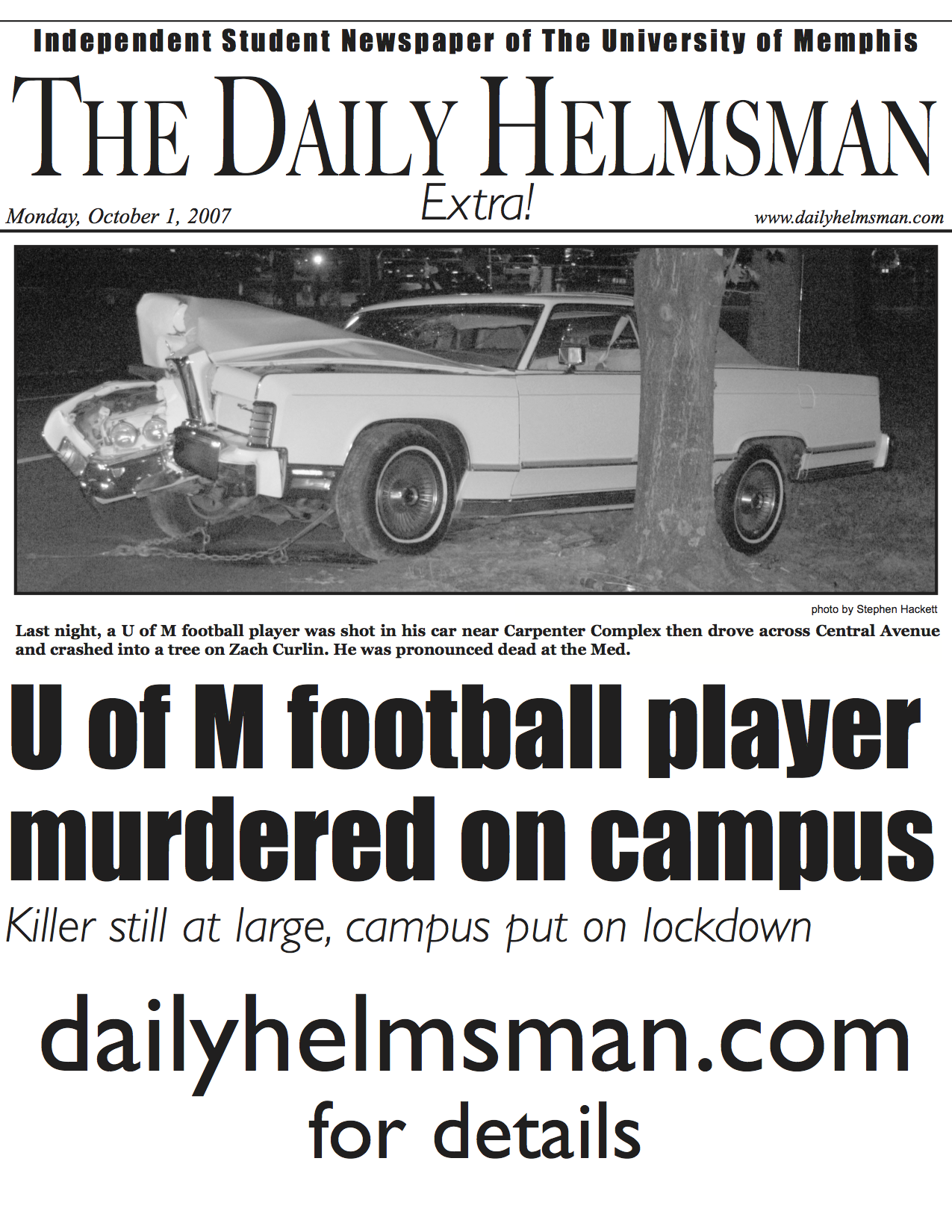
It got the news out there, and pointed students and faculty to the newspaper’s website, where we could publish up-to-the-minute news on the first murder on the university’s campus ever.
Nevin — the managing editor — and I went out to hang them across campus. We weren’t stopped a single time, despite the campus-wide lockdown. I had, however, had a run in with the campus police department on the way to the newsroom.
The journalism building sits at just about the center of campus, with very little of its own parking. Most of the spots near it are reserved for the girls’ dorm across the street, and are usually filled.
Not wanting to walk across campus just yet, I had pulled my SUV up on the sidewalk, bypassing the security gate to park behind the building. A few minutes in to our staff meeting, a campus police officer stormed in to the newsroom, demanding to see “which of you kids” had an Xterra with a bike rack.
I raised my hand, assuming he wasn’t about to give the newspaper a quote or tip on the story.
He took me in to the hall, berating me for “bypassing campus security measures” on “tonight, of all nights,” writing me a $250 parking ticket.
I guess he wasn’t thrilled the real cops had been called in to handle the crime.
* * *
By May 2011, the four men who had robbed Bradford had all been found or pled guilty to charges associated with the case. Two of the men are serving life sentences.
In the years following the murder, the University of Memphis came under criticism for waiting six hours to alert students via “Tiger Text,” the system used to contact students in case of an on-campus emergency.
As classes resumed later that week, the Helmsman staff was worn thin, covering candlelight vigils, police press conferences, SGA meetings and more. For a brief moment, the campus — and the city — sat aside all of their issues to remember a kid who had been killed over a chunk of money.
Our editor has been recognized several times for his leadership during this time, but I’m not sure any of us who were there that night are quite over it yet. I don’t think I am, honestly.