My mini-series on NeXT Computer: Installment 1: On the Creation of NeXT Installment 2: NeXT: The Hardware Installment 3: NeXT: The Software Installment 4: NeXT: The Apple Purchase Installment 5: Why Did NeXT Fail?
In 1988, NeXT showed off prototype hardware and started shipping “beta” hardware — and software — the next year. The first machines didn’t ship until almost a year later. When approached about the delays, Steve Jobs replied:
Late? This computer is five years ahead of its time!
First-Generation Hardware
The original machine - dubbed the NeXT Cube (two words) — has powered by a 25 MHz Motorola 68030, with up to 64 MB RAM, with a 256 MB magneto-optical drive, an optional 40 Mb SCSI hard drive, 10Base–2 Ethernet, NuBus (Of course, NuBus was also in use by Apple at this time.) and a 1120 by 832 grayscale display powered by Motorola’s 56001 digital signal processor. The 030 Cubes also came with a 25 MHz Motorola 68882 FPU serving as the math co-processor.
The machine had a base price of $6,500, and was targeted to the US higher education market.

The NeXT Cube — image via nextcomputers.org
This case was 12-inch cube built of magnesium and painted black.
This machine was etched in to technology history when Tim Berners-Lee at CERN used it to build the first web server software, named CERN httpd.
Apple’s fastest machine by the end of 1989 was the Macintosh IIci.[3. The Macintosh IIfx blew the IIci out of the water, just a few months later.] It was specced in a similar fashion, with a 25 MHz Motorola 68030, with enough RAM slots to hold a staggering 128 MB of memory. It sold for $6,300.
However, the lower-powered Macintosh SE/30 sold for $4,300, while the Macintosh IIcx sold for $5,300. Both of these machines were powered by a 16 MHz Motorola 68030, but may have led to the widely-held belief that NeXT’s failure was based on hardware prices alone. When spec’d similarly, the NeXT boxes weren’t that much more expensive.
Second-Generation Hardware
In 1990, NeXT release two new models — revised Cube and an all-new machine named the NeXTstation.
The NeXTcube sold for $6,500. It was based on the original NeXT Cube, and came in three configurations:
- NeXTcube 030: 25 MHz Motorola MC 68030
- NeXTcube 040: 25 MHz Motorola MC 68040
- NeXTcube Turbo: 33 MHz Motorola MC 68040
All three models shipped with a 25 MHz Motorola 56001 DSP chip for audio processing.
(The name was worse from the previous generation.)
The NeXTstation was released in September 1990. Taking the familiar “pizza-box” case design used by Apple and others at the time (hence the “Slab” nickname), the NeXTstation was cheaper than the Cube and often compared to the Mac IIsi, even though the Slab was faster, had more RAM and hard drive space and included Ethernet.
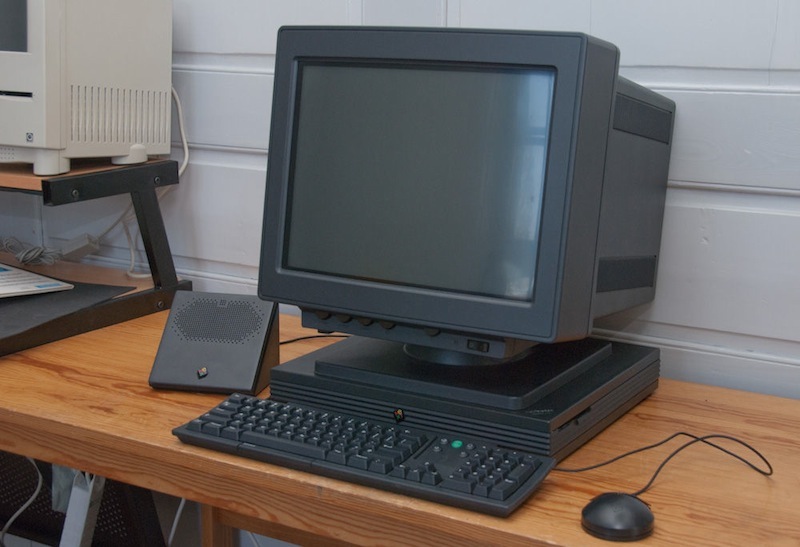
The NeXTstation — image via cuk.ch
Expansion & Upgrades
The poorly-named NeXTdimension was released in 1990. It was an expansion card for the Cube, giving it color capabilities. The board included:
- S-Video input and output
- RGB output
- An Intel i860 64-bit RISC processor at 33MHz (for Postscript acceleration)
- 8–32 MB RAM and 4MB VRAM for a resolution of 1120 by 832 at 24-bit color
The card included its own OS, built on a stripped-down Mach kernel. Because all Cubes came with an on-board GPU, this card allowed users to hook up a second display. NeXT released a “Turbo” version of the Cube, clocked at 33 MHz.
The NeXTdimension cost $3,395. A CL550 chip for MJPEG video compression was announced by the company, but never shipped.
While the Cube required a costly add-on card to handle color and more advanced video, NeXT released several versions of the NeXTstation to enable this and other capabilities:
The base model was powered by a the same chip as in the Color version, but sold for only $4,995, making it the most popular of the NeXT machines. (The Color went for $7,995 and the Turbo for $6,500.)
Other Hardware
Besides the computers, NeXT shipped a laser printer — the NeXT PN N2000 — a 400 DPI PostScript printer actually developed by Canon. The company also sold a color inkjet printer, also built by Canon.
NeXT also shipped displays. Ranging from 17–21 inches, these grayscale displays were dubbed “MegaPixel” displays — with a resolution of 1120 x 832 at 92 DPI. Later models included a built-in microphone and speaker set. They were sold separately from the computers themselves.
There was also an external sound box that could be used.
The company also shipped keyboards and mice for their products, based on the ADB technology invented by Steve Wozniak. NeXT at first shipped keyboards and mice mini-DIN connector with 5 pins. ADB was only supported on later machines, such as the NeXTstation Turbo.
Reflections
Looking back at these computers, I’ve come to several conclusions:
- Steve Jobs loved cubes. The NeXT machine, the PowerMac G4 Cube and the Fifth Avenue Apple Store all were born out of his love of the shape. All three examples are breathtaking works of art.
- NeXT built pretty nice computers — at decent prices. When compared with Apple’s equivalent offerings at the time, the difference isn’t as large as I thought they were when I started reading about NeXT’s machines.
- NeXT hardware was bleeding-edge. Like he did with the iMac in 1998, Jobs left the 3.5-inch floppy drive out of the NeXT machines. The magneto-optical drives were cutting-edge, but never took off as a standard storage solution.
- While the company built its workstations to suit education customers, it is hard to see — based on the hardware alone — if that goal was met well.
- I really want a NeXT Cube. My G4 Cube is getting lonely.

