
James Galbraith’s benchmarks of the new MacBook Air models are impressive. The morale of the story? Hard drive are really, really slow. Even with low-end processors, these machines are giving the Pro line a run for its money.
512 Pixels
On iPhoto ’11
I think iPhoto ‘11 is a great piece of software for most people, just not for people who are really into working with their photos.
Excuse me, I have some work to do in Aperture 3 this morning.
On Using a Dumbphone in 2010
On last week’s DadCast, I was asked how my Motorola Droid was treating me.
I gave an answer the guys probably weren’t expecting.
Background
I was an Apple employee in 2007 when the iPhone launched. As such, I was an early user. I remember it being uncomfortable to pull it out in public for months, as it always drew a crowd.
Fast forward two years. At the end of 2009, I was carrying an iPhone 3GS (in white, naturally), and was growing tired of the iPhone experience.
So I switched to the Motorola Droid in January of this year. And after a brief stint with a Palm Pre, went back to the Droid.
The Droid is a great phone. As the last phone that offered a truly vanilla Android experience, it runs like a dream. Not to mention the hardware is awesome. Battery life is great, Android is stable and the entire thing just feels good.
I loved it, right up until the moment I sold it.
Moving On
So, why did I sell a device I really liked?
Well, in a word — iPad.
The iPad has become my secondary device. Before the tablet, I had a computer and I had a phone. Clear, distinct products for clear and distinct things.
The iPad obviously lives in the gray area between notebooks and smartphones. And for me, it marginalized the smartphone.1
In a former life as the Service Manager of a busy Apple-Authorized Service Provider, I lived on my phone, working out of my car most days. 3G was literally my lifeline back to the office and to my customers. Now, however, I really don’t need 3G because I’m not really out and about that much. Wi-Fi is anywhere I am these days, and my Wi-Fi iPad serves my needs much better2
In short, most of the time, I was using my expensive, fancy smartphone for non-smartphone things.
So I bought a Motorola RAZR V3m. In silver, naturally.
The RAZR V3m
The V3m was Motorola’s version of their legendary device for Verizon. Sadly, Big Red stripped many of the phone’s features from the firmware. Happily, it’s pretty easy to re-flash the phone’s firmware to gain these features back using a Motorola utility in Windows.
The phone itself is tiny. Battery life is great. The ringer, earpiece and speaker are all loud and crystal-clear, in true Motorola fashion. There’s a reason this phone ruled the roost for so long.
Thanks to the magical technology that is Bluetooth, the V3m syncs with Address Book on Snow Leopard (via iSync) with no problems. Calendar data, however doesn’t sync. Which while a bummer, isn’t a deal-breaker, since my iPad is pretty much always with me.
Motorola’s custom predictive text system — named iTap — is pretty great. It’s not super smart, but it makes texting on the RAZR bearable. I can even send and receive MMS messages. I have Twitter setup to send DMs right to my phone as well.
The camera is a joke, however. And people give me funny looks if I pull it out of my pocket during meetings.
Side Effects
- At the beginning of the year, I had a strong urge to simplify things in my life. This is the single biggest step I’ve taken in this direction. I also find myself with empty time sitting in traffic or waiting for an appointment, since I don’t have the option to check Twitter or Google Reader. It’s really freeing, actually.
- Finding apps I can use is a lot simpler, since I just have an iPad and some Macs. Having Android in the mix makes finding decent apps a little harder.
- Instead of snapping sub-par photos with my phone, my Canon PowerShot G9 is getting a lot more use. Which is a good thing.
- By removing data from our cell phone plan, my wife and I are saving almost $80/month. (She gave up the Palm Pre Plus.)
- I gave up MobileMe when I moved to Android. Now that I’m back to all-Apple gear, it looks appealing again.
-
I think the same thing would have happened if I was using the iPhone. This isn’t a commentary on Android. ↩︎
-
To read about how I use my iPad, check out my interview over at The Brooks Review. ↩︎
‘Micro Apps’
Here’s what I’m thinking: one of the most popular apps since the inception of the iPhone App Store has been Pandora. Pandora obviously works through the web browser, but plenty of people would be into a small app that sits somewhere on your desktop running in the background. How do I know? Because Pandora actually already makes such an app — but it runs on AIR and you need a Pandora One premium account to use it. What if Pandora made a free ad-supported Pandora Mac app? Or a paid version (maybe $5 or $10) that gives you premium features? A lot of people would want such an app.
[…]
But a real opportunity may exist in small apps that don’t just fully mimic popular web apps, but instead extend upon them. Imagine a Facebook app, for example, that offered a great photo upload and viewing experience? Again, this is sort of the idea Apple seemed to originally have with their Desktop Widgets, but those never really took off. One reason, undoubtedly, is that distribution was lacking, and developers had no way to make money from them. The Mac App Store solves both of those issues.
Mobile apps do a lot of things that would be done in the browser on the desktop. The question is if that trend will make it to the desktop in the trojan horse of the Mac App Store. I think Siegler may be on to something — a whole class of little apps that make life a little bit easier.
Windows Phone 7 Achieving Android’s Dream?
Anand Lal Shimpi & Brian Klug, on carrier-bundled apps on Windows Phone 7 devices:
While Microsoft won’t enforce a clean install on every Windows Phone, it does ensure that anything your carrier/OEM installs on top of the OS can be uninstalled. My Samsung Focus for example came with a bunch of AT&T apps. Not only can they be unpinned from the start menu, they can also be completely uninstalled. Carriers get the option to differentiate, but users get the option to say no, it’s a win-win situation. If you do a factory reset of your phone however, it will restore the phone to its original state - which will include reinstalling carrier/OEM installed apps.
Coupled with Microsoft’s oversight concerning their partners’ hardware, it really sounds like Microsoft has spent some serious time looking at Android’s problems and learning from them.
The Droid X and almost every other Android phone1 come with tons of crapware that can’t be uninstalled, and every week there seems to be a new UI on top of Android. The original Motorola Droid was the last true “vanilla” Android device with no preloaded apps and no custom UI, and it’s been discontinued for months.
If Microsoft can keep carriers from loading up handsets with crappy apps (or at the very least, keep this uninstall feature around) and keep hardware manufacturers from producing sub-par gear and customized UIs, Windows Phone 7 may indeed fulfill Android’s original dream — a smartphone OS that runs across multiple carriers on multiple form factors while delivering the same experience to everyone.
Which is a hell of a feat to pull off. Google doesn’t seem like they are able to do this. But Microsoft… well, they might just get this right.
-
Even the T-Mobile G2, which is the latest “Google Phone” comes with pre-loaded apps and protection against rooting. ↩︎
A Grand Stand
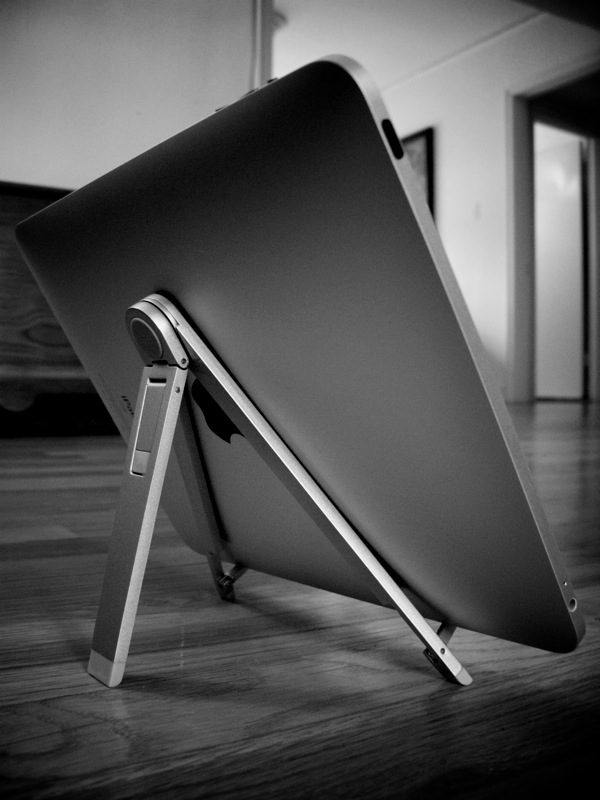
I picked up a Twelve South Compass iPad stand today at the Apple Store. If you use your iPad without a case, you need this little guy in your life. It’s handsome, well-made and a lot heavier than it looks. Which makes it quite sturdy, even when typing on the iPad. The rubber feet and insets grip the iPad to keep it from moving, and keep the stand from scratching it. You won’t regret having it around.
The Problem with iLife
Nine years ago, Steve Jobs announced the new era of computing was about to begin. Pete Mortensen:
It was January 9, 2001. It was the silver anniversary of Apple, and the newspapers were full of stories about the demise of the personal computer. Lots of digital devices had emerged that were tailored to single tasks that they did really well, from digital cameras to DVD players to DVRs to CD players to camcorders to PDAs. Many thought that we would replace our multi-use but often inefficient computers with a bunch of highly effective single-taskers. But not Jobs. As he made clear, the strength of a computer was its ability to control and integrate all these many digital devices. A Mac, in short, could serve as the Digital Hub that unites those disparate points in your digital life.
iLife — first launched as a product family in 20031 — served as Apple’s solution to the Digital Hub problem.
When it first came out, iLife was magical. There had never been such a great way to organize photos, edit home videos or create DVDs. Over the years, music editing and simple website creation were added with GarageBand and iWeb.
Since its launch, iLife has been one of Apple’s main tools to lure PC users to the Mac. And for good reason. iLife is unique in the computer industry. There’s nothing like iLife on the PC — in any price range. The fact that Apple bundles it for free with new Macs is mind-blowing.
As important as iLife is to Apple, there is a segment of Mac users seem to have grown weary of it. As the iLife demos were happening at this week’s event, there were tons of comments on Twitter (and in the Macgasm chat room) wishing the event would just move on, past iLife.
I talked on the DadCast this week about about the Mac App Store possibly creating two classes of Mac users — new users, pulled to the Mac via iOS devices and older users, who have been on the Mac for years who use things like Terminal and Console.
I think iLife is becoming another line in the sand between classes of Mac users. My lovely, hot wife (whom I love very much) isn’t a power use by any stretch of the word. She uses iPhoto all the time. I however, use Aperture. In fact, I use exactly zero iLife programs on a regular basis.
I think this is a pretty common. I think a lot of moderate to power users are frustrated with iLife’s simplicity.
With pro apps like Aperture, Logic and Final Cut Express cheaper and more powerful than ever, iLife has some real competition on the Mac.2
There’s nothing wrong with more serious users wanting more serious programs. The problem is that Apple’s pro apps don’t get the time or attention that iLife does. iPhoto’s fancy new card printing got several minutes of air time during Apple’s event. When was the last time Aperture got that much love?
Apple needs to find a balance. iLife is still wooing over new users, but there is a large segment of users that want and need more. 25 minutes of iLife updates are fine to sit through, just follow it up at some point with 25 minutes of something more hardcore. Apple’s pro apps don’t get the same attention as iLife gets, which makes a lot of professional-level users feeling a little forgotten by the company.
An alternative would be for Apple to add some complexity to the iLife applications, instead of just more pre-built slideshows to iPhoto and re-touching music lessons in GarageBand.3
iMovie ’11’s new audio tools are a good example of this. While easy to use, these new tools add a level of complexity and flexibility that has been missing from iMovie for a long time. Adding more complex photo editing to iPhoto and better podcast tools to GarageBand would make for a more powerful, well–rounded iLife.
Which would benefit both classes of Mac users.
Which would be good for Apple, too.
Update: I totally get that Apple’s growth over the last decade is due in major part to the fact that the company caters to consumers. That’s not a bad thing at all — Apple wouldn’t be the powerhouse it is toady without consumer programs and consumer hardware. My beefs are (1) that those of us who want more powerful apps wait far longer for updates than consumer-level users, and (2) that iLife could be made more powerful, which would help alleviate problem #1. Apple has a large segment of power users, and the company can’t forget about them.
On Living Without Flash
So, for the last few days, I’ve been running with no Flash plug-in at all, and honestly not really missing it very much.
His post outlines how to setup Safari 5 to run without Flash and without those annoying “Missing Plug-in” alerts.
Ars Reviews Windows Phone 7
The platform will not do well in checklist feature comparisons, but when it comes down to human interaction and using the thing, this software is a winner.
Microsoft doesn’t often get version one releases right, but this time, it has got the release very right indeed. Windows Phone 7 looks great, works well, and is a treat to use. Market success isn’t assured, but judged on its merits alone, this is a platform that absolutely deserves to succeed, and I really, really hope it does.
WP7 represents what I think is the biggest shift we’ve seen in mobile smartphone software in a while. Android and iOS operate basically in the same way, and even WebOS isn’t too dissimilar. WP7’s Metro UI, however is a big change. One that I too hope will succeed.
Apple Stops Bundling Flash with OS X
To be clear, this is a significantly different situation than with iOS. With iOS, Flash not only isn’t preinstalled, it can’t be installed, period. With Mac OS X, users are free to download Flash Player from Adobe and install it themselves.
Apple spokesperson Bill Evans told me: “We’re happy to continue to support Flash on the Mac, and the best way for users to always have the most up to date and secure version is to download it directly from Adobe.”
That’s a big change. I’m not sure exactly when Apple began bundling Flash Player as a standard component in Mac OS, but it was long enough ago that it was not a mistake that I didn’t include the “X” in the name of the OS. If I had to guess, I’d say Mac OS 8.6 — around the time of the deal to bundle IE as the default Mac OS browser, or maybe even earlier. We’re talking ancient history.
Wow. Either Flash penetration on the Mac is about to tank, or Adobe will ship a better way to install Flash than the current method.
Either way… wow.
A National Nightmare
Federico Viticci at Mac Stories:
As Steve Jobs confirmed at the “Back to the Mac” event, the Mac App Store will be the best way to discover and install apps, but not the only one. You’ll still be able to purchase apps directly from developers’ websites and run installers or .DMG files just fine. Can you imagine what could ever happen if Apple turned the Mac into an App Store-only “closed” system with no possibility to download software from other sources? After 20 years of regular installations?
This, without a doubt, is the scariest thing about the Mac App Store. But I really don’t see Apple pulling the trigger on closing app installation on the Mac. The outcry from developers like Microsoft and Adobe would be deafening. These companies are not going to use an App Store to publish their major software titles. Without Office and Creative Suite, the Mac would be dead in the water to a lot of people.
‘The Lion in Waiting’
If you have a free hour this weekend, be sure to listen to Episode 26 of the DadCast, a popular Canadian1 podcast that covers the tech world around and beyond Apple.
I joined the regular crew to talk about this week’s announcements, make some bad jokes and derail the conversation with observations about living in the South. It really was a lot of fun, and you’ll have fun listening to it.
-
Between this and writing for Macgasm, I’m freaking huge in Canada. ↩︎