With powerful subscriber tracking, white labelled domain name support, integrated newsletter sign-up, and automated publishing to popular social networks such as Twitter, Facebook, and App.net, FeedPress is the publishing tool for bloggers and podcasters looking for a great way to deliver their RSS content to readers and listeners everywhere.
No Data Lock-In
FeedPress includes built-in diagnostic tools, responsive design, multi-feed redirect and push support, integration with popular analytics and publishing tools such as WordPress, Mint, Piwik, and more. Integration with services such as Dropbox and Box.com, allow you to easily export your subscribers, or you can download a compatible JSON file containing all of your data.
With custom host name redirect, you are not beholden to a single platform. If you choose to leave at any time, you may do so. A simple change in redirect is all you need to get up and running again. There’s no need to waste your reader or listener’s time to update their feed with a new URL. We know all too well that this can lead to lost subscribers and pent-up frustration on both ends. Furthermore, you can export any newsletter subscribers that you may have, as well as download a compatible JSON file containing subscriber data collected from your feed.
Support And Migration
Support is available 7 days via email, and with lots of great tutorials, including how you can migrate from FeedBurner, the transition should be easy.
History And Trust
FeedPress now serves more than 30 million requests per month and is trusted by many popular blogs and podcasting networks such as: ESN, Mule Radio, Beautiful Pixels, and The Brooks Review.
FeedPress powers the RSS feed here on 512 Pixels, as well.
Create An Account Today
Sign up today for a free account and use promo code 512Pixels during checkout to get 20% off a premium account. Premium accounts feature even more awesome, such as: podcast analytics, full JSON and file API access, multiple social network publishing with optional URL shortening, feed refresh times of 20 minutes – even without push, display and click-through tracking, and priority support.
FeedPress is everything you wanted to know about your reader and listenership, no matter where they’re situated across the globe.
Apple has determined that the sleep/wake button mechanism on a small percentage of iPhone 5 models may stop working or work intermittently. iPhone 5 models manufactured through March 2013 may be affected by this issue.
Apple will replace the sleep/wake button mechanism, free of charge, on iPhone 5 models that exhibit this issue and have a qualifying serial number.
Good on Apple — it seems that a lot of people I know have run in to this issue. Taking care of people out of the warranty period is the right thing to do.
Building a new operating system is a monumental challenge, and in January 2000 when Aqua was introduced, Apple was in the thick of the transition to OS X.
Beyond the staggering amount of development work taking place to smash Mac OS and NeXTSTEP together, Apple was hard at work on the user interface of OS X. But to understand what OS X would become (and how it would look), it’s important to remember where the company had been before.
A Visual Tour of Mac OS
From the original Macintosh up through System 6, Mac OS looked basically the same:
As the screenshot shows, Apple was very conservative when adding color to the Mac’s user interface.
Mac OS 8 brought much more color with its Platinum interface. Notice the monochromatic pinstripes and simple controls. Even here, color is used somewhat sparingly:
Mac OS 8 was released over 12 years after the original Macintosh. For over a decade, the Mac’s UI stayed basically the same. Screens grew in size and color support was added, but Apple moved very slowly.
( OS 9 — released partly as a stop gap carried much of the same UI.)
It would come back to bite them in the ass.
Enter NeXT
While Apple was trudging along with Mac OS, the team at NeXT was hard at work. While the initial release of NeXTSTEP was monochrome, later builds — including OpenStep, pictured below — were in full color.
After the purchase, Apple announced [Rhapsody,](http://en.wikipedia.org/wiki/Rhapsody_(operating_system) a BSD-based operating system was powered by a Mach microkernel. It contained the object-oriented Yellow Box API framework, the Blue Box compatibility environment for running “Classic” Mac OS applications and a Java Virtual Machine.
In short, Rhapsody was the structure bridging the old and the new. It was also the front lines for Apple’s work on the interface of its new system.
This is how the company described its work:
Rhapsody’s user interface will combine elements from both the Mac OS and NEXTSTEP, but will be closer in look and feel to the Mac OS Finder. We realize that customers need a consistent interface in the two operating systems to deploy them throughout a single organization. It’s important for training and ease of use. One of the advantages of NeXT’s technology is the easy support of multiple user interface paradigms.
Shipping in August 1997, Rhapsody looked like Mac OS with little chunks of NeXT design, as Apple outlined:
Rhapsody would end up becoming Mac OS X Server 1.0 in March 1999. Still running the mash-up of Mac OS’ and OpenStep’s UIs, OS X Server 1.0 was the first retail release of an Apple-branded, NeXT-based OS:
The user interface was designed to reflect the hardware of the day. Candy-colored iMacs and iBooks looked great with Aqua’s bright buttons and colorful window controls.
As anyone who’s seen the screenshots knows, Aqua looks very nice. Even in this very first private release, the attention to detail in Aqua is impressive. Everything appears sharp and polished. All the UI elements look just as good as they do in the screen shots on Apple’s web site. Some even look better.
The road to hell is paved with good intentions, and I believe that Mac OS X DP3 has its heart in the right place. It certainly looks very nice, and it is generally impressive in action. But the devil is in the details, and Aqua manages to get most of them wrong. The dock is a total write-off. It doesn’t need to be “fixed” so much as it needs to be split-out into individual components that do a particular task (and do it well), rather than a catch-all dock that does everything atrociously. The Finder still needs to be fleshed out, but it’s on the right track with its offering of both the new browser-style interface and the traditional Finder windows. The core OS is sturdy and interesting as ever. As with DP2, I was not able to freeze the system at any time, and performance was quite good, with a few eye-candy-related exceptions (genie on the G3 and opaque window resizing on both machines). I continue to enjoy the technical aspects of Mac OS X, and I hold out hope that Apple will listen to its users and reconsider some of the UI decisions made for Mac OS X.
Just reviewing that screenshot shows some of the UI’s initial problems. The Dock was terrible, the transparency made some content — like window titles — impossible to read at times, single-application mode was super janky and the menu bar’s centered Apple logo was very troublesome.
(Fun fact — Mac OS’ “Apple menu” was still intact on the left end of the menu bar. That logo was just eye candy that apps with too many menus had to skip over. Seriously.)
By the time 10.0 Cheetah shipped in March 2001 (after four developer previews and the Public Beta), Apple had fixed a lot of the weirdness in Aqua, including that Apple logo:
In fact, most OS X users would look at 10.0 and not be surprised by much at all.
This is due to the fact that, for many years, OS X’s UI didn’t change all that much, besides gaining speed. Once Mac hardware caught up to the UI’s demands, Aqua shined.
These days, there’s not much of Aqua left. While OS X Mavericks’ interface is clearly derived from what Apple announced 13 years ago, it has aged.
The changes started with 10.3 Panther and right off the bat, things went off the rails a little. Many of Aqua’s conventions remained intact, but the pinstripes that once mimicked Apple’s hardware were replaced with our friend Brushed Metal:image via GUIdebook
Panther’s buttons and scrollbars seem out of place next to the brushed metal, and the window controls are downright cringe-worthy. Mac OS X Tiger didn’t stray far from Panther’s line, although the company did make several improvements to the UI, including dialog boxes and font smoothing. As shown below in this image, even 10.4 included some very Aqua-like elements:
image via Ari Weinstein, who sent me a correct version of the screenshot I had been using originally here.
Tiger’s successor, however, brought sweeping changes.
image via Apple PRLeopard’s user interface came crashing down like an iron fist. Pinstripes were smoothed over, and brushed metal was swept away. The rounded corners that had defined the Mac’s menu bar since 1984 were removed.
The new theme will likely involve tweaks to the existing design and perhaps a “flattening” of Aqua in-line with Apple’s iTunes and iPhoto interface elements.
At the time, I thought this rumor was really weird. 10.6 didn’t bring a new UI, and Marble sounds more like Leopard than anything else. Oh well.
During the event, the company announced Mac OS X 10.7 Lion. The new OS brought many iOS-based features to the desktop, including full-screen apps, improved gesture support, and a grid-based app launcher named Launchpad.
Lion continued down Leopard’s path of dulling Aqua, but brought things like stitched leather, linen and green felt from iOS to the Mac.
Today, OS X Mavericks looks like the successor to 10.6 more than anything else:
image via Apple PR
10.7 and 10.8’s skeuomorphic elements are basically already considered outliers at this point.
But even in Mavericks, there’s not much left of our old friend Aqua. I’m not even sure the name still really applies, at least how Steve Jobs introduced it over a decade years ago.
Homework Assignment:Find an hour to watch John Gruber’s talk from Webstock 2011 on the history of Apple’s UI design. The bits toward the end of the talk are a little dated, but it’s still worth the watch.
The Future
There’s been a lot of chatter that Mac OS X 10.10 ( Sigh.) will usher in a new UI.
Based on the product artwork alone, it’d be easy to think that OS X and iOS 7 are closer in appearance than they are:
Both of these icons were present at last year’s WWDC, but Mavericks got only a slight UI refresh — nothing more than losing some stitched leather and a bunch of linen. It was no redesign.
This year, however, many people believe OS X is due for a visual overhaul.
OS X 10.10 will be the successor to the current OS X, 10.9 Mavericks. Mavericks focused on power-user features and under-the-hood enhancements to improve hardware performance, battery life, and graphics processing. 10.10, however, will focus on aesthetics. According to sources, Apple Senior VP of Design Jony Ive is leading a “significant” design overhaul for OS X, and the new design will be the operating system’s cornerstone new feature (none of the mockups online, like the one above, are a good indicator of what to expect).
The new design will not be as stark as iOS 7, but it will include many of the flat elements and white textures instead of re-creations of life-like elements. The end-to-end redesign is said to be a top priority at Apple right now, with the specific details about the changes being sworn to extreme secrecy. Apple has been testing new features such as Siri and support for iOS AirDrop compatibility, but it’s unconfirmed if those enhancements will be ready for 10.10.
As Peter Cohen pointed out at iMore, Apple could move OS X closer to iOS without merging the operating systems.2013 didn’t bring an OS X redesign but it’s not hard to imagine that if Apple does have a new UI ready for OS X, it would fall in line with iOS.
There’s no doubt in my mind that Apple is going to overhaul the look of Mac OS X in the next version. As more and more apps bridge the gap between the desktop and mobile, the lack of consistent branding and design across platforms is becoming a problem.
I fully expect to see flatter user interfaces, squircle icons, a new Dock, and Helvetica Neue as the system font.
I’ll be surprised if Lucida Grande survives as the system font past 10.9. I will, however be sad. It has defined so much of OS X for years, but I bet that 10.10 will bring more than a new typeface.
While I don’t know if Apple would go this far with OS X, it is interesting to consider.
Apple’s recent opening of an OS X Beta Seed Program is interesting, too. Surely new builds of 10.9 aren’t so important that Apple would introduce this system. 10.9.3 isn’t much to write home about, and certainly doesn’t require a wide-reaching base of testers.
If 10.10 is going to have a new face, wouldn’t it make sense to let all sorts of people test it before it ships as a final product?
As we spoke about on The Prompt, iOS 7 brought excitement. People showed off the beta to their friends like it was new toy. It’s not hard to imagine that Apple would want to bottle some of that up and dump it on its aging — and comparatively boring — desktop operating system.
I don’t know what’s going to happen during Tim Cook’s keynote on June 2, but there is a lot of smoke pointing to an Aqua-colored fire.
This week, we discuss honeymoon etiquette and dispense financial wisdom about AAPL before discussing Loom, Apple’s new environmental video, MacStories 4.0 and the new OS X Beta Seed Program.
Sponsored by lynda.com and Harry’s (use code PROMPT for $5 off your first purchase)
For MacStories 4.0, we wanted to get back to basics. We deleted the old design and codebase and decided to focus on what, ultimately, readers come to MacStories for: reading articles.
We realized very early on that our readers don’t need to see dozens of boxes or widgets in a sidebar, nor do they want to deal with multiple toolbars, menus, or guessing RSS feeds on their own. Readers want a readable article, not an article hidden somewhere in a cluttered sea of stuff. We redesigned MacStories with the idea of prioritizing articles over everything else, using a responsive layout to let content take advantage of every screen size.
I’ve been reviewing the site’s new design for several weeks now, and boy, is it good. I welcome our new Italian responsive web design overlords.
Before today, you needed a developer account to help test Apple’s upcoming software releases before they hit the general user population. You didn’t need to actually develop anything, but it would still cost you $99 per year to partake, and technically it was still sort of against the rules. Today, Apple introduced its OS X Beta Seed Program to make pre-release Mac operating system software available to all who want to help try it out.
Signing up is simple, and with WWDC just six weeks away, my guess is that things could get really exciting for program participants soon.
Of course, Apple hasn’t had a public beta of OS X in a long time. I can’t help but think that OS X may be getting a lot of attention in June.
One could say we’ve been busy these last couple of months, but that would only be the half of it. We have two great releases today that are packed with so much stuff, we had to cut down on our What’s New text just to fit it within the App Store requirements.
1Password 4.5 for iOS beings lots of features, including an overhauled — and flattened — UI, AirDrop support, the ability to create multiple vaults and more.
I’ve enjoyed using the beta, and I think the new UI really does the app a lot of good. This update is out much later than most iOS 7 overhauls, but the wait is worth it. Beyond new pixels, the app is faster, on-boarding has been made easier and the in-app browser feels much better.
In short, 1Password is the best app for managing your passwords because it does the best job of taking hold of our slippery digital identity, all the myriad digital bits of ourselves we use to prove who we are, and helps ease the friction of our travels through the digital world.
They certainly have great technology, but to call them a technology company doesn’t seem quite right. They have great marketing, but to call them a marketing company isn’t true either. They have an incredible retail chain, but to call them a retailer is clearly off base as well.
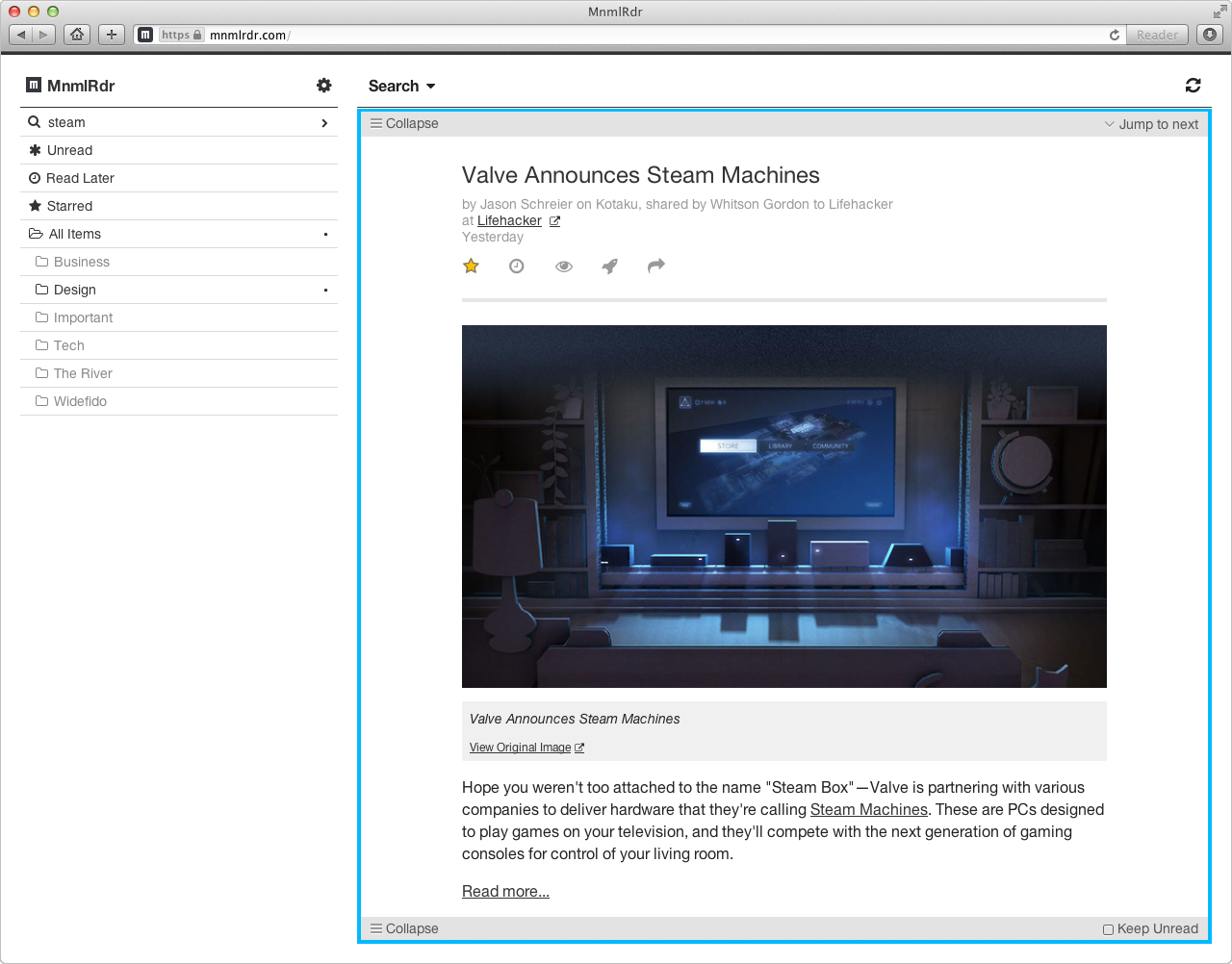
MnmlRdr is a lightweight & minimal RSS feed reading service, and, this week only, there is a special deal for 512pixels.net readers to get 50% off the normal price.
MnmlRdr’s primary goal is to minimize clutter and make content easy for you to read. By hiding distracting elements and turning advanced features off by default, MnmlRdr helps you focus on what matters most: the content.
But, MnmlRdr doesn’t stop there…it has everything you need in an RSS feed reader neatly tucked away, like search, tagging, real-time updates, full-text extracts, and intuitive gestures on mobile. Best of all is that MnmlRdr is private, ad-free, and supported through subscriptions…so you don’t have to worry about the service suddenly disappearing one day.