New emoji are coming with iOS 16.4, so it’s time for Federico to guess their names.
Bluetooth Database Spills the Beans on New Macs ⇢
Rumors about that new 15-inch MacBook Air and the future Mac Pro keep heating up, as Joe Rossignol reports:
Apple this week filed a new listing in the Bluetooth Launch Studio database, a move that sometimes foreshadows the launch of new products. The filing does not mention any specific products, but it lists the latest Bluetooth 5.3 standard and references a prior macOS-related listing, suggesting the filing could be related to upcoming Macs.
Apple is rumored to be planning new versions of the MacBook Air and the Mac Pro for release in the first half of 2023. The new MacBook Air is expected to feature a larger 15-inch display and the M2 chip, while the new Mac Pro is expected to have the same design as the 2019 model with a new M2 Ultra chip. Both new Macs could be announced as early as March or April, potentially alongside the release of macOS 13.3. However, there remains a possibility that the new Macs will not be announced until WWDC in June or later.
Bluetooth 5.3 is present in a bunch of new Apple hardware, including the new M2-based MacBook Pros and the M2 Mac mini. It is not present on the M2 MacBook Air introduced last year. That machine ships with Bluetooth 5.0.
Kbase Article of the Week: iWeb: Menu Items are Unavailable After Reinstall ⇢
Symptoms
When iWeb is opened after a reinstall of the original disc, many of the menu items may be unavailable and new page creation may not be possible. Also the theme selection screen may not appear if there was no existing site in iWeb.Note: These issues could occur if the iWeb software was updated prior to a reinstall using the original disc.
Solution
When you perform a reinstall from the disc, the original version of iWeb that shipped with the computer is installed, but the Receipts from the updated version of iWeb is still in place causing Software Update not to recognize that an update is needed. To resolve this issue, simply download and install the latest version of iWeb.
KeyboardCleanTool ⇢
This weekend, I was using someone else’s MacBook Pro and wanted to clean their keyboard. I could not shut it down for cleaning, as it was downloading a macOS update. This prompted me to look for an app that could lock the keyboard for me to wipe it down.
This led me to KeyboardCleanTool, a free utility by Andreas Hegenberg, the genius behind apps like BetterTouchTool.
Sponsor: DEVONthink of DEVONtechnologies ⇢
Whether you’re in the harbor or at high sea, you need to know where you are or where you’re sailing. If you have all the maps, books, and documents. DEVONthink for Mac and DEVONthink To Go for iOS will not let you down on your mission and help you navigate the “seven seas of information.”
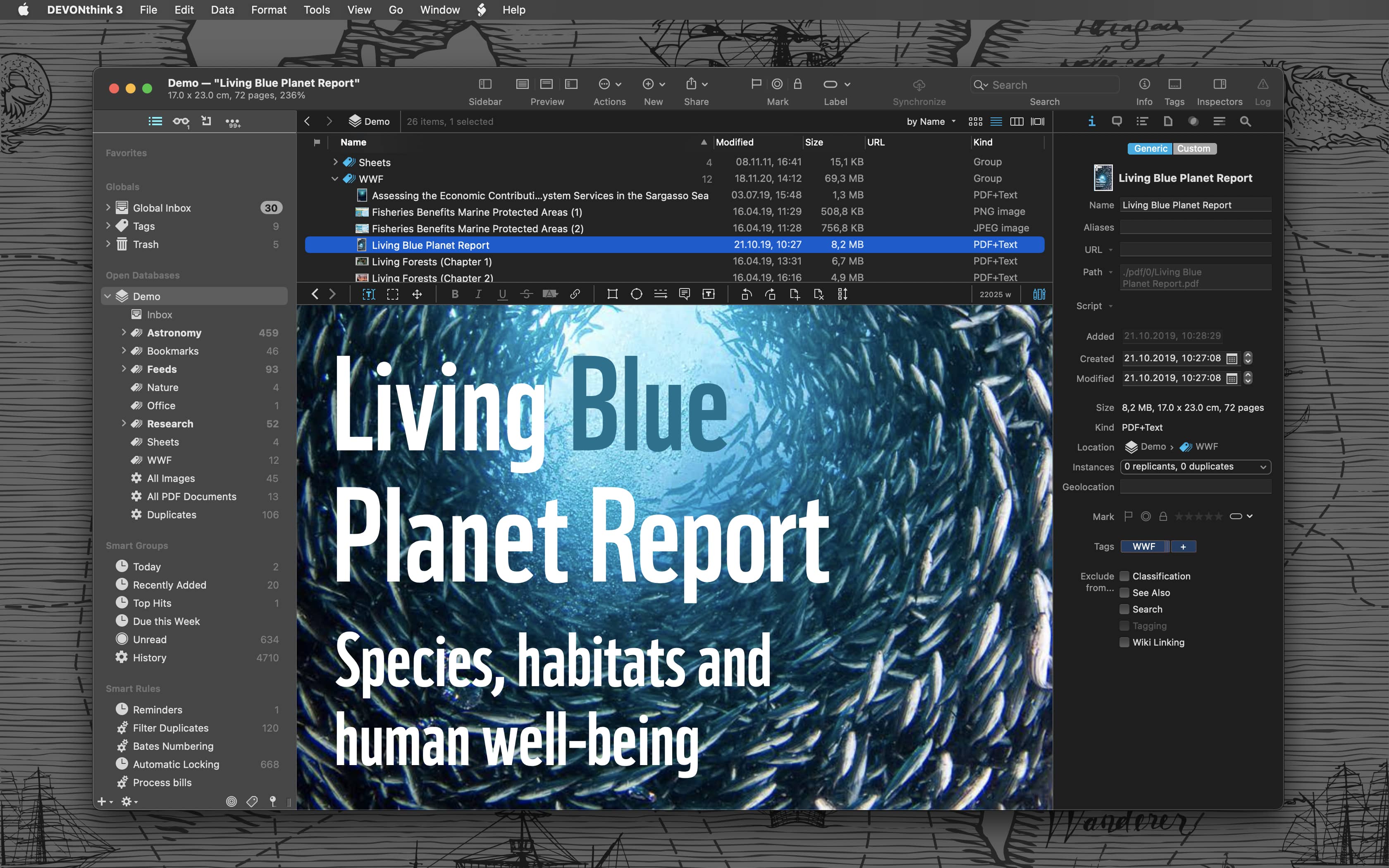
Sailor jokes aside … DEVONthink helps you get organized in your office, home office, or on the go. It keeps all your documents, snippets, and bookmarks in one place. Organize them however you need and let DEVONthink’s unique AI assist you all the way with filing and finding. And if that wasn’t enough, smart rules and flexible reminders let you delegate all the boring, repeating daily tasks to DEVONthink too. On iOS, use Shortcuts actions to integrate DEVONthink To Go with your other apps.
Of course, whatever you keep in your databases remains yours. It’s all stored locally, nothing is uploaded anywhere unless you say so. Flexible synchronization technology with strong encryption makes sure that you have all your important documents with you on whatever device you’re working on or taking with you. Use iCloud, Dropbox, any WebDAV service you may have booked. Or synchronize directly over your local network.
And, of course, there’s so much more, from email archiving and scanning to an embedded web server for sharing your data securely with your team. Check out https://www.devontechnologies.com to learn more about DEVONthink, DEVONthink To Go, and more.
Mac Power Users #680: Workflows with Marco Arment ⇢
This week on Mac Power Users, developer and podcaster Marco Arment joins the show to talk about his desktop-laptop setup, the current state of development on Apple’s platforms and what the company may do in 2023.
It is always a treat to record with Marco, and I love how this episode came out. Don’t miss the More Power Users segment, where he shared his experience with Family Setup on the Apple Watch.
Meta Announces Verification Program, Complete with Blue Badges ⇢
Good morning and new product announcement: this week we’re starting to roll out Meta Verified — a subscription service that lets you verify your account with a government ID, get a blue badge, get extra impersonation protection against accounts claiming to be you, and get direct access to customer support. This new feature is about increasing authenticity and security across our services. Meta Verified starts at $11.99 / month on web or $14.99 / month on iOS. We’ll be rolling out in Australia and New Zealand this week and more countries soon.
At least you won’t have to pay to use SMS 2FA.
Considering the Next Mac Pro ⇢
Jason Snell, writing at Macworld:
So what makes a Mac Pro a Mac Pro? If it’s a tower enclosure, Apple’s got a relatively fresh one from 2019 that it can just roll out again. (Gurman says that’s now the plan, which is also a little disconcerting when you consider that the original reports suggested a new, half-height enclosure and that quad-M2 chip.) But what’s inside the Mac Pro matters, and if it’s just an M2 Ultra chip, it’s hard not to consider the new Mac Pro just a Mac Studio that moved out of its apartment and into a mini-mansion.
Does it help if there’s expandable internal storage? Sure, I suppose–it’s certainly a lot neater than attaching drives via external ports. Does it help if Apple offers additional M2 GPU cores via some sort of proprietary add-on card system? Maybe, if it’s done the extra engineering work. What about RAM expansion? Sure, but again, such a choice would undercut the work Apple has done to create a pool of fast, shared memory right next to the CPUs and GPUs.
And all that custom work, all those distortions to what makes Apple silicon so successful, would be done for a product that’s a niche of a niche–and it’s work that Apple’s chip design team could have spent on a next-generation chip for the iPhone, iPad, and Mac.
On Login Items, Background Items and macOS Ventura ⇢
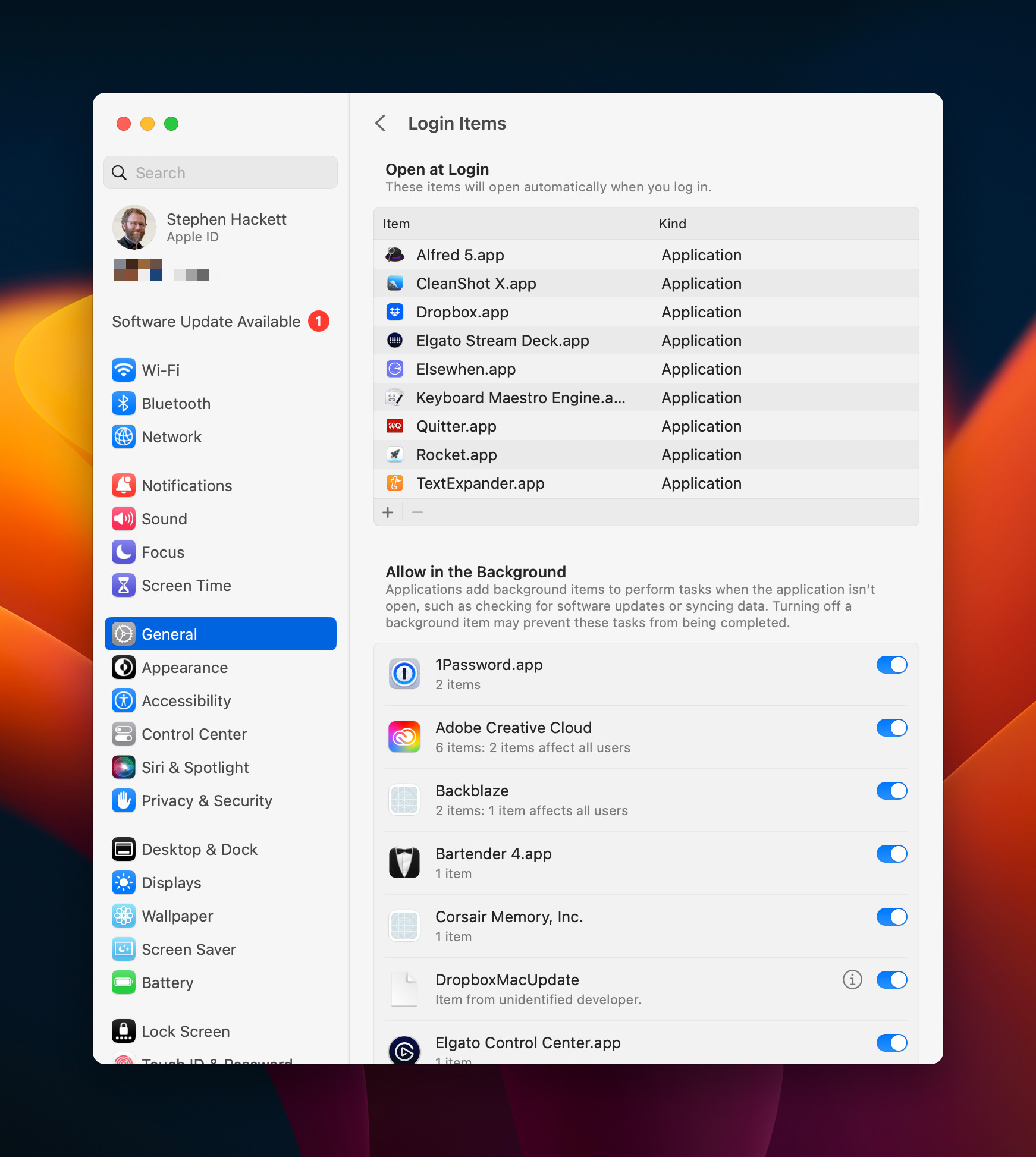
There was a time when the great majority of apps consisted of just an app bundle, created their own settings file in ~/Library/Preferences, and that was that. For various reasons, this became steadily more complicated, with some apps assembling arrays of files and folders in /Library/Application Support, and in recent years many apps have required helpers too. One common reason for this is that they need to perform certain functions with elevated privileges, such as root. To do that, they have become even more elaborate, with Login Items, property lists installed in folders like /Library/LaunchAgents, and more. This article explains how Ventura is trying to make things simpler again.
We spoke about this recently on Mac Power Users. While the new system attempts to give users more control over what’s happening on their Macs, I can’t help but think the UI for it is too confusing for most users:
Microsoft Blesses Parallels as Official Way to Run Windows on Apple Silicon Macs ⇢
Andrew Cunningham, writing at Ars Technica:
In the absence of a version of Boot Camp that runs on Apple Silicon Macs, the best way to run Windows on them has been to use a virtualization app like Parallels or (more recently) VMware Fusion. The problem is that, until now, the Arm version of Windows that runs on Apple Silicon Macs hasn’t technically been allowed to run on anything other than Arm PCs that come with it due to Microsoft’s licensing restrictions.
These licensing problems haven’t technically stopped people from running the Arm version of Windows on other hardware, including Apple Silicon Macs and the Raspberry Pi, but it could be more of an issue for IT managers who wanted to deploy Windows on Macs without worrying about legal liability.
Today, Microsoft is formally blessing Parallels as a way to run the Professional and Enterprise versions of Windows 11 on Apple Silicon Macs. Windows running under Parallels has some limitations—no support for DirectX 12 or newer OpenGL versions, no support for the Linux or Android subsystems, and a few missing security features. But it can run Arm-native Windows apps as well as 32- and 64-bit x86 apps thanks to Windows 11’s code translation features; pretty much anything that isn’t a game should run tolerably well, given the speed of Apple’s M1 and M2 chip families.
It’s good to see this get official support from Microsoft, as running Windows was on of the last dominos to fall in the ability in just about everyone to switch to Apple silicon.
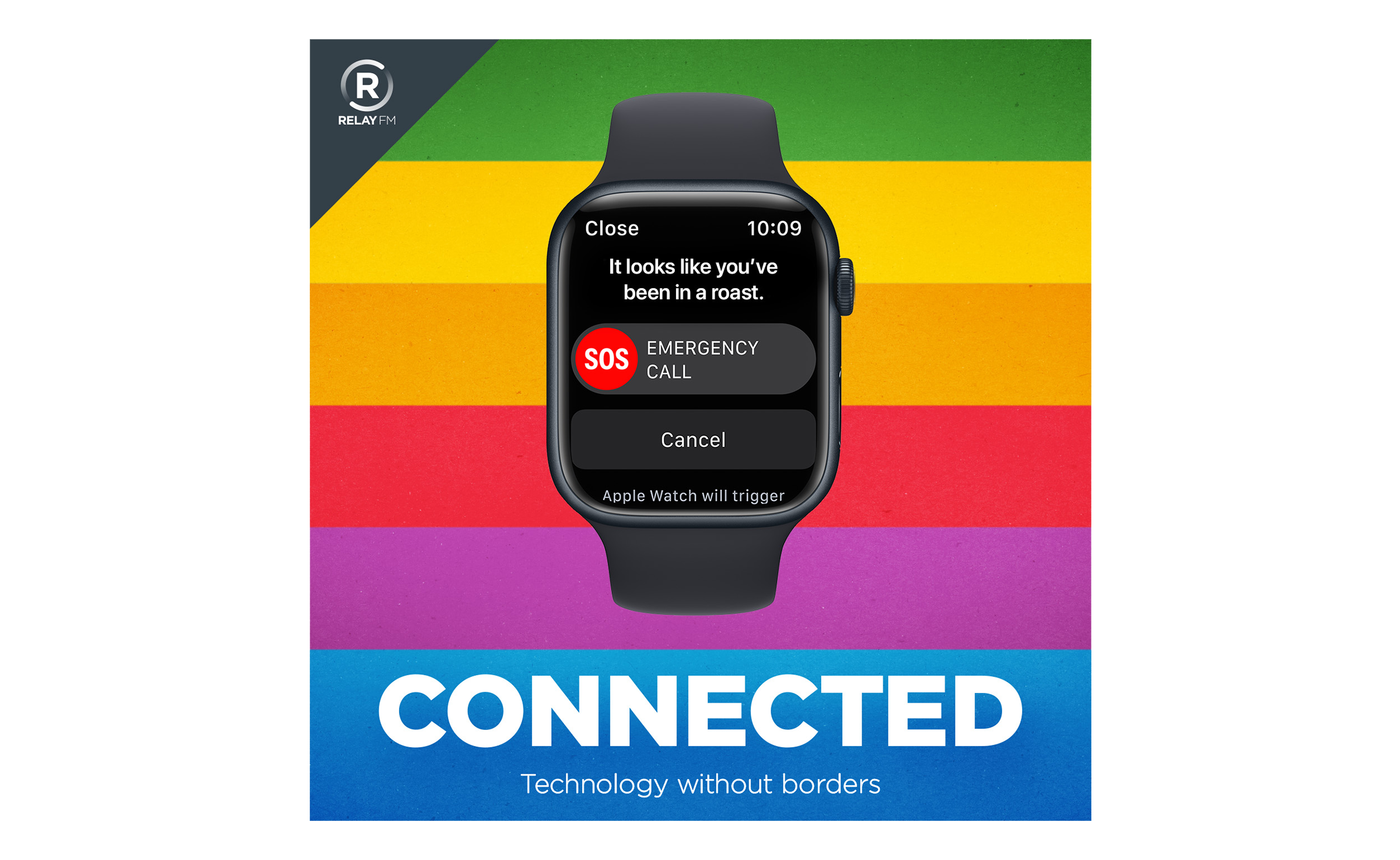
Connected #437: Mr. Nice Wrist Guy ⇢
This episode of Connected is very good:
This week, the guys roast each other’s Apple Watches and things get weird.
On Connected Pro, Myke announces his newfound interest in golf.
Kbase Article of the Week: Applications With Calendars Cannot Add March Events With Abbreviated Month Name ⇢
You may experience difficulty when adding events for the month of March in applications with a calendar feature, such as Microsoft Entourage v. X. This occurs when the date region is set for Belgium, Italy, Netherlands, or Switzerland (Italian).
Note: This issue occurs any time you schedule an event for March, whether or not it is March when you attempt to schedule the event.