512 Pixels

Apple Announces Self Service Repair for Select Mac Notebooks

Apple Newsroom:

Apple announced Self Service Repair will be available tomorrow for MacBook Air and MacBook Pro notebooks with the M1 family of chips, providing repair manuals and genuine Apple parts and tools through the Apple Self Service Repair Store. Self Service Repair for iPhone launched earlier this year and the program will expand to additional countries — beginning in Europe — as well as additional Mac models later this year.

Self Service Repair for MacBook Air and MacBook Pro offers more than a dozen different repair types for each model, including the display, top case with battery, and trackpad, with more to come. Customers who are experienced with the complexities of repairing electronic devices will be able to complete repairs on these Mac notebooks, with access to many of the same parts and tools available to Apple Store locations and Apple Authorized Service Providers.

Jason Snell has more details at Six Colors:

At launch, Apple is supporting some specific repair types, though others will be added as the program goes along. For this first round of Macs, you’ll be able to perform replacements for many items, including the audio board, battery (for MacBook Air), bottom case, display, keycaps, logic board, speaker, top case, Touch ID board, trackpad, fans (for MacBook Pro), MagSafe (for MacBook Pro), and the antenna modules. (Apple says there will be a MacBook Pro battery replacement available in the near future.)

The cost of repair parts varies widely. An audio board replacement might cost $12, and speakers $29, while the logic board for a 32-core GPU MacBook Pro with 32GB of memory and a 1TB hard drive would run more than $1900. However, depending on the part, Apple will buy back the broken part and refurbish it for re-use in another repair, making that $1900+ logic board repair cost a little less than $600. (If Apple doesn’t reimburse you for a part, they’ll still accept it and recycle it if you want to send it back to them.)

Like with the iPhone Self Service Repair Program, users can purchase parts and rent tools from the Self Service Repair Store, which as previously discussed, is managed by CTDI for Apple.

Also like the iPhone Self Service Repair Program, I don’t think most people are going to opt to crack open their Macs when a repair is needed. This is great for those of us with the skills — or bravery — to do so, but if I were still in the Apple-Authorized Service Provider business, I wouldn’t be too worried about this tanking my repair revenue.

I am curious to see what will happen with machines like the iMac and Mac Studio are included in the program, as they are more difficult to open than a notebook. Until then, I’m glad to see this program continue to grow.


Sponsor: Unite 4 for macOS ⇢

Unite 4 for macOS allows you to turn any website into an app on your Mac. Using a lightweight, WebKit powered browser as a backend, you can easily create isolated, customizable apps from any site.

Unite 4 includes dozens of new features, including support for native notifications, new customization options, and much more. Unite apps also serve as a great alternative for resource hogging Electron apps or half-baked Catalyst apps.

Some examples of apps you could create in mere minutes with Unite:

  • A Gmail web client that behaves like a native mail client.
  • A status bar app for Apple Music or Overcast
  • An isolated workspace for apps that may track you like Facebook
  • A Google Meet app that works efficiently without using Chrome
  • A fully-featured Instagram app that has a resizable window, unlike the M1 version.
  • A Robinhood, Figma, or Roam Research app for your desktop.

512 Pixels readers get 20% off this week when you purchase Unite 4 at bzgapps.com/unite512 or when you use the promo code ‘512Pixels’ at checkout.

You can also try Unite for 14 days absolutely free or use it as part of your subscription if you’re a Setapp subscriber!

How Apple Builds Its macOS Apps ⇢

Alexandre Colucci:

WWDC 2019 had a major impact on the UI toolkit landscape: while the venerable AppKit APIs remained available, Apple removed the old Carbon APIs and introduced 2 brand new frameworks: Mac Catalyst and SwiftUI.

Apple sporadically mentioned some apps built with these new UI toolkits. In this article, I try to bring a better overview of Apple’s use of AppKit, Mac Catalyst and SwiftUI in the different versions of macOS, from macOS Mojave to macOS Ventura.

The charts aren’t a huge surprise to me — there is a lot of AppKit still kicking around in macOS. This transition is going to take a long time, both in the third-party ecosystem and within Apple itself.

MarsEdit ⇢

My thanks to MarsEdit for sponsoring the site this week. It is a fantastic blog editor for macOS that eschews all the increasingly complicated parts of WordPress. I use here on 512 Pixels — including for this very blog post.

Go check it out.

Inside AirPower ⇢

Apple Demo and 91 Tech has an incredible video out, all about AirPower, Apple’s never-launched wireless charging mat.

Relay FM Turns Eight

If you had told me eight years ago that we’d be where we are today, with an amazing community of podcasters, listeners and members, it would have sounded like a dream come true.

That’s exactly what it is.

Relay 8

Janet Jackson Versus XP Laptops ⇢

Raymond Chen, writing at The Old New Thing at Microsoft:

A colleague of mine shared a story from Windows XP product support. A major computer manufacturer discovered that playing the music video for Janet Jackson’s “Rhythm Nation” would crash certain models of laptops. I would not have wanted to be in the laboratory that they must have set up to investigate this problem. Not an artistic judgement.

One discovery during the investigation is that playing the music video also crashed some of their competitors’ laptops.

And then they discovered something extremely weird: Playing the music video on one laptop caused a laptop sitting nearby to crash, even though that other laptop wasn’t playing the video!

What’s going on?

The answer — and the fix — are pretty wild.

Kbase Article of the Week: MacBook Air (Original, Late 2008, and Mid 2009) Hinge Quality Program has Ended ⇢

Apple Support, in a pretty terse document:

The eligibility period for the MacBook Air (Original, Late 2008, and Mid 2009) Hinge Quality Program has ended.

The eligibility period covering this issue has ended.

I had forgotten about this situation, but I linked to a support article about it back in 2009.

The URL I linked to back then now redirects to the short announcement quoted above, but here is what it said:

Learn what you can do if you experience one or more of these issues with the hinges on your MacBook Air.

  • Unable to close lid completely.
  • Broken or cracked plastic near one or both of the hinges.
  • More than one inch (2.54cm) of free play while opening or closing the lid.
  • Lid falls freely into closed position from a 30-degree open position. (From a closed position, open the lid approximately 30 degrees and let go.)

You can take your MacBook Air to an Apple-Authorized Service Provider or Apple Retail Store for evaluation and repair if necessary, even if your product is out of warranty.

If you previously paid for a repair for hinge-related issues that were not caused by accidental damage, you may be eligible for a refund. Contact Apple for more information.

That last bit is important, as Apple had previously been treating failed MacBook Air hinges as if they were cases of accidental damage.

A War of Head Versus Heart: The M2 MacBook Air

I’m a big fan of Death Cab for Cutie. Like most music that has stuck with me, I first came across the band’s work in high school. My buddy Levi drove a first-generation Miata, and one night as we drove around the suburb outside of Memphis that we called home, he popped in a burned CD labeled “DCFC.”

“I think you’re going to like these guys,” he said, turning up the volume. As a somewhat-emo 17 year old, I was hooked.

Their album Plans came out in August 2005, at the start of my sophomore year of college. I wore out those bits on my iPod. To this day, it may be my favorite album of all time. I don’t listen to it often, but when I do, it’s an experience.

One of the singles is the 8th track on the record, named “Crooked Teeth.” Here are the lyrics from the bridge:

I’m a war of head versus heart

And it’s always this way

My head is weak

And my heart always speaks

Before I know what it will say

I’m not sure it is what Ben Gibbard and Chris Walla had in mind when they wrote the song, but this sums up how I feel about the new M2 MacBook Air.

M2 MacBook Air

At this point, you know just about everything there is to know about this computer.1 The new design fits with the MacBook Pros Apple introduced last year. The Touch Bar is gone; the Notch is here. MagSafe is back. The M2 probably does thermal throttle, but you won’t ever notice it. It comes in a few colors, but not the ones we all wanted.

There’s no doubt that the MacBook Air is the most important computer Apple makes. Even when Apple tried getting away from it, customers refused to let them.2 It was a stunning fall from grace, but the machine was able to make a rebound. There’s a pretty clear line between Apple rebooting the MacBook Air in 2018 to the machine we have today.

And what a machine it is. The wedge shape may be gone, but everything that made the MacBook Air good back in the day is still here today: performance that will meet the needs of almost everyone, impressive battery life and a portable design that makes it easy to take the notebook anywhere. In a vacuum, the M2 MacBook Air is one of the best Macs Apple has ever made.

But the Air doesn’t exist in a vacuum.

When looking at any product, one has to consider the context of that product. For the M2 MacBook Air, that context is the M1 MacBook Air that is still for sale and the 14-inch MacBook Pro.

If you’re on a budget, you should probably buy the M1 MacBook Air, especially given the fact that the base-level M2 MacBook Air comes with kinda-lame SSD speeds. The M1 Air is a great machine, and while it’s a shame the M2 couldn’t hit the magical price of $999, at least Apple has a good option for those on a budget.

The 14-inch MacBook Pro is a more interesting comparison, and not just because it has been my notebook for the last nine months.3

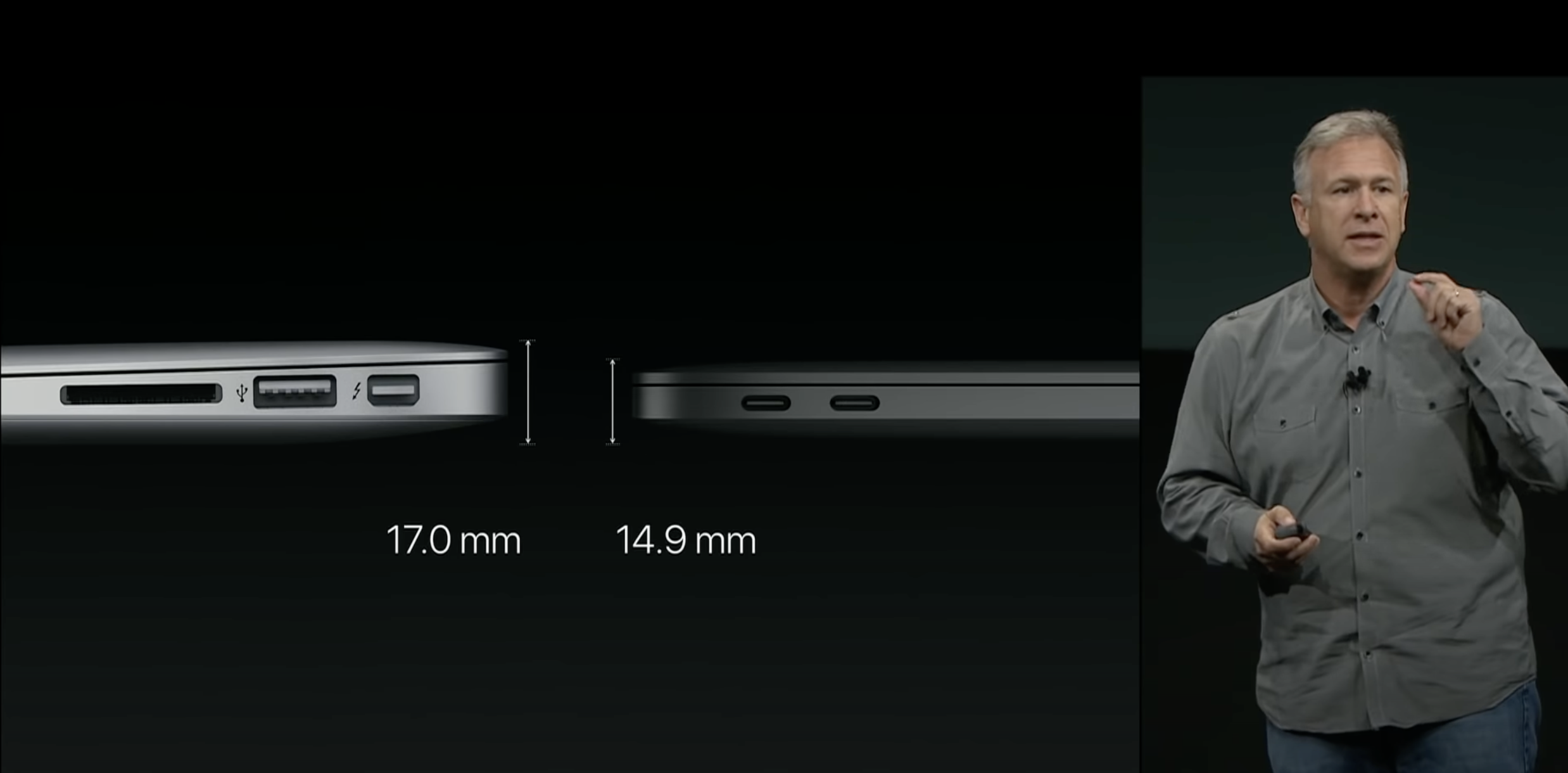
Back when Apple introduced the USB-C-and-nothing-else MacBook Pros in the fall of 2016, I had my first Something isn’t right here thought when I saw this slide:

Thickness of the pre-retina MacBook Air and 2016 MacBook Pro

Apple was thrilled that the then-new 13-inch MacBook Pro was thinner than the pre-Retina MacBook Air, had 13% less overall volume and weighed the same three pounds.

With that design, Apple blurred the lines between the MacBook Air and MacBook Pro in a way it hadn’t done before. That decision got reversed last year when the new 14-inch and 16-inch MacBook Pros were introduced. The Pro got thicker, heavier and a lot more capable. Many people fell in love with it, including me. Finally, after five years, Apple was letting the MacBook Pro be a pro notebook again.

The M2 Air, in many ways, is the opposite side of that coin. The design is cut from the same smooth aluminum cloth, and side-by-side, it’s clear that the M2 Air and 2021 MacBook Pros were indeed designed together.

This has made the decision between the MacBook Air and the MacBook Pro easier in a bunch of ways, especially if you are like me and pretend the Touch Bar-laden 13-inch MacBook Pro with M2 isn’t a thing.

If you need something lightweight and thin, the MacBook Air is an excellent choice. On the other hand, if you need more power and more ports, the MacBook Pro is there, ready to meet your needs. They are two divergent paths, and most customers will know which one they should traverse.

This is where we get to the Head Versus Heart of it all. My workflow benefits from the M1 Pro’s extra horsepower, especially when it comes to multi-threaded tasks like encoding MP3s. Logic renders are also faster on the MacBook Pro, and the inclusion of an HDMI port and SD card slot meant that I took most of the dongles out of my backpack months ago.

In my head, I know that the 14-inch MacBook Pro is the right notebook for me and the work that I do when away from my desk. My heart says otherwise.

There’s something about the design of this machine that I can’t escape. The footprint is pretty similar between the two notebooks, but in my backpack, there’s a huge difference. Don’t get me wrong: I am thrilled that the MacBook Pro has beefed up to be a better computer, but I’m drawn to the clean, simple look of the Air. I know the Pro is a better match for my workflows, but the Air can do everything I need — if just a little bit slower. And I don’t care about that speed difference any time I pick up the Air to take it with me. Something about it just clicks with me in a way I didn’t anticipate.

I think my heart is going to win this one.


  1. If you have just woken up from a coma or just gotten back from a stay at the South Pole and haven’t seen coverage of this machine, check out Quinn Nelson’s video about it. ↩︎

  2. The 12-inch MacBook really did bring a ton of chaos with it: a muddy product line, a bad keyboard and the USB-C-and-nothing-else era we’re just now leaving behind. I know some people loved it, but in hindsight, it’s amazing just how wrong Apple got so much of how it was presented and where it was in the lineup of Mac notebooks at the time. ↩︎

  3. I’ve been a desktop-first Mac user for years but have always kept a notebook, for times I want to work away from my desk or am on the road for work. For me, a notebook is a secondary Mac, and I treat it as such, with a subset of the data and workflows present on my Mac Studio being set up on my MacBook Pro. ↩︎

Sponsor: MarsEdit ⇢

MarsEdit 4 is a native Mac interface to WordPress and other blogging systems that focuses on one thing: blogging! As WordPress gets increasingly complicated with an emphasis on BLOCKS and whole-site design, MarsEdit sticks to the classic idea that:

  1. There would be an editor.
  2. You could write in it.
  3. You could publish it to your blog.

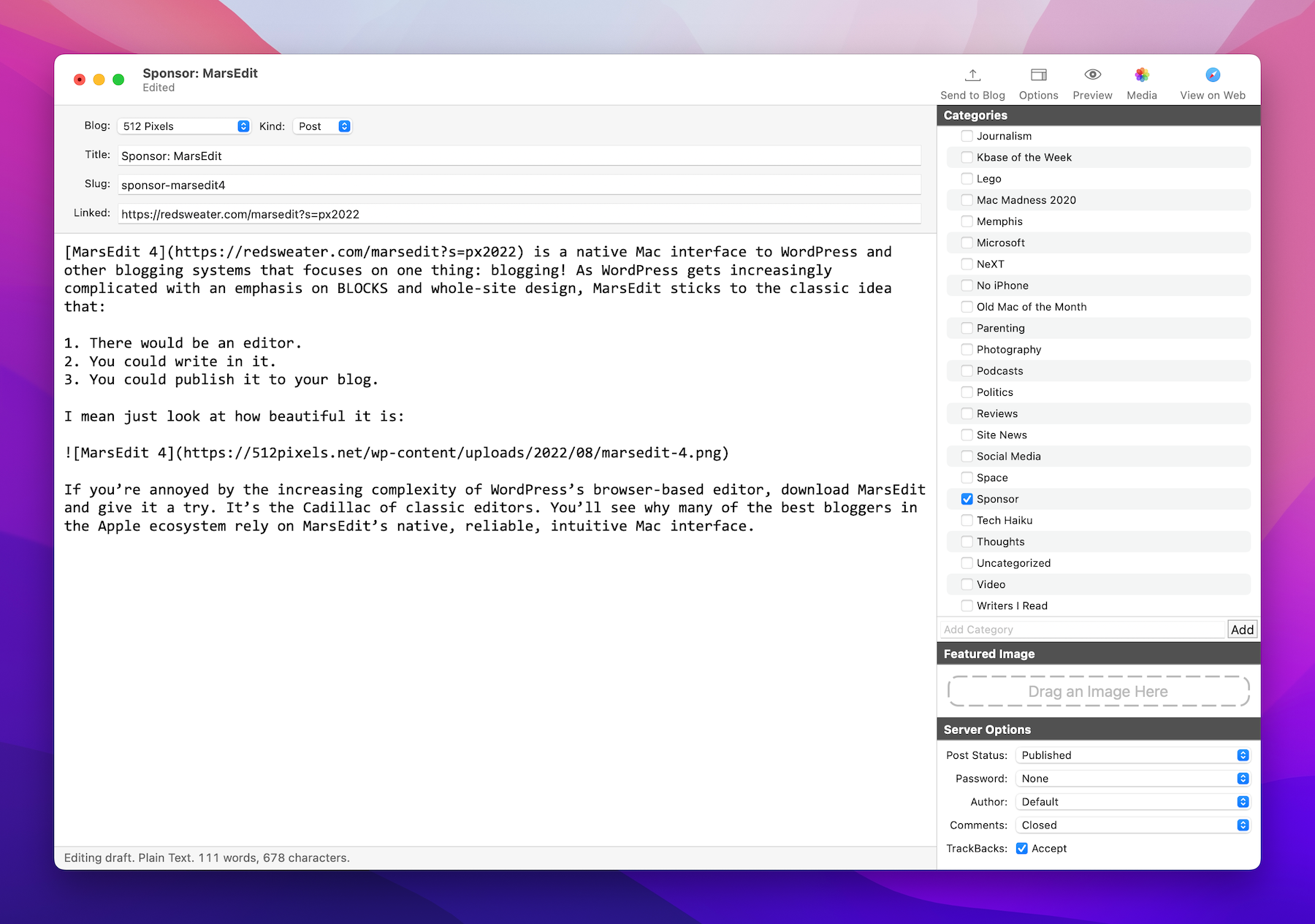
I mean just look at how clean it is:

MarsEdit 4

If you’re annoyed by the increasing complexity of WordPress’s browser-based editor, download MarsEdit and give it a try. It’s the Cadillac of classic editors. You’ll see why many of the best bloggers in the Apple ecosystem rely on MarsEdit’s native, reliable, intuitive Mac interface.