
Big Sur is a big deal. The OS picks up where Catalina left off, further rationalizing Apple’s product lineup through design, new ways to bring apps to the Mac, and updates to existing system apps. The approach realigns functionality across Apple’s platforms after years of divergence from their common foundation: Mac OS X. The result is an OS that walks a perilous line between breaking with the past and honoring it, acknowledging the ways computing has changed while aiming for a bold future.
Big Sur also clarifies Apple’s Mac strategy, the contours of which began to emerge with Catalina. It’s a vision of a continuum of computing devices that offer a consistent, familiar environment no matter which you choose while remaining true to what makes them unique. In practical terms, that means a carefully coordinated design language and a greater emphasis on feature parity across OSes. Conceptually, it’s also an opportunity for macOS to shed the perception that it’s a legacy OS overshadowed by iOS and reclaim a meaningful place in Apple’s lineup for years to come.
512 Pixels
A Visual Tour of macOS Big Sur ⇢
macOS Big Sur is here. As always, you should give it a little while before upgrading to it in a production environment, but in the mean time, check out its entry in my macOS Screenshot Library.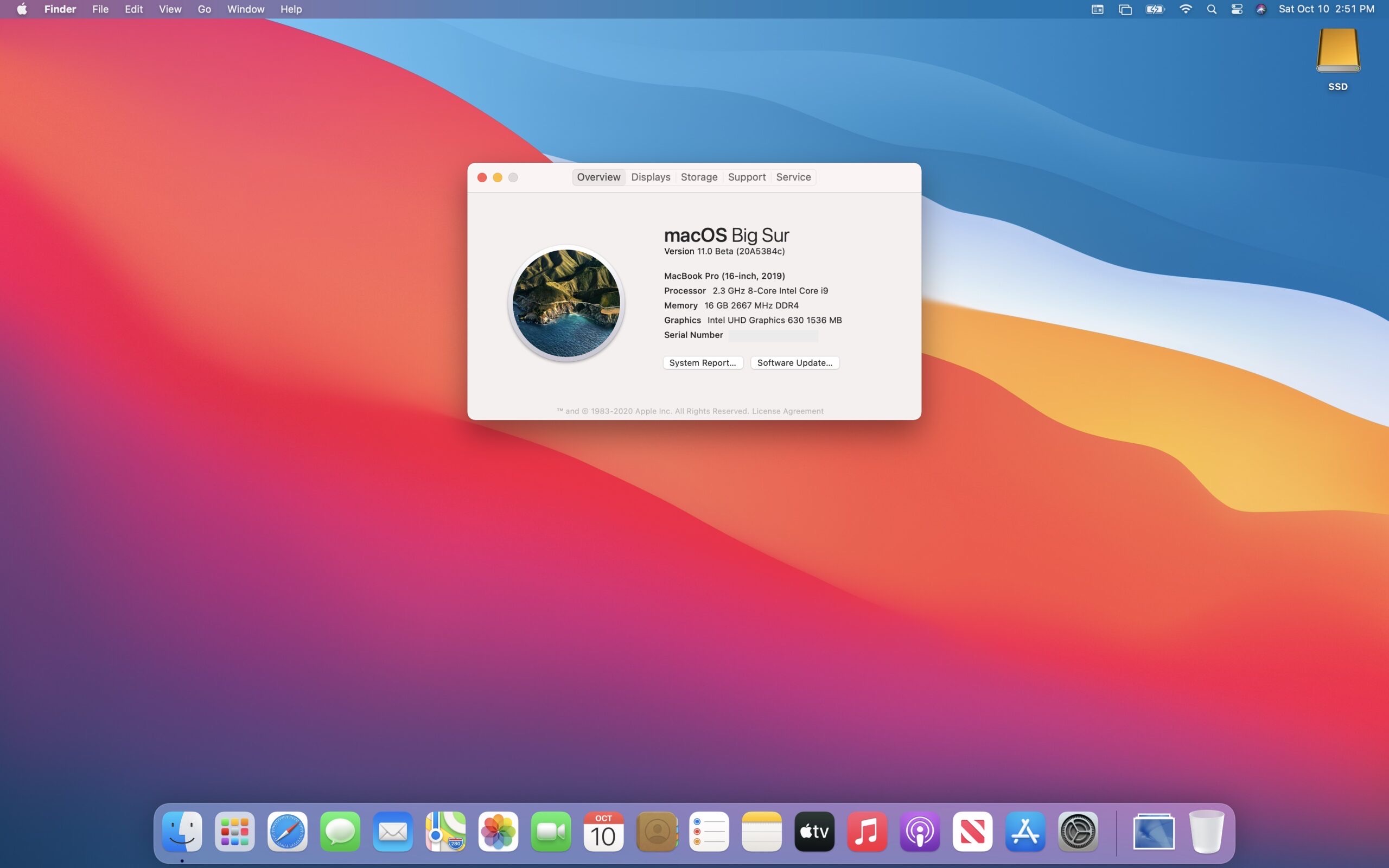
On Running Virtual Machines on M1-Powered Macs
With M1 Macs mere days away for early adopters, those who need to run virtual machines on their Macs may have a bumpy time ahead.
Here’s Nick Dobrovolskiy with Parallels:
It is important to note that currently available versions of Parallels® Desktop for Mac cannot run virtual machines on Mac with Apple M1 chip. Good news: A new version of Parallels Desktop for Mac that can run on Mac with Apple M1 chip is already in active development.
When Apple Silicon Mac was first announced during the keynote at WWDC on June 22 of this year, Apple demoed a Parallels Desktop for Mac prototype running a Linux virtual machine flawlessly on Apple Silicon. Since WWDC, our new version of Parallels Desktop which runs on Mac with Apple M1 chip has made tremendous progress. We switched Parallels Desktop to universal binary and optimized its virtualization code; and the version that we are eager to try on these new MacBook Air, Mac mini and MacBook Pro 13″ looks very promising.
VMWare Fusion isn’t ready yet either, according to this tweet:
So excited for todays announcements from @Apple!
While we’re not quite ready to announce our timeline, we’re happy to say that we are committed to delivering VMware virtual machines on #AppleSilicon! pic.twitter.com/en1FNorxrM
— VMware Fusion (@VMwareFusion) November 10, 2020
Even when these and other virtualization tools are ready,1 running Windows as a VM atop a M1 Mac probably isn’t going to be. So far, all the public has seen running virtually on M1 Macs is ARM-based Linux, back at WWDC.
Microsoft has a version of Windows running on ARM chips, but as of this summer, things didn’t look great for getting it to run virtually on the new Macs:
“Microsoft only licenses Windows 10 on ARM to OEMs,” says a Microsoft spokesperson in a statement to The Verge. We asked Microsoft if it plans to change this policy to allow Windows 10 on ARM-based Macs, and the company says “we have nothing further to share at this time.”
That said, ARM Windows is getting better. Back in September, Microsoft announced that the ARM version of Windows 10 is gaining x64 emulation:
We are excited about the momentum we are seeing from app partners embracing Windows 10 on ARM, taking advantage of the power and performance benefits of Qualcomm Snapdragon processors. We heard your feedback and are making Microsoft Edge faster while using less battery, and announced that we will soon release a native Microsoft Teams client optimized for Windows 10 on ARM. We will also expand support for running x64 apps, with x64 emulation starting to roll out to the Windows Insider Program in November. Because developers asked, Visual Studio Code has also been updated and optimized for Windows 10 on ARM. For organizations, we’re committed to helping them ensure their apps work with Windows 10 and Microsoft 365 Apps on ARM64 devices with App Assure.
Before this, the ARM version of Windows could only emulate 32-bit applications. It’s a nice improvement, and maybe one day it will matter to Mac users.
-
Oh, and Boot Camp is totes dead. Docker is currently busted, but should work in the future. ↩︎
512 Pixels Sponsorships
A quick programming note about sponsorships here on 512 Pixels. I’ve got just three spots open left this year, and am starting to book weeks for 2021. If you have an app, product or service you’d like to share with some of the coolest people on the Internet, get in touch!
Connected #320: Actually Quite Precedented ⇢
Apple has announced the first batch of Macs running on its own silicon, so the boys are judging yet another set of Rickies. Will Federico’s dual-title fall? Will Myke get his Ricky? Did Stephen make a mistake having six Flexies?
On the membership version, we discuss Myke’s curse, Federico’s Twitter findings and my getting stranded in my kitchen.
My thanks to our sponsors:
- Squarespace: Make your next move. Enter offer code CONNECTED at checkout to get 10% off your first purchase.
- PDFpen, from Smile: Powerful PDF Editing On Your Mac.
- Pingdom: Start monitoring your website performance and availability today, and get instant alerts when an outage occurs or a site transaction fails. Use offer code CONNECTED to get 30% off. Offer expires on January 31, 2021, and can be used only once.
AirBuddy 2 ⇢
AirBuddy is one of those apps that makes the Mac so much better that I can’t imagine using AirPods with my computers without it. The all-new version brings with it an updated UI, powerful listening modes and a lot more. It is well worth the $10.
Alfred Ready for first Apple Silicon Macs ⇢
Good news about my app launcher of choice:
Alfred has an exceedingly clean code base, so we were hoping for it to be reasonably easy to create our first Universal build. To our pleasant surprise, it was as straightforward as loading up Alfred’s code into Xcode 12 Beta, selecting the Universal architecture, and compiling. That was it, no other changes were needed, and we were immediately able to take full advantage of the new architecture.
Three More Things
At its event today, Apple unveiled three new Macs, all powered by the new M1 chip. The MacBook Air and Mac mini are now powered by Apple’s own silicon, as are two of three default configurations of the 13-inch MacBook Pro.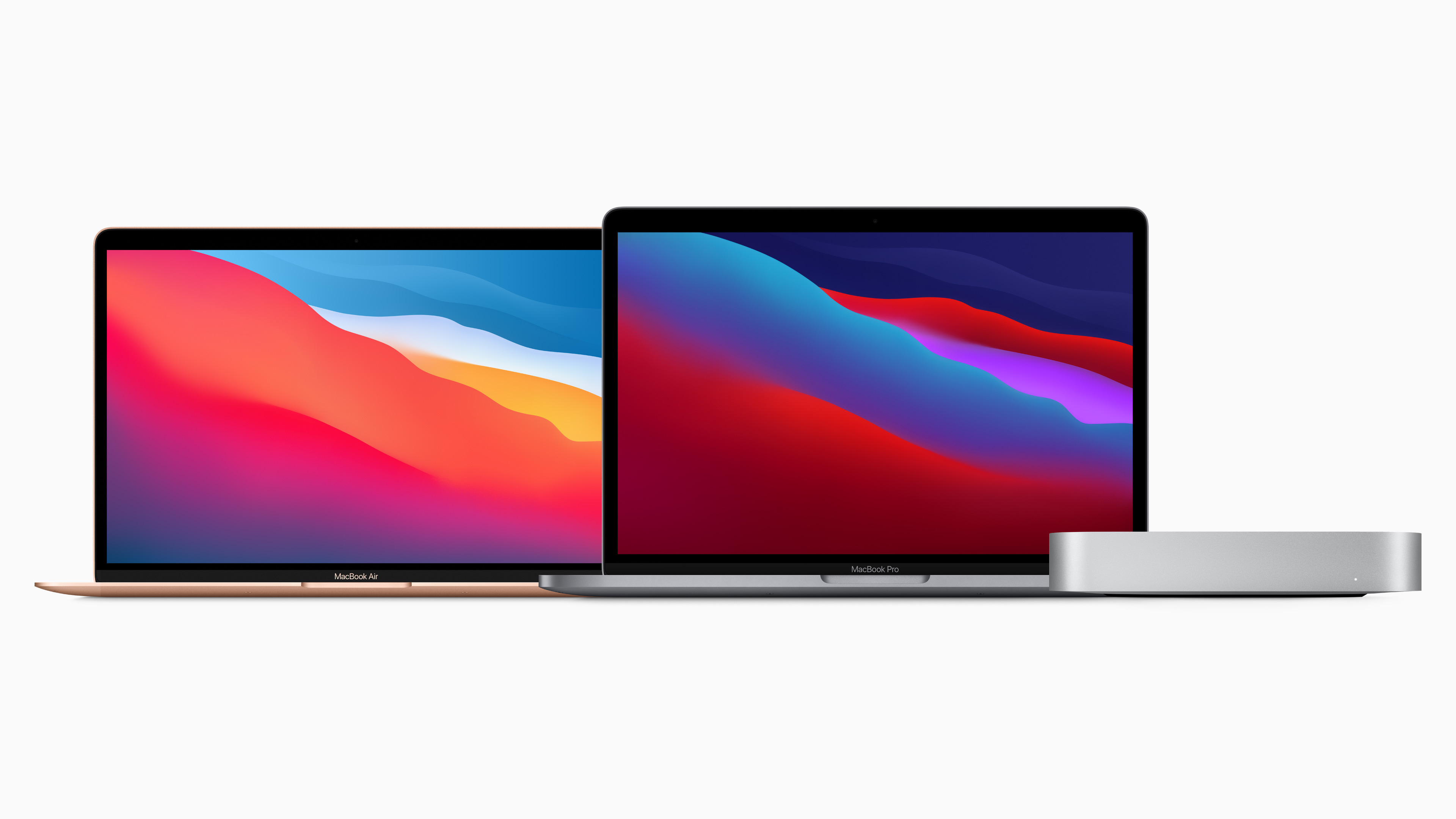
Apple isn’t saying anything about the clock speed of the M1, just like they’ve remained silent about these figures when announcing new iPhones and iPads. One can assume that future M-class chips will be faster than these, but it’s all Bezos Charts from here:
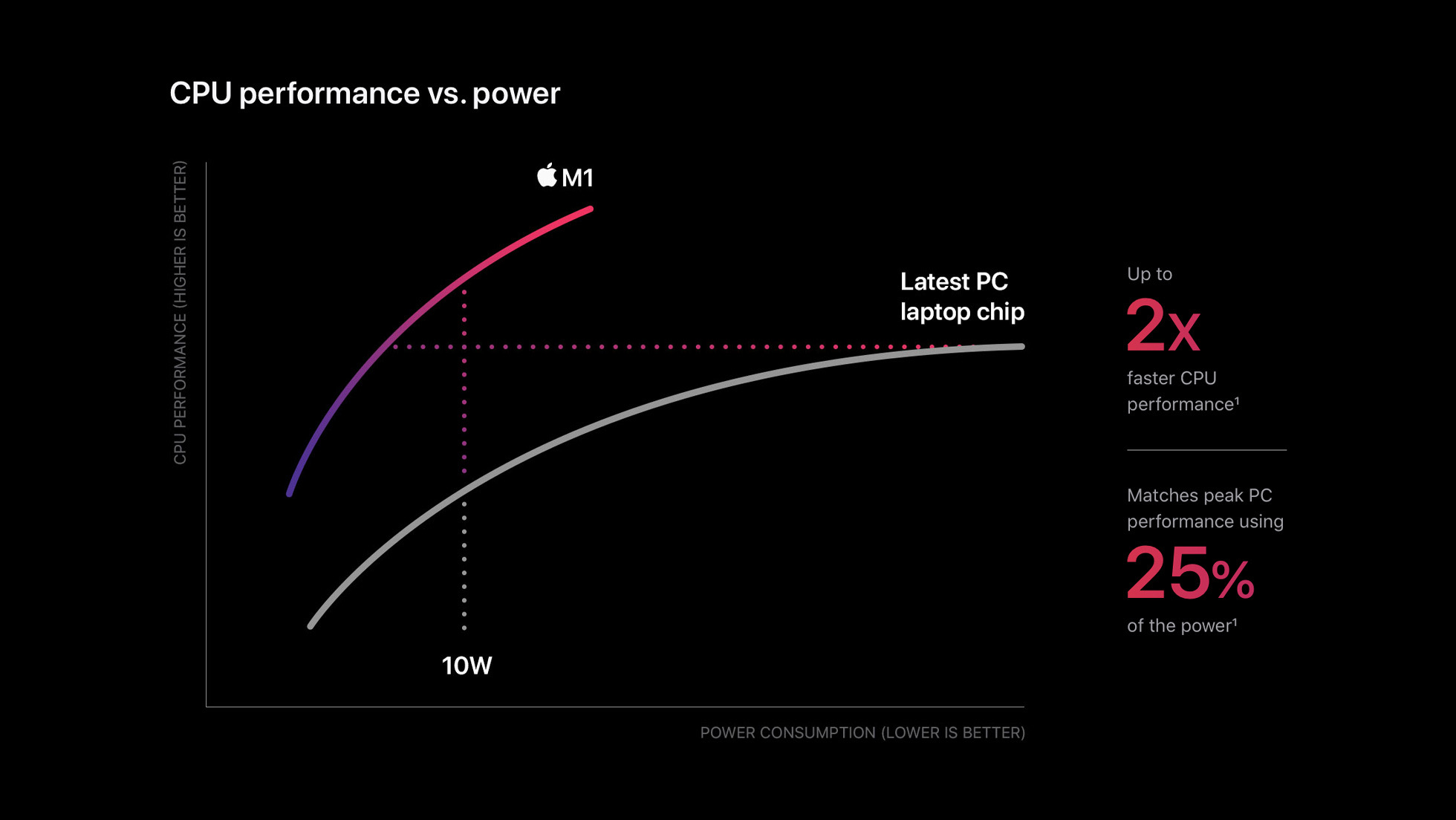
For things that did get numbers, be sure to check out this post by John Voorhees over on MacStories.
Structurally, the M1 is very similar to its A-class cousins in the iPhone and iPad. The CPU, GPU, neural engine, I/O and other features are all in one package, sharing one pool of memory. You can still choose between 8 or 16 GB of memory when ordering one of these machines, but knowing how that memory is being used just got more complicated. This also means the end of upgrading RAM in the Mac mini, which is a bummer.1
The new hardware brings other assorted goodies including WiFi 6, Thunderbolt / USB 4 and — in the case of the MacBook Air — fan-less, silent operation.
The headline is, of course, that these new machines will be much, much faster than the Intel models they replace, while using less energy and achieving better battery life. As impressive as this factor was when Apple switched to Intel 15 years ago, it seems even more so now. Apple touted CPU performance of 2.8-3.5x faster, with GPUs coming in 5-6x faster, depending on the specific product.
On the outside, these new Macs are just like the ones they replace. There’s no 14-inch MacBook Pro, and as touch-friendly as Big Sur looks, there are no panels anywhere in the line.2
I’ve ordered a nicely-optioned MacBook Air for my wife, but when it gets here in a couple of weeks, I’m going to migrate everything from my 16-inch MacBook Pro to it and spend some time with it. I’m looking forward to what iOS apps are like on the Mac, and am a little afraid of how fast it’s going to seem compared to my Intel notebook.
Re-watching the Intel Announcement ⇢
Yesterday I re-watched the Intel announcement from WWDC 2005 over on my Twitch channel. On Friday at 11 AM Eastern, I’ll be doing another stream, this time of Macworld 2006, where the first two Intel Macs were unveiled.
Matthew Panzarino, on Apple’s MagSafe Duo Charger ⇢
The MagSafe Duo does work, and there are a couple of engineering bright spots. But you will not feel that it’s worth the money by the time you purchase the $129 charger and the $19 20W power brick to go with it, and there are many third party accessories on the market that do this job just fine.
This accessories feels like a one-and-done for sure.
The 12 Mini and 12 Pro Max Get Sized Up ⇢
Seeing the 12 Mini next to the iPhone 5S is rather surprising. This phone is going to be small.
The Computer Chronicles: Ergonomics ⇢
I’ve been stuck in bed for the last several days recovering from surgery on my foot, and instead of reading or meditating or something else good and useful, I’ve fallen down the rabbit hole of watching old episodes of The Computer Chronicles on YouTube.
This episode really jumped out at me, as half-way through, the Macintosh and its designer Susan Kare make an appearance.