
512 Pixels
That’d Be One Way to Fix the MacBook Pro ⇢
As spotted by The Verge, Apple has filed a patent for a keyboard designed to be resistant to crumbs and other debris:
The patent describes two different ways that a keyboard can keep dirt out, either by sealing gaps off or having a membrane beneath each key that would blow out air every time a key is pressed, pushing out unwanted debris.
From the figures shown in the patent, it’s clear that Apple is considering many different approaches and alternatives to create a crumb-resistant keyboard.
I’m all for this, but the Magic Keyboard I’m typing this sentence on is pretty robust and exists today, and feels way better to type on that the current MacBook Pro keyboard. Why can’t it be fit into a MacBook Pro?
Connected #183: PodStorm ⇢
Stephen’s family staged a HomePod intervention, Myke names his favorite Apple Watch apps, Apple kills off iTunes LP and Federico has some news.
My thanks to our sponsors:
Alexa is Laughing at Users (Updated) ⇢
Over the past few days, users with Alexa-enabled devices have reported hearing strange, unprompted laughter. Amazon responded to the creepiness in a statement to The Verge, saying, “We’re aware of this and working to fix it.”
As noted in media reports and a trending Twitter moment, Alexa laughs without being prompted to wake. People on Twitter and Reddit reported that they thought it was an actual person laughing near them, which can be scary when you’re home alone. Many responded to the cackling sounds by unplugging their Alexa-enabled devices.
This is creepy as hell. Update: Amazon has commented on the problem:
“In rare circumstances, Alexa can mistakenly hear the phrase ‘Alexa, laugh,’ the company said in a statement to GeekWire. “We are changing that phrase to be ‘Alexa, can you laugh?’ which is less likely to have false positives, and we are disabling the short utterance ‘Alexa, laugh’"
“We are also changing Alexa’s response from simply laughter to ‘Sure, I can laugh’ followed by laughter,” Amazon said.
Concerning Steve Wozniak’s Blue Boxes
I’ve long been fascinated by blue boxes, small devices built in the 1960s and 70s to hijack the old analog phone systems for free calls.
The underground group of hackers and tinkerers behind this were dubbed phone phreaks. One leader of this group operated by the handle of Captain Crunch, as it was discovered a plastic toy whistle included in the cereal could generate a tone used to trick the phone system into allowing long-distance calls.
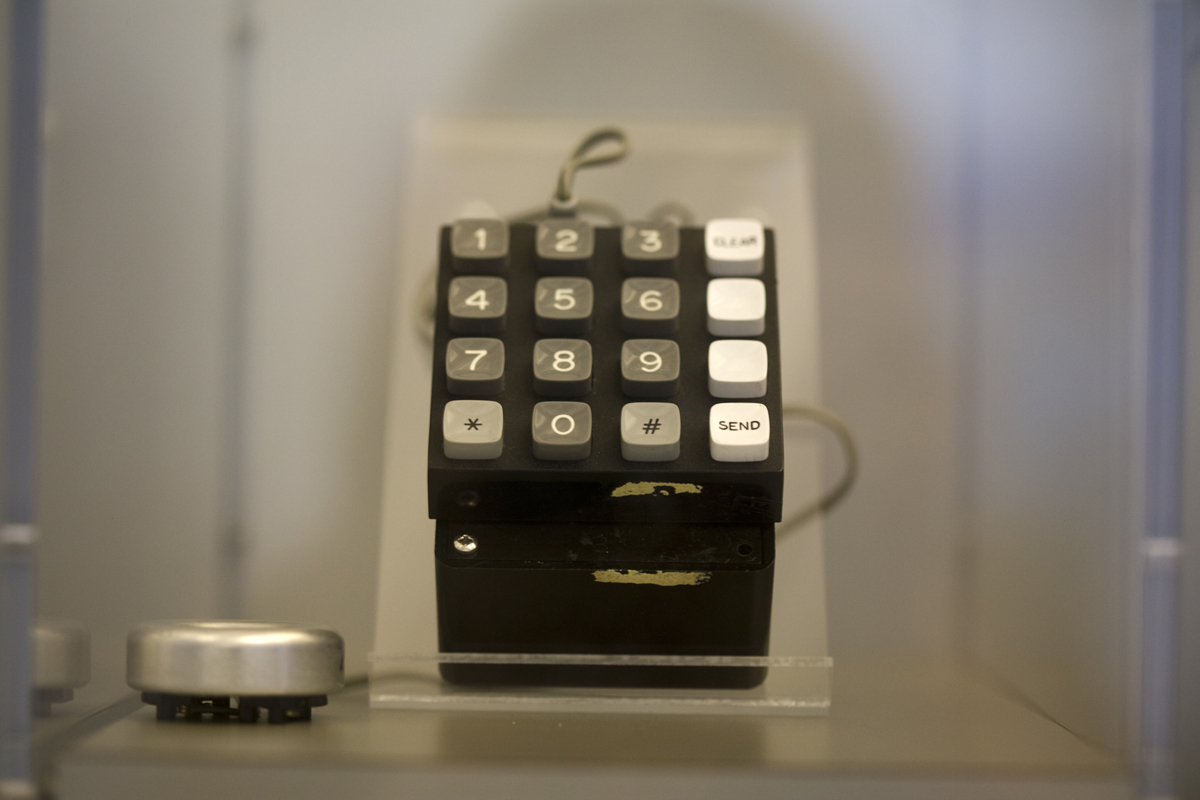 Image Courtesy of The Computer History Museum
Steve Wozniak and Steve Jobs were a part of this scene,1 as I recently discussed with Kristen Gallerneaux, Curator of Communications and Information Technology at The Henry Ford Museum.
The Museum recently added a Blue Box built by Woz to their impressive collection,2 so I thought it’d be a fun chance to look at part of the pre-Apple relationship between these two men, and what this little device could do.
Stephen: I think there’s a perception that Wozniak and Jobs invented the Blue Box, but that’s not true, is it? Kristen: The first blue box wasn’t made by Wozniak, but by Robert Barclay, in 1960. But if you’ll humor me for a minute, the central concept behind the blue box-finding ways to circumvent telephone operators. It really comes down to the broad idea of automation in the telephone network, which pre-dates the blue box by at least 80 years.
In Phil Lapsey’s book, Exploding the Phone, he mentions a device made by an undertaker named Almon Stowger in the 1880s. Stowger noticed a drop in his business, which he traced back to the fact that whenever someone asked to be connected to the local mortician, the operator was forwarding all of the calls to one place: her husband’s competing funeral parlor. This inspired Stowger to invent a mechanical telephone switch that allowed people to dial their own calls, without operator assistance.
It wasn’t perfect, but with a few refinements, Stowger’s idea was eventually licensed by Bell and the “step by step” switch helped to mechanize the human-machine interface. So, you could say that if Bell hadn’t automated their system, the Blue Box wouldn’t have been invented.
The person who is credited with making the first true blue box was Ralph Barclay. There are some interesting parallels between his story and Wozniak’s. Barclay happened upon an issue of Bell Systems Technical Journal in 1960.
He was a young engineering student, and like Wozniak, was living in a dorm room around people who wanted to stay in touch with family and friends, without having to pay for calls. Barclay read the Bell journal and through wunderkind pattern recognition, realized that Bell had exposed a core ingredient that would allow him to exploit their system.
Barclay made the connection to the importance of the 2600hz tone. He built his first single-frequency tone generator box in 1960, and then made a more functional multi-frequency version. The first MF box was in a blue case, and from that point on, all blue boxes were called blue boxes — even if most were black or silver.
And with Wozniak, of course, the story goes that he discovered the blue box via reading Ron Rosenbaum’s article, Secrets of the Little Blue Box, published in Esquire magazine. Woz calls up Jobs, and they sneak into Stanford’s library that same day to find the technical information they need.
 Image Courtesy of The Henry Ford
They go buy the parts, and build a rudimentary circuit that night. From his dorm, while making improvements to his device, Wozniak rallies his friends and gets them excited about phone phreaking. This turned out to be useful when he and Jobs started selling the boxes, since people were already primed and eager to buy them.
Stephen: Was there anything unique about Woz’s particular implementation of the Blue Box? Something that set it apart? Kristen: If you do a search for Wozniak-built blue boxes, you’ll notice that some of the examples have an articulated keypad, which is different from The Henry Ford’s. The first blue boxes Wozniak built in 1972 had solid keyboard-style keys.
The responsive keys made the blue box pleasing from a tactile standpoint, but also made the devices more expensive to produce. The blue box the museum recently acquired also from 1972, but is the second “soft keypad” version:
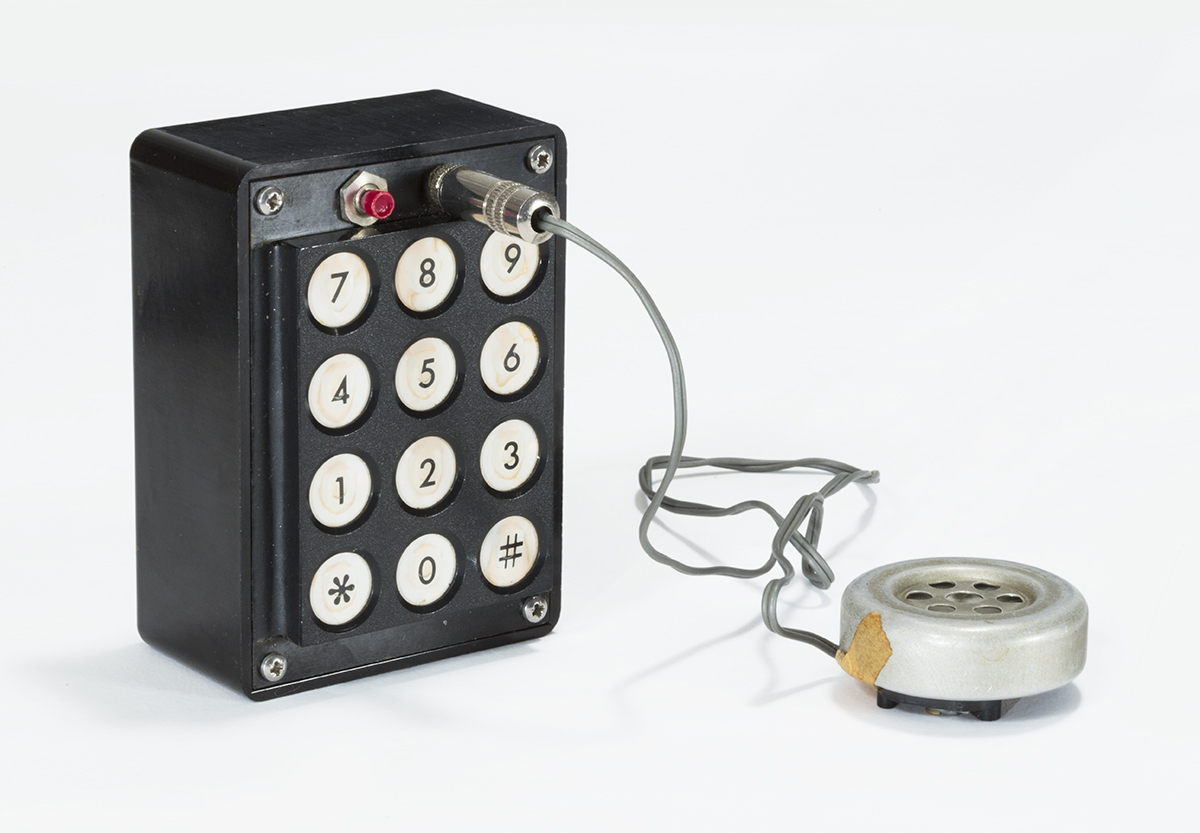 Blue Box Acquired by The Henry Ford
Another special thing about the Wozniak-designed blue box is that it was the first implementation to use a digital circuit, making it more stable and reliable than other analog examples.
The original owner of our blue box was Bill Claxton. He was dorm neighbors and friends with Wozniak at Berkeley, and Claxton helped to build and distribute the blue boxes. Claxton’s brother, David, was attending university 300 miles away, so Bill gave this particular device to his brother so that they could stay in touch. Bill Claxton was apparently present on the day that Wozniak met the infamous phone phreaker, Captain Crunch. So our box has a great backstory.
Stephen: Legend has it that Steve Jobs saw what Woz was doing and decided they could make a business out of it. How did that conversation go?
Well, I think Jobs’s business and marketing mind really took flight with the Apple 1 in 1976, but the blue box was the foundation for that in 1972. It was the origin point for Woz and Jobs working together on a commercial product, and to learn about one another’s working style. Jobs saw potential to monetize the blue box-I believe they cost around $40 to produce, and were marked up to around $150. To meet sales demands, a few helpers were brought in to help out with assembly for large orders.
At first, the boxes were sold to insiders, but then they became a little braver-or reckless-and started making cold-calls in the dorms, knocking on people’s doors. Later, they expanded their sales geography to the Los Angeles area, thanks to the help of fellow phreaker, “Johnny Bagel.”
Stephen: How many did they make? Were they successful in selling any?
My understanding is that the blue boxes sold like hotcakes at first, and then sales started to dwindle. Perhaps it was market saturation in their small corner of the Berkeley dorms, or maybe it was because Wozniak and Jobs shifted focus to other projects.
The amount of boxes they made depends on who you ask. Jobs once said that they made over 100 units, but Wozniak puts the number between 30-40. I’m going to side with Wozniak on this one, since he was the one that was actually assembling them.
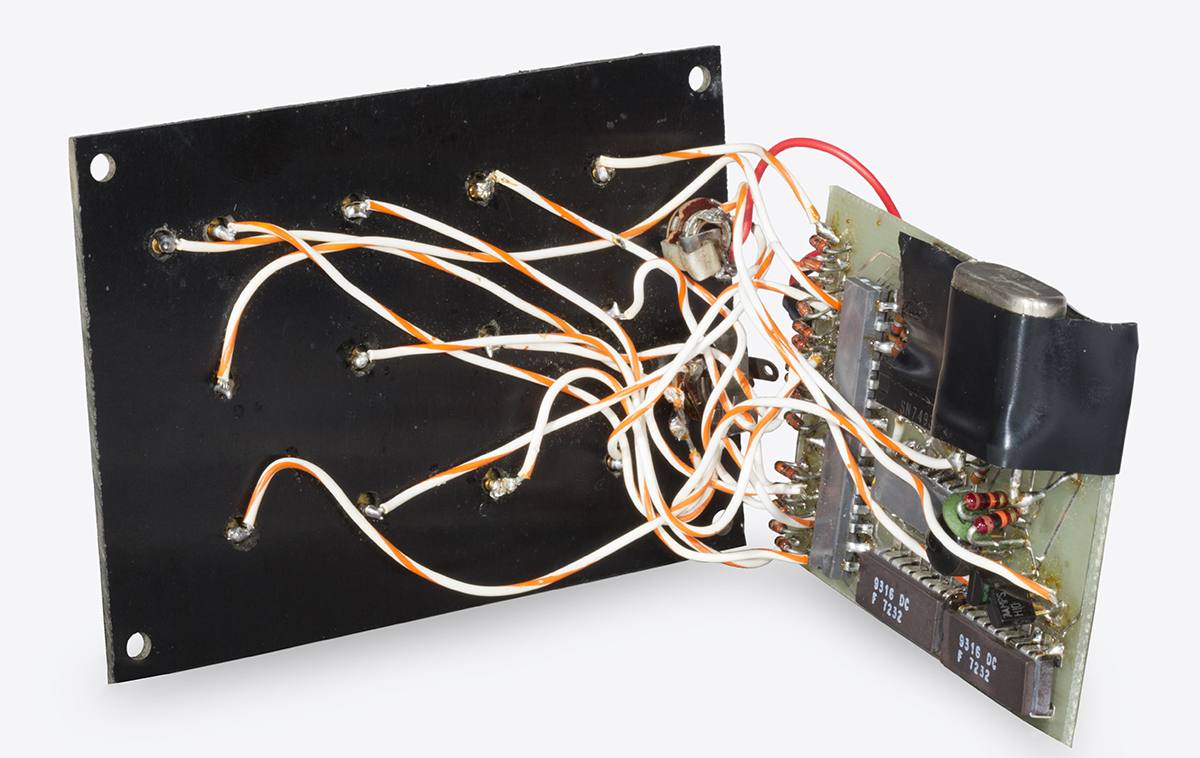 Blue Box Acquired by The Henry Ford Stephen: What would have been the ramifications had they been caught? I assume all of this is crazy illegal.
Definitely crazy illegal. By the early 1970s, the FBI and police had started seizing blue boxes, and sending the devices into evidence lockup. They made arrests and filed charges for electronic toll and wire fraud. Some people got off with probation or having their cases dismissed — others were not so lucky and served jail time.
The telephone company was trying to send the message that the phone lines were not a playground for phreaker shenanigans, and consequently some offenders became the public face of worst-case scenarios of: “this what happens when you get caught.”
Somehow, despite the fact that many of their blue boxes had been seized by law enforcement, and there were definitely indicators that they were all made by the same outfit, the boxes were never linked back to Woz and Jobs.
Stephen: Eventually, the phone companies built technology in their networks to make these boxes ineffective, but that was years after Woz and Jobs had given up on them. What led them to leave the phreaking lifestyle behind?
A favorite story of mine about Wozniak and Jobs was when they were approached by the police while using a blue box after their car broke down. In a fit of inspiration, when the police asked the pair what the device was, they claimed it was an electronic music synthesizer.
I really love this story because not only is The Henry Ford the home of this early Woz-made blue box, we also have the Moog synthesizer prototype in our archives.
To put a personal slant on things, I’ve brought analog synthesizer equipment of my own through customs in airports, and there’s always the nerve-wracking moment: “Am I going to be able to convince security that this is a musical instrument, and not something sinister?” So, it’s funny to me that the illegal blue box — which also happens to operate on sonic frequencies — like a synthesizer-was being pitched to the police as something friendly. It was dumb luck and quick wit that allowed them to scrape by with this story.
This is all a roundabout way of saying that my guess is the reason the blue box venture ended was because the focus shifted. I believe Wozniak began working at HP soon after, and Jobs started college.
When they regrouped, the phreaking lifestyle had to be left behind in order for them to legitimize their business as they founded Apple.
Things became very busy, very fast, once they took their first bulk order for the Apple 1, and they had to focus on the bigger picture.
I’m always happy though to read interviews about the early days at Apple, to know that the (now legal) pranks continued, and that Wozniak still prides himself on being a prankster. I guess the blue boxes came with a lifetime repair guarantee — I have to wonder if that still holds true today?
My thanks to Kristen for her time and for sharing a bit about this little corner of pre-Apple history. — Stephen
-
Don’t miss this video of Steve Jobs talking about blue boxes. ↩︎
-
I love that my iMacs live under the same roof as a Blue Box built by Woz. ↩︎
10 Years of iPhone SDK ⇢
Craig Hockenberry has pointed out that today marks a decade since Apple first published the iPhone SDK for download by developers:
I don’t think it’s an understatement to say that this release changed a lot of people’s lives. I know it changed mine and had a fundamental impact on this company’s business. So let’s take a moment and look back on what happened a decade ago.
This blog post was a real joy to explore.
Kbase Article of the Week: AAUI: Pinout Equivalents to AUI ⇢
Ungeniused #47: The New England Vampire Panic ⇢
This week’s Ungeniused is creepy:
Today, we all know vampires are fictional, but in the late 1800s, many believed they inflicted disease on their still-alive family members.
My thanks to our sponsor:
- Squarespace: Make your next move. Enter offer code UNGENIUSED at checkout to get 10% off your first purchase.
Video: The AlphaSmart Word Processor ⇢
Over on the YouTube channel, I’ve taken a look at the AlphaSmart, a keyboard-based computer first developed in the 1990s by a couple of former Apple engineers:
The machine was sold mostly to schools for writing, educational content and typing lessons, but in recent years, they’ve been adopted by writers who want a minimal writing environment. I find the device super interesting, and I hope you will, too.
A HomePod Intervention
Since wrapping up HomePod vs. iPod Hi-Fi video, my HomePod has been in our kitchen, sitting where our Amazon Echo has been for the last year and a half. I unplugged the Echo and put it away, leading to many questions about where Alexa went, voiced by our three year old son.
That was about three weeks ago, and in those three weeks, the entire family has gotten acquainted with HomePod and this iteration of Siri.
We used our Echo for music listening, checking the weather and news, setting multiple timers while cooking and controlling the handful of smart lights in the house.
Obviously the HomePod blows away the Echo in terms of audio quality. I really like how the HomePod sounds, and as we already pay for Apple Music, we were good to go there.
The Echo’s “Flash Briefing” ability can be adjusted. We have ours read NPR news, play the most recent episode of Subnet then share the weather. This all happens automatically if we ask Alexa to play the news. Siri can do these things as well, but each item has to be requested independently. Annoyingly, Siri constantly reminds us that its source can be changed from NPR to Fox News, CNN or The Washington Post. This reminder should be played one time then never again, with the setting visible in the Home app.1
As a result of this, we’re asking Siri for the news far less than we were Alexa.
Siri’s lack of multiple timer support has been well documented. It is bonkers that Apple products — the iPhone included — can only handle one timer at a time.
On the smart home front, all of our tech can be controlled via HomeKit or Alexa, sans our Nest thermostat. There’s been no real change in our usage when it comes to turning lights on and off with our voices.
Hardware wise, the HomePod may sound amazing but its physical controls aren’t as good as the Echo’s. Our first-gen Echo has a big ring that spins around to control the volume that works perfectly; the HomePod’s touch buttons can be finicky and slow to respond.
Even more annoying is the HomePod’s resumption of music playback if you touch the top of the unit. Our smart speakers have always been under a counter in the kitchen, and we brush the top of them a lot more than we realized after the HomePod would start blaring music after any accidental touch. Apple should have an option to disable it.
All in all, I thought the move to the HomePod was going well right until my family staged an intervention. Their annoyance with Siri misunderstanding or misinterpreting has grown over the last few weeks, and the clumsiness with which Siri handles — or doesn’t handle — some requests has become bothersome.
I’ve overheard several interactions with the HomePod that entail a family member asking for a song or album that ends in getting upset with the device when it starts playing something else. The Echo — coupled with Amazon Music — had a much higher hit rate when it came to accurately playing what was desired.
In short, the increase in sound quality doesn’t make up for the frustration of using Siri. The HomePod is going to live in my studio; the Echo is back in its rightful place in the kitchen.
-
The Amazon Echo App may have its problems, but cramming the HomePod’s settings into Home.app has proved clumsy at best. I don’t want yet another first-party Apple app on my iPhone, but I think a lot of the HomePod’s software controls need to be revisited. ↩︎
Cheaper MacBook Air on Its Way? ⇢
KGI Securities analyst Ming-Chi Kuo via MacRumors:
We expect Apple (US) to roll out the new MacBook Air with a lower price tag in 2Q18. We forecast total shipments of MacBook models will grow 10-15% YoY in 2018 (vs. 0-5% YoY decline for the NB industry), up from 15.5-16mn units in 2017. While Quanta, Radiant, Catcher and SZS are likely to benefit from strong shipments momentum, SZS also stands to benefit from increased market share and a higher ASP.
While the internals of the MacBook Air haven’t been substantially improved since 2015, I think it is safe to bet that the 13-inch, non-Retina notebook is still selling quite well. I would love to see Apple shave some off of its $999 price point and move beyond the Broadwell CPUs the machine uses, but my guess we’ll get one or the other, if anything.
The Origins of QuickTime ⇢
The Computer History Museum has an incredible YouTube channel, and just yesterday, they published a conversation with members of the original QuickTime team about the technology and how it came to be: