Details Matter on Campus 2 Project

Reuters’ Julia Love:

[Steve Jobs’] last work – Apple Inc’s sprawling new headquarters in Cupertino, Calif. – will be a fitting tribute: a futuristic campus built with astonishing attention to detail. From the arrangement of electrical wiring to the finish of a hidden pipe, no aspect of the 2.8 million-square-foot main building has been too small to attract scrutiny.

But constructing a building as flawless as a hand-held device is no easy feat, according to interviews with nearly two dozen current and former workers on the project, most of whom would not be named because they signed non-disclosure agreements.

The details matter to Apple … maybe a little too much, sometimes.

Vizio Caught Mining Consumers for Data

Lesley Fair, writing on the Federal Trade Commission’s website:

Starting in 2014, Vizio made TVs that automatically tracked what consumers were watching and transmitted that data back to its servers. Vizio even retrofitted older models by installing its tracking software remotely. All of this, the FTC and AG allege, was done without clearly telling consumers or getting their consent.

What did Vizio know about what was going on in the privacy of consumers’ homes? On a second-by-second basis, Vizio collected a selection of pixels on the screen that it matched to a database of TV, movie, and commercial content. What’s more, Vizio identified viewing data from cable or broadband service providers, set-top boxes, streaming devices, DVD players, and over-the-air broadcasts. Add it all up and Vizio captured as many as 100 billion data points each day from millions of TVs.

Vizio then turned that mountain of data into cash by selling consumers’ viewing histories to advertisers and others.

The article goes on:

And let’s be clear: We’re not talking about summary information about national viewing trends. According to the complaint, Vizio got personal. The company provided consumers’ IP addresses to data aggregators, who then matched the address with an individual consumer or household. Vizio’s contracts with third parties prohibited the re-identification of consumers and households by name, but allowed a host of other personal details – for example, sex, age, income, marital status, household size, education, and home ownership. And Vizio permitted these companies to track and target its consumers across devices.

Vizio ended up settling the case for a total of $3.7 million in fines. Additionally:

Vizio has agreed to stop unauthorized tracking, to prominently disclose its TV viewing collection practices, and to get consumers’ express consent before collecting and sharing viewing information. In addition, the company must delete most of the data it collected and put a privacy program in place that evaluates Vizio’s practices and its partners.

This is seriously troubling. I don’t own a Vizio,1 but if I did, I would be super pissed.

It does make me wonder what else in my life is spying on me without my knowledge.


  1. We own an LG with zero smart-TV functions. It’s glorious in its simplicity. 

RSS Sponsor: HoudahSpot — Advanced File Search for Mac

HoudahSpot is a powerful file search application for your Mac. Use HoudahSpot to find documents, mail messages, photos, image files and more.

HoudahSpot is easy to use. Just fill in the blanks to find files by name, text, kind, author, recipient, date, image dimensions, etc.

Start with a simple search. Refine by adding and combining criteria. Tell HoudahSpot to look at certain folders and ignore others. Sort results by any of the hundreds of columns available. Preview files and text matches. Work with the files you have found: Organize them. Share them.

HoudahSpot is the fastest way to get to the files you need. For example: It takes just a few clicks to find image files with the name “logo” that are 512 pixels wide and were opened in the last 30 days.

Get HoudahSpot today. Try it for free. Buy this week and get 20% off using coupon code 512PIXELS.

‘Dave, Do You Remember the Year 2000?’

Ken Segall:

I used to devote hours to feverishly writing up my annual Super Bowl ad review. And then, one day, the thrill was gone.

Between the lack of surprise (so many spots are released early now) and the general mediocrity, it became more chore than fun.

That said, I refuse to lose my Big Game spirit. So — how about a little story from Apple’s Super Bowl past?

What follows is the tale of HAL: Apple’s 1999 Super Bowl commercial starring the malevolent computer from Stanley Kubrick’s 2001: A Space Odyssey.

Hybrid Questions

Jason Snell, on the whole ARM+Intel thing:

If you were to list Mac functions that might be offloaded to an ARM processor, Power Nap would be a good place to start, especially if macOS were tuned to be more aggressive about putting the system to sleep.

What would an ARM-Intel hybrid Mac look like? Would whole segments of the operating system run on the ARM processor, allowing the more power-hungry Intel chip to be put to sleep except when it was absolutely needed? There are a bunch of big questions here, most notably the identity of the code that would run on the ARM processor and where it came from. Would Mac apps include extensions or plug-ins that would be designated to run on ARM? Would Mac apps provide two separate sets of program binaries so that the system could switch them between processor architectures at will?

PowerPC to Intel was clean and fast; this sounds anything but.

Google, Apple, Facebook and Microsoft Drafting Letter on Trump’s Refugee Ban

Kara Swisher has posted a draft of the letter:

Since the country’s birth, America has been the land of opportunity — welcoming newcomers and giving them the chance to build families, careers and businesses in the United States. We are a nation made stronger by immigrants. As entrepreneurs and business leaders, our ability to grow our companies and create jobs depends on the contributions of immigrants from all backgrounds.

Good.

Update: Hundreds of Comcast employees are currently protesting the ban.

Report Claims Intel/ARM Hybrid Macs Coming

Mark Gurman:

Apple Inc. is designing a new chip for future Mac laptops that would take on more of the functionality currently handled by Intel Corp. processors, according to people familiar with the matter.

The chip, which went into development last year, is similar to one already used in the latest MacBook Pro to power the keyboard’s Touch Bar feature, the people said. The updated part, internally codenamed T310, would handle some of the computer’s low-power mode functionality, they said. The people asked not to be identified talking about private product development. It’s built using ARM Holdings Plc. technology and will work alongside an Intel processor.

This is a very interesting idea, and is really different than the rip-the-bandage-off approach Apple took when moving from PowerPC to Intel a decade ago.

The Story Behind the Ill-Fated ‘Apple Cafes’

Apple had a lot of whacky ideas in the 1990s, but the weirdest one may be the Apple Cafe concept.
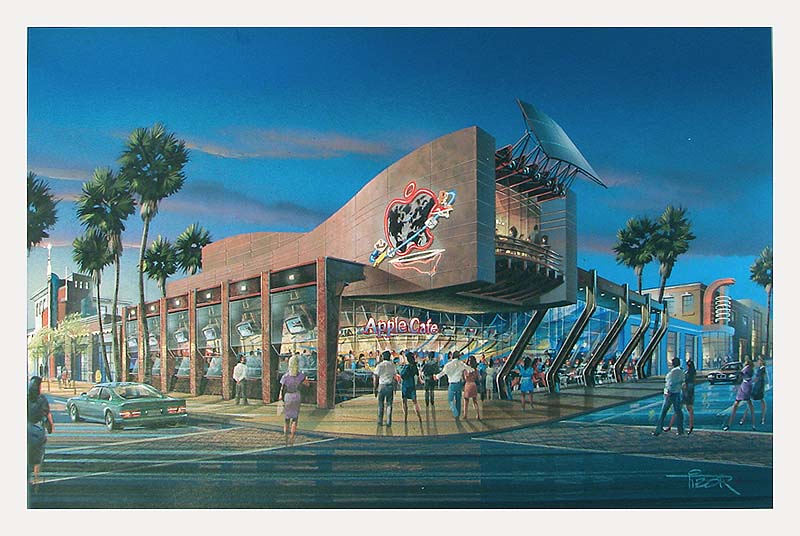
Apple Cafe - Exterior

Apple Cafes were announced in late 1996, and were set to open in Los Angeles, New York, London, Tokyo and beyond the next year.

Here’s Jeff Pelline, writing for CNET:

“The time is right,” said Satjiv Chahil, senior vice president of marketing for Apple, in a telephone interview. “Cybercafes are in. The technology finally is reaching out to ‘the rest of us.’ This will be a place to showcase our products in the real world.”

The cafes could also help solve the “shelf-space problem” that Apple has in raising the profile of its products against Microsoft and others. Details such as how much people will pay for Net access still have to be worked out, he said.

The L.A. location was going to be 15,000 square feet of dining, browsing the web and videoconferencing. Here’s Pelline again:

The deal is part of Apple’s effort to license its brand name more widely and, at the same time, promote its computer products. In the company’s eyes, cybercafes offer the perfect venue. They are thriving through the United States and Europe as many users find that they can surf the Net and socialize at the same time. Some cybercafes charge a membership fee, such as $10 per year, and offer Net access for 18 cents per minute.
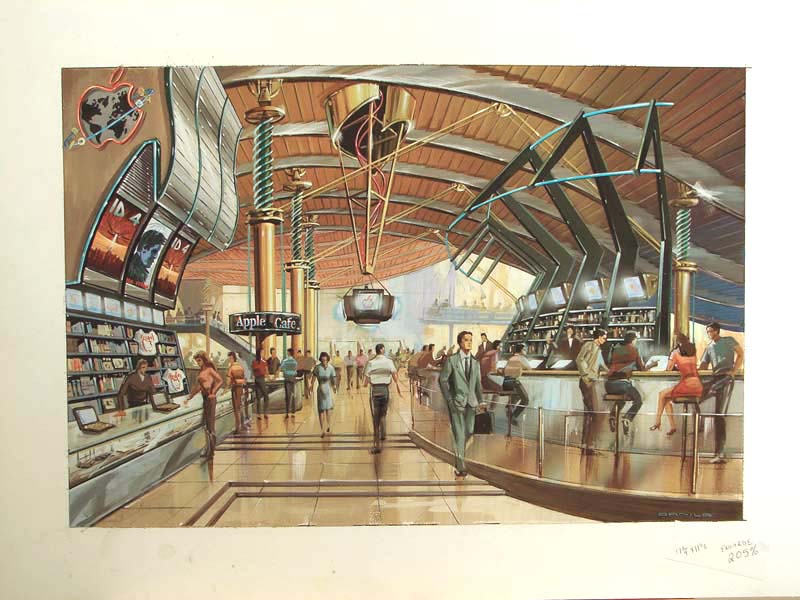
Apple Cafe - Interior

With 20 years of hindsight, this idea is pretty laughable. Internet cafes enjoyed a very brief moment of success before fading away. Apple would solve its “shelf-space problem” with the Apple Store, launched by Steve Jobs and Ron Johnson in 2001.1

Thankfully the plan was scrapped by December 1997.

I think we all know who killed it.

Apple Cafe logo

Update: A few weeks after publishing this, Fast Company interviewed Tony Christopher about the Apple Cafe concept. It’s a fun read.

images via GUIFX and copyright Landmark Entertainment Group


  1. Of course, since then, the Apple Stores have evolved heavily, with some flagship locations offering space to meet and hang out.