
If you’re looking to use AirPlay with a Sonos speaker and don’t mind doing some fiddly stuff on a Mac, I’m having good luck with Airsonos.
512 Pixels
Kbase Article of the Week: iPod nano (6th generation): Multi-Touch gestures⇢
In light of my recent dive into the iPod nano, I thought this article would be a fun one to link to this week:
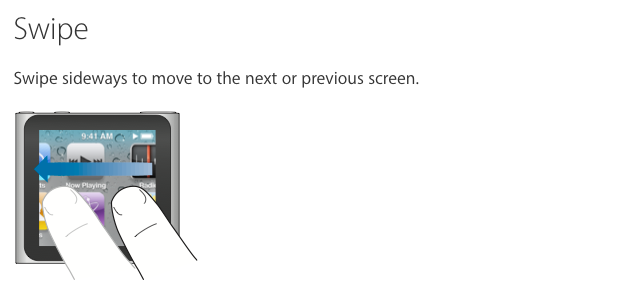
The Multi-Touch screen on iPod nano (6th generation) responds to your finger gestures. Use the following gestures to use the features on iPod nano.
Come for the knowledge; stay for the creepy hand illustrations:
Apple releases Music Memos and GargeBand 2.1 for iOS⇢
Jim Dalrymple has the details. Music Memos looks really neat.
Caltech Researchers Find Evidence of a Real Ninth Planet⇢
Kimm Fesenmaier, writing for the California Institute of Technology:
Caltech researchers have found evidence of a giant planet tracing a bizarre, highly elongated orbit in the outer solar system. The object, which the researchers have nicknamed Planet Nine, has a mass about 10 times that of Earth and orbits about 20 times farther from the sun on average than does Neptune (which orbits the sun at an average distance of 2.8 billion miles). In fact, it would take this new planet between 10,000 and 20,000 years to make just one full orbit around the sun.
The researchers, Konstantin Batygin and Mike Brown, discovered the planet’s existence through mathematical modeling and computer simulations but have not yet observed the object directly.
This is obviously very exciting news. Batygin and Brown worked for over a year, trying to understand why certain objects in the far outer solar system are positioned where they are. The answer? A giant, yet-to-be-seen planet. Amazing stuff.
Connected #74: Orange Light, Blue Light⇢
This week in the warm glow of Night Shift, we talk about Federico and I’s recent forays into video editing on iOS and the Mac.
My thanks to our sponsors this week:
- PDFpen, from Smile: The Swiss Army Knife for working with PDFs.
- Squarespace: Build it beautiful. Use code ‘WORLD’ for 10% off.
On Trump and Apple⇢
Donald Trump, the billionaire and leading Republican candidate for President of the United States, says he wants Apple, the biggest technology company in the world by market valuation, to make its computers and other products in America. It made for a good sound bite, but it betrayed a deep ignorance of how the tech economy actually works and the role of American workers in it.
RSS Sponsorships for sale now
The best way to advertise on 512 Pixels is via RSS sponsorship. Exclusive for one week, sponsored posts come with a whole pile of benefits. I have a bunch of dates open; get in touch if you’re interested!
Hacking the iPod⇢
Nicholas Deleon at Motherboard:
“I’ve [refurbished] four iPod Classics and six iPod Minis,” one iPod reseller, Tired8281, told me recently via Reddit private message. “They all sold, and I made a nice profit on all but one.” These refurbished iPods, he explained, are all outfitted with brand new batteries and, depending on the model, either a CompactFlash card or an SD card. Both solutions replace the mechanical hard drives that were originally present on the portable media player, increasing both battery life and the device’s responsiveness since there’s no moving parts to slow things down.
For others like Anthony, a member of a large, invite-only BitTorrent music site who owns a refurbished 240GB model, the appeal of these refurbished, souped-up iPods is clear to diehard music fans who are unwilling to outsource their listening habits to the cloud.
The spinning 160 GB hard drive in my iPod classic is still just fine, but I like that I’ll have options when it does fail.
Liftoff #12: The Size of a Refrigerator⇢
On this fortnight’s episode of Liftoff, Jason Snell and I are joined by Geof Morris, a Payload Rack Officer for the International Space Station.
My thanks to our sponsors this week:
- Luminos: A fantastic astronomy app, 10 years in the making! Now with an Apple Watch app for skygazing!
- Squarespace: Build it beautiful. Use code ‘LIFTOFF’ for 10% off.
Mac Power Users Episode 300⇢
Mac Power Users is an institution, and it was an honor to join Myke in interviewing David and Katie for their 300th episode. It’s up now, and is a fun look at the show and what goes in to it each and every week.
The history of the iPod nano
Since its introduction there have been seven generations of iPod nano. When Steve Jobs showed off the first model back in 2005, the world was impressed.

The first-generation model was much smaller than the iPod mini it replaced, thanks to its flash storage. Available in 1, 2 and 4GB models, and in both black and white cases, it made music portable in an all-new way. It weighed just 1.5 ounces!
The color screen was just 1.5 inches across, but was bright and could be used to show off album art as well as photos synced over from iTunes.
Thanks to its small size, the nano became an instant hit. It was great for runners and starting at just $149, it became the gift to give during the holiday season.
Apple didn’t rest on its laurels. A year later, it replaced the iPod nano with a second-generation product.

This iPod nano was technically more or less identical to its predecessor, but came in a colorful new anodized aluminum case, like the iPod mini. The black model, however, was more expensive, only available with 8 GB of storage. Personally, I was always partial to the blue.
2007’s third-generation nano was a big departure from the previous candybar form factor. The so called “fat Nano” came in pastel colors, and could play video on its 2-inch, 320x240 display.

With the wider display, Apple made its first change to the iPod nano’s UI, giving it a 2-up look, with album artwork, photos or graphics on the right side of the menu screens. This UI would also be found on the iPod classic.

For 2008 and 2009, Apple returned the iPod nano to its candybar roots. Both years were full of numerous color options. The taller screens were touted to be even better for watching video on the go; simply tip the iPod over and you were off to the races. 2009’s 5th-generation model had a polished, candy-like finish, making the colors more vibrant and darker. Of my stack of blue iPods, this is as close to purple as it gets.

2009 also brought the addition of a video camera to the iPod nano. Apple wanted to compete against the Flip cam, which in hindsight seems … silly. As you can see, the 640x480 video isn’t much to write home about these days. But for a device that cost as little $149, you can’t blame Apple for trying.
In 2010, things got weird. The iPod nano lost its clickwheel and the ability to play video but gained a clip in the name of being more wearable.

Without the clickwheel, this nano adopted a touchscreen interface that was designed to look like iOS, but wasn’t actually iOS. The only physical controls were for volume, leading to complaints that skipping tracks or pausing music was harder to do without looking.
Some people even wore this Nano in a watchband. I’m still a little ashamed that I tried it.
That brings us to today … kind of. The current, 7th generation iPod nano still sports a touch screen, but has returned to the candybar form factor. It has physical controls down one side and Bluetooth, making it easy to stream music to a speaker or even to your car. Gone is the 30-pin Dock connector, replaced with the more modern Lightning port.

But don’t be fooled, this iPod nano has been basically unchanged since 2012 with the exception of some color changes to the case.
There’s no doubt that the once-mighty iPod line is now just a blip on Apple’s radar, but the iPod nano is still here. While the case for dedicated music players is harder and harder to make, I know I’ll miss them when they’re inevitably gone.
Ten years of Intel Macs
I would have missed this anniversary if it hadn’t been for this week’s episode of Simple Beep: at Macworld 2006, Steve Jobs unveiled the Intel-based iMac and the very first MacBook Pro.
I’ve written a little bit about the first Intel iMac in the past, while discussing the iMac G5 (iSight). That machine was very short lived, and the original Intel iMac ate its lunch in terms of speed and power.
The MacBook Pro was a little more interesting. Apple took the opportunity to slightly redesign the PowerBook G4’s case, making it thinner and adding things like MagSafe and an IR port for use with the Apple remote. With Apple never being able to squeeze the hot and power-hungry G5 into a notebook, the new machine was a really nice upgrade for customers who wanted both power and portability.
Having come to the Mac toward the end of the OS 9 to OS X transition, this was the fist major change I lived through as a Mac user. I remember all the chatter than Intel Macs wouldn’t feel like Macs running on the trusted PowerPC architecture. Onlookers mocked the idea of Apple slapping “Intel Inside” stickers on their computers. People scrambled to run Windows natively on the hardware before Apple announced Boot Camp.
Now of course, there’s talk of Apple putting ARM chipsets into Macs. I’m not sure how that will pan out, but the last decade of Macs have been pretty great. While a lot of Core2Duo machines are stuck on OS X Lion, Apple is supporting older machines longer than ever, thanks to the power Intel provides these machines. If you buy an i5 or an i7 machine with a good bit of RAM, it’s amazing how long it will be viable computer. That’s not something that could be said so confidently during the PowerPC era.