
The latest episode of the Vector podcast is a great one. On it, Rene Ritchie and Matt Drance have the best conversation about Apple’s marketing I’ve heard in a long time.
512 Pixels
Browsing the web with a Mac Plus⇢
Good stuff here, on both the hardware and software fronts.
‘The whopping $3.99 purchase price’ - Updated⇢
Jeff Blagdon at The Verge, on Instapaper being Apple’s App of the Week:
If you’ve never looked at Instapaper before or been hesitant to drop the whopping $3.99 purchase price, now is your chance. The free download campaign runs until December 19th.
I tweeted a link to this story earlier today, and several people replied hoping that The Verge was simply “being sarcastic” when it came to describing to Instapaper’s price point of $3.99.
I don’t think that’s the case however, as this sentiment isn’t a new one at The Verge. Back in October, Ellis Hamburger had a headline that got some people fired up: Tweetbot 3 for iPhone gets a fresh new design, but at a price.
In that article, he wrote:
Worth noting — Tweetbot for iPhone is on sale for $2.99, but will eventually make its way up to $4.99.
The reality is that $3.99 (or $4.99, in the case of Tweetbot 3) isn’t a lot of money for an app as good as Instapaper, but in the App Store, it’s becoming an outlier. Even relative to the App Store’s baseline, $3.99 isn’t “whopping.”
While paid apps may be dying, it’s hard to tell from here if tech journalists are making the problem worse or not. My Twitter replies are full of people mocking The Verge’s choice of words, but there’s no denying that free apps do better than their paid competitors out on the open App Store.
Do The Verge’s writers really think that $4 for an app is crazy, or are they simply reflecting the feelings of the wide range of iOS customers that may come across Instapaper and move to something like Pocket 1 based on price alone?
I may not want to know the answer to that question.
Update: I reached out to Jeff Blagdon on Twitter. “I was being sarcastic, guess it didn’t come across in the post. Instapaper’s easily worth twice what they charge for it,” he said.
I’ll take him at his word, but it’s a poor choice of words, and probably even worse editing. Sarcasm isn’t a luxury journalists are afforded. I still think the comment reflects the overall state of thought around paid apps, however.
Update 2: As of a little while ago, The Verge added a parenthetical to he article making Blagdon’s sarcasm more clear. While this is an improvement, such sarcasm doesn’t have a place in actual reporting. Sarcasm is hard to read online, and based on the comments under the article, I’m not the only one who read “whopping” as a serious remark.
-
To save you from emailing me let me say this: I don’t care how much you love Pocket, for reasons beyond the free price tag. I really dislike the app’s reading environment, which is far inferior to Instapaper’s. As that’s the whole point of an app in this category, I’m not interested in changing. ↩︎
Tim Cook awarded lifetime achievement award from Auburn University⇢
In his acceptance speech, Cook builds a case for human equality. Since seeing a burning cross in his Alabama hometown as a child, Cook says he has been aware of the struggle for equality for all. From raising the bar for workers in overseas factories to backing the Employee Non-Discrimination Act, Cook is putting his — and Apple’s — money where his mouth is. I think it’s great.
The Meaning of the Term "Sherlocking"
In the Brushed Metal Diaries, we take a look at one of Apple’s most unique — and most hated — user interface paradigms.
In our modern, always-on world, finding just about anything online is just a Google search away, that hasn’t always been the case. Today we’re looking at an old app that brought the Internet to Mac users the world over.
Sherlock 1
In October 1998, Apple shipped Mac OS 8.5. The first PowerPC-only release of the Mac OS came with a much simpler installer, an improved Help system and Sherlock:
The OS 8.5 promo artwork featured Sherlock heavily, showing just how important the software was to the release.

Here’s how Apple introduced the application:
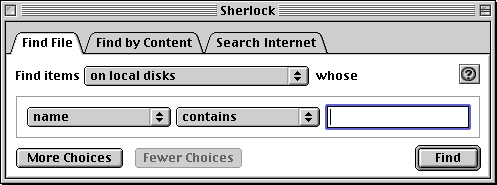
The Find File application, previously located in the Apple menu, has been expanded and renamed Sherlock in Mac OS 8.5. It includes two additional features: Find By Content and Search Internet. In addition, Sherlock allows you to save search settings into a settings file which can be used to quickly perform searches.
Sherlock looked like a regular OS 8 application but packed a punch. Its tabbed interface allowed users to find items on their disk or mounted volumes, find items based on content (think Spotlight’s ability to see inside documents) and find things on the Internet.
That last one was a big deal:
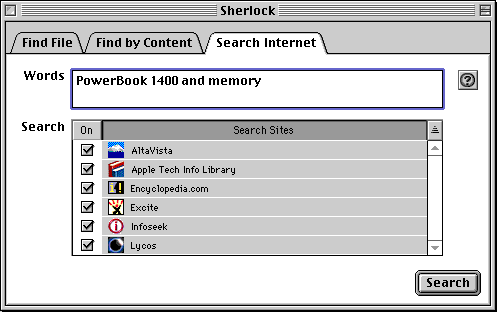
Sherlock wasn’t really searching the actual Internet in some cases. Here’s Apple again:
Internet search site files may be periodically updated for changes in search engines or to take advantage of newer features. When performing an Internet search with a search source file, an automatic check is performed to determine if an updated search source is available.
For 1998, this was forward-thinking — Google was founded just one month before Mac OS 8.5 shipped — and it was clear that Apple was thinking about the Internet. In tandem with the iMac G3, the company was making a bet that the Internet was going to be a critical component to the future of Apple’s products.
Sherlock 2
Shipping with Mac OS 9 a year later in October 1999, Sherlock 2 was a major step forward for the application.
It also came dressed up like our old friend, QuickTime 4: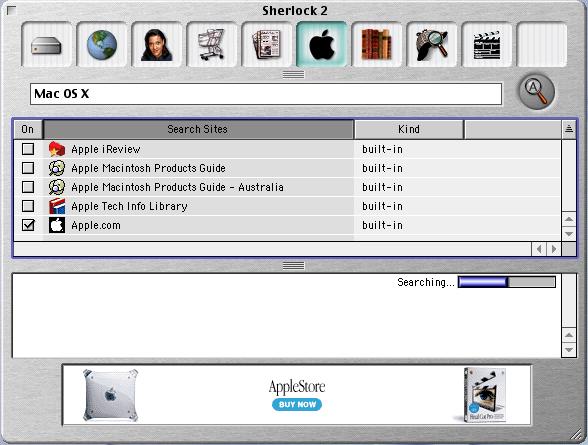
Sherlock 2 was a stand-alone application. Instead of the tabbed interface that was used in OS 8.5 and 8.6, this version of the application had various channels. In addition to file search, the application could find content on the open Internet, contact information, news, Apple news, entertainment and more. In addition to this better organization method, Sherlock 2 auto-updated its search site database.
A Brief — but Necessary Sidebar — on Watson
Many Apple fans will recognize the term “sherlocking.” It comes from the drama sorrowing an application named Watson.
Built by developers at Karelia Software, Watson shipped in November 2001 as an Internet search application for Mac users. Taking advantage of OS X-only technology, Watson won many awards — including an Apple Design Award. 1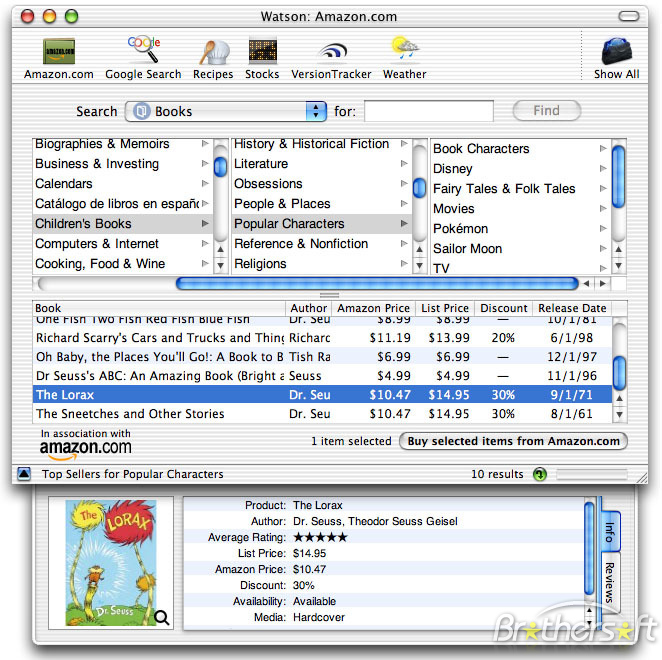
Of course, the devil’s advocates among Apple fans said that Karelia Software designed Watson to infringe on what Apple was doing with Sherlock. The application shipped with an interface that looked like Sherlock, and of course, a name that was probably too similar to Apple’s.
In 2004, Watson was sold to Sun Microsystems. The company announced that it was going to port the application to Java, but not much ever happened with that effort.
In short, Apple copied Watson with later Sherlock versions and killed the third-party app in the process, and a term that remains in the industry remains alive and well today.
Sherlock 3
Watson was a big deal because of Sherlock 3, which shipped with Mac OS X 10.2. The new app dropped local search, becoming an Internet-focused application. In addition to the previous channels, Sherlock 3 could find data from online services, including databases of flight data, language translation and more.
In the process, Sherlock lost its brushed metal and picked up some pinstripes:
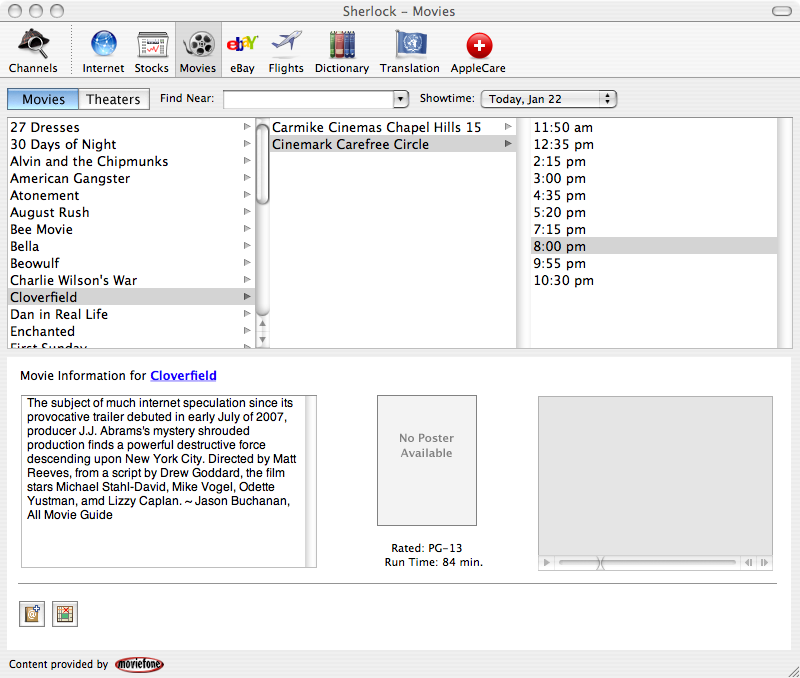
Sherlock 3, however, was short-lived. With 10.4 Tiger, Sherlock played second-fiddle to Spotlight, and the app wasn’t included with 10.5 Leopard.
Conclusions
Sherlock is a really interesting app. As it spanned several generations of Mac OS releases, each major release of the application sported a different user interface. Platinum, Brushed Metal and Pinstripe-flavored Aqua all make an appearance.
Past that, Sherlock embodied so much about the Mac and the Internet in this time frame. In the late 1990s, web portals were how people got stuff done on the Internet. Sherlock brought that idea to the desktop.
While Sherlock itself looks and feels dated in a Google-powered world, it shows that Apple hasn’t changed all that much. Just like the Apple of today, Sherlock-era Apple tried to bring the power of the Internet to rich, native apps.
-
The ADA was given just a few months before Apple shipped Sherlock 3, which is also crazy to me, and doesn’t look good for Cupertino, honestly. ↩︎
Fleksy⇢
It doesn’t seem like this could be allowed under Apple’s rules. While the company has allowed developers to use custom keyboard in their apps, I believe this is the first time that a third-party has provided one to multiple applications. I’m a fan of the innovation, but I just fear for its longevity.
Instagram Direct⇢
Instagram:
Today, we’re excited to bring you Instagram Direct, a new way to send photo and video messages to friends.
Basically, after taking a photo, you select if it should be posted on your timeline or sent “direct” to specific people.
You know when you see a DM fail on Twitter? I can’t wait to see someone’s romantic selfies accidentally posted for the world to see.
The Prompt 26 - What the Bleep is a Pepper Jack?⇢
This week, free of British tyranny, Federico and I discuss iBeacons, Feedly, Federico’s friends and my new business idea.
Sponsored by Squarespace (use code TALLYHO12 for a special 20% off)
Decisions and tensions⇢
Underscore is one of the good guys.
RSS Sponsor: Atlassian’s agile guide⇢
What’s the point of an agile standup meeting?
Gone are the days of 30-minute status meetings where most people are half-asleep or pecking away on their laptops, oblivious to what’s being said. Agile standups are the leaner, more efficient cousin of status meetings where attendees actually stand up. On our feet, we’re more focused, attentive, and concise. It’s science!
Whether you need robust tools for planning and tracking projects, communicating with coworkers, deploying products, or just some general tips on how to run an agile shop (and how to run them Rong?), Atlassian is here to offer you the tools and advice you need to get the most out of your agile practice.
Reform Government Surveillance⇢
A letter addressed to the President and Congress:
We understand that governments have a duty to protect their citizens. But this summer’s revelations highlighted the urgent need to reform government surveillance practices worldwide. The balance in many countries has tipped too far in favor of the state and away from the rights of the individual — rights that are enshrined in our Constitution. This undermines the freedoms we all cherish. It’s time for a change.
For our part, we are focused on keeping users’ data secure — deploying the latest encryption technology to prevent unauthorized surveillance on our networks and by pushing back on government requests to ensure that they are legal and reasonable in scope.
The signees? Aol, Apple, Facebook, Google, LinkedIn, Microsoft, Twitter and Yahoo. It’s sad that it may take companies of this size to affect change, but I’m all for this if it can help.
Steven and Stephen⇢
This week, I joined Steven Aquino on The Accessibility Show to talk about the iPad, Siri and stuttering, OS X’s accessibility features and Touch ID. My thanks to him for having me on the podcast.