
Woot!
512 Pixels
Capture Form — Reworked in TextExpander
Back in September, I shared the “Capture Form” I created to take notes in meetings.
I’ve been using this form consistently, but have come to a point where my system breaks down when moving from the paper to my computer. Things aren’t making it in to OmniFocus, iCal, etc. Additionally, in some meetings, I have to have my laptop or iPad with me, so bringing paper and pen seemed like too much to carry.
So I’ve created a new version of the Capture Form, in TextExpander.
Now, when I type ;mtg TextExpander gives me this:
+ MEETING:
DATE: [DATE]
TIME: [TIME]
ATTENDEES:+ NOTES:
-
+ ACTION ITEMS FOR ME:
-
+ ACTION ITEMS FOR OTHERS:
Now, I can type four characters on any of my devices and start taking notes. The snippet includes the date and time automatically, and moves the cursor to one space to the right of the colon after the “MEETING” line.
Likewise, each of the dashes includes one blank space to the right. This makes entering text just a tiny bit quicker.
I still don’t like using my iPad or MacBook Pro in meetings, but this is helping it become a little easier when I have to do it.
PlainText for iOS has TextExpander support and syncs with Dropbox. Here’s a screenshot of the Capture Form in PlainText on my iPad as proof.

You can download the snippet here as a .txt file.
I Know I’m Cranky, But Munster Always Bothers Me
Dear Business Insider,
Gene Munster is hardly an “Apple Guru.” A monkey could make these predictions, probably with the same — or better — accuracy.
Love,
Stephen
Asus Eee Pad Transformer Prime
It’s cool. When the tablet is in the keyboard dock, it looks like an iPad 1 attached to a MacBook Pro.
Wait, is cool the right word?
I hate the world.
‘A Great Coaster’
I’ll be with you in just a minute, I’m just finishing some online holiday shopping. There’s nice deal on a Kindle Fire. That would make a great coaster for my iPad.
Millions of Smartphones Tracking Users’ Every Move
The Android developer who raised the ire of a mobile-phone monitoring company last week is on the attack again, producing a video of how the Carrier IQ software secretly installed on millions of mobile phones reports most everything a user does on a phone.
Though the software is installed on most modern Android, BlackBerry and Nokia phones, Carrier IQ was virtually unknown until 25-year-old Trevor Eckhart of Connecticut analyzed its workings, revealing that the software secretly chronicles a user’s phone experience — ostensibly so carriers and phone manufacturers can do quality control.
Horrific. There’s no other word to describe this.
‘Cooking With Brett And Myke’
My pals Brett Kelly and Myke Hurley have a new podcast. It really is very, very funny. Go check it out.
The Fire Loses Round One
Vivek Gowri, Anand Lal Shimpi:
I’m curious to see how this plays out. The e-ink Kindle has a unique (perfect?) form factor and delivers a pretty good experience. The Kindle Fire has a more generic form factor (perhaps too small for certain uses?) and delivers a varied experience depending on what you’re doing. I appreciate what Amazon is trying to do here: good tablet experiences shouldn’t cost as much as much higher performing computing devices, and cheap tablets shouldn’t sacrifice everything to get there. The Kindle Fire is Amazon’s first attempt at bridging the gap between those two extremes. It’s the best out today given its price point, but it’s not the best Amazon could have done. I’m waiting for round two.
Ungeniused Episode 10 — Lumber
In our tenth episode, Myke and I discuss lumber — the material that is literally keeping you alive right now, if you’re in a building built with wood.
FTC Versus Facebook
The social networking service Facebook has agreed to settle Federal Trade Commission charges that it deceived consumers by telling them they could keep their information on Facebook private, and then repeatedly allowing it to be shared and made public.
[…]
The proposed settlement bars Facebook from making any further deceptive privacy claims, requires that the company get consumers’ approval before it changes the way it shares their data, and requires that it obtain periodic assessments of its privacy practices by independent, third-party auditors for the next 20 years.
Way to go, FTC. That’s sure to keep Facebook in line.
The Case Against Curation
A web site or a blog with links pointing to other web sites or blogs is not being curated. Such things are lists. There may be commentary, but by the very nature of the web, the person assembling the links does not have primary responsibility to care for the linked things. He or she has no control over them. They are not preserved and maintained by the one who links to them.
It’s the wrong term.
[…]
It’s called “reporting.” All of these sites are doing journalism. It’s news, not a museum.
And my suggestion is this: embrace the term reporting. It’s a noble profession. And it needs more good people practicing the art.
While I don’t normally blockquote such a large amount of text from someone else’s site, I really like what Randy is saying here.
The term “curation” has popped up all over our corner of the web. It’s fairly understandable, actually. People with sites like mine (or whose sites I copied when starting Forkbombr three years ago) hand-pick our linked items and sweat over our long-form articles. Most of us even care about things like line height of body text, validating CSS and good grammar.
As much as I agree with Randy about curation being a wrong term for weblogs, I am not sure reporting is the right word to serve as a replacement.
Reporting is often defined as follows:
give a spoken or written account of something that one has observed, heard, done, or investigated.
I’m not sure linking to an XKCD comic counts as reporting. Linking to news stories or reviews with a line or two of commentary doesn’t make the grade in my book, either.
Maybe a better word is editorializing, which is defined as:
make comments or express opinions rather than just report the news.
NeXT: The Hardware
My mini-series on NeXT Computer: Installment 1: On the Creation of NeXT Installment 2: NeXT: The Hardware Installment 3: NeXT: The Software Installment 4: NeXT: The Apple Purchase Installment 5: Why Did NeXT Fail?
In 1988, NeXT showed off prototype hardware and started shipping “beta” hardware — and software — the next year. The first machines didn’t ship until almost a year later. When approached about the delays, Steve Jobs replied:
Late? This computer is five years ahead of its time!
First-Generation Hardware
The original machine - dubbed the NeXT Cube (two words) — has powered by a 25 MHz Motorola 68030, with up to 64 MB RAM, with a 256 MB magneto-optical drive, an optional 40 Mb SCSI hard drive, 10Base–2 Ethernet, NuBus (Of course, NuBus was also in use by Apple at this time.) and a 1120 by 832 grayscale display powered by Motorola’s 56001 digital signal processor. The 030 Cubes also came with a 25 MHz Motorola 68882 FPU serving as the math co-processor.
The machine had a base price of $6,500, and was targeted to the US higher education market.

The NeXT Cube — image via nextcomputers.org
This case was 12-inch cube built of magnesium and painted black.1
This machine was etched in to technology history when Tim Berners-Lee at CERN used it to build the first web server software, named CERN httpd.
Apple’s fastest machine by the end of 1989 was the Macintosh IIci.[3. The Macintosh IIfx blew the IIci out of the water, just a few months later.] It was specced in a similar fashion, with a 25 MHz Motorola 68030, with enough RAM slots to hold a staggering 128 MB of memory. It sold for $6,300.
However, the lower-powered Macintosh SE/30 sold for $4,300, while the Macintosh IIcx sold for $5,300. Both of these machines were powered by a 16 MHz Motorola 68030, but may have led to the widely-held belief that NeXT’s failure was based on hardware prices alone. When spec’d similarly, the NeXT boxes weren’t that much more expensive.
Second-Generation Hardware
In 1990, NeXT release two new models — revised Cube and an all-new machine named the NeXTstation.
The NeXTcube sold for $6,500. It was based on the original NeXT Cube, and came in three configurations:
- NeXTcube 030: 25 MHz Motorola MC 68030
- NeXTcube 040: 25 MHz Motorola MC 68040
- NeXTcube Turbo: 33 MHz Motorola MC 68040
All three models shipped with a 25 MHz Motorola 56001 DSP chip for audio processing.
(The name was worse from the previous generation.)
The NeXTstation was released in September 1990. Taking the familiar “pizza-box” case design used by Apple and others at the time (hence the “Slab” nickname), the NeXTstation was cheaper than the Cube and often compared to the Mac IIsi, even though the Slab was faster, had more RAM and hard drive space and included Ethernet.
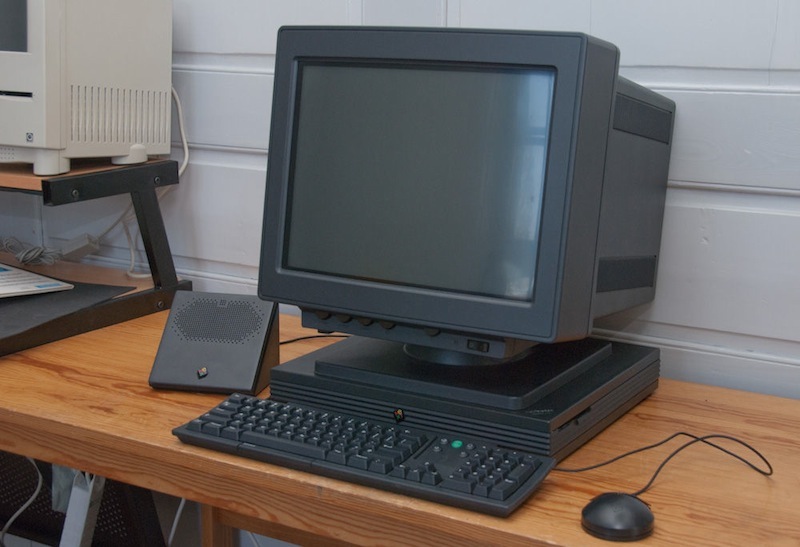
The NeXTstation — image via cuk.ch
Expansion & Upgrades
The poorly-named NeXTdimension was released in 1990. It was an expansion card for the Cube, giving it color capabilities. The board included:

- S-Video input and output
- RGB output
- An Intel i860 64-bit RISC processor at 33MHz (for Postscript acceleration)
- 8–32 MB RAM and 4MB VRAM for a resolution of 1120 by 832 at 24-bit color
The card included its own OS, built on a stripped-down Mach kernel. Because all Cubes came with an on-board GPU, this card allowed users to hook up a second display. NeXT released a “Turbo” version of the Cube, clocked at 33 MHz.
The NeXTdimension cost $3,395. A CL550 chip for MJPEG video compression was announced by the company, but never shipped.
While the Cube required a costly add-on card to handle color and more advanced video, NeXT released several versions of the NeXTstation to enable this and other capabilities:
- NeXTstation Turbo — included a 33 MHz Motorola 68040 processor and up to 128 MB of RAM
- NeXTstation Color — 25 Motorola 68040 processor MHz, color video
- NeXTstation Turbo Color — included a 33 MHz Motorola 68040 processor and up to 128 MB of RAM and color video
The base model was powered by a the same chip as in the Color version, but sold for only $4,995, making it the most popular of the NeXT machines. (The Color went for $7,995 and the Turbo for $6,500.)
Other Hardware
Besides the computers, NeXT shipped a laser printer — the NeXT PN N2000 — a 400 DPI PostScript printer actually developed by Canon. The company also sold a color inkjet printer, also built by Canon.
NeXT also shipped displays. Ranging from 17–21 inches, these grayscale displays were dubbed “MegaPixel” displays — with a resolution of 1120 x 832 at 92 DPI. Later models included a built-in microphone and speaker set. They were sold separately from the computers themselves.
There was also an external sound box that could be used.
The company also shipped keyboards and mice for their products, based on the ADB technology invented by Steve Wozniak. NeXT at first shipped keyboards and mice mini-DIN connector with 5 pins. ADB was only supported on later machines, such as the NeXTstation Turbo.
Reflections
Looking back at these computers, I’ve come to several conclusions:
- Steve Jobs loved cubes. The NeXT machine, the PowerMac G4 Cube and the Fifth Avenue Apple Store all were born out of his love of the shape. All three examples are breathtaking works of art.
- NeXT built pretty nice computers — at decent prices. When compared with Apple’s equivalent offerings at the time, the difference isn’t as large as I thought they were when I started reading about NeXT’s machines.
- NeXT hardware was bleeding-edge. Like he did with the iMac in 1998, Jobs left the 3.5-inch floppy drive out of the NeXT machines. The magneto-optical drives were cutting-edge, but never took off as a standard storage solution.
- While the company built its workstations to suit education customers, it is hard to see — based on the hardware alone — if that goal was met well.
- I really want a NeXT Cube. My G4 Cube is getting lonely.
-
Be sure to check out what happened when Simson L. Garfinkel, Senior Editor of NeXTWORLD Magazine, tried burning a Cube case. ↩︎