I am not going to add any commentary to this. There’s just nothing I can so but WHY ARE YOU STILL HERE?
[via MacStories]

I am not going to add any commentary to this. There’s just nothing I can so but WHY ARE YOU STILL HERE?
[via MacStories]
Adam Rosen at Low End Mac, on Mac OS 9:
What surprises me is how many people are still using a ten-year-old operating system for productive tasks. A not-insubstantial set of folks still need (or want) to run OS 9 for reasons both business and personal. We know that Macs themselves are well-built machines that stand the test of time; it appears Mac OS versions do so as well.
I respectfully disagreed three years ago. That said, I do love booting my Clamshell iBook into OS 9 every once in a while.
Shawn Blanc interviewed Chad Sellers, who runs Useful Fruit Software, the maker of Pearnote. The software is available on Amazon’s store as well as Apple’s. Here’s an interesting look into Amazon’s processes for developers getting their software to the company from Sellers:
Currently, I email it to them. They are working on an online submission system, but it doesn’t exist yet. It’s non-ideal, but they processed my latest update very quickly.
And here he is on licensing:
The licensing and upgrades are the same on Amazon as they are on my website. Amazon seems to treat licensing of downloads just like licensing of boxed software — they are simply delivering the file to the user.
Say what you will about the Mac App Store, but it seems a lot better of an experience for developers and users.
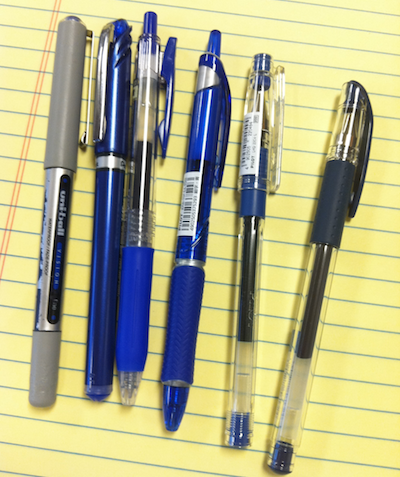
I don’t write much by hand anymore, but when a guy at JetPens.com offered me some pens, I couldn’t turn him down.
Check out my notes on each pen here, as a hand-written PDF.
Years before the Star Wars franchise lit up the eyes of adults and children alike, the US Army was working with General Electric on the “Walking Truck” project, basically a large walker which was controlled by a lever-pushing operator.
Called the Cybernetic Anthropomorphous Machine (or CAM for short), the walker may not have been used by the US Army in combat on rough terrains, but the idea was certainly explored by them in 1965.
Be sure to check out the video.
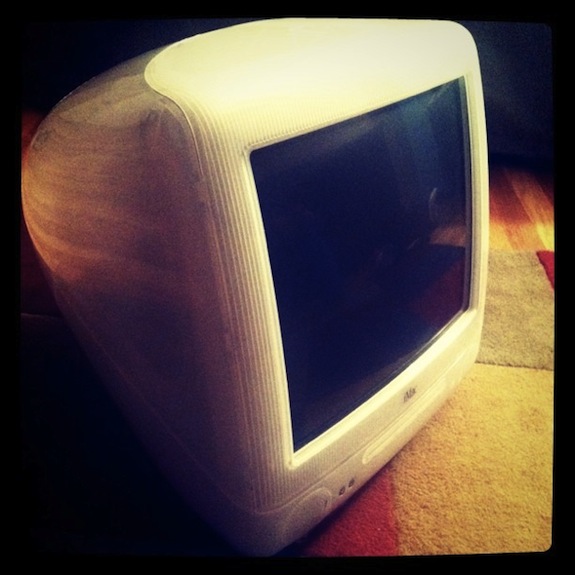
My Sage iMac G3 has a new friend thanks to my buddy Paul.
Two weeks ago, I was waiting for my rental car at the Alamo car lot at National Airport in DC. Also waiting for a car was a US Navy Rear Admiral (two stars). I was rather surprised to see that an Admiral had to wait for a car and jokingly asking him why the Pentagon didn’t send a one for him. As we were talking story, I pulled out my Newton to check my schedule. Upon seeing this, the admiral smiled and said “Is that a Newton? I haven’t seen one of those for years.” He went on to tell me that the Navy had a large program to evaluate the newton for use on ships and subs to facilitate communications and wireless access to the ships’ central computers from anywhere onboard. He apparently was in charge of a major part of this project. He told me that the Navy was very pleased with the Newt and made plans to issue 2100s to all shipboard personnel Petty Officer and above but canceled the deployment when Jobs canned the Newton. Now the Navy has issued Palms to most of their personnel but the Admiral told me they are not satisfied with the capabilities compared to the Newton.
[via My Apple Newton]
I don’t use a case on my iPhone, and most probably never will. Apple made the thing to be a beautiful little block of glass. Precision engineered to be as slim and light as possible. It just feels perfect when you hold it. A case - any case - ruins that. If you have an iPhone and use a case, take it off for a second. Just hold it ‘naked’ for a second, and remember how it’s supposed to feel.
I totally agree.
If you think about it, cloud computing is a lot like the old centralized IT processing model of the past embodied by the mainframe. Computing power is moved away from the end users and into a centralized entity that’s managed by someone else. To be fair, the cloud isn’t really centralized the way mainframes of the past were (and are). However, the cloud and mainframes are alike in that they both move the computing power and infrastructure governance farther from the users of those platforms.
Spirit’s final troubles began in April 2009, when it got stuck in a patch of Martian sand. Engineers worked for eight months attempting to free the rover, but to no avail. In its stationary position, Spirit’s solar panels weren’t able to tilt toward the sun and so it lost power during the winter of 2009 and 2010.
When Spirit lost power, its internal temperature plunged to minus 67 degrees Fahrenheit — the coldest it had ever experienced — and it likely sustained electronic damage that prevented it from powering back up last spring.
Mission managers had been considering scaling back the listening campaign from once a day to once a week, but on Monday, Callas notified the rover team that he decided against that plan, saying that any continued effort would cut into other missions.
NASA got an amazing seven years of scientific discovery out of this amazing little machine. It is sad to see it go.
When Josiah was first diagnosed with brain cancer, we spent almost a month on the south wing of the fifth floor at Le Bonheur Children’s Hospital here in Memphis. While there, our six month old had massive brain surgery, followed by a smaller operation weeks later. We spent two days in the ICU, praying the pain killer would kill him asleep. We spent countless nights, staring out the window across Memphis’ medical district, listening to ambulances and watching helicopters land at various hospitals. We got to know every nurse on the floor by name. We ate more hamburgers in the cafeteria than any one person ever should.
A few weeks ago , I wrote about some of this. It was the single hardest thing I’ve ever published on the Internet. It took me weeks to finish it. Then days to finally get the nerve up to post it.
One thing that I did not include in that essay was telling our families the news the doctors gave us on that couch. A few minutes after they left, I kissed Merri and Josiah, and walked out of Josiah’s hospital room, turned right, walked past three room and the nurses’ station, made a right then a left, and came to the elevators.
“5 South” really doesn’t have a waiting area. Someone stuffed some chairs in the hall just past the elevators at some point, and it just stuck. All of our parents were out there, talking quietly, which was a hell of a thing, as everyone is divorced. I got to the elevators and started to say that Josiah had a tumor, probably cancerous.
I couldn’t get the second word out. I lost it.
I’m normally very composed. I’m not the emotional type. I never have been, but there, in that hallway with the ridiculous tile work on the walls and the dirty windows overlooking some of Le Bonheur’s AC units, I fell apart.
While I’m just now realizing it, that was one of the very few times I’ve been emotionally upset about Josiah’s cancer. I’ve been angry, but never that broken over it. Life moved so quickly after that weekend, I simply didn’t have the time or energy to deal with me. To some degree, I think it was a necessary response to it all just so I could function. Part of it was selfish. Part of it was self-destructive.
Since starting to deal with my depression, this has been at the forefront of my mind.
And it is scary as hell.
Part of me is afraid of what will happen if I let myself start to feel again. Part of me likes being emotionless. It’s just so much easier.
But it’s killing me.
Then, on Sunday, I revisited 5 South.
Our daughter had an allergic reaction to some medication, and the pediatrician wanted us to take her to Le Bonheur’s ER. While we were there in 2009, the hospital was building a new building. It’s now open, and parts of the old building are due to be torn down — including 5 South.
I parked in the old parking garage, and walked through the old building on my way to meet my wife in the new ER. The old building has been stripped of its artwork, and has clearly been out of use for some time. It was heartbreaking to see it. After the doctors saw little Allison — who is fine now, thankfully — I walked back to my truck, retracing my steps in the dusty hallways.
When I got to the elevators to go to the tunnel leading to the parking garage, I had what I can only call a panic attack. I had to visit our old floor. I had to see the floor. I needed to open the door to the room we spent so many days and nights in. I needed to sit in the lobby, looking out the window. I needed photos.
So I ignored the “Do not Enter” signs, and walked to the old tower. Random equipment was stacked in hallways. The playground I used to pass several times a day was gone, it’s blue padding looking out of place without swings above it. The little windowed office with the accounting people was locked shut.
I made it to the elevators without seeing another human being. I hit the button, the door to the right opened immediately, with the same squeak that was burned in my brain for so long. I climbed in and pressed the button I’d pressed so many times before. There was still no option to get off on the third floor. The button to the second floor was still shattered, just as it was two years ago. I imagine it’s been that way for years.

The elevator creaked as it climbed to the fifth floor, as if it had forgotten the path it traveled for years. The trip up took longer than I thought it did. An eternity.
When I stepped off the elevator on the fifth floor, it was totally different — but just the same — as it was. The panel between the elevator doors with the call buttons still had its terrible pattern of mauve, green and white tiles. The painting of the school bus full of smiling kids hadn’t faded a bit. The clock ticked away, hoping for someone to come by and be thankful for its prompt time-keeping.
The chairs were gone. In its place, a large piece of equipment labeled “Trash.” Trash bags were stacked where the vending machines used to hum, ready to take my money one dollar at a time.
The doors to the floor itself were locked, but the sign said the space was being used for training temporarily. No more neuro patients will sleep there. No more nursers, no more parents. Just … nothing.
I only spent about 30 seconds up there. As I looked around, I felt it all coming down. I leaned over into a trash can and threw up. I then got back on the elevator and got away from 5 South as quickly as possible.
When I got home, my wife asked me what had happened. I told her I had made a mistake. It took a day or so before I could tell anyone — including Merri — where I had gone. Trespassing aside, something had happened that I wasn’t expecting. I was ashamed of what I viewed as an insane act.
I thought visiting 5 South would be like visiting my old elementary school — relaxing, and a nice place to shoot some photos capturing part of my past. It wasn’t.
Part of my identity is tied to that building. I can’t imagine the Memphis skyline without it.
I’m not sure what any of this means in my recovery. I do know that that hallway, that floor, those elevators are ground zero for me and my family. Psychologically speaking, there’s not much of anything more crazy that I can do. At least that’s what my doctor said. I hope he’s right, but part of me hopes he’s wrong, too. I pushed the envelope, probably past what I was ready for, honestly. It may have been reckless this early in the process. The part of me that liked being locked away and self-destructive was thrilled at the pain that came back. At least I felt something, which is better than being numb. (Right?)
I’m still processing what I felt, and how I reacted in such a violent, physical manner. I’ve never thrown up as a reaction to any type of news. Even at the hospital that first weekend. It’s all very confusing, very frustrating, and yet, at the same time, freeing.
Whatever that means.