
Jeff Geerling is living the dream:
512 Pixels
Connected 610: The Only Way to Deal with John⇢
This week on the podcast:
The Apple Watch is rumored to undergo some big changes, Safari is gaining MCP support, and the Rickies may have accidentally created a black hole.
An Update to My Apple History Calendar⇢
Several years ago, I ran a series of Kickstarter campaigns highlighting important dates in Apple’s history with three different wall calendars.
There were also digital versions of the calendars that folks could subscribe to in Apple Calendar, Fantastical, etc.
Today, I have some news about that part of the project:
- Backers of the three Kickstarters are getting access to updated digital versions of the particular calendar they backed. If you’re in that crowd, be on the lookout for a Kickstarter message with details. These calendars haven’t been updated since publication, so there’s a lot of new stuff in there. This is a one-time update as a thank-you to everyone who backed the campaigns.
- I have combined dates from all three calendars into a new Apple History Calendar that is for sale now as a one-time $10 purchase. I will be updating the calendar each month with new dates, so setting it up as a subscription in your calendar application means new dates will flow in automatically.
I am so excited to have found a way to keep the Apple History Calendar project going after all this time, and I would love for you to check it out.
As a bonus, you can also get a copy of my book Aqua & Bondi. It covers the iMac G3 and the transition to Mac OS X. If you pick up both, you’ll get 25% off your entire order.
EveryMac Turns 30⇢
Anyone who dabbles in Apple history probably has EveryMac.com bookmarked, and today it celebrates a milestone:
On July 2, 1996, EveryMac.com launched.
Thirty years is a long time – and a great deal has changed since then – but what has not changed is that EveryMac.com has been there to provide you with detailed info on every Mac from the original 128k to the current line. Thank you very much for your support through the years.
There are a bunch of ways to support EveryMac, and its anniversary prompted me to chip in to help keep the lights on at a very important resource.
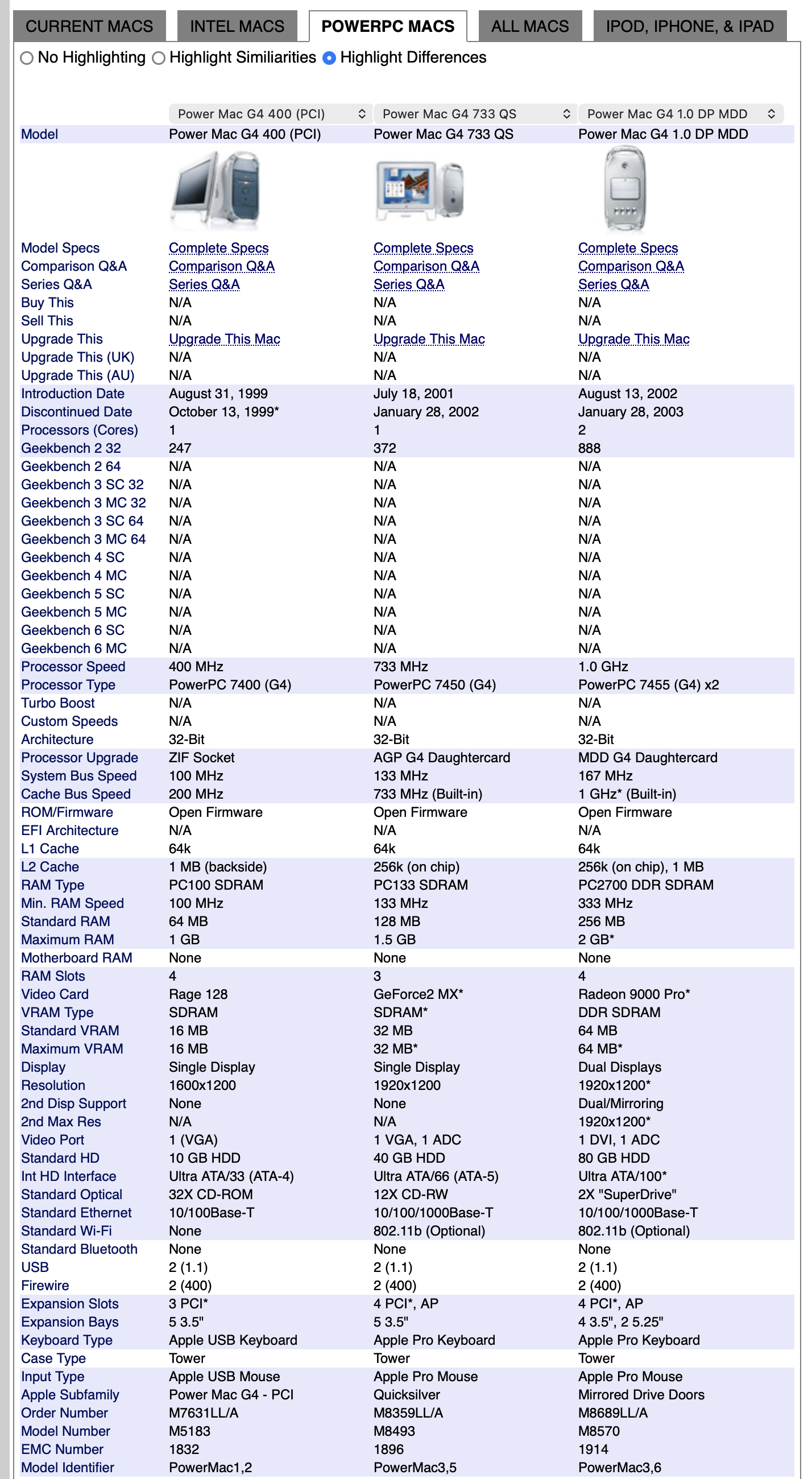
I am a huge fan of the site’s comparison charts, which make it easy to see how a particular model evolved over time:
The Honda Element Set to Return⇢
Jack Fitzgerald, with some very exciting news at Car and Driver:
The Honda Element could make a comeback, at least according to a new report by Automotive News. Honda killed the once-popular SUV in 2011 after years of sliding sales, but a resurgence in off-road-capable vehicles and a dearth of affordable models are spurring the boxy Element’s revival.
Car and Driver reached out to Honda for comment, and a spokesperson shared this statement: The Honda Element has maintained a cult following since it was discontinued in 2011, and hopes for its possible return continue to circulate online. We sincerely appreciate the enthusiasm for the Element, but we are not going to engage in speculation about our future product plans.
We owned a 2007 Element for several years. Because it was so weird, it was a lot of fun. It was also surprisingly useful. I was a full-time consultant at the time, and would use it to haul pallets of MacBooks between the office and the K-12 schools we serviced. Here it is, in a very 2009 photo:

It was not perfect, though. We ended up trading it in when we bought our first minivan, as the suicide doors made getting kids in and out of car seats difficult in parking lots. Even though one hasn’t been in my driveway for a long time, I always take a second look when I see one in traffic.
Om Malik, 1966-2026⇢
Om Malik passed away on June 24, 2026, at Stanford Hospital after a long health journey with his heart. He was surrounded by family and friends.
I’ve read Om’s writing since before starting this site over 17 years ago. It is hard to believe he won’t be lighting up my RSS reader anymore.
Connected 609: You Gotta Be Gud⇢
This week on the podcast:
Apple has increased prices across its Mac and iPad lines, the guys are all on iOS 27 Beta 2, and the Bill of Rickies is amended.
Apple Has Increased Prices Across Mac and iPad Models⇢
As foretold, Apple has increased the prices of many products today. Chance Miller has put together a list:
Macs
| Product: | Old Price: | New Price: | Increase: |
|---|---|---|---|
| MacBook Neo | $599 | $699 | 16.7% |
| 13-inch MacBook Air | $1,099 | $1,299 | 18.2% |
| 15-inch MacBook Air | $1,299 | $1,499 | 15.4% |
| M5 MacBook Pro | $1,699 | $1,999 | 17.7% |
| M5 Pro MacBook Pro | $2,199 | $2,499 | 13.6% |
| M5 Max MacBook Pro | $3,599 | $4,099 | 13.9% |
| iMac | $1,299 | $1,499 | 15.4% |
| M4 Max Mac Studio | $1,999 | $2,499 | 25% |
| M3 Ultra Mac Studio | $3,999 | $5,299 | 32.5% |
iPads
| Product: | Old Price: | New Price: | Increase: |
|---|---|---|---|
| iPad | $349 | $449 | 28.7% |
| 11-inch iPad Air | $599 | $749 | 25% |
| 13-inch iPad Air | $749 | $949 | 26.7% |
| 11-inch iPad Pro | $999 | $1,199 | 20% |
| 13-inch iPad Pro | $1,299 | $1,499 | 15.4% |
| iPad mini | $499 | $599 | 20% |
Other
| Product: | Old Price: | New Price: | Increase: |
|---|---|---|---|
| Apple TV 4K | $129 | $199 | 54.3% |
| HomePod | $299 | $349 | 16.7% |
| HomePod mini | $99 | $129 | 30.3% |
| Vision Pro | $3,499 | $3,699 | 5.7% |
Additionally, many upper-level SKUs saw increases. The Mac mini with M4 Pro got a $200 bump to $1,599, while the M5 Max MacBook Pro jumped from $3,599 to $4,099. As expected, increases really stack up when you start configuring higher-end options like larger SSDs and additional unified memory.
Apple addressed the increases to The Wall Street Journal’s Rolfe Winkler:
“We have now reached a point where we need to begin raising prices,” [Apple] said in the statement. “We have never seen a component price increase this much, this quickly.”
Driven by surging demand from AI hyperscalers, the prices of memory chips, called DRAM, and storage chips, called NAND, have both quadrupled over the past 12 months, according to research firm TechInsights, which projects those prices to keep rising into next year.
An Apple spokesperson said that “the rapid expansion of AI data centers has created an extraordinary surge in demand for memory and storage” and that the company has “never seen a component price increase this much, this quickly.”
Apple added it has “shielded our customers from these increases so far, but we have now reached a point where we need to begin raising prices on a number of products including today’s increases for iPad and Mac.” “We know this is not welcome news, and we are working tirelessly to find solutions,” it said.
Consumer electronics getting significantly more expensive due to the AI industry may accelerate the backlash even faster than the data center buildout.
Notably, Apple was able to keep the iPhone at its existing price points.1 I suppose time will tell if Apple can hold the line there.
-
Prices for the Apple Watch, AirPods, Studio Displays, and accessories also remain unchanged. ↩︎
On Apple’s Pending Price Increases⇢
John Gruber, writing about Apple’s pending price increases:
I won a steak dinner from my Dithering cohost Ben Thompson, betting that Apple would not raise the prices on RAM when they introduced the M5 Pro and M5 Max MacBook Pros in March, largely on the basis that Apple considers the pricing part of the product’s brand. For the same reason, I also do not think they’re going to raise the prices of existing products mid-cycle. I think Cook’s warning is about the fall, starting with the iPhones 18 Pro and the folding “Ultra” in September, and he issued the warning months early just to make the bad news “old news” by the time September gets here.
But unlike with the MacBook Pros in March, I wouldn’t bet more than a beverage on my hunch here. However out of character it would be for Apple to raise prices midway through product cycles, the global RAM shortage is unprecedented. I wouldn’t be surprised if Apple pushes price increases moments after I hit “Publish” on this post. (I’m checking right now, before I hit the button, in fact.)
I agree; it would be very unusual for Apple to raise prices at the end of an iPhone cycle. Part of me thinks Apple will do it anyway to provide some cover for John Ternus’ first product keynote as CEO. Having the outgoing guy take the heat for a price increase seems wise to me, but perhaps the company thinks that a rare Tim Cook interview was enough.
SpaceX Recommits to Memphis Water Treatment Plant⇢
Had a productive meeting with SpaceXAI President Michael Nicolls on Monday.
In the meeting they committed to resuming construction on the recycled wastewater treatment facility no later than Q1 2027.
This facility will offset water usage from both SpaceXAI and TVA. Our engagement that led to this commitment will continue until the facility is complete.
Samuel Hardiman, for The Daily Memphian:
The facility was expected to treat wastewater from the City of Memphis’ nearby TE Maxson Wastewater Treatment Plant and turn it into a suitable industrial coolant, replacing the hundreds of thousands of gallons of freshwater the company uses each day. In February, it used 840,000 gallons of water a day, according to bills obtained by Protect Our Aquifer and provided to The Daily Memphian.
The land for the water treatment plant was purchased in June 2025, with ground being broken in October of that year before work paused in April. You’d think one of the world’s most valuable companies could move more quickly.
Connected 608: Here’s How to Fix a Sink⇢
Myke questions Stephen about his home network, then discusses the ups and downs of having an LLM power Siri. Also: a love letter to the iPhone Air and questions about Snap’s new AR glasses.
On Connected Pro, I trained Myke to be a technology historian. That’s the longer, ad-free version of the show that you should sign up for!
TimeCapsuleSMB⇢
After yesterday’s post about the end of the Time Capsule, several people pointed me to James Chang’s project on GitHub to keep them running:
Apple AirPort Time Capsules only support AFP and SMB1. Apple removed AFP support in macOS 27 (and removed SMB1 support from macOS a long time ago). This is a modern Samba setup that runs directly on the Time Capsule itself; macOS 27 can connect to the Time Capsule as a network share, and use it for Time Machine backups.
This project has 2 parts:
- a fork of Samba 4, modified to work on the Apple Time Capsule
- the installers for the Samba binary, via python or the macOS GUI app.
This now fully works for all Time Capsules. The Time Capsule will run its own Samba 4.24.3 server, advertise itself over Bonjour (show up automatically in the “Network” folder on macOS), and accept authenticated SMB3 connections. You should then be able to open Finder, choose Connect to Server, and use a normal SMB URL instead of relying on Apple’s legacy stack.
I can’t speak to the patch’s effectiveness, but dang, I love that someone is out there keeping these things running.