Musk Confirms Second Memphis xAI Site Could Use One Gigawatt of Power

Yesterday, in a late-night post on X, the billionaire wrote:

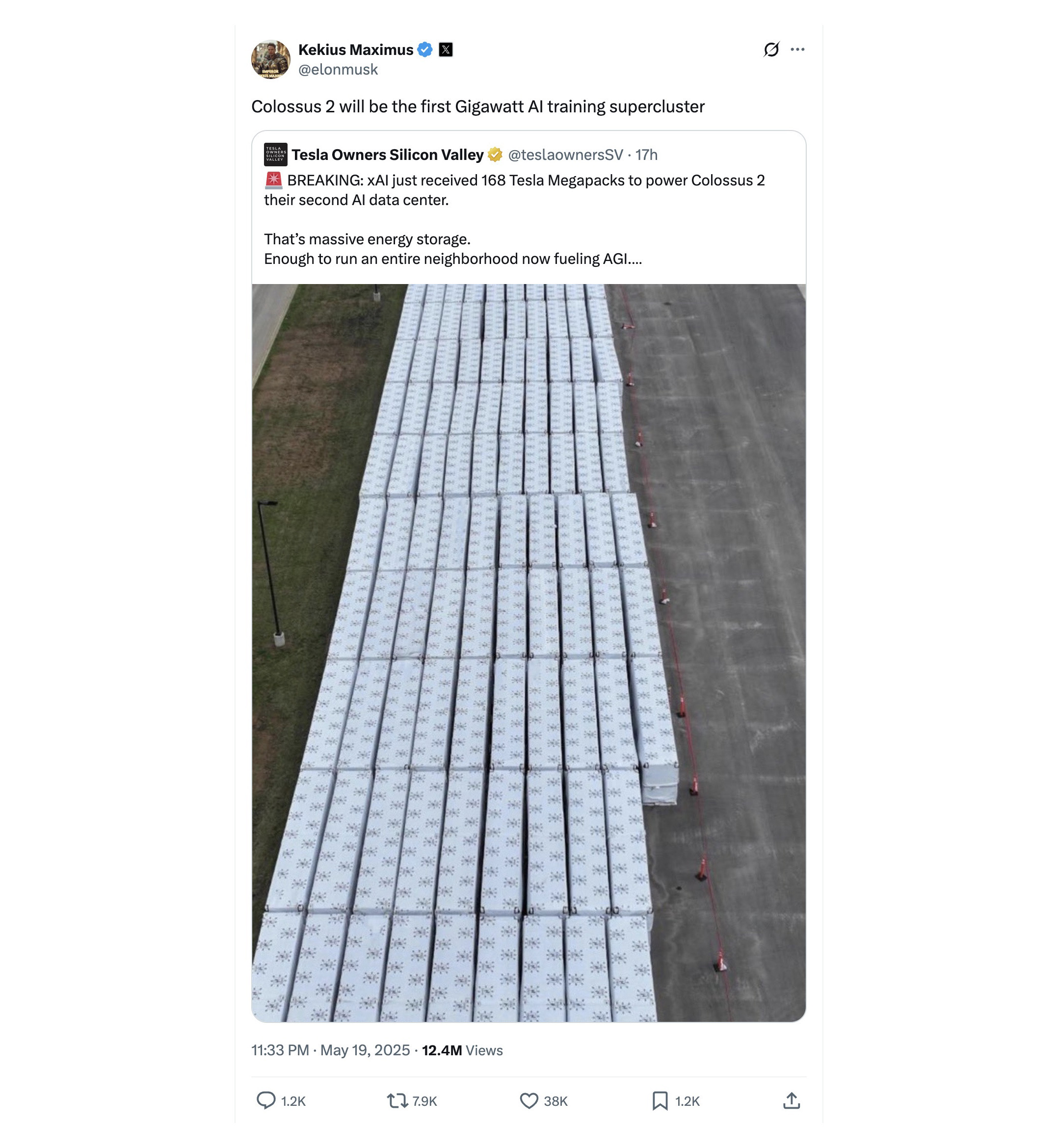
Colossus 2 will be the first Gigawatt AI training supercluster

X embeds don’t seem to be working for me so here’s a screenshot

Samuel Hardiman, at The Daily Memphian earlier today:

MLGW’s maximum electricity demand of all time is about 3,500 megawatts, or three-and-a-half gigawatts. Its power use is weather dependent: In the summer, MLGW uses 2,800 to 3,000 megawatts, while during the winter, it’s 1,700 to 1,800.

Continue reading ⇢

‘Our Health Was Never Considered’ 

Laura Paddison and Rene Marsh for CNN:

Last summer, an abandoned factory in southwest Memphis got a new life courtesy of the world’s richest man. Elon Musk’s artificial intelligence company xAI moved in to transform this unprepossessing building into the “world’s largest supercomputer.”

Musk named it Colossus and said it was the “ most powerful AI training system in the world.” It was sold locally as a source of jobs, tax dollars and a key addition to the “Digital Delta” — the move to make Memphis a hotspot for advanced technology.

Continue reading ⇢

xAI Reports ‘An Unauthorized Modification’ Leading to Grok Being Obsessed with ‘White Genocide’ 

Kyle Orland, writing at Ars:

On Wednesday, the world was a bit perplexed by the Grok LLM’s sudden insistence on turning practically every response toward the topic of alleged “white genocide” in South Africa. xAI now says that odd behavior was the result of “an unauthorized modification” to the Grok system prompt—the core set of directions for how the LLM should behave.

That prompt modification “directed Grok to provide a specific response on a political topic” and “violated xAI’s internal policies and core values,” xAI wrote on social media. The code review process in place for such changes was “circumvented in this incident,” it continued, without providing further details on how such circumvention could occur.

Continue reading ⇢

Shelby County Health Department to Address xAI Turbines and Public Complaints 

As I’ve previously written, xAI has a permit to run 15 gas turbines at its first site, but more than 30 have been spotted running. Those additional turbines are operating under an emergency-use exemption that is good for one year, and were initially slated to provide backup power when the utility company couldn’t keep up. Our county Health Department will be weighing in on the matter later this summer, according to a press release:

Continue reading ⇢

Shelby County Commission Proposes Monthly Air Quality Tests in South Memphis Near xAI Site 

Desmond Nugent at ABC24:

In response to growing environmental concerns in South Memphis, the Shelby County Commission has proposed a resolution that would require the Shelby County Health Department to provide monthly — rather than quarterly — updates on local air quality in South Memphis.

The proposal stems from rising tensions surrounding emissions linked to xAI, the world’s largest supercomputer facility, which began operations in South Memphis last year. Community members and environmental groups say xAI and other related facilities have contributed to a noticeable decline in air quality.

Continue reading ⇢

xAI May Turn to North Mississippi for Powering Second Memphis Site 

Once again, Samuel Hardiman for The Daily Memphian, writing about xAI’s power needs:

Elon Musk’s artificial intelligence company, xAI, appears to be exploring how to generate electricity for its second data center in Memphis. And those plans could cross the Tennessee-Mississippi border.

The plans could involve a former natural gas plant in Southaven, Mississippi, just over a mile from xAI’s second data center, which is being built at 5420 Tulane Road in Whitehaven.

Continue reading ⇢

xAI Has Failed to Publish Final Version of Its Safety Policy 

Kyle Wiggers, writing at TechCrunch:

Elon Musk’s AI company, xAI, has missed a self-imposed deadline to publish a finalized AI safety framework, as noted by watchdog group The Midas Project.

xAI isn’t exactly known for its strong commitments to AI safety as it’s commonly understood. A recent report found that the company’s AI chatbot, Grok, would undress photos of women when asked. Grok can also be considerably more crass than chatbots like Gemini and ChatGPT, cursing without much restraint to speak of.

Continue reading ⇢

Memphis Chamber of Commerce Claims No New Gas Turbines Will be Placed at Second xAI Location, Despite Documents to the Contrary

As I wrote about earlier this week, xAI has broken ground on a second data center on Tulane Road here in Memphis that will require an unbelievable amount of electricity. Today, the Greater Memphis Chamber of Commerce sent an email saying:

xAI is demobilizing turbines in Shelby County and has no plans to site any turbines at its Tulane location. The company continues to evaluate various power solutions for its Memphis facilities while working within all applicable regulatory frameworks.

Continue reading ⇢

Memphis Behind Other Cities in Data Center Legislation

Dyana Bagby, writing in 2024 for Georgia Public Broadcasting, the PBS/NPR affiliate in Atlanta:

The Atlanta City Council voted Tuesday, Sept. 3, to ban data centers along and near the Atlanta BeltLine and within a half-mile of MARTA stations.

The new legislation aims to preserve new residential and mixed-use developments, trails and green space along the 22-mile BeltLine trail loop encircling the city’s urban core. The council also wants to make sure the BeltLine remains focused on building more affordable housing and providing a safe space for pedestrians, cyclists and others in non-vehicular modes of transportation.

Continue reading ⇢

‘It Smells Like Gas Outside’ 

Ariel Wittenberg for Politico, writing about xAI’s use of gas turbines to power its supercomputer in Memphis:

Just three miles away is Boxtown, a secluded neighborhood that officially became part of the city of Memphis in 1968, the year that the Rev. Martin Luther King Jr. was assassinated at the Lorraine Motel downtown. While the annexation had come with the promise of connecting Boxtown to municipal utilities, many homes still had no running water or sewage service as late as the 1970s.

Continue reading ⇢

Second xAI Datacenter Could Take Enough Energy to Power 40% of Memphis; Government Agency Charged with Studying Impact Targeted by DOGE 

After linking to that New Yorker article about xAI using gas turbines to help power its first supercomputer here in Memphis, I opened my RSS client to see this article by The Daily Memphian’s Samuel Hardiman who writes:

Memphis Light, Gas and Water said Monday, May 5, that artificial intelligence company xAI’s second Memphis datacenter could require enough electricity to equal 40% of Shelby County’s demand.

On its website, the City of Memphis-owned utility said that xAI and the utility have discussed using up to 1.1 gigawatts of power at its Tulane Road datacenter. However, the utility said that amount of power is not poised to be delivered soon and is not being formally studied by MLGW.

Continue reading ⇢

‘There Were No Responses to Questions’ 

I’ve been paying close attention to the on-going saga of xAI’s Memphis-based supercomputer, and how the company seems to be misleading both the public and our local officials on how much pollution it is causing.

The story is now gaining national attention. Bill McKibben at The New Yorker ( Apple News+ link) writes:

Memphis was, indeed, home to Elvis—but it was also, of course, where Martin Luther King, Jr., who came to the city to support striking sanitation workers, was assassinated, and it remains a place of sharp economic and racial division. It will surprise no one to learn that the neighborhoods in South Memphis surrounding Musk’s facility—including Boxtown and Westwood—are predominantly Black and also home to a number of industrial facilities, including chemical plants and an oil refinery. The area already has elevated levels of pollution compared with leafier precincts, and, according to Politico’s E&E News, “already leads the state in emergency department visits for asthma.” Those same neighborhoods came together at the beginning of the decade to fight, and ultimately defeat, the proposed forty-nine-mile-long crude-oil Byhalia pipeline, which would have run through the area. In that process, a new political star emerged: Justin Pearson, a young African American who rode that battle into the state legislature (from which he was later expelled for joining an anti-gun-violence protest on the floor of the Tennessee House after a shooting at a Christian school, only to soon be reappointed by the county and reëlected to office in the next election).

Continue reading ⇢