
Not everyone has a stack of old Macs for running older software, but the Internet is a magical place, and Mac OS 9 has joined OS 8 and System 7 in being able to be run in the browser.
Category: Apple History
Inside a Rusty Molar Mac⇢
Steve at Mac84 has a new video up, in which he tears down a pretty sad looking Power Mac G3 All in One:
The Apple Keynote Search Engine⇢
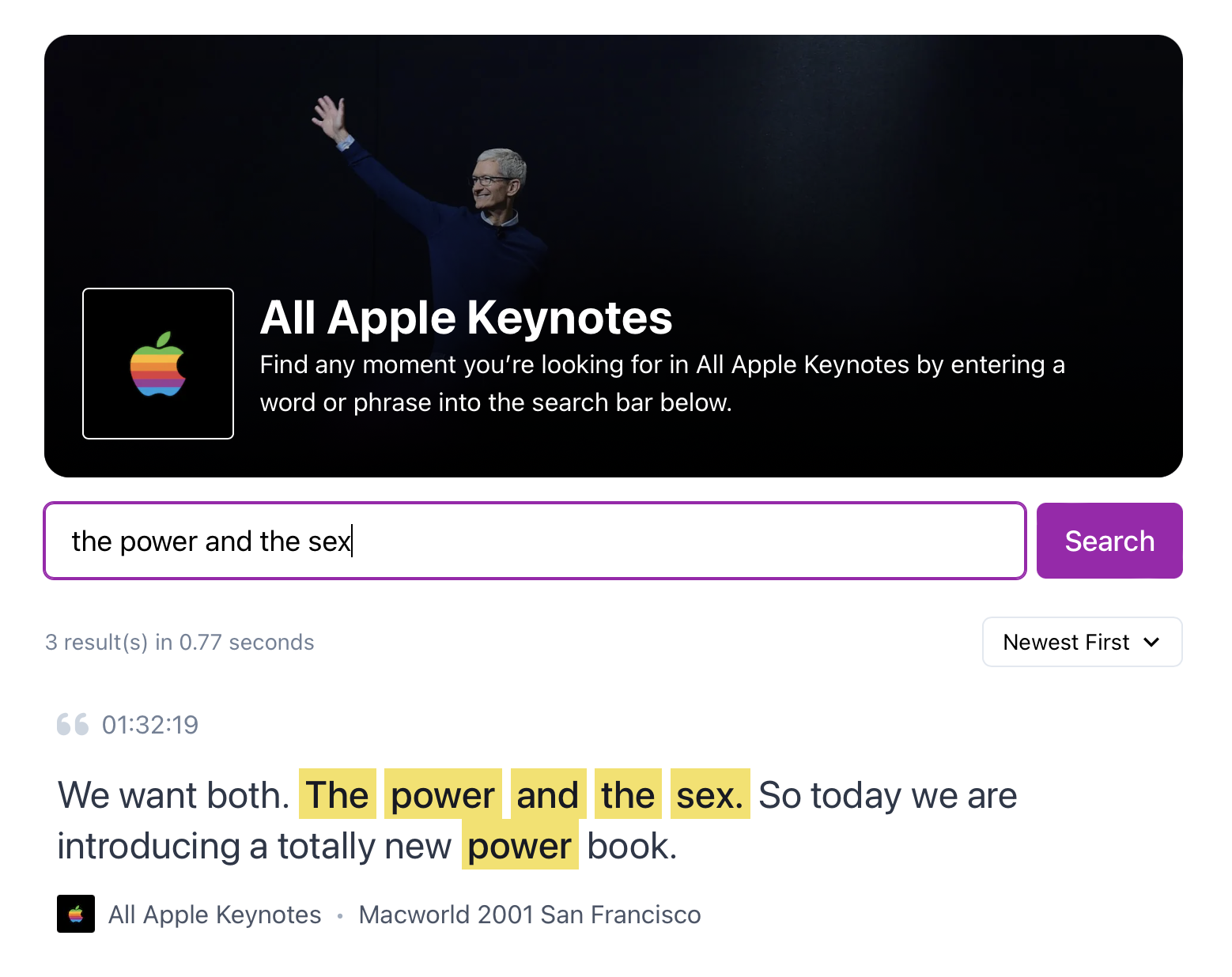
The folks behind Context, a new way to search video and audio clips for keywords, have created something very useful if you’re someone like me:
Find any moment you’re looking for in All Apple Keynotes by entering a word or phrase into the search bar below.
It even has one of the most awkward lines Steve Jobs ever used on stage, moments before introducing my beloved Titanium PowerBook:
The Macintosh ROM Scarf⇢
The Sad Saga of the 500 MHz Power Mac G4
In August 1999, Apple announced the first Power Mac G4: 1
The Power Mac G4 is powered by the revolutionary new PowerPC G4 chip architected by Apple, Motorola and IBM, and is the first personal computer in history to deliver supercomputer-level performance of over one billion floating-point operations per second. The Power Mac G4s run professional applications like Adobe’s Photoshop up to twice as fast as 600MHz Pentium III-based PCs.
The G4 chip incorporates a new execution unit named the Velocity Engine — the heart of a supercomputer miniaturized onto a sliver of silicon. In a set of Intel’s own tests published on their web site, the 500MHz G4 chip was 2.94 times as fast as the 600MHz Pentium III processor.
A Mac Portable in Spaaaaaaaace⇢
That famous clip of a floppy disk floating through the air after being ejected from a Macintosh Portable really makes my brain vibrate in a special way. In this video, Scott Manley explains why the Portable was there in the first place:
Aperture Script Still Included as Template in Script Editor
Script Editor, the built-in macOS app for creating and dealing with AppleScript and JavaScript automation, comes with a handful of example templates, including this gem for importing files into Aperture:
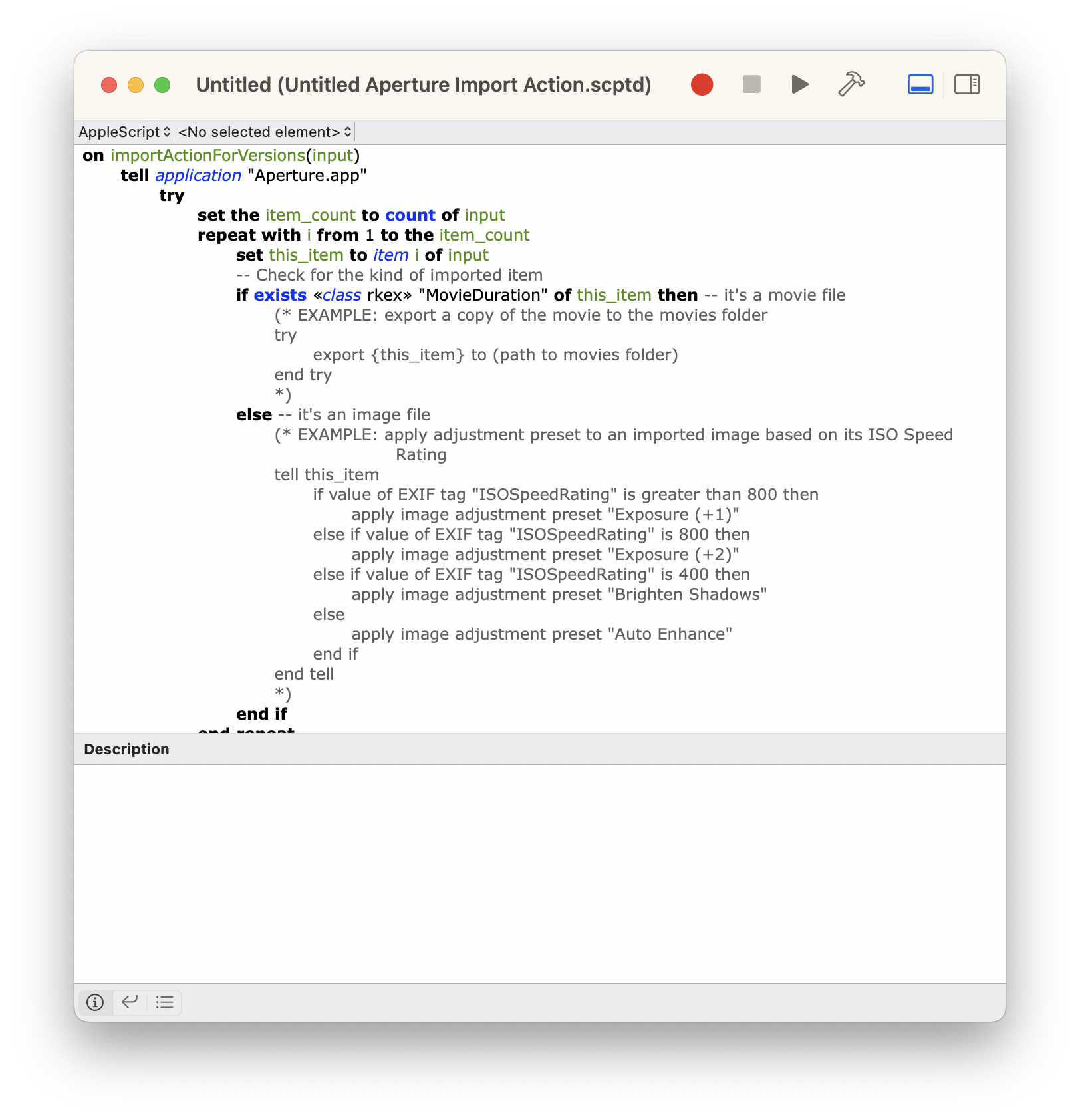
Aperture was discontinued some eight years ago, but this template is still included in the version of Script Editor bundled with macOS Ventura.
Bono, on ‘Songs of Innocence’ Being Given to All iTunes Customers⇢
The Guardian has an excerpt from Bono’s memoir, and the excerpt includes a bit on the time Apple and U2 added the band’s newest album to everyone’s iTunes music libraries:
If just getting our music to people who like our music was the idea, that was a good idea. But if the idea was getting our music to people who might not have had a remote interest in our music, maybe there might be some pushback. But what was the worst that could happen? It would be like junk mail. Wouldn’t it? Like taking our bottle of milk and leaving it on the doorstep of every house in the neighbourhood.
Kbase Article of the Week: Mac OS X: Script Editor Has Two Choices for Saving Compiled Script⇢
Speaking of weird bugs and scripts, here’s Apple Support on a weird bug that was present in an early version of Mac OS X 10.2:
When using Script Editor to save a new file, there are two choices for compiled script.
When you choose Save As or save a script for the first time, you see two choices for the format:
- compiled script
- Compiled Script
The choices produce identical scripts. It does not matter which format you choose; they only differ in the capitalization. This is to expected [sic] to be corrected in a future version of Script Editor.
The Terrible Tale of iTunes 2
A tweet from Mr. Macintosh over the weekend reminded me of one of the worst bugs Apple shipped in an application update.
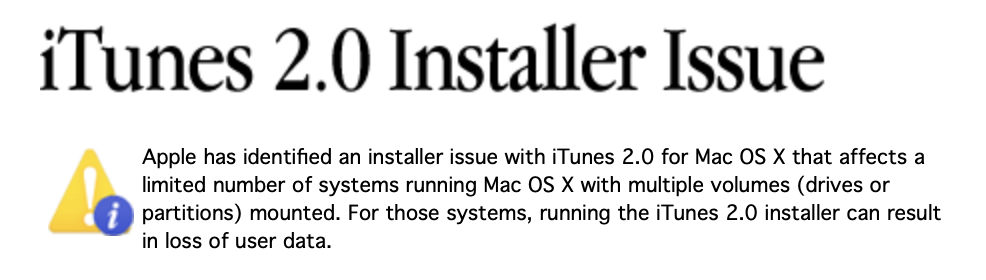
Version 2 of iTunes was going to be a big deal, including support for the just-announced iPod and the addition of an equalizer with cross-fading.
Things did not go well. Here’s a bit from Adam Engst, dated November 12, 2001:
After releasing the new version late Friday night, Apple hastily pulled the Mac OS X installer Saturday morning due to a problem where, in some situations involving multiple volumes named in specific ways, the installer could delete a large number of files. Needless to say, this is a bad thing, and there have been reports of Apple quietly offering to buy file recovery software or even pay for DriveSavers recovery of affected hard disks. A revised installer, with the designation iTunes 2.0.1, was released before the end of the weekend.
After Dark Mucho⇢
Garth Beagle has uploaded something pretty special to the Macintosh Garden:
A (mostly) complete collection of After Dark modules, pre-installed, ready to go, using an install of After Dark 4.0.3. Tested on a color-capable Macintosh with System 7.1 and Mac OS 7.6.1.
Apple I Drama⇢
Today I read a story about an Apple I that is reported to have been built by Woz. That may or may not be true, according to some experts. Ethan Baron, writing at The Mercury News, has more:
Mike Graff, spokesman for Boston-based RR Auction, said Jobs gave the Apple-1 to its current owner, who wants to remain anonymous, around 1990. The device had languished for years in a drawer “with things on top of it and below it” in the famed “Apple Garage” where Jobs and Wozniak did their early work in Jobs’ childhood home in Los Altos, said Corey Cohen, a board member of the Vintage Computer Federation and a prominent Apple-1 expert.