
The single largest addition to the setup process is the integration of a clever Migration Assistant tool. Much like Apple’s software of the same name, it’s meant to transfer an existing system to a new one – in this case, to create a VM on a Mac from a Windows PC. It’s relatively painless as it actually uses Bonjour zero-configuration networking to find the Windows computer on the local network and make the conversion. We would definitely take heed of VMware’s advice to use Ethernet for the process, however, as this is not a quick process: with the OS alone taking several gigabytes and likely many apps and documents to bring over, Wi-Fi will simply be too slow and unreliable. It’s also a good idea to have a large amount of space free as the finished VM will likely involve more than the total amount of disk space used by the Windows system.
Category: Apple
Droid vs. iPhone
If you must compare the DROID to the iPhone, then know that the Android platform still has a ways to go before the experience of using the phone is as seamless as the one Apple has created — but also know that Apple has a long way to go before its messaging, email, and customization can match what Google is offering. Both products have very distinct strengths and weaknesses.
The Hobby
Macworld, in their look at Apple TV 3.0:
Perhaps Apple is content with Apple TV never being anything more than a front-end for the iTunes store. Or perhaps Apple is well aware of its device’s limitations and is hard at work on a new version with upgraded hardware and improved support for the rest of the stuff that’s out there on the Net.
It’s sad, really. The Apple TV could have been awesome. Instead, consumers are opting to install a Mac mini, which can do everything the Apple TV can do plus a whole lot more. Of course, Apple makes more money off of the Mac mini than the Apple TV, so maybe this whole thing is designed to sell Mac minis.
Wired Having Tablet Mock-Up Contest
Even though many anonymous sources have described Apple’s tablet as a “larger iPhone,” you’re unlikely to win if all you do is re-size a photo of an iPhone. That would be yawn-inducing. Challenge yourselves artistically, have some fun and make a compelling device worthy of all the hype.
Honestly, the artwork with the story is more compelling than any of the ones entered so far.
RIP, iMac G5
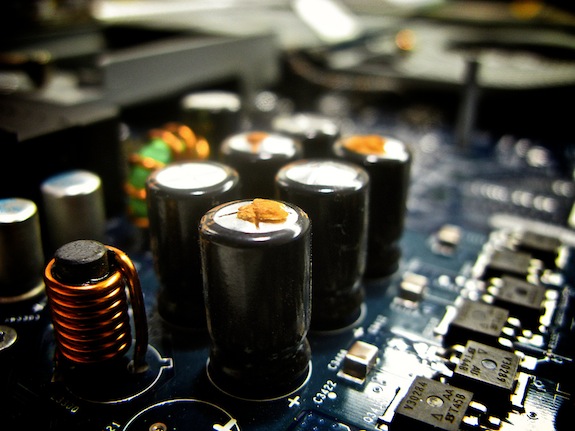
Many, many non-iSight iMac G5s died after having capacitors on their logic board fail like these little guys. This machine joined their ranks today, after getting dropped off at our shop for repair.
AppleTV 3.0 Unleashed
Not surprisingly, it sports a new interface and iTunes LP.
Quality vs. Quantity
Is the App Store popular because the iPhone is great? Or is the iPhone great because the App Store is popular? There’s a big difference between those two arguments. The latter is the argument Microsoft has long made regarding the advantage of Windows: Windows is great because Windows has the most software and most developers.
[…]
But my interest remains, as ever, in the quality of the apps, not the quantity. Let’s say that when the dust starts to settle in this market, Android winds up with far fewer total apps than iPhone OS, but they’re of generally higher quality. That would make Android the Mac to the iPhone’s Windows. I would switch to that platform. (Feel free to substitute WebOS for Android in the above hypothetical.)
The Uber-Device
It’s nice that my iPhone can do it all, but it’s real annoying to get text messages while using it for turn-by-turn GPS.
Apple, on Ergonomics
Today, changes in technology, changes in the way we perform work, and where and how we work are occurring at a rapid pace. Nowhere is the change more evident than in the use of computers.
This new technology has brought on new demands for information as well as new and more sophisticated computing systems. Today, almost every one of us interacts with computers on a daily basis to create new things and ideas, to produce documents, to correspond with friends and associates, and to retrieve information. Along with the expanding use of this technology have come reports about adverse health changes for computer users.
Steve Jobs, the LaserWriter and Adobe
It’s a fascinating read:
Jobs says, simply, “I convinced them [Adobe] to drop plans to be a hardware company and be a software company instead.”
‘Apple Presents iPod’
Apple has applied its legendary expertise in human interface engineering to make iPod the easiest to use digital device ever. Simply rotate iPod’s unique scroll-wheel with your thumb or finger to quickly access your entire music collection by playlists, artists or songs. The scroll-wheel makes it possible to hold and operate iPod with just one hand and features automatic acceleration when scrolling through long lists so you can find your music in seconds. iPod also features customizable settings such as shuffle, repeat, startup volume, sleep timer and menus in multiple languages including English, French, German and Japanese. iPod can display song data in any of these languages, enabling users to mix and match songs from all over the world.
‘Couldn’t Have Been More Wrong’
The first iPod had 10 hours of battery life, a FireWire port (which I still miss), and 5GB of storage for $399. Oh, and it was Mac-compatible only. When I first heard about it I thought, “Who the heck even has one gig of music? Dumb move, Apple.” Good thing Apple doesn’t call me up for business pointers because I couldn’t have been more wrong about the iPod if I had tried.