Nickel and Dimed by Verizon

InfoWorld:

Verizon offers three data plans for Droid customers: $30 month on top of your voice plan’s rate for non-Exchange usage, $45 per month on top of your voice plan’s rate for Exchange usage, and $50 per month total cost for a data-only plan (whether or not you use it to access Exchange). Verizon spokeswoman Brenda Raney notes that the requirement to get the $45 “smartphone plan” for corporate e-mail usage applies to any smartphone, such as the BlackBerry – not just to the Droid.

Continue reading ⇢

Verizon Pushes App to Users Without Warning

Phone Arena News:

Those who purchased the new BlackBerry Storm2 9550 found a Bing application pre-loaded on the device. Earlier this year, Microsoft and Verizon shook hands on a 5 year deal that will make Bing the default search engine on many Verizon phones, even those using Google’s open source Android OS. Keeping up with the attempt by Verizon and RIM to making both Storm models the same when it comes to software (it’s called a guilty conscience!), the carrier “pushed” the app to owners of the first-gen Storm on Friday.

Continue reading ⇢

TUAW Posts Another Non-Story, This Time About Warranty Parts

TUAW’s Josh Carr:

The vast majority of parts that Apple ships to repair centers are what they consider “re-manufactured.” As a Genius, I was coached to explain that process when we were asked where the parts came from. Customers would always respond with, “Wait, so you’re giving me a refurbished iPhone?”

[…]

This doesn’t just apply to iPhones and iPods; it actually applies to any part they put into your Apple product. The logic board they put into your MacBook Pro: refurbished. The optical drive they put into your iMac: refurbished. The DC-In Board they put into your PowerBook G4: refurbished. There are many, many parts out there that Apple will happily replace for you, but beware – it’s probably not new. Re-manufactured is no different than refurbished.

Continue reading ⇢

On Looks

Engadget’s Chris Ziegler:

Of course, it’s like dating a supermodel: just because the DROID is unbelievably attractive doesn’t mean you want to marry it. Those that aren’t used to Android (or have tried it before and didn’t like it) might cringe at some of the platform’s nuances, and it’s still not as visually slick as webOS or iPhone OS is. I personally found the physical keyboard to be a pretty miserable experience – worse than the G1 and the CLIQ – an inevitable casualty of trying to fit this much technology into a space less than 14mm thick, but the good news is that the capacitive display is large enough to make the soft keyboard very usable for me. It’s also the smoothest, fastest, most satisfying Android experience on any device to date, a combination of 2.0’s enhancements and the speedy OMAP3 heart powering them.

Continue reading ⇢

MacNN Reviews VMware Fusion 3

MacNN:

The single largest addition to the setup process is the integration of a clever Migration Assistant tool. Much like Apple’s software of the same name, it’s meant to transfer an existing system to a new one – in this case, to create a VM on a Mac from a Windows PC. It’s relatively painless as it actually uses Bonjour zero-configuration networking to find the Windows computer on the local network and make the conversion. We would definitely take heed of VMware’s advice to use Ethernet for the process, however, as this is not a quick process: with the OS alone taking several gigabytes and likely many apps and documents to bring over, Wi-Fi will simply be too slow and unreliable. It’s also a good idea to have a large amount of space free as the finished VM will likely involve more than the total amount of disk space used by the Windows system.

Continue reading ⇢

Droid vs. iPhone

Joshua Topolsky:

If you must compare the DROID to the iPhone, then know that the Android platform still has a ways to go before the experience of using the phone is as seamless as the one Apple has created — but also know that Apple has a long way to go before its messaging, email, and customization can match what Google is offering. Both products have very distinct strengths and weaknesses.

Continue reading ⇢

Wired Having Tablet Mock-Up Contest

Wired:

Even though many anonymous sources have described Apple’s tablet as a “larger iPhone,” you’re unlikely to win if all you do is re-size a photo of an iPhone. That would be yawn-inducing. Challenge yourselves artistically, have some fun and make a compelling device worthy of all the hype.

Honestly, the artwork with the story is more compelling than any of the ones entered so far.

Continue reading ⇢

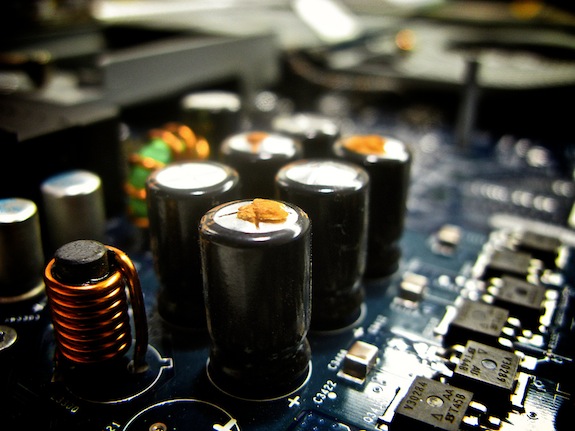
RIP, iMac G5

4056525535_713dfdcccc_b.jpg

Many, many non-iSight iMac G5s died after having capacitors on their logic board fail like these little guys. This machine joined their ranks today, after getting dropped off at our shop for repair.

Continue reading ⇢

Moto, on Design

The New York Times:

Motorola’s Droid is the first phone to use the latest release of Android, called Éclair, which features free turn-by-turn directions from Google and sophisticated speech recognition. The biggest problem was the balance between design, which was once a Motorola hallmark, and the phone’s performance. “When you are trying to make something small and powerful, everything is a tradeoff,” Mr. Osterloh explained. “You have to iterate the design thousands of times to get it right.”

Continue reading ⇢

iTunes 9.0.2 Breaks Pre Syncing

PreCentral:

Here we go again. Apple has updated iTunes to version 9.0.2 and Palm Pre sync is dead again using webOS 1.2.1, despite Palm’s Hurculean efforts to spoof nearly every aspect of USB identification known to mankind. As with previous breakages, iTunes does launch when you connect a Pre with Media Mode, but it doesn’t appear as a device on the sidebar.

Palm needs to get over this and build a good, cross-platform syncing solution to interface with iTunes, instead of having their hacked-together solution break every time Apple updates their software.

Continue reading ⇢