512 Pixels

Another Plea to the Reminders Team, This Time About the Today View

After getting my much-loved badge change in Reminders last year, I am back with another request, now as a full-time Reminders user.

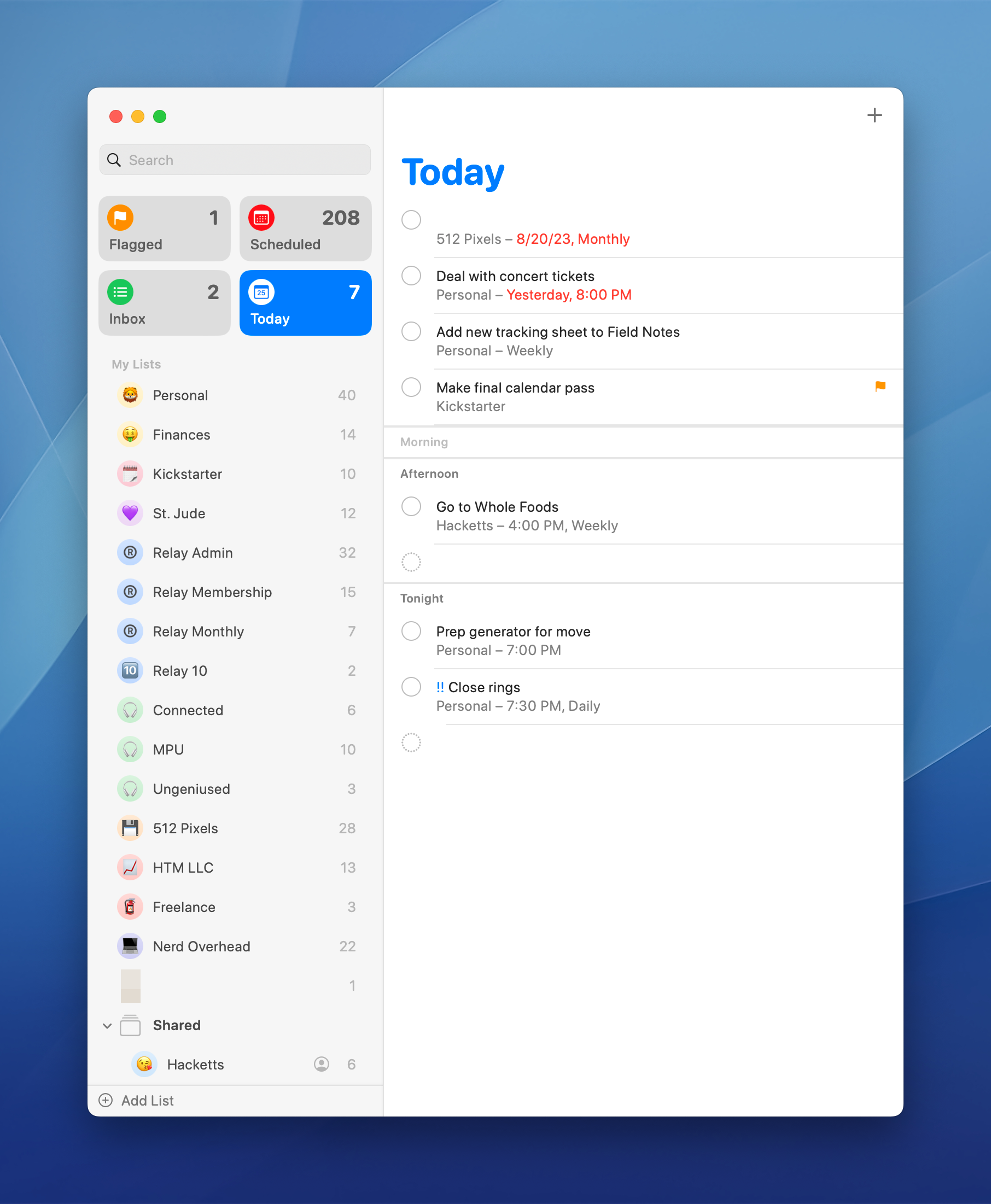
The Today view is the most important UI in Reminders, as it pulls in overdue and due tasks into one place. Here is what mine looks like right now:

Reminders Today

As you can see, Today puts tasks in this order:

  • Overdue
  • Due Today (no time)
  • Due this Morning
  • Due this Afternoon
  • Due Tonight

The last three are dependent on the “Group by Time” option being enabled. If it is not, the list simply looks like this:

  • Overdue
  • Due Today (no time)
  • Due Today (with due time)

This screen almost has it right, but I believe that putting tasks without due times above those with that detail can lead to confusion, or worse, missed tasks when reviewing this list.

This should be reversed, with timed tasks, appearing at the top of Today. Thus, the other would be:

  • Overdue
  • Due this Morning
  • Due this Afternoon
  • Due Tonight
  • Due Today (no time)

If this were how Reminders acted, I wouldn’t have to scroll down past a bunch of untimed tasks to make sure I saw everything I needed to get done this morning. It would make the whole screen flow much more naturally. Every other task app I’ve used either does this by default, or as an option, and I hope Apple considers this change.

(This has been filed with Apple as FB13055999, but while you’re in there, please check out FB12336797 as well, which deals with the Task Inspector being much more useful on iOS then it is on macOS.)

Update: This was added to Reminders in 2024 with iOS 18 and macOS Sequoia.

Alex Hay’s Apps Live on at Snailed It ⇢

In March, app developer Alex Hay tragically passed away. Hay’s apps, which include Toolbox Pro, Logger for Shortcuts and Nautomate.

Thankfully they all have a new home, and the news couldn’t be better. Here’s Rosemary Orchard:

We’re truly honoured to be able to announce that we have taken over development of Toolbox Pro, Logger for Shortcuts, and Nautomate.

All three apps were originally developed by indie developer Alex Hay before he tragically passed away back in March after a battle with cancer.

Alex was a well loved member of the indie development community, featuring on numerous podcasts and articles. He was always known as being a kind and generous man, being willing to share his time and knowledge with anyone who asked.

While Alex was an incredible talented developer, producing a series of much loved Apps, his day-job was as an editor and filmmaker where he worked for a variety of TV channels, including programmes such as “My Big Fat Gypsy Wedding” (Channel 4), “Ambulance” (BBC One), as well as cutting content for various Formula 1 brands.

Siri, Define ‘Irony’ ⇢

Ashley Belanger at Ars:

Earlier this month, Zoom announced a surprising decision to require some of its employees to return to the office, where they were expected to work more effectively. Now, leaked audio from an internal Zoom meeting shared with Business Insider has revealed that Zoom CEO Eric Yuan called employees back to the office because he believes that “remote work didn’t allow people to build as much trust or be as innovative.”

The Case For — and Against — Apple Shipping a Larger iMac

There’s been a lot of discussion about the iMac recently, and the thing I was struck by this time around was the place the iMac holds in Apple’s product line.

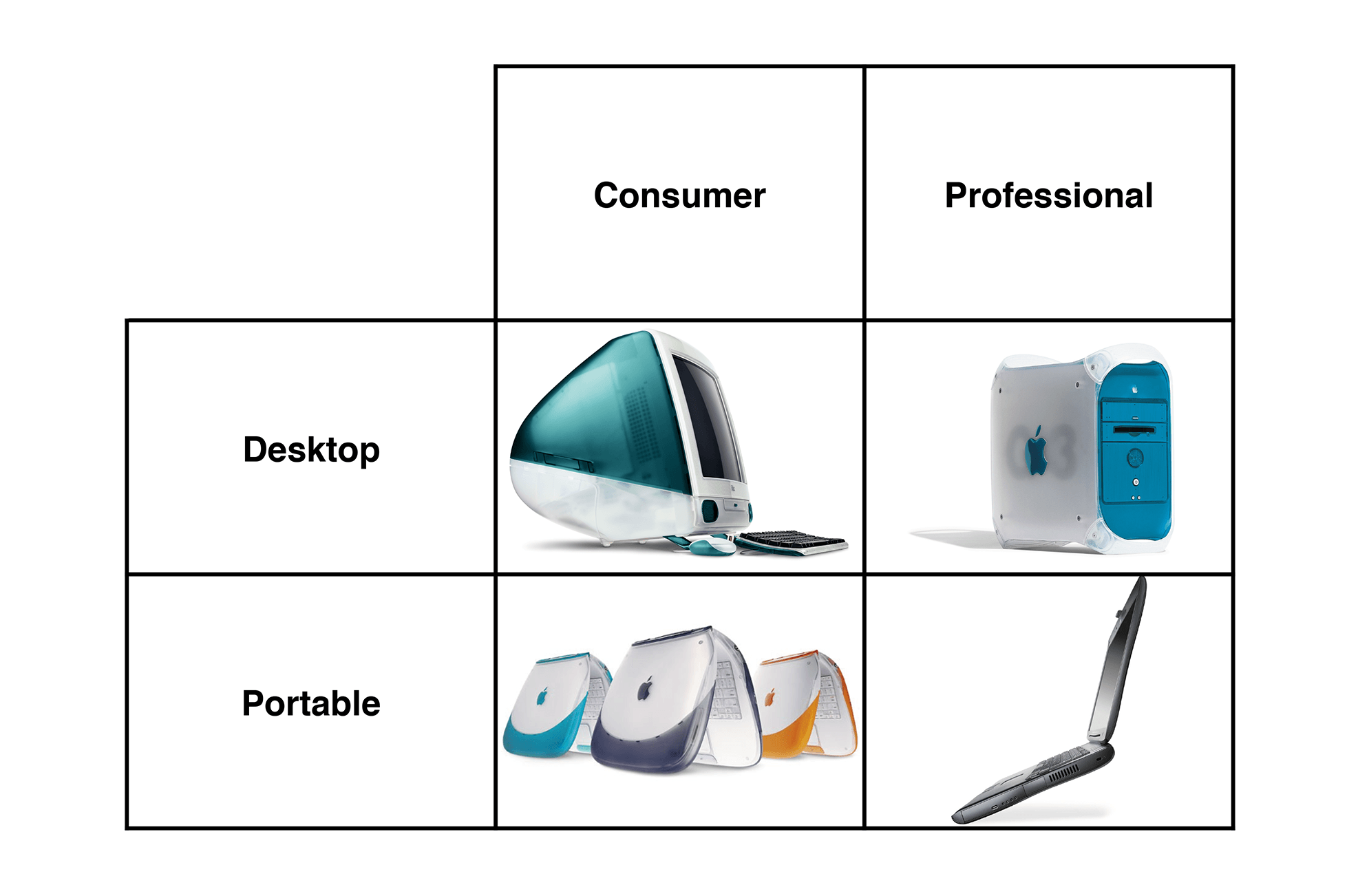
I’ve shown this chart a lot over the years, but it highlights that when it was launched, the iMac was squarely on the consumer side of the grid:
Grid of 4

Apple blew away the Grid of 4 a long time ago — first breaking it with the G4 Cube — and over time, the iMac slowly creeped up to encroach on the professional side of things.

First, it got FireWire, then a G4 and a SuperDrive, then it was the first Mac (by a few minutes) to switch to Intel.

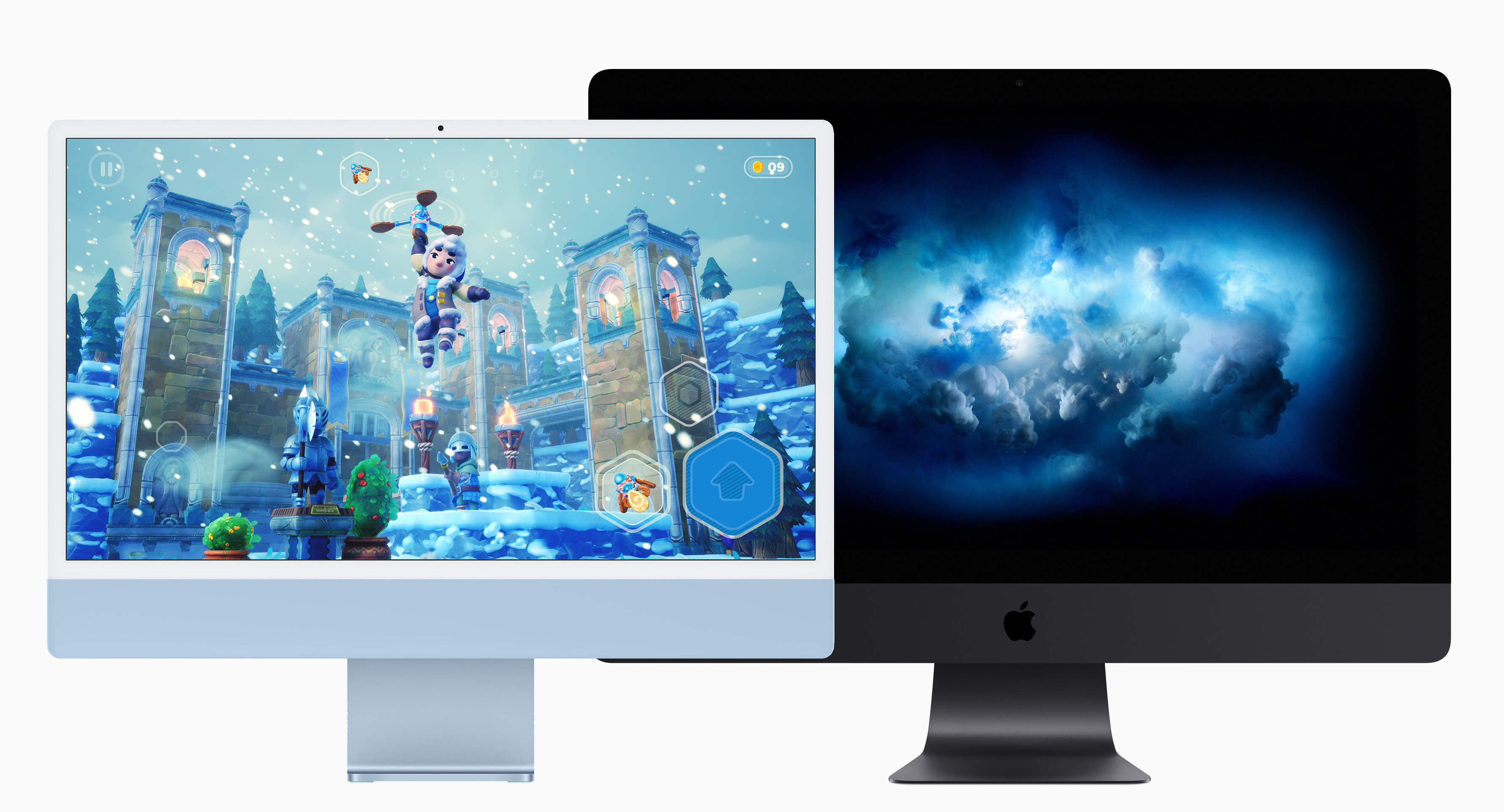
In the Intel era, the iMac truly shined, becoming more and more capable.1 The 5K iMac was jaw-dropping, and the iMac Pro that followed it was the best all-in-one Apple has ever shipped.

In the Apple silicon era, the iMac was reinvented yet again, The current M1-powered machine is beautiful and powerful, but Apple has let it sit since introducing it in April 2021, even as almost every other Mac in the lineup has been updated to an M2-based system on a chip.

The lack of updates and the 24-inch display have left many considering the iMac to be a consumer-level machine again. “Sure, it’s pretty,” you may be tempted to tweet post, “but it’s not the powerhouse the iMac Pro was six years ago when it was introduced.”2The iMac and iMac Pro
This all brings us to the fact that, for the first time in two decades, Apple is only selling one size of iMac. Let’s dive into why Apple should (or shouldn’t) change that, mostly ignoring the web of rumors that surround this topic.

The Case Against a Larger iMac

All-in-ones are inherently compromised due to their form factor. Do you think Apple wanted to put the headphone jack on the side of the M1 iMac? What about when the computer is out dated? Target Display Mode is long gone, and doesn’t seem to be coming back, so it just seems wasteful to pay for a nice, big display just to have the computer behind it drag it down like an anchor after its useful life is over.

Apple has fixed all of this with the Studio Display and its other desktops! The M2 Pro Mac mini is great! Need more? Get a Mac Studio! Shoot, you can even buy a notebook and use it as a desktop without many of the compromises that would bring back in the bad old Intel days! You just don’t need a big iMac anymore with the riches that Apple silicon has brought to the lineup.

The Case For a Larger iMac

The big iMac fits many workstations better than a display with a computer hanging around somewhere. Who wants cables?! Gross! All-in-ones are graceful and elegant, and when’s the last time you actually had an iMac around and you wanted to use its display as a display? That sounds like a fairy tale made up to argue with someone on a forum somewhere.

The iMac is the flagship Mac, and Apple should treat it as such. I’d be willing to pay for the all-in-one experience with a 27-inch (or larger!) display. The company had something really special on their hands with the iMac Pro, and having a Mac mini just doesn’t have the same feeling to it. A big iMac has a presence about it that Apple should preserve.

Apple spent two decades shaping the iMac into something that pros could really use, and they shouldn’t throw away all that good will. Apple should give the people what they want; just listen to Dan Moren:

As an all-in-one desktop, the iMac offers a convenience and price unmatched by any other Apple desktop. Even a base-level Mac mini starts to get pricey once you add an Apple Studio Display to it, and while the flexibility is appreciated, there are still customers (including institutions and education) that appreciate the simplicity of a one-and-done purchase. Adding a more powerful configuration could entice people who might otherwise by a cheaper model to upgrade to a better configuration, especially if they don’t also have to buy a display.

What Do I Think?

I, for one, would like to see a larger iMac make it out into the world, complete with a Pro-level SoC, like the Mac mini has received. The RAM and storage caps on the base-level SoCs feel too limited for a larger iMac. Yes, it would even more SKUs to an already-crowded desktop line, but for twenty years, iMac users have been able to choose a larger, more powerful machine if it fits their needs and preferences, and the M1 model just doesn’t live up to that legacy.


  1. There is a caveat to this, and it’s the fact that Apple kept spinning hard drives around for way too long in the iMac, and the 21.5-inch model languished in the last few years of its life pretty badly. ↩︎

  2. Don’t think too hard about the fact that the M1 iMac is faster than the iMac Pro in a bunch of tasks. ↩︎

RIP, Dr. John Warnock ⇢

Adobe:

It is with profound sadness that Adobe shares the passing of the company’s beloved co-founder Dr. John Warnock. Dr. Warnock passed away on Saturday surrounded by his family.

Dr. Warnock co-founded Adobe in 1982 with Dr. Charles Geschke after meeting as colleagues at Xerox. Their first product was Adobe PostScript, groundbreaking technology that sparked the desktop publishing revolution. Dr. Warnock retired as CEO in 2000 and he was chairman of the board, a position he shared with Dr. Geschke, until 2017. He was a member of the Board of Directors since then. In recognition of their technical achievements, Dr. Warnock was awarded the prestigious National Medal of Technology and Innovation by President Barack Obama; the Computer Entrepreneur Award from the IEEE Computer Society; the American Electronics Association Medal of Achievement; and the Marconi Prize for contributions to information science and communications.

Sponsor: MarsEdit 5 ⇢

MarsEdit 5 is a major upgrade to the preeminent Mac app for editing WordPress, Micro.blog, Tumblr, and many other types of blogs.

The new Microposting feature makes it “as easy to post to your own blog as it is to post to Twitter.” When MarsEdit 5 is running on your Mac, just press a configurable global keyboard shortcut, write out your latest thoughts, and instantly publish to your blog.

MarsEdit supports editing posts in rich or plain text, and the latest update is especially great for Markdown fans. Now when you’re writing Markdown in plain text mode, MarsEdit applies live, beautiful syntax highlighting to make it easier to focus separately on the content and style of your posts.

MarsEdit is used by top bloggers to maximize their productivity and enjoyment of blogging. It’s great for pros like John Gruber of Daring Fireball, and yours truly, while also being simple enough to remove the mystery of blogging for everyday folks who just want to share their thoughts with the world.

New this month: MarsEdit has a new beta featuring preliminary support for publishing to Mastodon! Now you can use the same app you use to write and publish to your main blog, to write and publish to your Mastodon microblog. Check out the beta at this link

One app, limitless publishing opportunities.

Download MarsEdit today, and see what all the hype is about. It’ll make you a better blogger!

Some Tasty Numbers Concering X ⇢

Matt Binder at Mashable, reporting on data from Travis Brown about Elon Musk’s 153 million followers:

Of the 153,209,283 X accounts following Musk at the time the data was collected, around 42 percent of Musk’s followers, or more than 65.3 million users, have zero followers on their own account. Just over 72 percent, or nearly 112 million, of these users following Musk have less than 10 followers on their account.

When it comes to content creation on the platform, more than 62.5 million Musk followers have zero tweets. This would include users who have deleted all of their tweets by the time this data was collected over the past few weeks as well as accounts that have never before tweeted. More than 100 million Musk followers have less than 10 tweets posted to their account.

If that wasn’t concerning enough, this paragraph has to sting:

However, according to this latest collection of @ElonMusk follower data, only around 453,000 Musk followers or 0.3 percent subscribe to X Premium. Mashable reported earlier this week that there were around 830,000 X Premium subscribers in total based on another data set compiled by Brown.