512 Pixels

The Sad Saga of the 500 MHz Power Mac G4

In August 1999, Apple announced the first Power Mac G4: 1

The Power Mac G4 is powered by the revolutionary new PowerPC G4 chip architected by Apple, Motorola and IBM, and is the first personal computer in history to deliver supercomputer-level performance of over one billion floating-point operations per second. The Power Mac G4s run professional applications like Adobe’s Photoshop up to twice as fast as 600MHz Pentium III-based PCs.

The G4 chip incorporates a new execution unit named the Velocity Engine — the heart of a supercomputer miniaturized onto a sliver of silicon. In a set of Intel’s own tests published on their web site, the 500MHz G4 chip was 2.94 times as fast as the 600MHz Pentium III processor.

“The Power Mac G4 is not only the fastest Mac ever, it’s the fastest personal computer ever,” said Apple’s interim CEO Steve Jobs. “The revolutionary G4 processor with its remarkable Velocity Engine is the first ‘supercomputer on a chip,’ delivering over one gigaflop of sustained performance.”

The new lineup was clad in a more mature version of the Blue and White G3’s case, but on the inside, things were a bit confusing.

Power Mac G4

At the low end was the Power Mac G4 (PCI Graphics) clocked at 400 MHz. It was joined by the Power Mac G4 (AGP Graphics), with 450 and 500 MHz configurations.

In the November 1999 edition of Macworld, Andrew Gore explained the differences between the models:

In the initial Power Mac G4 lineup, are two different configurations, one an intermediate step between the faster G4s and the blue-and-white Power Mac G3, and the other a high-end configuration featuring impressive new technologies.

In order to get one model in the G4 lineup down under $2,000-and to get it out to customers as soon as possible Apple placed a 400MHz G4 processor onto a slightly modified version of the blue-and-white G3’s logic board and put the board in the new Power .Mac G4 case. In almost all other respects, the low-end Power Mac G4 is exactly the same as the G3 Power Macs. One notable exception: none of the Power Mac G4 models feature an ADB port.

The article was joined by this helpful table of specs:
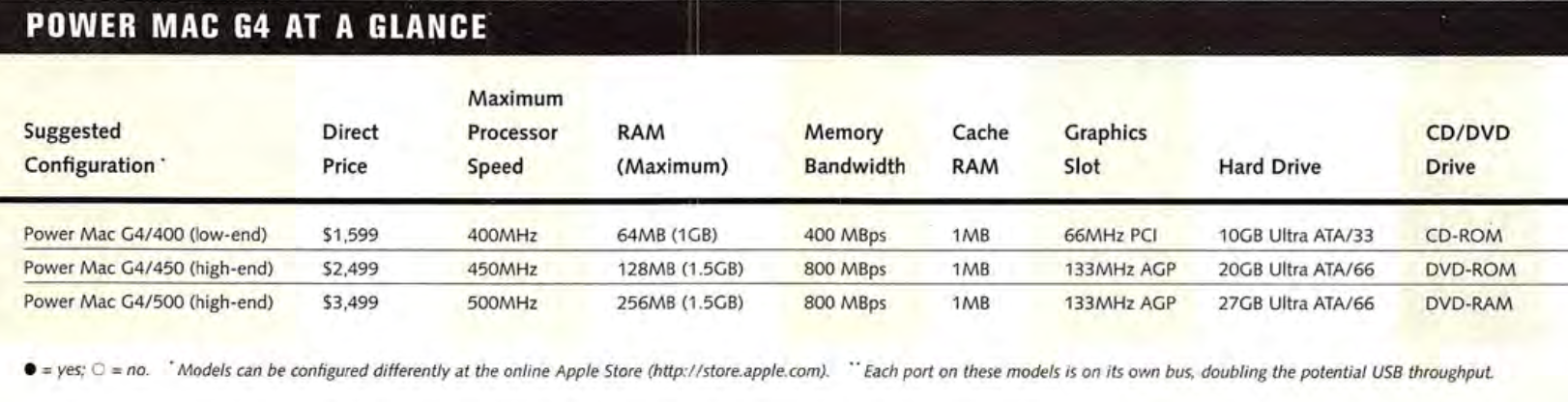
G4 specs, as of fall 1999

Toward the end of the piece, Gore wrote:

If you’re itching to rush out and buy one of the high-end Power Mac G4s, hold your horses. While Apple says the low-end 400 MHz system is shipping now, at press time the company was predicting shipment of the 450 MHz G4 model sometime in September and the 5OO MHz unit in October.

He urged the reader to hold out for an AGP model, which was faster and more forward-looking than the PCI machines, which were basically the old G3 with a faster processor:

Unless you absolutely can’t afford the pricier models or can’t wait another minute, we suggest you bide your time and wait for the high-end G4 configurations to appear. Although the G4 processor does account for a lot of the performance improvements in the new models, the niceties of the new logic-board design will also have major impacts on speed. And if you opt for the low-end model, you won’t be able to play with cool new capabilities like using an AirPort card, internal FireWire devices, two separate USB ports, or the new Apple Cinema Display.

This press release, dated October 13, 1999, explains what was going on with Apple’s supply of PowerPC G4s:

Apple today announced that it has reconfigured the processor speeds in its Power Mac G4 line to match PowerPC G4 chip availability from Motorola. The new Power Mac G4 configurations will now include processors running at 350 MHz, 400 MHz and 450 MHz, and will be priced at $1,599, $2,499 and $3,499, respectively. The move is in response to Motorola’s delays in reaching volume production of its 500 MHz G4 processor chip, which is now scheduled for availability early next year.

These new configurations will enable us to meet the tremendous demand for our new Power Mac G4 line, said Steve Jobs, Apple s interim CEO. Fortunately, the machines remain very, very fast easily outperforming Pentium III-based PCs.

Apple also announced today that IBM will begin manufacturing G4 processor chips in the first half of calendar 2000 for use in Apple products.

It’s not very often in Apple’s history that one comes across a product update that results in a slower product, but clearly it wasn’t the plan. Notably, Apple didn’t lower the price of the towers to reflect their new, slower speeds. The move took on the name “speed dump,” as Mac users weren’t happy with the changes.

In December Apple updated the lineup, getting rid of the PCI model, replacing it with a 350 MHz Power Mac that included all the upgrades present in the AGP models.

Thankfully the 350 MHz Power Mac G4 didn’t lead a long life, as in February 2000, Apple updated the lineup once again:

Apple today announced it has increased the performance of its industry-leading Power Mac G4 line with faster processors running at 400-, 450-, and 500 MHz. Pricing remains unchanged, starting at US$1,599. The Power Mac G4, which features the PowerPC G4 processor with its remarkable Velocity Engine, runs professional applications like Adobe Photoshop over 50 percent faster than 800 MHz Pentium III-based PCs.

A full six months after its original introduction, Apple was finally shipping a 500 MHz Power Mac G4. In the grand scheme of things, this was a mere hiccup in what was otherwise a golden era for Mac hardware advancements, and a lesson in controlling your own technology stack that Apple wouldn’t forget.


  1. If you want to read more about the entire Power Mac G4 family, check out this article over on MacStories. ↩︎

Something Old, Something New, Something Borrowed and Something Blue ⇢

In the upheaval surrounding Twitter’s changes to its verification system, many were left wondering how accounts posing as politicians, journalists, musicians, athletes and others could be noted as official. As it turns out, the checkmark was the way to go after all.

Jay Peters at The Verge has more:

Twitter is rolling out another type of checkmark to help distinguish accounts that users actually need to know are real. Although you can pay for a blue checkmark with the new version of Twitter Blue, select accounts for governments, companies, or public figures will get a gray “Official” checkmark, according to a thread from Twitter’s Esther Crawford, who is heading up the new Twitter Blue initiative.

“A lot of folks have asked about how you’ll be able to distinguish between @TwitterBlue subscribers with blue checkmarks and accounts that are verified as official, which is why we’re introducing the ‘Official’ label to select accounts when we launch,” Crawford says.

“Accounts that will receive it include government accounts, commercial companies, business partners, major media outlets, publishers and some public figures.”

Being previously verified doesn’t automatically mean you’ll get the new “Official” label, and you can’t buy the new label, meaning Twitter will be the one making the call on who gets to have it.

It really feels like someone is making this stuff up as he goes along.

Update: A couple hours after this rolled out, it stopped, with Elon tweeting “I just killed it.” ROFFFLLLLLLLLLLLLLLLL.

2023 Sponsorships Now Open

Just a quick programming note that I have opened up sponsorships for next year. Details are all over on this page. If you have a cool product, app or service, 512 Pixels is a great way to get the message out.

Apple Frames 3.0 ⇢

Federico has updated his amazing Apple Frames shortcut:

Apple Frames 3.0 is a major update that involved a complete re-architecture of the shortcut to improve its performance and reliability on all Apple platforms. For Apple Frames 3.0, I entirely rebuilt its underlying file structure to move away from base64 and embrace Files/Finder to store assets. As a result, Apple Frames 3.0 is faster, easier to debug, and – hopefully – easier to maintain going forward.

But Apple Frames 3.0 goes beyond a new technical foundation. This update to the shortcut introduces full compatibility with the iPhone 14 Pro and 14 Pro Max with Dynamic Island, Apple Watch Ultra, and the M2 MacBook Air. And that’s not all: Apple Frames 3.0 also brings full support for resolution scaling on all iPad models that offer the ‘More Space’ display mode in iPadOS 16. And in the process, I also added support for ‘Default’ and ‘More Space’ options on the Apple Silicon-based MacBook Airs, MacBook Pros, and iMac. All of this, as always, in a native shortcut designed for high performance that uses Apple’s official device images and requires no manual configuration whatsoever.

This is a very useful Shortcut, and I’m so glad Federico keeps iterating on it.

Twitter is Literally Breaking ⇢

It’s just been a few days since Musk let go roughy half of Twitter’s staff, and the cracks are already beginning to show, as Elizabeth Lopatto has discovered:

I can’t change my screen name on Twitter. I can change my bio. But not my screen name. So although I was helpfully trying to describe myself as “Elizabeth Lopatto (parody)” that simply wasn’t possible.

[…]

I have no idea what’s causing this problem but I’m not the only one experiencing it. My coworker Alex Cranz can’t change hers either. Neither can Jay Peters, Tom Warren, or Sean Hollister. However, our coworker Mitchell Clark can! Cranz, Peters, Warren, Hollister and I are all verified. Clark isn’t.

Hmmmmm.

Update: It’s a little unclear if this was a technical problem or a policy change. Honestly, it’s hard to tell the difference all of a sudden.

Apple Highlights NightWare ⇢

I have not come across this app before, but it was really neat to read about it on Apple Newsroom this morning:

NightWare is a digital therapeutic system that works in conjunction with Apple Watch and iPhone to disrupt nightmares related to post-traumatic stress disorder. Available by prescription only, it’s also the first and only digital therapeutic developed specifically to treat nightmares that is cleared by the FDA. NightWare uses information from the Apple Watch heart rate sensor, accelerometer, and gyroscope to detect a nightmare and then disrupt it through haptic feedback, generating gentle pulses on the wrist that gradually increase until the user is roused from the nightmare, but not from sleep.

This sort of thing is consumer technology at its best.

Kbase Article of the Week: Use USB-C cables with your Mac ⇢

Apple Support:

If you have a Mac with Thunderbolt 3 (USB-C), Thunderbolt / USB 4, Thunderbolt 4 (USB-C), or USB-C ports, you can use cables to transfer data and connect your Mac to other devices and displays. If you have a Mac notebook computer, you can also connect to a power adapter to charge your Mac.

It’s great having One Connector to Rule Them All, but wow is USB-C messy.

Sponsor: Magic Lasso Adblock: YouTube Ad Blocker for Safari ⇢

Do you want to block all YouTube ads in Safari on your iPhone, iPad and Mac?

Then download Magic Lasso Adblock – the ad blocker designed for you. It’s easy to setup, doubles the speed at which Safari loads and now blocks all YouTube ads.

Magic Lasso Adblock for YouTube

Magic Lasso is an efficient, high performance and native Safari ad blocker. With over 4,000 five star reviews; it’s simply the best ad blocker for your iPhone, iPad and Mac.

It blocks all intrusive ads, trackers and annoyances — letting you experience a faster, cleaner and more secure web browsing experience.

The app also now blocks over 10 types of YouTube ads including all:

  • video ads
  • pop up banner ads.
  • search ads
  • plus many more

And unlike some other ad blockers, Magic Lasso Adblock respects your privacy, doesn’t accept payment from advertisers and is 100% supported by its community of users.

Join over 250,000 users and download Magic Lasso Adblock from the App Store, Mac App Store or via the Magic Lasso website.

SLS Back on the Pad

NASA is about to try to launch its Artemis 1 mission again. Here’s Stephen Clark at Spaceflight Now:

NASA scrubbed the first launch attempt for the Artemis 1 moon mission Aug. 29, when data indicated one of the rocket’s four hydrogen-fueled main engines was not being properly thermally conditioned during the countdown. Engineers later determined that the thermal measurements were from a bad sensor, and not indicative of a more serious problem.

A second launch attempt Sept. 3 was scrubbed by a hydrogen leak in the connection between the core stage of the rocket and its mobile launch platform. NASA replaced seals in the connection fully fueled the rocket in a tanking test Sept. 21 without any significant leaks, paving the way for launch opportunities in late September and early October.

But the threat from Hurricane Ian forced NASA officials to move the rocket back to the Vehicle Assembly Building for safety, delaying the next Artemis 1 launch attempt to Nov. 14. Unlike the mission’s previous countdowns, the next three Artemis 1 launch opportunities will be at night. Trajectory limitations and the position of the moon relative to Earth determine when the mission can launch.

The launch window on November 14 starts at 12:07 a.m. EST and will extend 69 minutes,1 with backup windows on November 16 and 19.

If the SLS continues to give NASA trouble and the rocket doesn’t get off the ground in these upcoming windows, things could get a lot more complicated, as Eric Berger reports at Ars:

On Thursday, NASA officials held a teleconference with space reporters and discussed the planned rollout of the Space Launch System rocket and Orion spacecraft early on Friday morning. The space agency remains on track for an Artemis I launch attempt on November 14, shortly after midnight, said Jim Free, who leads exploration systems development for NASA. This will be the third attempt to launch the SLS rocket on its debut flight. Free said the launch team is confident, but acknowledged there are “unknown unknowns” that may crop up during the countdown.

December deadline? … One of the big questions about the rocket concerns the lifetime of its massive solid rocket boosters, which have now been stacked for nearly two years. NASA’s Cliff Lanham, who oversees ground systems, said NASA’s initial analysis found that the rocket boosters provided by Northrop Grumman had a lifetime of one year. However, a subsequent analysis of their health cleared one through December 9, 2022, the other through December 14. NASA could probably extend their life further with additional analysis, Free adds. But this will be a source of concern if the Artemis I mission has to be delayed again.

Given how rocky this rocket’s development has been over the last decade, I’ll feel a lot better about things once it’s on its way to the moon.


  1. Nice. ↩︎