
My thanks to Black Ink from Red Sweater for sponsoring 512 Pixels this week. Black Ink celebrates the art of crosswords by offering a beautiful solving experience on your Mac. Download and solve right in the app, or print the puzzles with your preferred layout to solve with a pen or pencil.
512 Pixels
The Mystery of the First Email Sent from Space (via a Mac Portable)
Thirty years ago, a Macintosh Portable was used to send an email from aboard the space shuttle Atlantis as part of the STS-43 mission.
The email in question was sent to Marsha Ivins at Johnson Space Center and said:
Hello Earth! Greetings from the STS-43 Crew. This is the first AppleLink from space. Having a GREAT time, wish you were here,…send cryo and RCS! Hasta la vista, baby,…we’ll be back!
The message was sent via AppleLink, an online service created for use between Apple, its customers, and its various dealers and partners. (It was replaced by eWorld in 1994.)
Adam Engst wrote about this event back in 1991:
According to Michael Elliot Silver, AppleLink Development Project Manager, this success came after two failed connections. An error message reading “The modem pool is not responding” was reported by the Atlantis crew, apparently caused by a spike in the signal putting the ROLM data switching system “back to sleep” after a connection had been established the first time. The second failure occurred because the ROLM had not reset itself properly. The third time was the charm, but because the TDRS (Tracking and Data Relay Satellite) was in low-power mode (part of one of the experiments) and because the shuttle was at a poor attitude in relation to the TDRS, the signal was very weak, and after a couple of minutes the signal began dropping in and out and was lost.
The message was part of a wider set of experiments looking at what sorts of computer controls were best suited for use in microgravity. Here’s Engst again:
The cursor-control experiments were designed (by Lockheed scientists) to determine what kinds of cursor-control devices might be suitable for use on future shuttle missions or on the planned space station. Since there is no gravity to speak of in orbit, a mechanical mouse, which depends on gravity holding a heavy ball against rollers, is useless. The devices that were tested were the Mac Portable’s trackball, a modified aircraft control stick fitted with a thumb ball at the top, a two-inch trackball, and an optical mouse. No test results are available as yet, but we will try to pass them along as soon as Apple or NASA releases them!
According to earlier reports, the Macintosh is not the computer of choice for the space program; a DOS-compatible laptop is. However, Lockheed discovered that the Macintosh had the widest variety of pointing devices available right now, so it became the obvious choice for the experiments. Some future experiments will probably take place with a DOS laptop, but if this mission is any indication, the astronauts will soon be clamoring to get their Macintosh back!
Apple has an archived support document about the project, which includes a very-90s Editor’s Note about the jargon used in the message:
cry = cryogenics (meaning, send more fuel for life support–air, etc.)
CS = Reaction Control System (meaning, send more fuel for maneuvering/control) In other words, they wanted to stay up there!
So where’s the mystery in all of this? Well, according to NASA, Apple, and Guinness Book of World Records this message was sent on August 9, 1991. STS-43 took place from August 2 to 11 that year, so I feel confident the date the message was sent is indeed August 9.
Despite this, I’ve seen it reported several times that August 28, 1991 is the date in question, including the Computer History Museum. I suspect this is the source often used, leading to the wrong date being published in multiple other places. I’ve contacted the museum with my research and will update this post if they get back to me with clarification.
Update: The Computer History Museum got in touch and fixed their error!
Where to Start with Mac Collecting ⇢
Steve at Mac84 has launched a new series talking about which Macs are good choices for burgeoning collectors. If you’re looking for a new pandemic hobby, this video is for you.
The Safari 15 Fight Isn’t Over Yet
Apple’s constant reworking of Safari 15 this summer has been one of the most interesting software stories to come out of the company in a long time. It’s not very often that we see Apple rework something so thoroughly in public.
I’m a fan of the changes Apple has made to Safari 15 so far. The iPhone version was a big mess, and the “compact” tab designed that debuted on the Mac and the iPad made little sense on devices with larger screens. As the time of this writing, we’re still in the beta cycle, but I suspect the options to move the iPhone’s browser UI to the top or bottom of the screen will ship, as will the ability to go back to the compact view on the iPad and Mac. Combined with the option to show color in the tab bar, it’s hard to believe these are all the same browser:
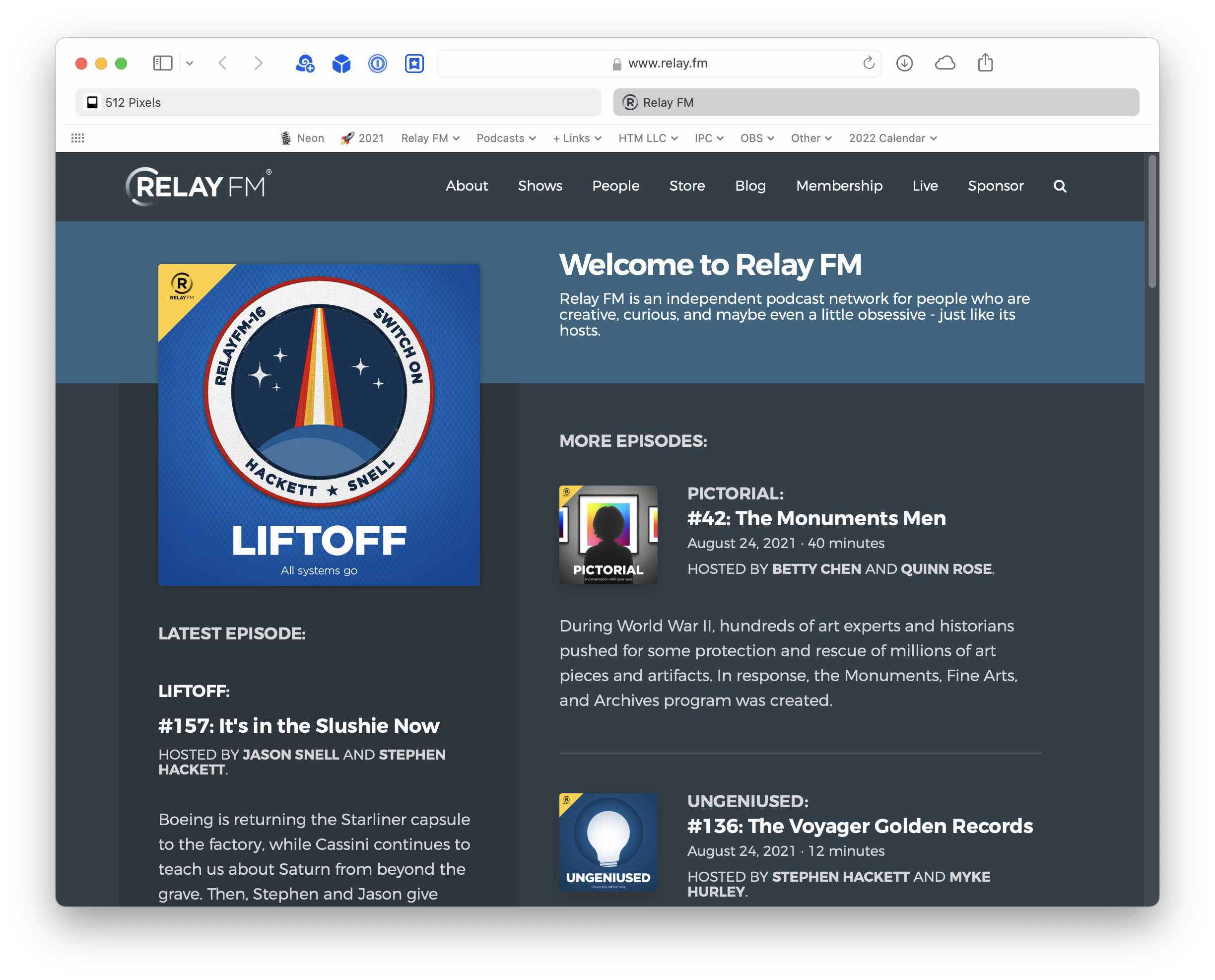
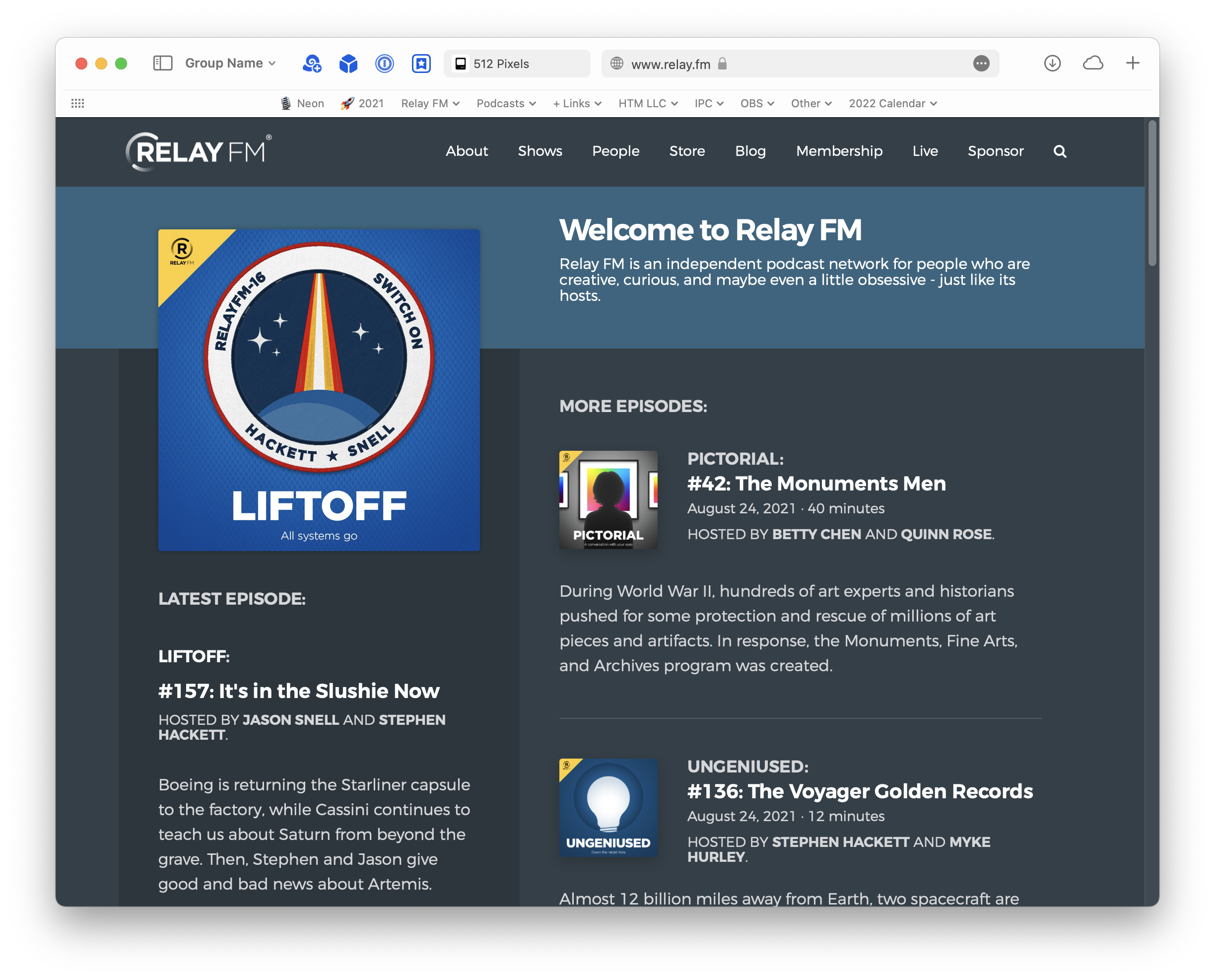
I’m showing the Mac version of Safari 15 here, but the iPhone’s changeable UI is just as jarring. I’m also using the Mac version as an example because it’s what I use all day every day when I’m at my desk.
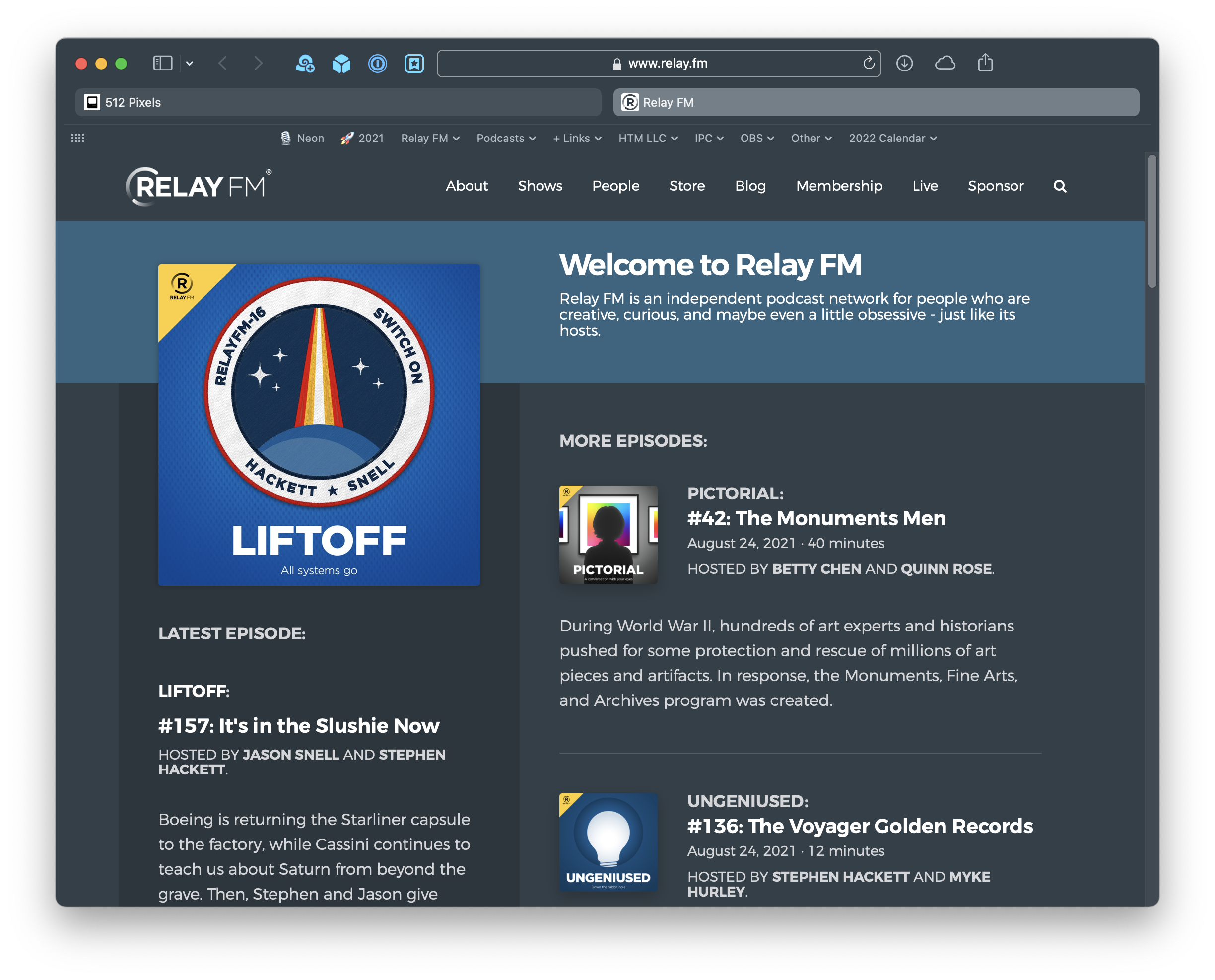
My personal preference is to disable the use of color in tabs, and to banish the compact view forever. This leaves my Safari looking liking this. My yet-unaddressed complaints revolve around the new tab design that I end up with after setting my preferences:

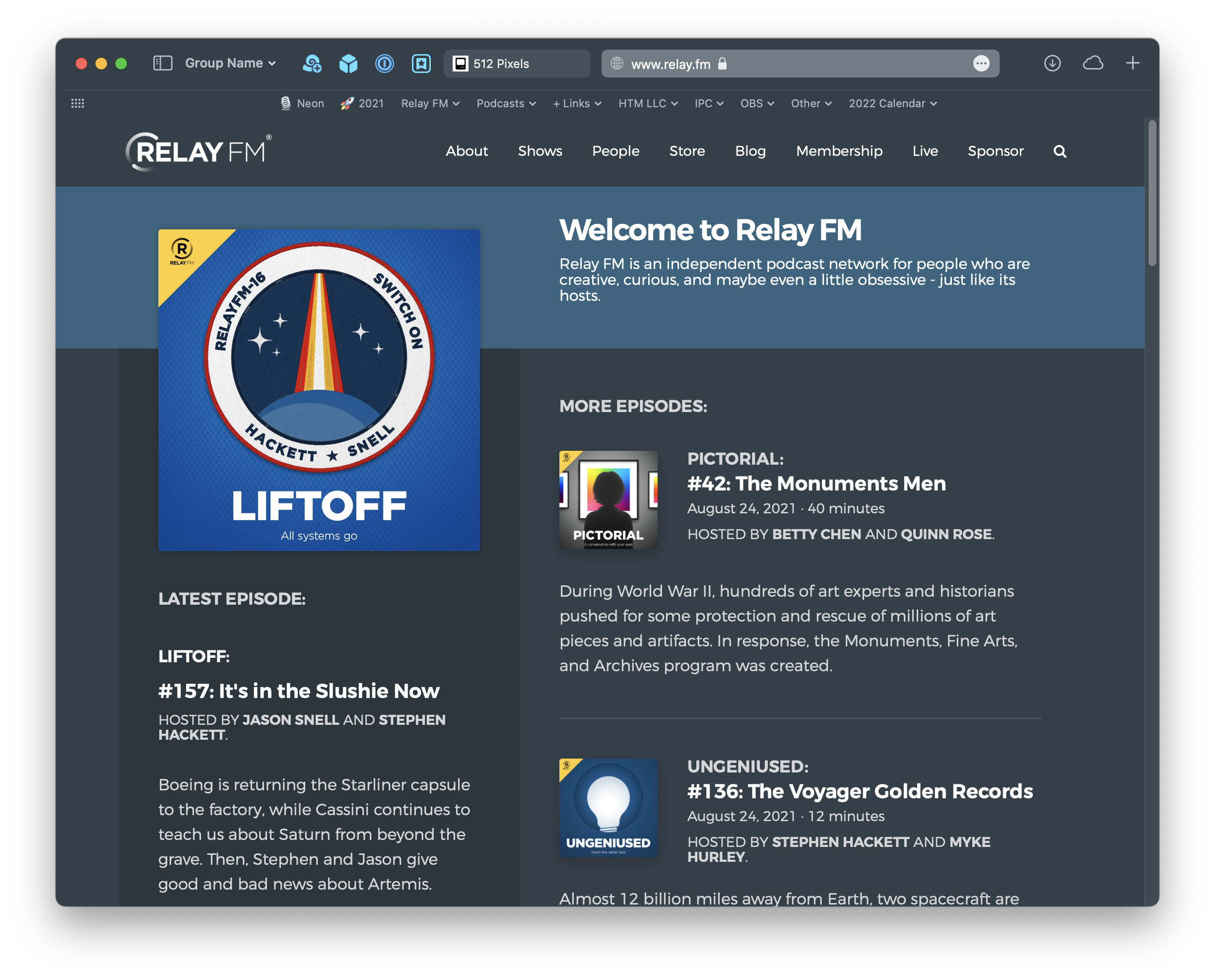
And here it is for you Dark Mode lovers:
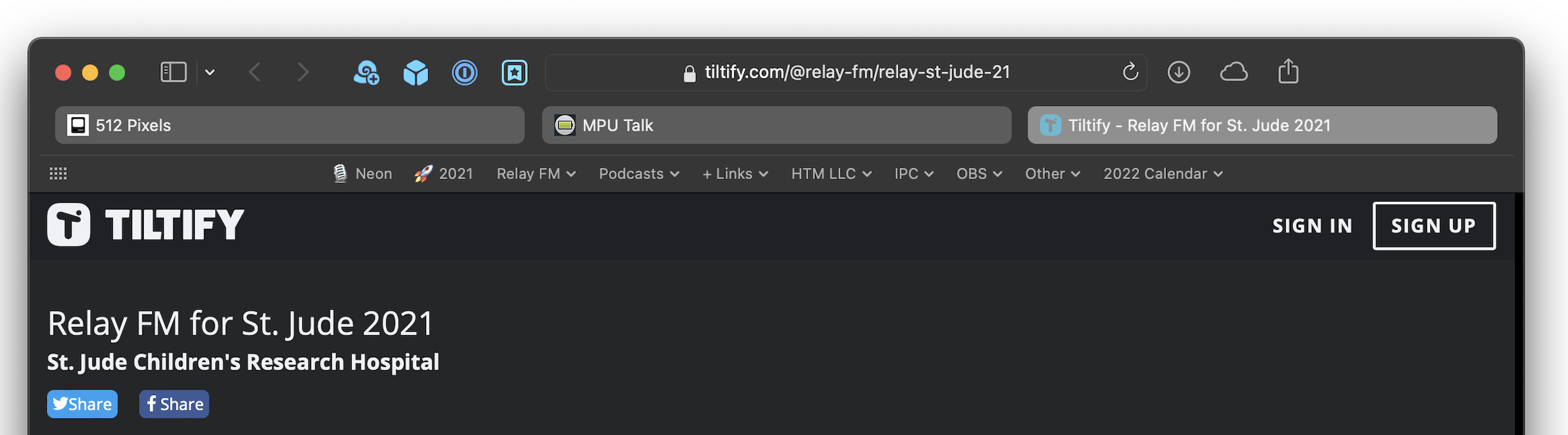
First, there’s the ordering of the UI elements at the top of the screen:
- Address and Search
- Tabs
- Favorites Bar
This divorces the tab — which includes the name of the current webpage — from the webpage itself. Maybe everyone at Apple prefers their bookmarks in the Sidebar instead, but for those of us who are used to the more traditional location,1 having the Favorites Bar split the tab and its content makes skimming what tabs are where more work than it should be.
To make matters worse, it’s hard to tell at a glance which tab is active and which is inactive. Previous versions of Safari didn’t struggle with this, but Apple has seem to fit to bring the age-old “which iPad app has focus” problem to the browser. Using the Monterey beta, I almost always end up trying to tab to or away from the wrong tab because I can’t quickly register which one is active when looking at the tab bar.
That’s not to mention that they look just downright silly, especially if you’re big into wide Safari windows:

Aaaaand that’s not to mention that the button to close a tab appears under the site’s icon at just the right moment for you to accidentally close a tab you’re just meaning to click into.
Apple has made good progress in righting was a terrible wrong with the first version of Safari 15, but just because it’s basically fixed on the iPhone doesn’t mean it’s fine on the iPad or the Mac.
-
If you’re like me and have folders and subfolders of bookmarks, the sidebar design isn’t nearly as efficient to use, but that’s a Radar err Feedback err blog post for a different time. ↩︎
Liftoff #157: It’s in the Slushie Now ⇢
Boeing is returning the Starliner capsule to the factory, while Cassini continues to teach us about Saturn from beyond the grave. Then, Stephen and Jason give good and bad news about Artemis.
My thanks to our sponsors:
- LinkedIn Jobs: Post a job for free by visiting this link.
- Privacy: Smarter payments. Get $5 to spend on your first purchase.
Ungeniused #136: The Voyager Golden Records ⇢
This time on Ungeniused, we’re going far out:
Almost 12 billion miles away from Earth, two spacecraft are speeding away from our Solar System, each carrying a small sample of what it means to be human.
My thanks to our sponsor:
- Privacy: Smarter payments. Get $5 to spend on your first purchase.
Apple Watch Series 7 Leaks Continue ⇢
If the next Apple Watch really does pick up Apple’s modern flat side design language, I’m all for it. I think these renders look great.
Kbase Article of the Week: Open Older iWork Files in Newer Versions of Pages, Numbers, and Keynote ⇢
Learn what to expect when using iWork for Mac to open documents created in older versions of iWork, or when exporting documents to iWork ‘09 format.
It’s always been impressive to me that Apple has kept backward compatibility with older iWork files, especially from before the desktop and mobile apps merged.
Sponsor: Black Ink ⇢
Black Ink celebrates the art of crosswords by offering a beautiful solving experience on your Mac. Download and solve right in the app, or print the puzzles with your preferred layout to solve with a pen or pencil.
You can download puzzles from a variety of sources, both free and subscription-based, right in the app. It also supports solving files in the ubiquitous “Across Lite” format which you can search for and download all over the web.
The New York Times recently caused an uproar by ending its support for Across Lite files. Not a problem for Black Ink users, since the app has adapted itself to continue downloading NYT puzzles just the same as before.
Not so confident about your solving ability? Don’t worry, Black Ink is ready to assist. If you’re stumped, just use one of its built-in features to offer hints or even to reveal a square you are really stuck on.
Rediscover your love of crossword puzzles with Black Ink. It’s free to download and all of its premium features are unlocked with a one-time payment.
Mac Power Users: #602: Was that a Rabbit Hole? ⇢
In this feedback episode, David and I discuss website redesigns, quote applications, encryption, virtualizing Windows and a whole lot more.
My thanks to our sponsors:
- 1Password: Have you ever forgotten a password? You don’t have to worry about that anymore.
- Squarespace: Make your next move. Enter offer code MPU at checkout to get 10% off your first purchase.
- Setapp: More than 200 powerful apps for your Mac. Try it free for a week.
‘Apple Clarifies Mac OS Position’
I recently came across a stash of old Apple press releases, and this one jumped out at me:
At a financial conference in Monterey, Calif., on October 30, 1996, Dr. Gilbert F. Amelio, Chairman and Chief Executive Officer, Apple Computer, Inc., spoke about the general future of operating systems. Contrary to the claims made in several media reports, he did not announce a new operating system strategy for Apple, nor make any new statements about microprocessor or product line direction.
The release goes on to include four points:
Dr. Amelio was speaking in general terms about how operating systems will evolve in the future. At no point did Dr. Amelio signal a change in direction for Apple’s Mac OS strategy.
Apple did not announce a new operating system strategy. Apple has stated that it will release incremental upgrades to the Mac OS and is in the process of finalizing its long term operating system strategy and will announce this by early 1997.
Apple’s strategic hardware direction is focused on the PowerPC. Apple has no current plans to migrate the Mac OS to other microprocessors.
Technologies previously worked on in the Copland project will be integrated into future releases of the Mac OS. It is wrong to characterize Apple’s current OS development efforts as “starting from scratch.”
October 1996 was near the bottom in terms of hope for Apple and its future. In December, the company would announce its acquisition of NeXT. In a press release outlining what the deal meant, this text appears:
NEXTSTEP’s maturity, networking, customer and developer acceptance, multi-tasking, protected memory, scalability from portable to server-level products, information linking, and powerful object-oriented architecture - will provide the Mac OS the underpinning it needs to provide differentiated multimedia and Internet leadership moving forward. Apple is also confident that compatibility with existing applications will be strong in Mac OS as it evolves.
I guess Gil was more right than he knew.
On the History of Tabs and the Rise of Electron ⇢
Francisco Tolmasky has written a fascinating Twitter thread 1 about Apple’s UI frameworks and the rise of Electron all through the lens of tabbed interfaces.
-
That’s what the young people call “blog posts.” ↩︎