Once upon a time, we made one of the earliest MP3 players for the Mac, Audion. We’ve come to appreciate that Audion captured a special moment in time, and we’ve been trying to preserve its history. Back in March, we revealed that we were working on converting Audion faces to a more modern format so they could be preserved.
Since then, we’ve succeeded in converting 867 faces, and are currently working on a further 15 faces, representing every Audion face we know of.
Today, we’d like to give you the chance to experience these faces yourself on any Mac running 10.12 or later. We’re releasing a stripped-down version of Audion for modern macOS to view these faces.
I can’t tell you how much self control it has taken not to spend a day fiddling with this.
My thanks to Backblaze for sponsoring 512 Pixels this week. Get peace of mind knowing your files are backed up securely in the cloud. You can a free 15-day trial with Backblaze and get unlimited computer backup for your Mac or PC.
The current iMac design hails from 2012, so it’s no big surprise that Apple is readying a new, modern iMac, but Gurman has two other interesting things in his report:
Apple is also working on a pair of new Mac Pro desktop computers, its priciest Mac machines that don’t come with a screen included, the people said. One version is a direct update to the current Mac Pro and will continue to use the same design as the version launched in 2019. Apple has discussed continuing to use Intel processors for that model rather than moving to its own chips.
The second version, however, will use Apple’s own processors and be less than half the size of the current Mac Pro. The design will feature a mostly aluminum exterior and could invoke nostalgia for the Power Mac G4 Cube, a short-lived smaller version of the Power Mac, an earlier iteration of the Mac Pro.
Updating the 2019 Mac Pro with new Intel chips would indicate to me a couple of things. First, that Apple knows not all high-end users are ready to switch to Apple silicon, and secondly, that Apple’s chips that could rival the Xeons currently in use aren’t going to be ready super soon.
I would be really surprised if Apple ships both of these concepts at the same time, so maybe the full-sized Mac Pro comes out, then is replaced with the smaller one.
Every time the company has made a small pro desktop, things have gone terribly wrong. The Cube was a real miss, and we all know how the 2013 Mac Pro turned out. Hopefully the third time is the charm.
Also in his report is a bit on a new external display geared to normal humans. I’m all for it.
It is no secret that more Apple silicon Macs are on their way. For the first three models, the new versions are more or less the same as their Intel counterparts, just way faster and better. The Mac mini, MacBook Air and 13-inch MacBook Pro with M1 all look just like the older models.
According to Kuo, Apple is developing two models in 14 and 16-inch size options. The new MacBook Pro machines will feature a flat-edged design, which Kuo describes as “similar to the iPhone 12” with no curves like current models. It will be the most significant design update to the MacBook Pro in the last five years.
There will be no OLED Touch Bar included, with Apple instead returning to physical function keys. Kuo says the MagSafe charging connector design will be restored, though it’s not quite clear what that means as Apple has transitioned to USB-C. The refreshed MacBook Pro models will have additional ports, and Kuo says that Most people may not need to purchase dongles to supplement the available ports on the new machines. Since 2016, Apple’s MacBook Pro models have been limited to USB-C ports with no other ports available.
A major change to the new computers will be how they charge. Over the past five years, Apple has relied on USB-C ports for both power and data transfer on its laptops, making them compatible with other manufacturers’ chargers. But the company is now bringing back MagSafe, the magnetic power adapter that means any accidental yanking of the power cable would simply detach it from the laptop rather than pull down the entire computer. It was a favorite feature of the company’s portable PC lineup that was first introduced in 2006 and most recently revived for its latest lineup of iPhones.
The return of MagSafe with the next MacBook Pros will also allow those laptops to charge at a faster rate, the person said. The connector will be similar to the elongated pill-shape design of the older MagSafe port.
Any time I plug in a laptop with MagSafe, I get sad that Apple dropped the connector. It was just so damn clever I still can’t believe the company killed it off. But the news keeps getting better, as Gurman and Kuo both report that the Touch Bar may be removed from these new models.
People are all over the place on how they think and feel about the Touch Bar, but Apple’s lack of meaningful updates to how it interacts with macOS makes me think it hasn’t been the hit the company wanted it to be. That said, if Apple was going to fully drop the Touch Bar, the M1 MacBook Pro I am typing this one sure seems like an outlier, as it has a Touch Bar. I could see a world where it becomes optional.
Additionally, Kuo writes that these new machines — due sometime in Q3 2021 — will come with additional ports that would mean users would need fewer dongles. While this could just be more USB-C ports, the return of USB A would be welcome. I’m not holding my breath for much more.
I love that these rumors are so exciting again. 2021 is going to be a fun year to be a Mac nerd.
This week on Connected, Federico, Myke and I gathered to discuss Apple’s new Racial Equity and Justice Initiatives, some things at CES that caught their eyes and how they feel about the Apple Watch.
On Connected Pro, the 5-second rule is discussed as is Federico’s switch to Spotify.
My thanks to our sponsors:
Pingdom: Start monitoring your website performance and availability today, and get instant alerts when an outage occurs or a site transaction fails. Use offer code CONNECTED to get 30% off. Offer expires on January 31, 2022, and can be used only once.
Hover: Make a name for yourself. Get 10% off any domain name.
Mack Weldon: Reinventing men’s basics. Get 20% off your first order with promo code CONNECTED.
Apple today announced a set of major new projects as part of its $100 million Racial Equity and Justice Initiative (REJI) to help dismantle systemic barriers to opportunity and combat injustices faced by communities of color. These forward-looking and comprehensive efforts include the Propel Center, a first-of-its-kind global innovation and learning hub for Historically Black Colleges and Universities (HBCUs); an Apple Developer Academy to support coding and tech education for students in Detroit; and venture capital funding for Black and Brown entrepreneurs. Together, Apple’s REJI commitments aim to expand opportunities for communities of color across the country and to help build the next generation of diverse leaders.
“We are all accountable to the urgent work of building a more just, more equitable world — and these new projects send a clear signal of Apple’s enduring commitment,” said Tim Cook, Apple’s CEO. “We’re launching REJI’s latest initiatives with partners across a broad range of industries and backgrounds — from students to teachers, developers to entrepreneurs, and community organizers to justice advocates — working together to empower communities that have borne the brunt of racism and discrimination for far too long. We are honored to help bring this vision to bear, and to match our words and actions to the values of equity and inclusion we have always prized at Apple.”
As part of this, Apple is supporting the launch of the Propel Center, which is designed to support students of Historically Black Colleges and Universities across the country. The company is also opening an Apple Developer Academy in Detroit, as well as invest in venture capital firms working with entrepreneurs of color.
On this episode of Liftoff, Jason and I start 2021 by picking some things they are looking forward to in what promises to be a very busy year in space.
My thanks to our sponsor:
Squarespace: Make your next move. Enter offer code LIFTOFF at checkout to get 10% off your first purchase.
You’re unable to import an MPEG 1 video file into your iDVD project. QuickTime Player can read and play the file, and iDVD Help says: “You can add any video or image file supported by QuickTime to your iDVD project.”
iDVD 1.0 cannot read MPEG 1 video files. The Help file is in error. You may be able to convert your MPEG 1 video files to a different QuickTime format that iDVD can read by using the Cleaner 5 application from Terran.
Terran is definitely not around anymore, but you can read about Cleaner 5 here.
Backblaze offers unlimited computer backup for Macs and PCs for just $6 a month (no gimmicks or add-ons or gotchas included). This means they will back up your movies, music, photos, videos, projects, and all the data you have! You can restore files from anywhere in the world and directly download them from the web or their mobile apps. You can also have your backup sent to you via hard drive and have it overnighted right to your home! Never worry about finding lost versions or deleted files—you can extend your retention period to one year or forever!
Backblaze has over an exabyte of customer data backed up and counting—that’s 1,000,000,000 gigabytes. They have also restored well over 50+ billion files for customers and they come recommended by The New York Times, Inc., Macworld, Tom’s Guide, 9to5Mac, and more.
Get peace of mind knowing your files are backed up securely in the cloud. Start your free 15-day trial with Backblaze today by going to backblaze.com/512pixels.
From the beginning, Mac OS X was designed with security and privacy in mind, but over the years Apple has worked to make both the Mac’s software and hardware more even more so.
We spent the entire episode talking what’s what when it comes to Mac security, and how Apple continues to evolve and improve things over time.
My thanks to our sponsors:
TextExpander from Smile: Get 20% off with this link and type more with less effort! Expand short abbreviations into longer bits of text, even fill-ins, with TextExpander from Smile.
Squarespace: Make your next move. Enter offer code MPU at checkout to get 10% off your first purchase.
Indeed: Get a free $75 credit to upgrade your job post.
In my series 2001 Revisited, I’m covering Apple’s major announcements from 20 years ago. This month, we’re looking at Macworld San Francisco.
To kick off what would be a very busy year, Steve Jobs took to the Macworld stage in San Francisco, boasting that in addition to the 5,000 people in attendance, tens of thousands of people were watching via livestream around the world via QuickTime.
Mac OS X
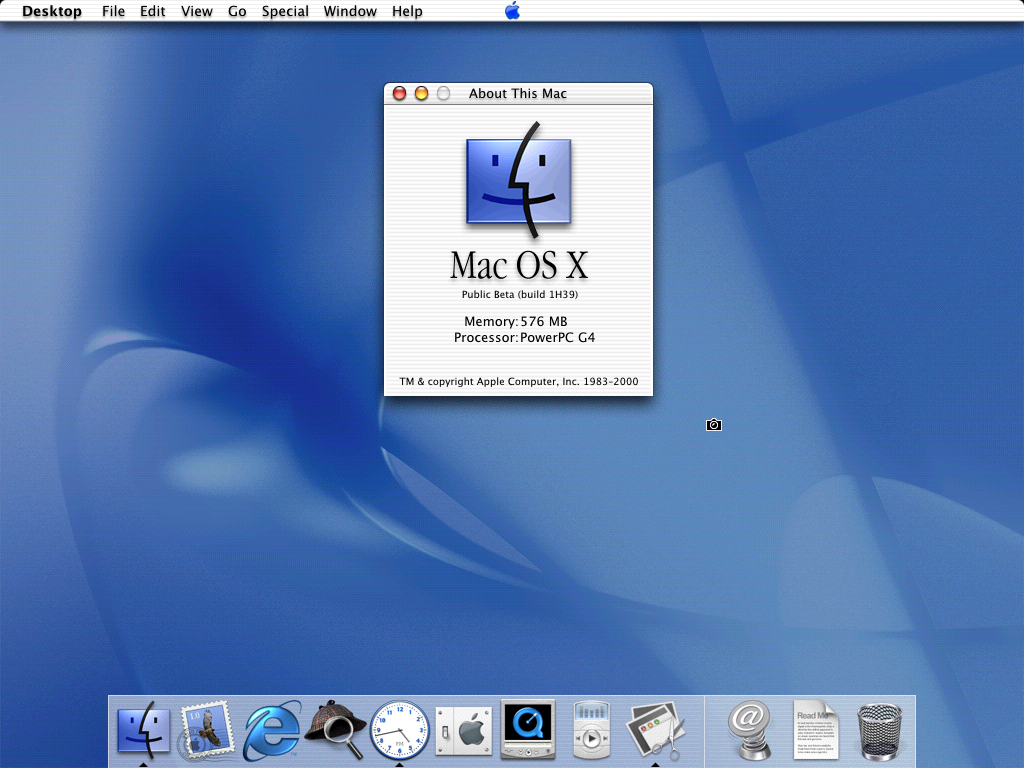
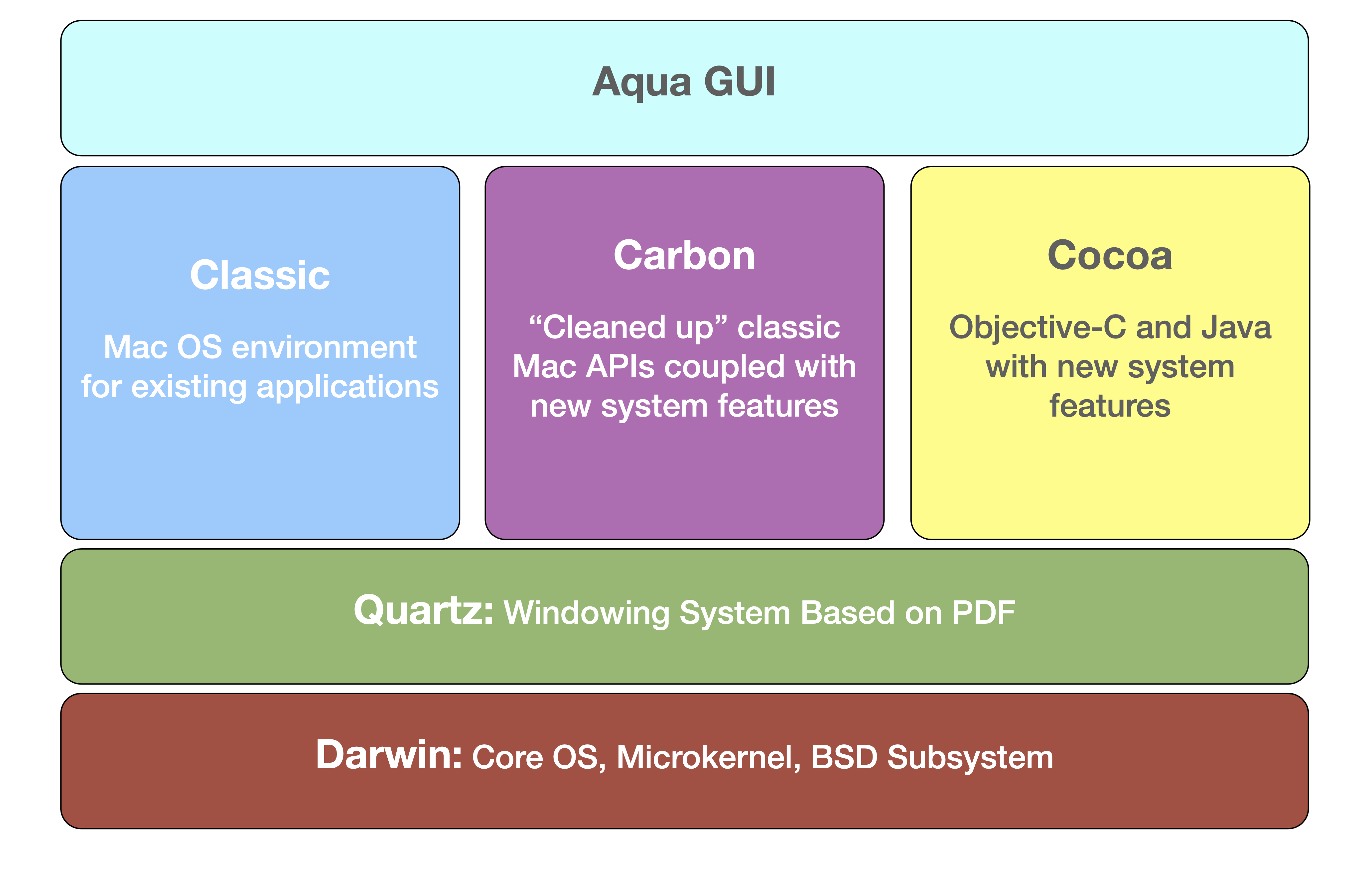
Jobs started by talking about Mac OS X, recapping the new operating system’s architecture, from the kernel on up all the way to the new UI, dubbed Aqua.
I ripped this graphic out of my book about the iMac G3 and the roots of Mac OS X. You should check it out.
He praised the Mac OS X Public Beta, which had on sale since September 2000. Some 100,000 people had purchased it, providing 75,000 feedback submissions.1
After thanking the community for their feedback and involvement, he outlined some common themes in the reports. The first was positive feedback, naturally:
“Far more stable”
“Aqua is incredible”
“Super easy to install”
“Classic really works”
“Mac + Unix is nirvana”
Then he tackled a list of features missing from the public beta:
AirPort support
Printing
Location manager
Dynamic network settings
PPP over Ethernet
After revealing that those features were all in the current build of the OS, Jobs shared some concerns they had been hearing from users:
The Apple menu was terrible
The lack of a clock in the Menu Bar
Disks and Trash on Desktop
No Control Strip
Toolbars were too big
The placement of the Apple logo in the Public Beta was centered in the menu bar, which was ridiculous:
To make matters worse, it was just a logo without any menu items, forgoing one of Mac OS’ more useful UI features.
Thankfully, Apple put it back in the correct place on the left and made it an actual menu again for system-level controls such as Sleep, Restart and Shutdown.
(In the classic Mac OS, these were under the Special menu, and were only available when in the Finder, which was a bit odd.)
To this, Apple added a list of recent items and a way to switch network locations without taking a trip to System Preferences. It wasn’t as flexible as the old Apple menu, but it was a big improvement over the beta.
Toolbars in Finder and other apps were made smaller and customizable, so users could put their own favorite commands and shortcuts where they wanted them. Finder also picked up the ability to spawn a new window for every folder and sub-folder moved through on a user’s way to their desired destination. While this may have looked like the classic Mac OS’ way of doing things, it missed the mark, according to John Siracusa:
The Mac OS X Finder needs a lot of work before it can fill the shoes of its predecessor. The addition of many useful and powerful features to the Mac OS experience (column view, browser mode, the toolbar, bundle manipulation, file mapping, and built-in network integration) does not outweigh the significant problems. Missing features, mis-features, and bugs render the new Finder unable to reproduce the spatial file manipulation environment that has been the defining characteristic of the Macintosh experience since 1984.
Speaking of features from Mac OS, the Control Strip wasn’t reintroduced, but its easy access to settings was shoved into “Docklets,” or icons in the Dock that managed these settings but didn’t launch applications.2 They were weird.
In the early days of Mac OS X, there were a handful of these, including:
Monitors: Manage screen resolution and color depth
Battery Monitor: Shows remaining battery levels on notebooks
Signal Strength: Displays the connection strength for a Wi-FI network
iTunes Dockling: Controls iTunes
Folders: Any folder put in the Dock by a user would show a pop-up of its content when clicked, just like today.
Mercifully, Docklets were killed off with Mac OS X 10.1 Puma, but that’s an operating system update for a different time.
Applications
After discussing Mac OS X itself, Jobs walked through the Carbon and Cocoa application environments. As a recap, early versions of Mac OS X could run classic apps inside a virtual OS 9 machine and apps that had been “carbonized” to run natively on OS X, accessing new features like protected memory and the updated user interface.
Lastly, there was Cocoa, which had its roots in NeXTSTEP, not Mac OS. This was to be a new generation of Mac applications, written in Objective-C.
Jobs boasted that some 400 developers had committed to Mac OS X, accounting for more than 1,200 software titles. While they would not all be out on day one, Jobs pitched a bright future, full of software for Apple’s new operating system.
After a demonstration of Maya on the new OS, the keynote turned to the schedule. Jobs announced that Mac OS X would go one sale on March 24, 2001 for $129. Starting in July, Mac OS X would be the bundled, default OS on new Apple hardware, Jobs said. He closed out this section saying:
We know that Mac OS X is really laying the foundation for the next decade to decade and a half of our software efforts. We think we’ve got something really, really good here. I hope you love it as much as we do.
Power Mac G4 Update
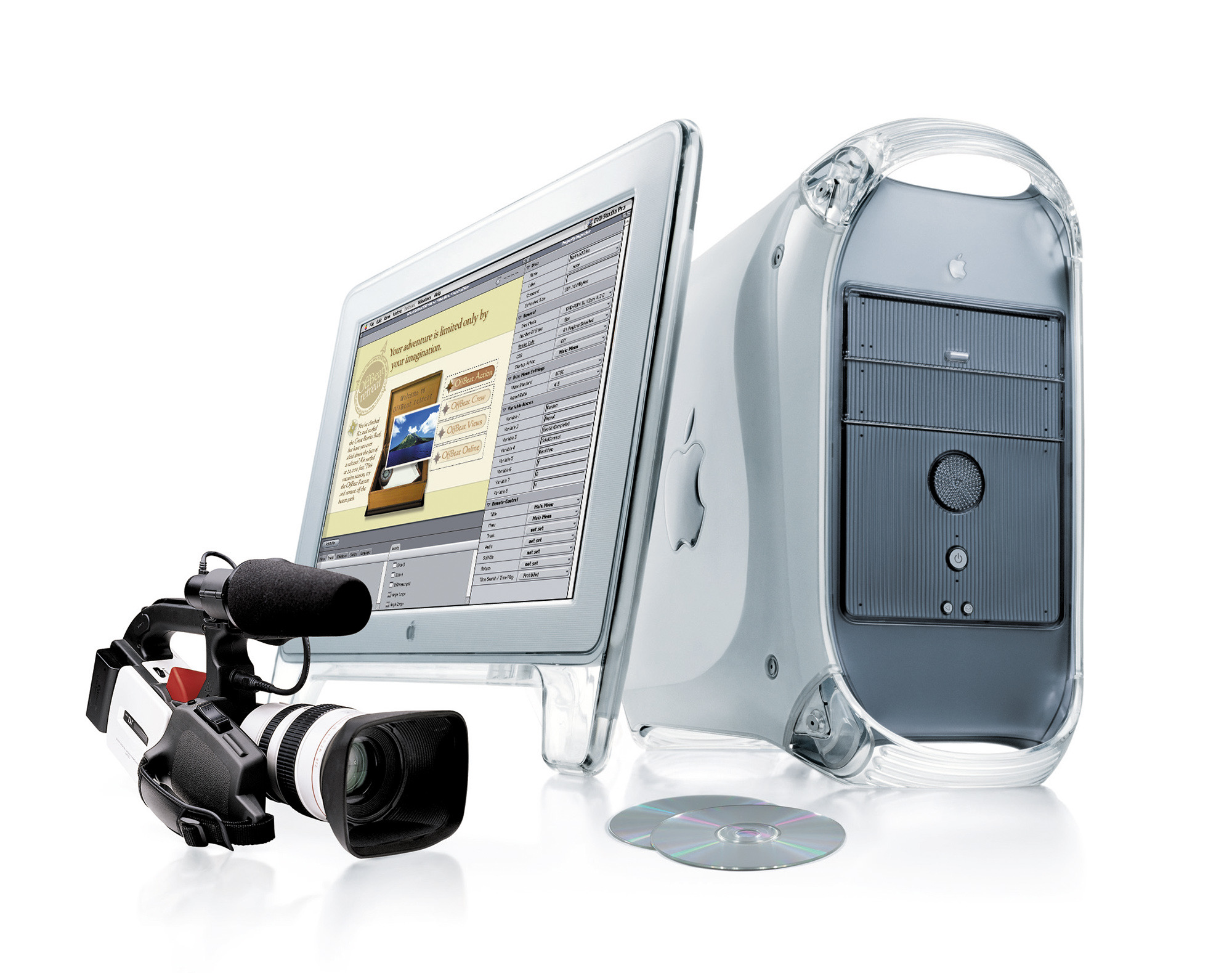
After thirty minutes of software talk, the keynote turned to hardware, starting with a new generation of Power Mac G4 towers. The last machines to use the original industrial design, these are known as the “Digital Audio” G4s.
The name came from the included built-in amplifier, which could be used with Apple’s USB Pro Speakers, also announced at Macworld 2001.
Jobs said the theme for this new generation of G4 was “Power to Burn,” before acknowledging that the Power Mac had topped out at 500 MHz a year and a half before this. These new machines could be ordered with up to a 733 MHz G4, delivering 5.5 gigaflops of computing power.
The processors in the four machines were clocked at 466 MHz, 533 MHz, 667 MHz and 773 MHz.3 The 533 could be custom ordered as a dual-processor system. The slower two machines used the PowerPC 7410 CPU, but the two faster models were built around the PPC 7450, complete with an on-chip 256 KB L2 Cache.
All four had that new digital amp, Gigabit Ethernet, five expansion slots, CD-RW drives, a faster 133 MHz system bus and AGP graphics with NVIDIA cards in the top three models.
Prices ranges from $1699 to $3499. That most expensive model came with a SuperDrive, which Jobs said was an industry first. It could read and write both CDs and DVDs. Those DVDs could be then played on a consumer DVD player. It was a big deal, as Jobs joked: The new G4 could burn CDs, DVDs and Pentiums.
This launched into one of many races Apple would hold between their slower-clocked PowerPC Macs and Windows machines running faster-on-paper Intel CPUs. This time, Phil Schiller came out to show that a 733 MHz Power Mac G4 could run circles around the new 1.5 GHz Pentium 4, at least in Photoshop 6.
The 466 and 533 MHz models were on sale immediately, with the faster SKUs coming the next month.
To make burning CDs on Mac OS 9 and Mac OS X easier, Jobs showed that Finder had been updated to treat blank optical media as a folder. A user could drag files and folders to it, then tell the system to burn the disc when they were ready.
Power Mac Accessories
I’ve already mentioned the Pro Speakers that Apple announced with these machines. Designed in conjunction with Harman/Kardon, they were clear spherical speakers, each roughly the size of the HomePod mini. They sold for $59 a set.
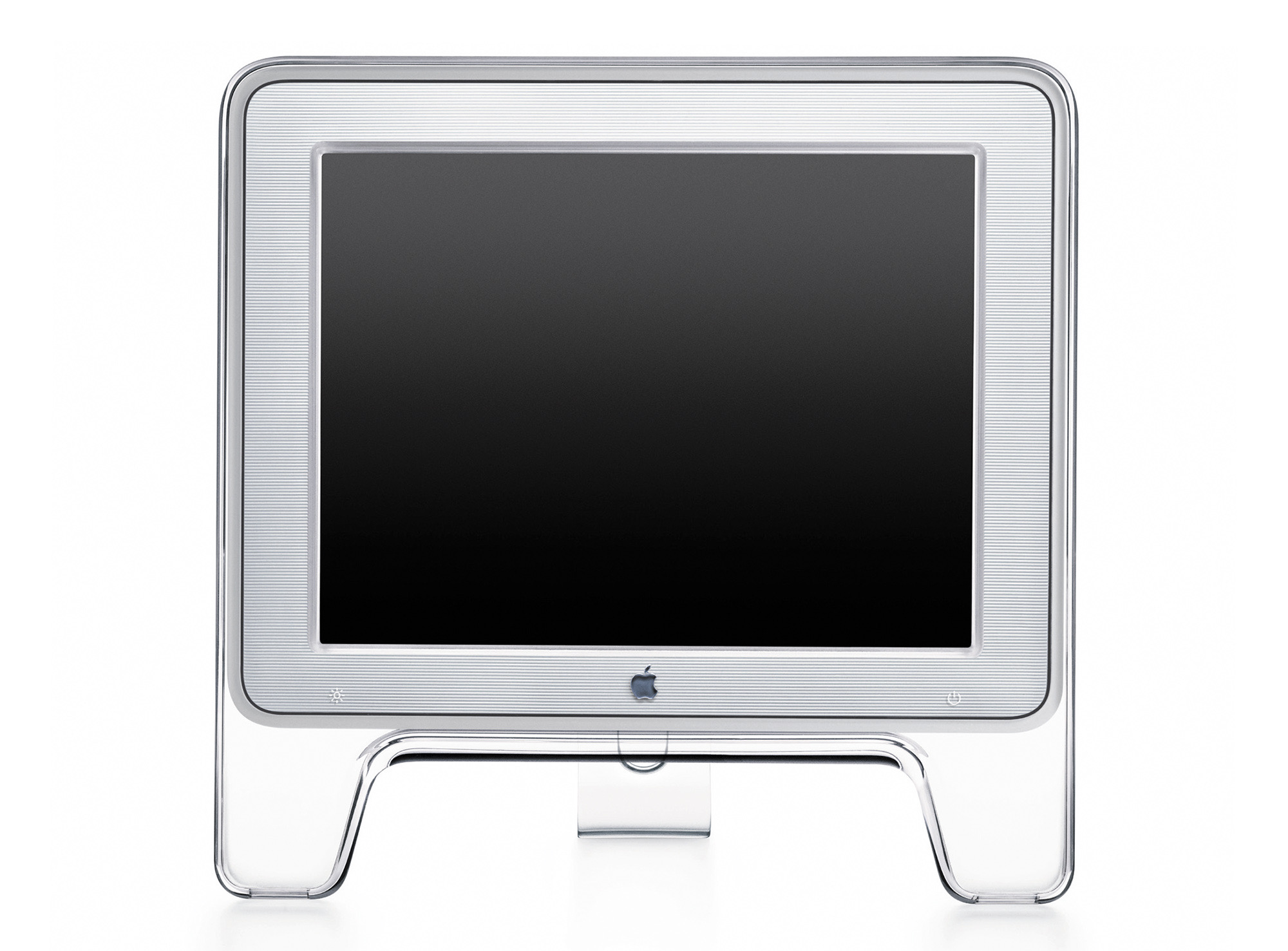
Then, Jobs showed the company’s 15-inch Studio Display, a smaller, less-expensive sibling to the 22-inch variant pictured above with the Power Mac. It used Apple Display Connector (ADC) for power, video and USB all over one cable. It had been for sale at $999, but got a price cut here to $799.
The Digital Hub.
Jobs opened the next section, referencing the downturn in the PC industry. While some were closing up shop on the personal computer, Jobs said Apple saw things differently. The PC wasn’t dying; it was evolving. He laid out his interpretation of the personal computer industry’s history:
1980-1994: The first Golden Age, thanks to productivity tools like word processors, spreadsheets and digital publishing applications.
1995-2000: The second Golden Age, thanks to the rise of the Internet. It added to the productivity tools, making the personal computer more valuable than ever.
Jobs then said the PC industry was about to enter its third great era — the age of the Digital Lifestyle.
Here’s how he laid out this vision:
We are living in a new digital lifestyle with an explosion of digital devices. It’s huge. And we believe the PC, or more importantly the Mac, can become the digital hub of our new emerging digital lifestyle, with the ability to add tremendous value to these other digital devices.
I wrote about the advent and evolution of the Digital Hub over on iMore if you want to read more. Needless to say, Jobs’ words were prophetic and over the subsequent years, Apple would flesh out this vision with products like the iPod for mobile music listening and iPhoto for managing digital photos.
The news at Macworld 2001 was all about digital music. He explained how MP3s worked, and how this was a revolution already underway. In fact, in 2000 alone, 320 million blank CD-Rs had been sold in the United States, and portable MP3 players were becoming popular.4
Jobs walked the crowd through the current music applications and showed how they were just too complex to use, and often came with restrictions on encoding and burning unless the user paid up.
Enter iTunes.
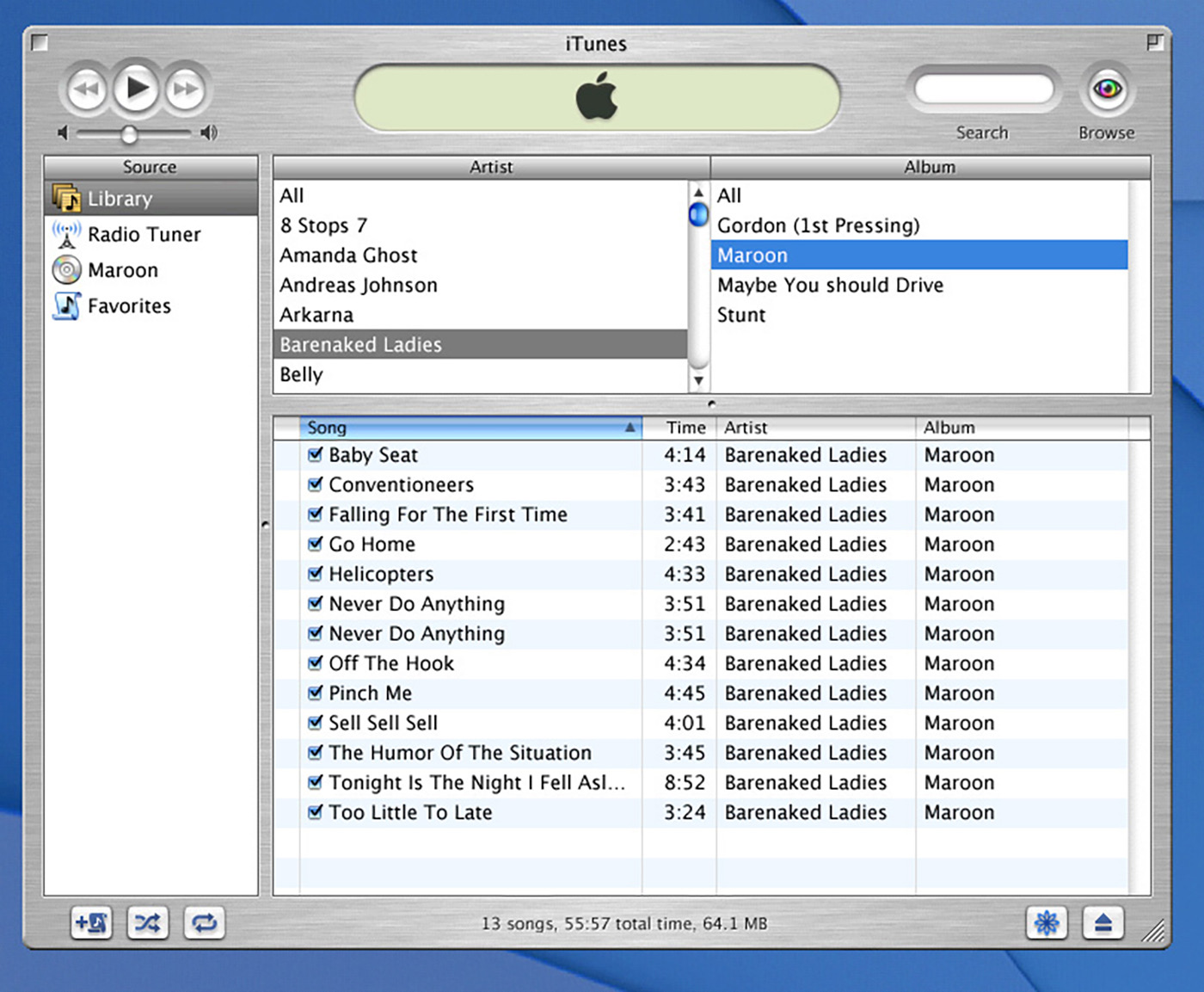
While it’s hard to believe given what would happen to iTunes over the next two decades, but this version of the product was clean and simple.5 Users could import CDs, organize their music into playlists and then burn those playlists onto CD-Rs to take with them. It even had a visualizer and a hip design.
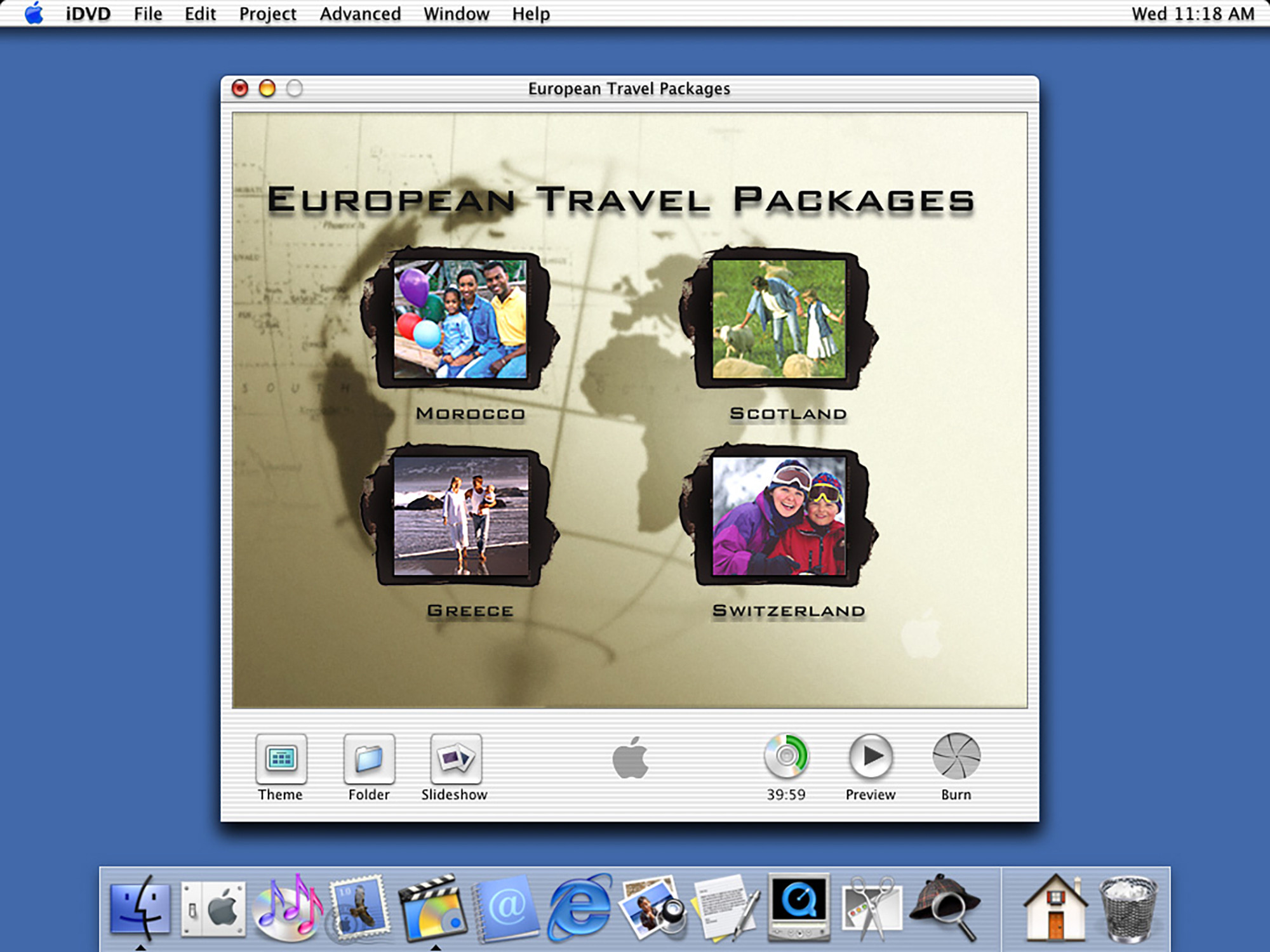
iDVD
After talking about iTunes, Jobs changed gears to talk about the explosion of DVD usage in households and businesses around the world. The dream, he said, was to make your own DVDs, with your own movies on them — and play them on consumer-grade DVD players.
iMovie, which had been around since 1999 let uses edit home video, but that’s as far as it went. By 2001, Apple was ready, thanks to the SuperDrive to burn the discs, and the power of the Power Mac G4’s Velocity Engine to encode the data in software at just 2x real time, a huge increase from the 25x real time that was required before this breakthrough.
This was all building to iDVD, a new application for laying out DVDs with menus.
Jobs demoed the new title on one of the just-announced Power Mac G4s running Mac OS 9. He quickly added titles, menus and the media for playback, thanks to iDVD’s built-in collection of themes, templates and layout tools.6
In just a few short years, this technology would show up in cheaper desktop and even notebooks, but this was a big deal, and along with iTunes and iMovie, formed the foundation that would later become iLife, complete with iPhoto and even later, iWeb.
Titanium PowerBook
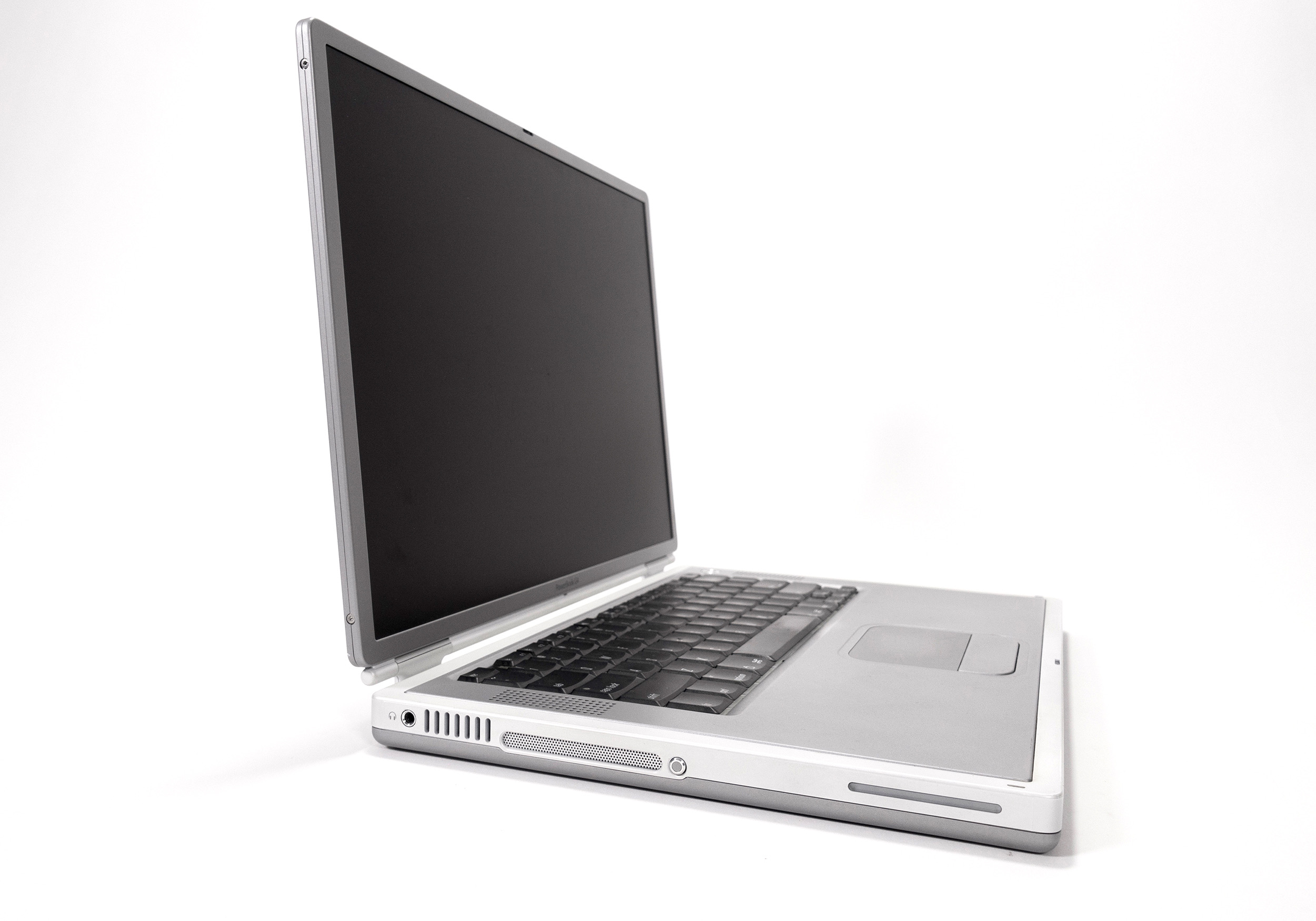
While the Power Mac G4 was great, the real hardware star of this event was my all-time favorite Apple notebook: the Titanium PowerBook G4. It was Job’s One More Thing, after 90 minutes on stage.
I’ve covered this machine a lot over the years, but in short, it was a huge departure from the PowerBook G3 series of machines. It was thin and made of metal, and brought the G4 to a notebook for the first time, with either a 400 or 500 MHz G4 in a chassis that was just one inch thick, weighing 5.2 pounds. It boasted a 15.2-inch widescreen display and slot-loading optical drive, all housed in a Titanium chassis.
Apple was very proud of this machine, as you can tell from the press release:
“The all new Titanium PowerBook G4 is the most revolutionary portable computer ever created,” said Steve Jobs, Apple’s CEO. “Its a supercomputer to go’ in terms of performance, yet it’s thinner and sexier than the best subnotebooks.”
As it would turn out, this would be a short-lived design, as it had rather weak hinges and the paint used on parts of the case would often chip and flake off, making the expensive laptop look like a beater.
…and of course my video on the machine from a few years ago:
In Conclusion
This Macworld keynote is jam-packed with stuff that would really change Apple’s trajectory for years to come. Mac OS X would spin off other operating systems to power things from the iPhone to the Apple Watch. iTunes has since been replaced,7 but music is still near and dear to Apple. Most people haven’t thought about iDVD in years, but we all use Apple devices to shoot and share video. And, of course, Apple is still in the business of making fast and capable Macs.
Jobs joked that some of these feedback submissions were quite long. I assume at least one of them was about a spatial Finder.↩︎
Jobs didn’t show these off on stage, but I wanted to include them here for the sake of completeness. ↩︎
I believe Apple’s tech spec page for these machines has an error on it. The keynote video includes a 667 MHz G4, but it’s not listed here. Instead, Apple published that machine as having a 773 MHz processor. ↩︎
Remember, this is some ten months before the iPod was introduced. ↩︎
There was also a professional-grade DVD authoring program announced named DVD Studio Pro, designed to work perfectly with Final Cut Pro, which Apple had purchased from Macromedia in 1998. ↩︎

 I ripped this graphic out of