
Huge news to kick off Apple’s 2020. Sadly, not all emoji are available, though.
512 Pixels
iPad of the Decade: 2013’s iPad Air
The 2010s are gone, so I thought it would be a good time to talk about what I think were Apple’s most influential products in the last ten years. Time to get some real work down and talk about the iPad.
The iPad 2 was a huge hit, and a big update over the original iPad. The iPad 3 brought with it a Retina display, but it was slower and heavier for it. The iPad 4 — released just seven months later — came with a much-needed improved CPU in the fall of 2012.
A year later, Apple took the wraps off an all-new iPad, dubbed the iPad Air. This tablet cribbed its design from the smaller iPad mini, complete with 43% thinner bezels on the long side of the screen and chamfered edges. It weighed just 1 pound, a full .44 pounds less than the iPad 4. I mean, in Apple’s official press photo, it looks like the thing is floating:
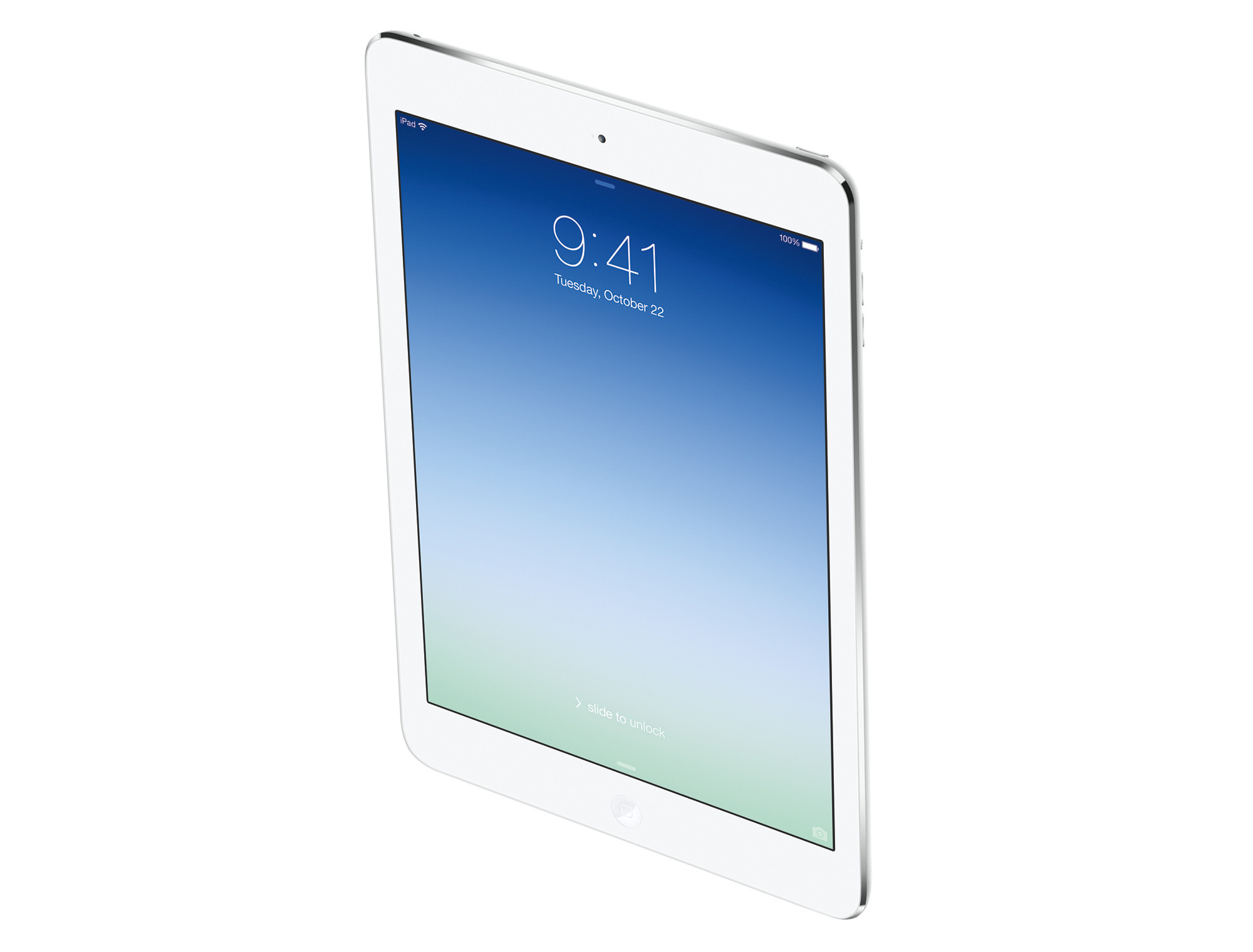
The iPad Air was 20% thinner than the iPad 4, and this new thinness was made possible by several advances. The 9.7-inch screen wasn’t yet laminated to the cover glass, but Apple’s engineers did what they could to shave as much space out as possible between components. The new A7 processor was far more efficient than the outgoing silicon, letting the iPad Air get by with less battery.
This iPad was remarkably different in the hand, something I noted in my review:
All of this adds up to something larger than just numbers. When picking up my wife’s iPad 4, I’m now surprised by how much the thing weighs. In a way that only Apple can, it’s managed to make its year-old product look and feel … gross.
This meant using a full-sized iPad out and about was easier than before. The iPad mini was smaller, but now the 9.7-inch model wasn’t the beast it once was.
That A7 CPU didn’t just mean the battery could be smaller, but it made the iPad Air 2x faster than the iPad 4, which was still struggling a but pushing so many pixels around. The iPad Air was the first iPad that felt fast, all the time, and I remember being really impressed with its performance.
Like the iPhone 6 I chose for the iPhone of the decade, I chose this iPad because it marked a real turning point in the history of its product line. The iPad mini may have pioneered the design used here, but the 9.7-inch iPad was far more popular. With the exception of the current iPad Pro models, every iPad continues to look like the iPad Air. I’m not sure a random person off the street could pick it out of a lineup of more modern iPads, actually. Apple flexed its hardware muscles with the iPad Air, and while it is not supported by iOS 13, the tablet itself still seems modern and fresh.
Connected #275: The Rickies (Early 2020) ⇢
This week, on a very special episode of Connected:
Federico, Myke and Stephen review their predictions for 2019 and a new Chairman is named before everyone makes their choices for 2020, including the Risky Picks. Also, one of them gets a very special delivery during the show.
Conspiracies abound, my friends.
My thanks to our sponsors:
- Booz Allen: Join a forward-looking team backed by a century of experience and fuelled by collaboration.
- Health IQ: Insurance for the Health Conscious. Save up to 41%. Take the quiz now to see if you qualify.
- Hover: Make a name for yourself. Get 10% off any domain name.
iPhone(s) of the Decade: the iPhone 6 and 6 Plus
With the 2010s coming to an end, I thought it would be a good time to talk about what I think were Apple’s most influential products in the last ten years. Today, let’s look at the iPhone.
When the 2010s started, the iPhone was still gaining steam, with the iPhone 4 released in June 2010. Today, it’s a juggernaut, and it demands both larger prices and larger places in our pockets.
It was hard to pick one iPhone release for this, but I’m going to go with 2014’s iPhone 6 and 6 Plus.

Yes, I can hear you. The iPhone 4 ushered in our age of Retina displays, the iPhone 5 brought LTE and the iPhone X seemed like magic compared to previous models.
Let’s consider the world in 2014. Samsung and other Android OEMs were shipping larger phones, and many in the iOS ecosystem longed for bigger screens and the improved battery afforded by a larger chassis. Apple had made the iPhone taller with the iPhone 5S, but just wasn’t enough.
At its September event that year, Apple delivered the 4.7-inch iPhone 6 and the larger 5.5-inch iPhone 6 Plus. Both came wrapped in a new design with rounded edges, cover glass that slightly curved to meet the phone’s frame and yes, a camera bump.
Ok, so that last one was a bit of a bummer, but the iPhone 6 felt smaller than it had any right to thanks to those smooth edges, as I wrote in my review:
The glass is now rounded at the edges, sloping down to meet the aluminum around the edges. This helps the phone feel smaller, and reminds me of the old “it’s like a river stone” claim Palm made about the original Pre. However, this means the iPhone 6 picks up weird light reflections around the edges. While these don’t affect the usability of the display itself, it can be distracting at times.
Gone are the flat sides and sharp angles where they meet the glass. The 6 has rounded edges, not unlike the iPad mini and iPad Air. This makes the phone feel thinner in hand than it actually is — a trick Apple used with the original iPhone and 3G — but it makes the device slippery. If your eyes are closed, the only way you can tell where the glass ends and metal begins would be the texture. On my phone at least, the seam is flawless all the way around.
To accommodate this larger screen, Apple moved the sleep/wake button to the side of the phone and introduced new gestures to go back and forward in applications, as well as “Reachability” to drop the top of the screen down to make it more … errr … reachable.
The rest of the physical design wasn’t quite as nice. The antenna lines were really noticeable on most finishes, the camera bump made the phone rock awkwardly when on a flat surface and those smooth edges made the phone easy to drop. Thankfully, all of those issues were resolved by slapping the phone in a case, which was probably a good idea, as this was Apple’s thinnest-ever iPhone and it was a bit to prone to bending.1
Don’t let that get you down on my pick, because we owe a lot to the iPhone 6. It sold in record numbers, affirming to Apple that the market did indeed want larger phones. The explosive sales of the iPhone 6 took Apple a little time to get used to, but it catapulted the company to new heights.
Just check out this Six Colors graph of iPhone sales. That big uptick is the iPhone 6 and 6 Plus doing their thing:

Likewise, that teeny-tiny-by-modern-standards camera bump broke the seal, giving Apple the boldness to grow the bump into the monster on the back of the iPhone 11 Pro that lets the phone take amazing photos and video.
The 6 Plus also introduced choice to the iPhone. While we had seen colors before, the addition of a second, even larger screen let Apple reach new customers who craved the largest possible iPhone.2
The design cues of the iPhone 6 are still felt today. The rounded edges are still with us today, and before glass returned to the back of the iPhone, the antenna lines had faded nicely into the aluminum. And of course, iPhones come in more sizes than ever now.
All of this adds up to why I think an iPhone that Apple dropped support for with iOS 133 is deserving of recognition here at the cusp of a new decade. iPhones owe a whole lot to the iPhone 6, and it fundamentally changed the iPhone forever.
-
The 6 Plus in particular had another issue — it was not the most performant iPhone ever sold. With the 6S Plus, Apple doubled the RAM to 2 GB and things ran much more smoothly. ↩︎
-
I ended up switching to an iPhone 6 Plus mid-cycle. I’ve hit my limit, though, as the iPhone 11 Pro Max is just too big for me. ↩︎
-
To be fair, Apple has released several updates for iOS 12 to let older devices in on security updates. ↩︎
Mac of the Decade: MacBook Air (Late 2010)
With the 2010s coming to an end, I thought it would be a good time to talk about what I think were Apple’s most influential products in the last ten years. Up first: the Mac.
When the original MacBook Air was introduced, it was positioned — both in price and marketing — as a high-end, ultra-portable notebook that was perfect for those who traveled a lot for work or just wanted the lightest Mac notebook possible.
Sadly, the first iteration of the MacBook Air was a pretty mediocre computer. The hinges proved to be fragile, the small port door was annoying and the computer was sllloooooowwwwwwwwwww. The iPod hard drive at the heart of the notebook made everything take longer than it should have, and the tiny fan inside the machine struggled to keep the Intel Core 2 Duo cool. MacBook Air customers often saw one whole core of the CPU shut down to keep things from overheating.
In hindsight, I think the original Air was a little bit ahead of its time — it really needed an SSD to truly sing, and the design was a bit compromised.1 However, a few years later, in the fall of 2010, Apple got it right.
Steve Jobs unveiled the second-generation MacBook Air at the company’s “Back to the Mac” press event, and he said the machine arose from a simple question:
What would happen if a MacBook and an iPad hooked up?
The answer was a remarkable new laptop that had a lot of iPad-like characteristics:
- Instant on
- Great battery life with 30-day standby time
- Solid-state storage
- Thinner and lighter than other notebooks
The new MacBook Air delivered on these promises, and defined a whole new class of laptops.

The new machine came in two sizes — 13.3 and 11.6 inches — and tapered down to a thin edge at the front of the machine. The keyboard and multi-touch trackpads were full-sized, and IO was way better than before. Each MacBook Air came with MagSafe, a pair of USB ports (one on each side) and a headphone jack. The 13-inch machine also shipped with an SD card slot.
Apple said that the lessons it learned building the iPhone, iPad and iPod made the MacBook Air possible, and it showed.
Gone was the slow spinning hard drive — every MacBook Air now shipped with an SSD as standard, and the LED backlit display sprang to life as soon as the notebook was opened.
Over the years, Apple would update the second-generation MacBook Air several times. USB 2 gave way to USB 3. RAM and disk options got more attractive, and both power and battery life got better as the machine matured. The 2013 model in particular was excellent with its bonkers jump in battery life.
The most important thing about this generation of MacBook Air is not the specs, but the era it helped birth. Jobs said Apple believed that all notebooks were going to look like this one in the future, and he was right. For years, PC manufacturers chased the MacBook Air, both in terms of design and popularity.
Like the white plastic MacBook before it, the MacBook Air was everywhere pretty quickly after going on sale. Users who found themselves needing a new notebook would often just buy a newer MacBook Air.
So why is this my Mac of the decade? Simple. It’s the most influential computer Apple shipped in the last ten years. That seemed really obvious for the first five years of its life, but I believe it still is today. Almost every notebook on the market is thin and light, and many are made of aluminum. Spinning media is all but gone in laptops, across the industry, and the 13-inch MacBook Pro today is actually smaller than this generation of 13-inch MacBook Air.
In late 2018, Apple revisited the MacBook Air, giving it a Retina display and an updated design. Apple was clear that it knows people love the MacBook Air, and I think it’s clear that the 13-inch MacBook Pro and 12-inch MacBook couldn’t spark the same emotion from users. Here at the end of the decade, the MacBook Air is the default Mac notebook, and that story started way back in 2010.
-
You can learn more about the first MacBook Air in this video on the 512 Pixels YouTube channel and in this column over on MacStories. ↩︎
Mac Power Users #516: Looking Toward 2020 ⇢
This week on Mac Power Users, David and I review 2019, and the changes it brought to the Apple ecosystem before talking about our hopes for 2020, both nerdy and not.
My thanks to our sponsors:
- 1Password: Have you ever forgotten a password? You don’t have to worry about that anymore.
- Freshbooks: Online invoicing made easy.
- Direct Mail: Create and send great looking email newsletters with Direct Mail, an easy-to-use email marketing app designed exclusively for the Mac.
- Squarespace: Make your next move. Enter offer code MPU at checkout to get 10% off your first purchase.
Upgrade #277: Who Killed the Butterfly Keyboard? ⇢
Jason and Myke have published an amazing holiday episode of Upgrade:
This week we try to solve a technology mystery. What if there was a murder, but no body? What if there were victims, but no crime? We all want answers: Who killed the butterfly keyboard, and why?
Find time this week to listen to this.
Kbase Article of the Week: Important Safety Information for Pro Display XDR ⇢
Set up your Pro Display XDR on a hard, stable work surface that allows for adequate air circulation under and around it. Never push objects into the ventilation openings. Your Pro Display XDR can be damaged if dropped, burned, punctured, or crushed, or if it comes in contact with liquids, oils, and lotions. Don’t use a damaged Pro Display XDR, such as one with a cracked screen, as it may cause injury.
Keep your Pro Display XDR away from sources of liquid, such as drinks, oils, lotions, washbasins, bathtubs, shower stalls, and so on. Protect your Pro Display XDR from dampness, humidity, or wet weather, such as rain, snow, and fog.
The XDR is overkill for a bathtub machine, for the record.
Mac Power Users #515: Stephen Takes One for the Team ⇢
It’s feedback time! David and Stephen revisit media management and external drives, then talk about David’s 16-inch MacBook Pro, meditation apps and USB-C hubs. Then Stephen makes a confession, which David takes rather well.
I won’t ruin my confession here, but it is probably not that big of a surprise, really.
My thanks to our sponsors:
- 1Password: Have you ever forgotten a password? You don’t have to worry about that anymore.
- TextExpander from Smile: Get 20% off with this link and type more with less effort! Expand short abbreviations into longer bits of text, even fill-ins, with TextExpander from Smile.
- Setapp, from Macpaw: More than 150 powerful apps for your Mac
- Kensington: The Professionals Choice. Find the right docking solutions for your organization today.
Secure ShellFish ⇢
My thanks to Secure ShellFish for sponsoring 512 Pixels this week. It is a SFTP client for iPhone and iPad that gives you access to all the files on your server from the palm of your hand.
OWC Accelsior 4M2 ⇢
OWC has launched a PCIe M.2 NVMe SSD card for the Mac Pro, and it looks pretty sweet:
Accelsior 4M2 NVMe SSD is OWC’s fastest SSD ever with over 6,000MB/s speed for large format video editing, VR/AR/MR environments, extreme gaming, and other high bandwidth needs. Available in capacities up to 8.0TB, Accelsior 4M2 is the ultimate performance drive for Mac Pro 2019, Mac Pro 2012 and 2010, and PC towers. It offers silent cooling via a finned heat sink cover and installation versatility with a half-length x8/x16 design.
Two Spies ⇢
I’m not a big game player, but I am loving Two Spies. My brother and I have been playing each other every day at lunch this week and it’s a great turn-by-turn game with just the right amount of chance thrown in.