512 Pixels

Apple’s Emoji Crackdown ⇢

Jeremy Burge had written up what seems to be an on-going change when it comes to iOS apps and how developers can use Apple’s emoji set:

It’s understandable there is much confusion about this right now, especially as the Apple Color Emoji font until now has been treated by many as a font like any other. If this is thought about as “a set of images created and owned by Apple”, the terms for what seems reasonable do shift.

Instapaper Turns 10 ⇢

An unnamed writer, publishing as Instapaper on Tumblr: 1

On January 28, 2008, Marco Arment announced a new side project called Instapaper. Ten years and billions of articles later, we’re thrilled to be helping our readers learn, research and experience the Internet removed from the typical distractions.

First, we want to thank all of our users. Whether you’ve been around since the Marco days, joined us when betaworks took over the development or signed up after our acquisition by Pinterest, thank you! We wouldn’t be anywhere without you, and we look forward to incorporating your requests into our 2018 updates.

In Internet years a decade is a century. Instapaper predates the App Store, Google Chrome and the entire Android OS, so we wanted to take this opportunity to look back on some of our product and business milestones.

Instapaper has been on my iPhone’s first home screen since the day it launched in the App Store. It’s so engrained into how I consume articles and other web content, I really can’t imagine my work without it.


  1. I can’t think of anything more ironic. ↩︎

Siri, Read Some HomePod Reviews

Early HomePod reviews are out. The TL;DR seems to be “It sounds great, you’re locked into Apple’s ecosystem and Siri isn’t great.”

None of that is surprising. Here are some highlights:

Nilay Patel, The Verge:

It feels like it was designed for a very demanding person to use while living alone entirely inside Apple’s ecosystem. It’s tied more closely to a single iPhone and iCloud account than any other smart speaker, and Siri has none of the capability or vibrancy of what’s happening with Alexa. Apple can try to move mountains by itself, or it can recognize that the HomePod is a little iOS computer for the home and let developers build on it as they have for so long and with such great success with the iPhone, iPad, and Mac.

The HomePod is a remarkable new kind of audio device. It does more to make music sound better than any other speaker of this kind has ever done before, and it really, truly works. But unless you live entirely inside Apple’s walled garden and prioritize sound quality over everything else, I think you’re better served by other smart speakers that sound almost as good and offer the services and capabilities that actually fit your life.

Matthew Panzarino, TechCrunch:

As a smart speaker, it offers best-in-class voice recognition, vastly outstripping the ability of other smart speakers to hear you trying to trigger a command at a distance or while music is playing, but its overall flexibility is stymied by the limited command sets that the Siri protocol offers.

Buy a HomePod if you already have Apple Music or you want to have it and you’re in the market for a single incredibly over-designed and radically impressive speaker that will give you really great sound with basically no tuning, fussing, measuring or tweaking.

Jim Dalrymple at The Loop:

It’s hard to explain the sound of HomePod, but you get a feeling that the sound is enveloping you, even when using just one speaker. There is a sense that this is how the songwriter and producer wanted the song to be heard when they recorded it.

The other speakers gave the feeling that music was just being blasted straight at me and not allowing me to become part of the experience. HomePod sounds great wherever you are in the room—there really is no particular sweet spot to hear the music, it just sounds great everywhere.

Megan Wollerton at CNET also wrote about this sound separation:

With the HomePod in the center of the room, for example, I heard distinct wedges of good (and less good) sound around the speaker. Sometimes the front sounded great and the back not so much. Sometimes the best sound came from 90 degrees on either side.

Apple says the speaker adjusts itself based on room position, and as I moved the speaker around I could hear the difference as it recalibrated. Overall I found that the HomePod sounded best placed against a wall or in a corner, which is fine since that’s where most people will probably place it anyway.

I’m picking mine up on Friday. I’m looking forward to hearing the thing, but I have my doubts that it will displace the Amazon Echos in our house.

Kbase Article of the Week: Safari 3 for Windows: Issues opening Safari with OmniPage installed ⇢

This article comes with some fine text:

Important: Mention of third-party websites and products is for informational purposes only and constitutes neither an endorsement nor a recommendation. Apple assumes no responsibility with regard to the selection, performance or use of information or products found at third-party websites. Apple provides this only as a convenience to our users. Apple has not tested the information found on these sites and makes no representations regarding its accuracy or reliability. There are risks inherent in the use of any information or products found on the Internet, and Apple assumes no responsibility in this regard. Please understand that a third-party site is independent from Apple and that Apple has no control over the content on that website. Please contact the vendor for additional information.

Intel Smart Glasses ⇢

Dieter Bohn at The Verge got an exclusive look at Intel’s smart glasses project:

The most important parts of Intel’s new Vaunt smart glasses are the pieces that were left out.

There is no camera to creep people out, no button to push, no gesture area to swipe, no glowing LCD screen, no weird arm floating in front of the lens, no speaker, and no microphone (for now).

From the outside, the Vaunt glasses look just like eyeglasses. When you’re wearing them, you see a stream of information on what looks like a screen — but it’s actually being projected onto your retina.

I think friend of the show Steve Troughton-Smith summed it up well:

Intel have created a Pebble for your face; it will be fascinating to see what the ‘Apple Watch’ is in this analogy — a full iOS-powered device that can avail of all the technologies developers need to make amazing things. AR is going to be huge

— Steve Troughton-Smith (@stroughtonsmith) February 5, 2018

A Quick Yida Update ⇢

Last month, I shared a little bit about Operation Broken Silence, and about how I wanted to help them fund an 8th grade classroom in a school they sponsor in the Yida refugee camp in South Sudan.

We’ve already raised over $2,000 for the classroom, and as my brother writes, work is already being done with those funds:

Last update, we announced that this year we would be adding the final grade and classroom to the primary school in Yida. That process is now underway and, at the moment, it appears we are on schedule!

Our education partner is currently shipping 60 chairs, 2 blackboards, and 96 school uniforms to Yida for the the P8 classroom.

There’s still a lot to be done to turn this classroom into a reality, and to do so, I need your help.

Judging the 18-core iMac Pro ⇢

Craig Hunter has put the 18-core iMac Pro through its paces:

So in summary, we see performance increases ranging from 27% to 79% for the 18-core iMac Pro when compared to the 10-core model. I suspect many computations and applictions will be in the middle of that range depending on how well they can take advantage of multiple cores, but there will certainly be some hot rod uses that get closer to that 79% end of the scale (and may do even better). Though I haven’t mentioned it, if you look back through the various benchmark results, you’ll see that the 18-core iMac Pro shows no disadvantage for single-core performance, despite running at a lower clock speed (2.3GHz/4.3GHz) than the 10-core iMac Pro (3.0GHz/4.5GHz).

I figured the higher core count would come at a higher cost in terms of single-core tasks.

Hunter concludes that the 18-core machine, while expensive, is worth the upgrade over the 10-core if you’ve got the cash.

Apple Opens Repair Program for iPhone 7 ⇢

Apple:

Apple has determined that a small percentage of iPhone 7 devices may show “No Service” in the status bar (even if cellular coverage is available), due to a component that has failed on the main logic board.

These affected units were manufactured between September 2016 and February 2018 and sold in China, Hong Kong, Japan, Macao, and the U.S.

If your device exhibits the symptom described above, Apple will repair your device, free of charge. Your iPhone will be examined prior to any service to verify that it is eligible for this program. This program only applies to iPhone 7.

If you have an iPhone 7, you can check the support document to see if your phone is eligible for repair. If it is, and you’ve paid for this repair to be carried out, Apple will reimburse you.

Apple Posts Q1 2018 Results: $88.3 Billion in Revenue ⇢

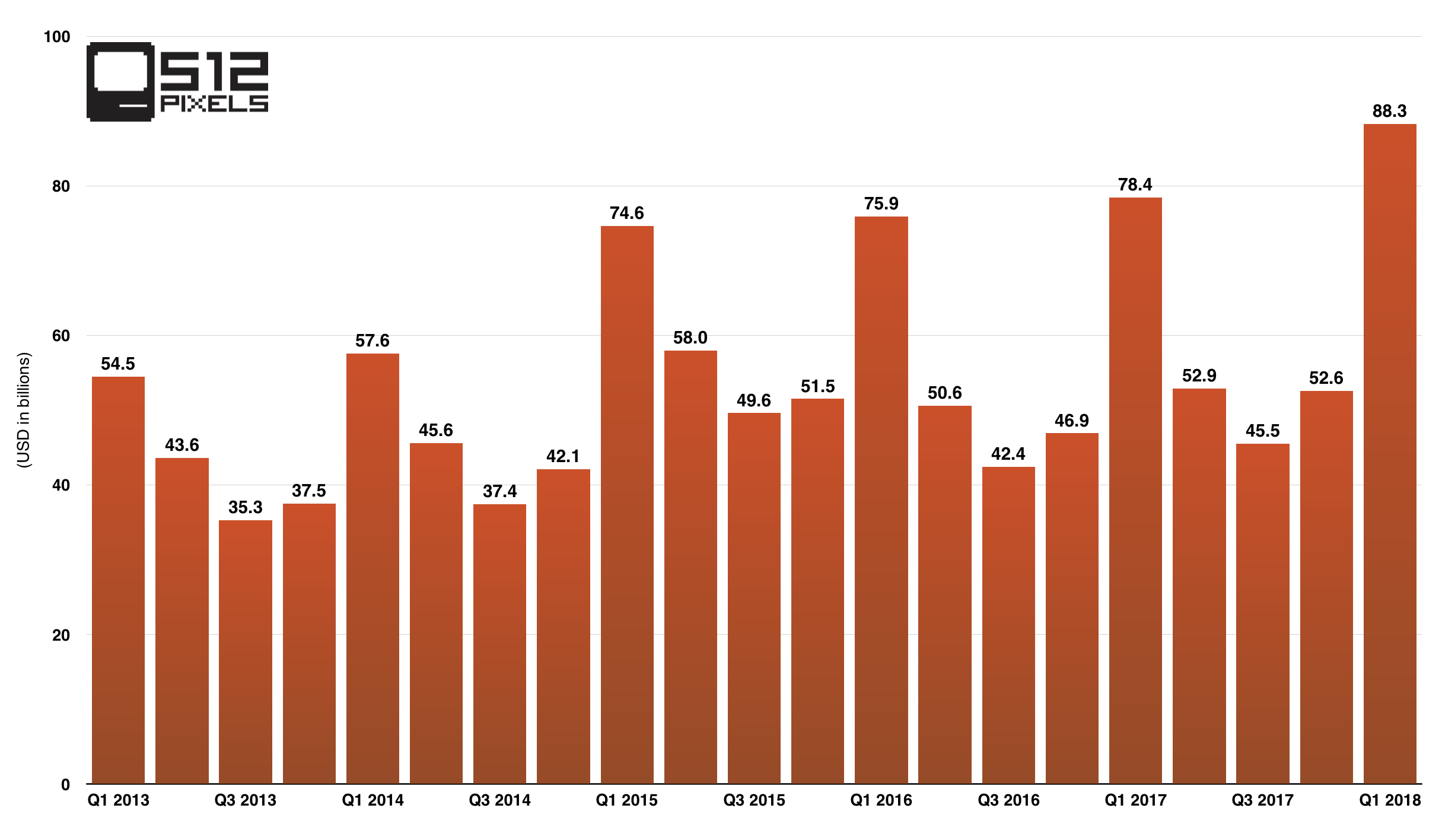
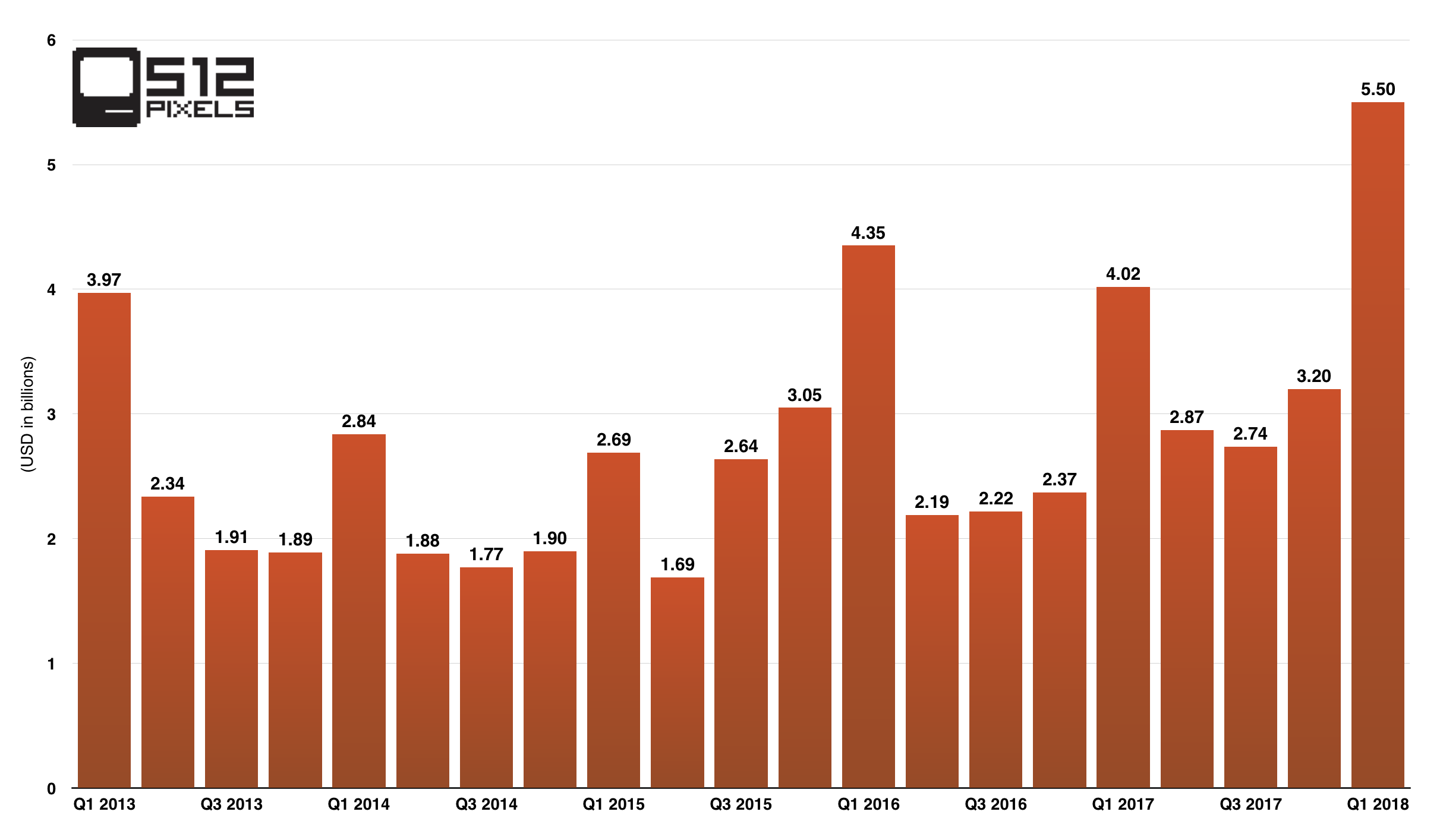
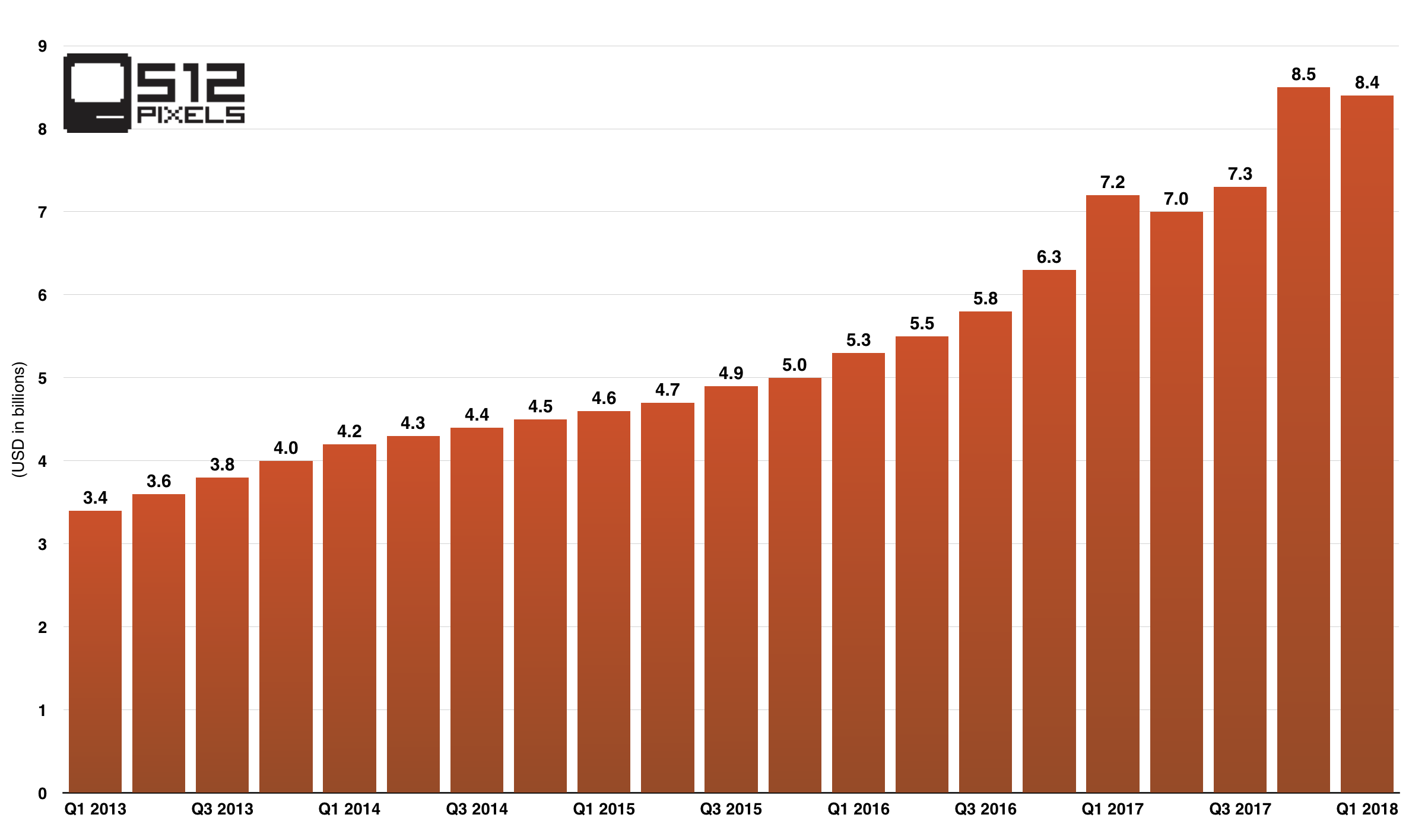
Apple just posted its largest quarter ever, booking $88.3 in revenue:

“We’re thrilled to report the biggest quarter in Apple’s history, with broad-based growth that included the highest revenue ever from a new iPhone lineup. iPhone X surpassed our expectations and has been our top-selling iPhone every week since it shipped in November,” said Tim Cook, Apple’s CEO. “We’ve also achieved a significant milestone with our active installed base of devices reaching 1.3 billion in January. That’s an increase of 30 percent in just two years, which is a testament to the popularity of our products and the loyalty and satisfaction of our customers.”

The company slightly exceeded its revenue guidance for the quarter.

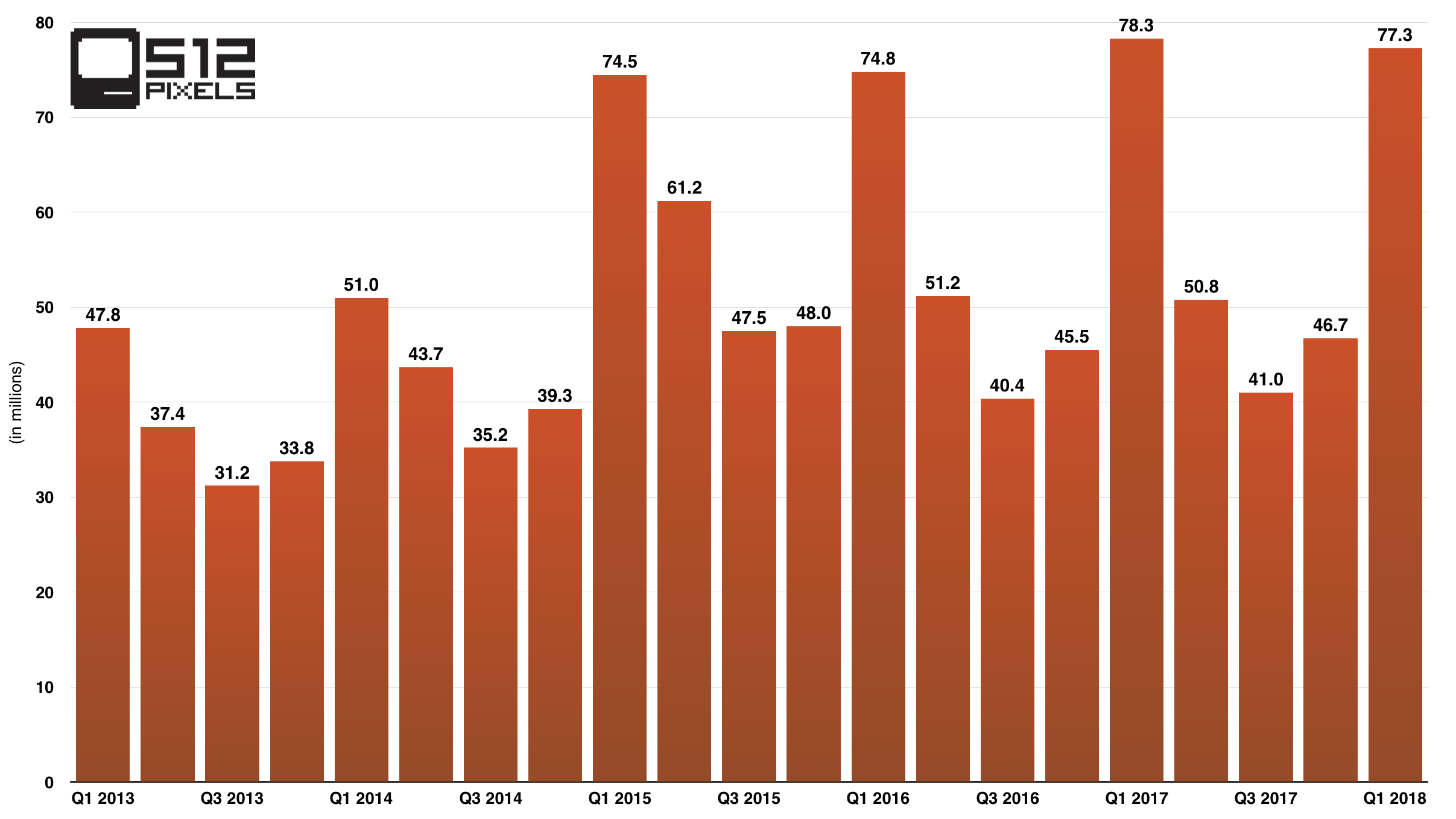
That said, the iPhone shrank slightly year over year, missing Apple’s targets for the quarter. Of course, the year-ago quarter was an extra week in length, so keep that in mind when seeing these numbers. Apple says its revenue-per-week is higher than it was a year ago.

However, iPhone revenue is up, probably due to the iPhone X’s higher price, as Jason Snell pointed out on Twitter:

Apple’s holiday quarter in a nutshell: Not record iPhone unit sales, but look at the rise in average iPhone selling price. pic.twitter.com/RiVwHya934

— Jason Snell (@jsnell) February 1, 2018

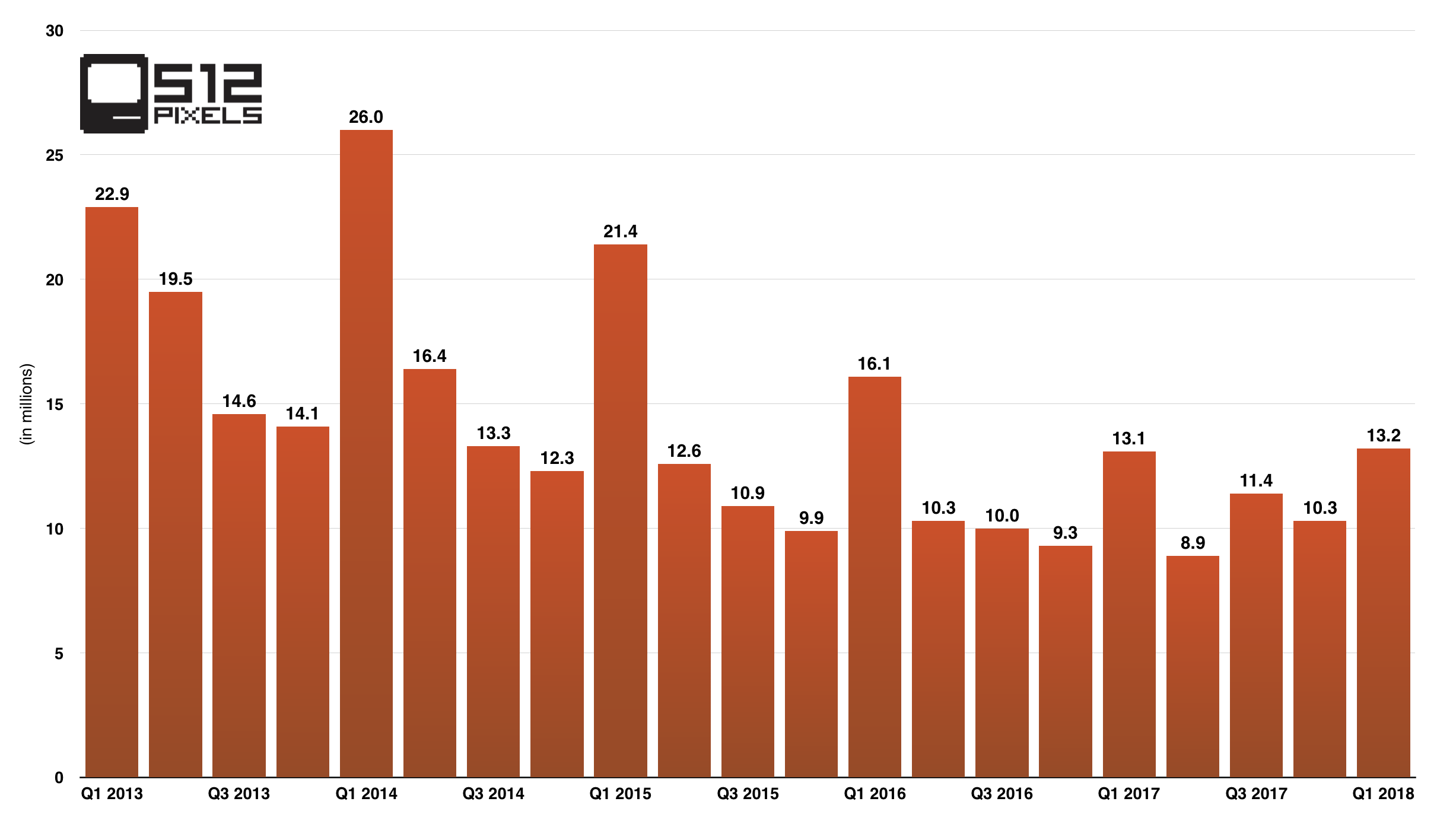
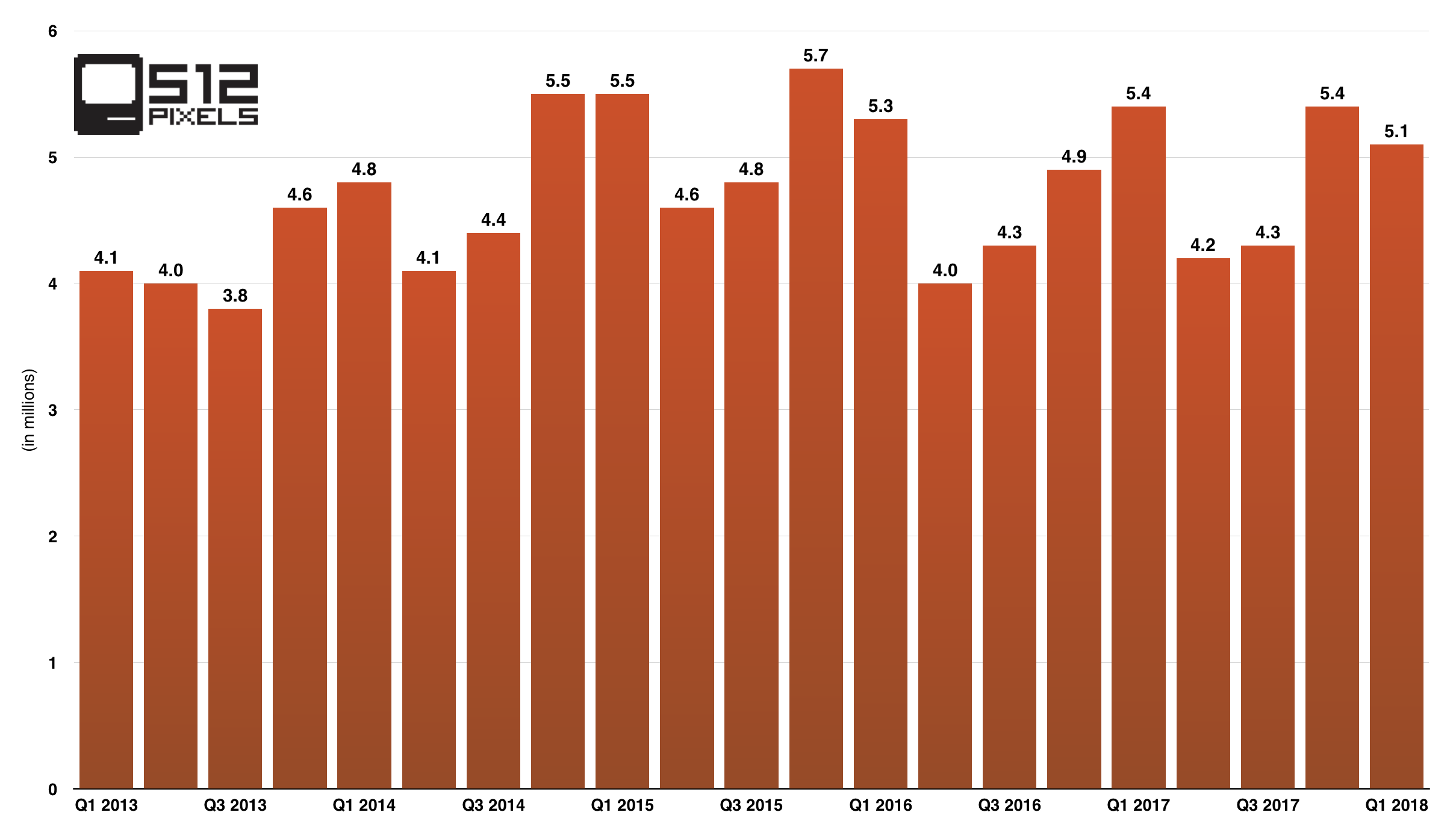
Revenue from services was up year over year, but flat from the previous quarter. The Mac was down, but the iPad was up a touch over last year.

The big winner here is “Other Products,” which includes things like the Apple Watch, Apple TV and Apple’s various audio products like AirPods and Beats. Clearly people picked up a lot of these devices for gifts.

Apple has reached 1.3 billion active devices as of January, which is an increase of 30% in 2 years.

For next quarter, Apple is projecting between $60 and $62 billion in revenue, which is a big jump over Q2 2017, which clocked in at $52.9 billion.

Some tidbits from the call:

  • Cook noted that Apple Pay is now accepted at over half of all retail locations in the United States.
  • For the fourth quarter in a row, the Apple Watch has seen 50% growth. The Series 3 is selling twice as fast as the Series 2 was a year ago.
  • Third consecutive quarter of growth for iPad revenue, with big gains with first-time tablet buyers.
  • The iMac Pro is off to a strong start, and 60% of Mac purchase were to switchers worldwide. In China, 90% of Macs were sold to first-time buyers.
  • Apple saw double-digit revenue growth in all major geographic segments.
  • Latest US research reflects 96% loyalty rate, highest ever measured.
  • The App Store set an all-time revenue record, with increases in visitors and views.
  • After the iPhone, Apple’s wearables were the second-largest contributor to revenue growth.
  • The iPad’s active install base has grown every quarter since it launched in 2010.

Here are some charts:

Revenue:
iPhone Units Sold:
iPad Units Sold:
Mac Units Sold:
Revenue From ‘Other Products:’
Services Revenue:
Apple Clarifies HomePod Audio Sources ⇢

With a little over a week to go before shipping, Apple has finally cleared up what audio the HomePod can play, as noted by MacRumors:

  • Apple Music: HomePod users can ask Siri to play any of over 45 million songs available on Apple Music. A subscription is required.
  • iTunes Music: HomePod users can ask Siri to play any songs, albums, or audiobooks they have previously purchased from the iTunes Store.
  • iCloud Music Library: HomePod users can ask Siri to play any songs uploaded to a user’s iCloud Music Library, including songs imported from other sources such as CDs, with an Apple Music or iTunes Match subscription.
  • Beats 1: HomePod users can ask Siri to play Apple’s official radio station that is apparently still a thing.
  • Podcasts: HomePod users can ask Siri to play podcasts from the Apple Podcasts directory.
  • AirPlay: HomePod users can use AirPlay to play other audio from an iPhone, iPad, iPod touch, Apple TV, and Mac. AirPlay 2, coming later this year, is only required to stream audio from these sources to multiple HomePods.

It’s silly that there was so much confusion over this, but I’m glad Apple has documented this for customers. This whole product launch has been unusual.

Connected #178: The Tiny Heads Trend ⇢

This week on Connected:

It’s January, so it’s time to spin up the iPhone rumor machine, but first Stephen and Federico consider what a “Snow Leopard” iOS release could look like. Lastly, one of them has switched to DuckDuckGo.

My thanks to our sponsors:

  • Squarespace: Make your next move. Enter offer code WORLD at checkout to get 10% off your first purchase.
  • Anchor: Radio, reinvented.
  • PDFpen, from Smile: Everything you need for more powerful PDF editing.