
Learn which power adapter, power cord and plug are appropriate for each Mac notebook.
Keep in mind that size, shape, and color of replacement adapters and cords may vary. If you are trying to locate an power adapter part number for an Intel-based Mac notebook, please see this article.
512 Pixels
Apple Music Customers Getting iTunes Match with Audio Fingerprinting⇢
Jim Dalrymple with good news for Apple Music users:
Apple has been quietly rolling out iTunes Match audio fingerprint to all Apple Music subscribers. Previously Apple was using a less accurate metadata version of iTunes Match on Apple Music, which wouldn’t always match the correct version of a particular song. We’ve all seen the stories of a live version of a song being replaced by a studio version, etc.
Using iTunes Match with audio fingerprint, those problems should be a thing of the past.
In addition to this, iTunes Match is now part of Apple Music. Pay for the latter and you get the former for free.
I’d love to hear why Apple didn’t do this when Apple Music first rolled out. Hopefully the days of people having their metadata nuked from on high are behind us.
OS X El Capitan 10.11.6 Released⇢
In what will probably be the last build of El Capitan:
This update:
- Resolves an issue that may prevent settings from being saved in accounts with parental controls enabled.
- Resolves an issue that prevented some network devices, such as speakers and multifunction printers, from accessing SMB share points.
The New Glif⇢
My friends Tom and Dan have made something awesome yet again:
The landscape for smartphone photography has changed dramatically since we launched the original Glif in 2010. With each successive smartphone, the camera is getting more and more incredible. The smartphone has become a legitimate tool, for photographers, filmmakers, and mobile journalists. So our goal is simple: to create the best tripod mount for smartphones, period. To do that, we are focusing on three areas.
Backed.
Mac Power Users #331: Stephen Hackett: Collector of Macs⇢
I crashed Mac Power Users this week:
Mac user, collector, and … yes … YouTuber Stephen Hackett joins in to explain essential cloud-based services used to run the Relay Network, his growing collection of Macs, and his photo and video workflows.
I’m not sure I’m a YouTuber, but it was a blast catching up with David and Katie. I hope you enjoy it.
Software Rot
As hard as it is to preserve vintage computer hardware, software is even harder.
If an iBook’s hard drive implodes, I can knock out the repair myself.
I have a bunch of old Apple hardware. Most of it still works, but if my Macintosh SE blows a capacitor, I can (more than likely) have it repaired by someone more skilled than I am.
If one of my old notebooks has screen failure, the problem may prove too difficult or expensive to repair. Spare parts are harder and harder to come by as time goes on.
There will be a day where some of my old machines will stop working. There will be a day where none of them work anymore.
As sad as that will be from a hardware perspective, it’s devastating in terms of preserving software. Old operating systems are sealed inside these machines. A dead Mac is really just a beige — or Bondi Blue — sarcophagus for the software stranded on its internal disk.
Granted, there are a few ways to emulate the classic Mac OS today. What happens when those projects aren’t updated anymore or a change to macOS prevents them from running? It’s not hard to imagine a day when the only way people interact with something like System 7 is through screenshots.
The story is even gloomier when it comes to rarer operating systems or individual software titles. There are countless programs that have already slipped away, just in the Apple ecosystem. For platforms like BeOS or even NeXTSTEP, the effect is far worse.
The vast majority of people will never need to run operating systems like Mac OS X Server 1.0 or older software titles like MacPaint. As a self-proclaimed Apple historian, I am interested in keeping it accessible.
Deep inside, I know it’s a losing battle.
I believe that to understand where we are and where we’re going, we have to know where we’ve been. That includes the technology we use. If it’s true that one day we all return to dust, it applies to our computers and their software, too.
(Don’t miss Steve Jobs talking about this subject in a 1994 interview.)
A Modern Example of Software Rot
Lest you think software rot is something that just affects operating systems and programs than ran on beige computers with weird names from the 90s, let’s look at the free iPhone case program that was announced in 2010 as a part of Antennagate.
The company released a free app customers had to use to order their free case.
The app still runs today, as pointed out by Parker Lyman, who sent me these screenshots:
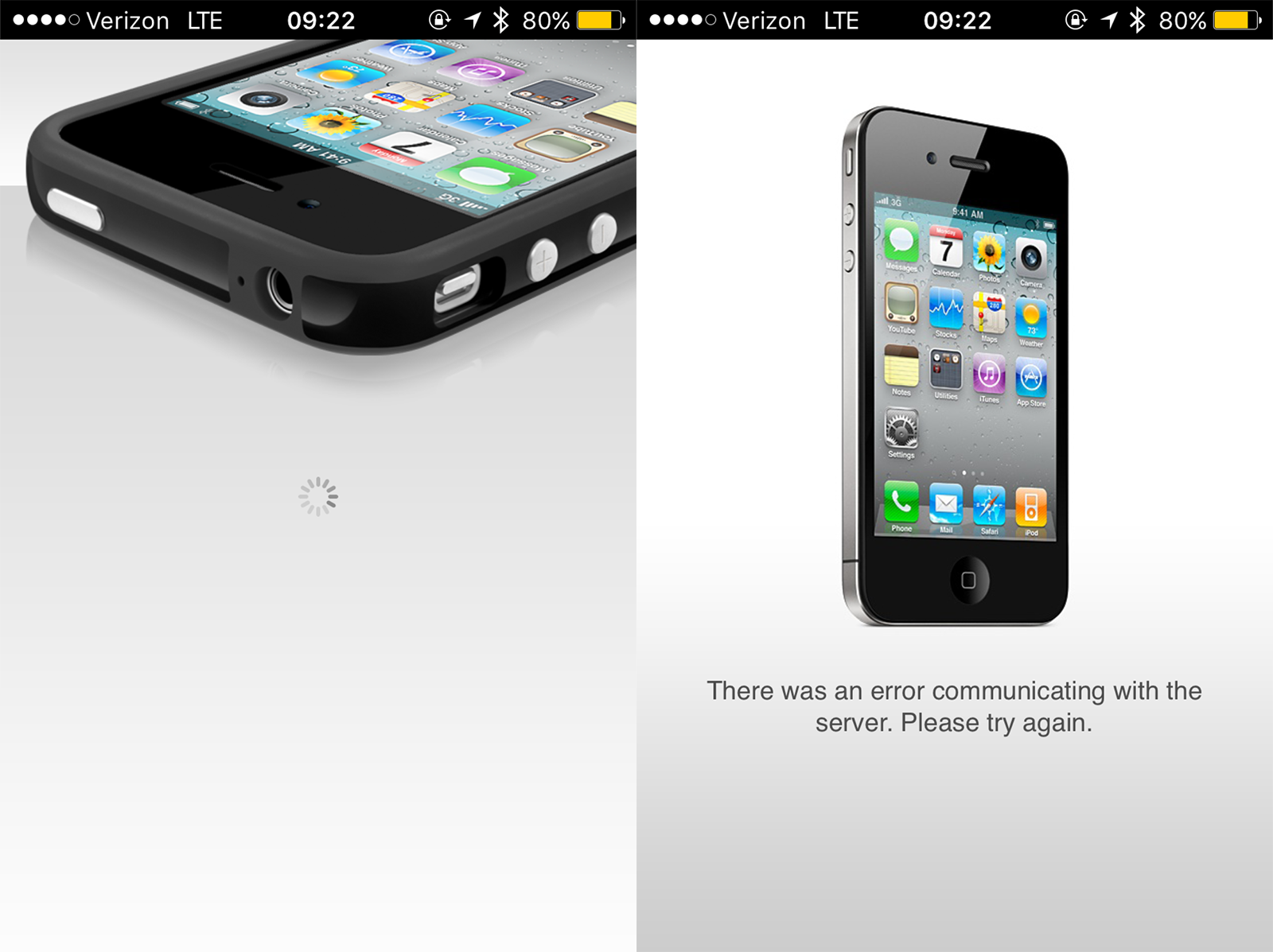
As this app runs on today’s iOS, I imagine it’s pretty simple. However, it is completely broken now that Apple has removed whatever infrastructure the app depended on. Without the server it is looking for, the app is just a shell.
This little app is not much more than a footnote in the iPhone 4’s story, but it’s already almost gone, just six years later. I think it’s a good example of how modern software apps are at just as much risk as old ones of becoming nothing more than a memory.
Connected #99: European Exotic⇢
For episode 99, listener Nathan sent in the best follow-up of all time. After that, the boys talk about Stephen’s PowerBooks, Myke’s two-factor authentication pains and Federico’s new line of work.
My thanks to our sponsors this week:
- Casper: Because everyone deserves a great night sleep. Get $50 off with the code ‘CONNECTED’
- MartianCraft: Training crafted just for you
- Braintree: Code for easy online payments.
The Relay FM Alphabet⇢
Last night, Quinn Rose sent me this video she made about Relay FM, and it made my week.
Juno sends first in-orbit image of Jupiter⇢
Juno will end up much closer to the gas giant next month, but this first image sure is stunning.
Adding weather info to Calendar.app⇢
BusyCal and other calendar apps add weather right into your calendar view, but Apple’s built-in Calendar.app on iOS and macOS doesn’t offer that feature.
Turns out, Weather Underground serves .ics files that can be imported to Calendar, as Chris Short explains:
Recently, I discovered Weather Underground provides ICS files for use in any calendar application you can think of (Google Calendar, Microsoft Outlook, and Apple’s Calendar.app). These ICS URLs do not appear to be documented by Weather Underground specifically but here are some examples to get you started.
I set it up, adding the calendar subscription to my iCloud account. Now, I can make outdoor plans without needing to jump to my weather app of choice first. Pretty neat.
My YouTube setup
Back in September, I wrote up my podcasting setup. That rig hasn’t changed since then, but since I started posting videos to YouTube, I have gotten quite a few requests to share my gear list for those projects.
I currently have two cameras in use. The first, a Sony RX 100 MKIII I tend to use just for photography, but it does a good job at shooting 1080 video as well. It’s small and compact, but does a great job. All of these images were taken with it. I shoot in RAW and edit in Photoshop on the Mac.
I also shoot with a Canon 70D. It’s been a workhorse for countless photographers and videographers for a long time. I have three main lenses I use:
The 50 is my walking-around lens. It’s dependable and fun. The 10-18 is pretty wide, and is what I used on this video.
For sound into the 70D, I use a Shure VP83 LensHopper. I don’t love this microphone, but it works for what I need.
I shoot product shots on a table with white butcher paper hanging from a stand to achieve the seamless Jony-Ive-white-room look. My lighting setup is pretty simple, with three LED fixtures on stands. It was already in the studio space I share with Operation Broken Silence, but it gets the job done just fine.
Small items like iPods are usually shot inside a Foldio 2 lightbox.
The studio is home to an assortment of tripods and sliders that I use from time to time as well.
I edit video in Final Cut Pro X, and any slides or animations are done in Keynote. If a video involves narration, I record it on my podcasting setup.
The best news aggregation service⇢
Joe Caiati, writing for The Sweet Setup:
In an age past, the newspaper was delivered to your doorstep in the morning ready to be digested over a cup of coffee. When you returned home from work and settled down on the couch, the nightly news on TV caught you up on the day’s events.
While those outlets are still around today, news is much more complicated.
We want our news to be personal. For years, everyone got the same news as everyone else, but that’s just not true today. We can customize and build custom experiences that can serve as something far more subjective than the daily newspaper and nightly news ever delivered.
His review of Nuzzel is great. If you aren’t using this app, you should check it out.