512 Pixels

24 Months

It’s a big month in our household. Our little Allison Mae is turning two years old, which is crazy. She’s talking, potty-training and climbing all over everything.

Allison’s birthday will always be linked — in my mind, at least — with the end of Josiah’s treatment. Just weeks before she was born, he underwent the last round of chemo of his custom treatment plan.

Josiah’s chemo was months of an ever-worsening roller coaster. At the beginning, he bounced right back (amazing for a 7-month old), but as time went on, he took longer to recover. We had more days and nights living in fear of a fever. Day and nights of cleaning his toys over and over. Bottles of hand sanitizer were used. By his last few rounds, he was getting blood every time, to help his body cope with the fact that the chemicals were doing more and more damage to his bone marrow each time.

The cycle was hard on Merri and I, too. We spent many days and nights at the hospital. I would stay at St. Jude as late as I could stand too (Josiah got chemo at night, so I wanted to be there when he was hooked up), drive home barely awake, to go to work just hours later. Being away from the hospital when Josiah was on treatment was brutally hard for me.

Two years later, his tumor remains to be stable. I’ve heard the word “dormant” a few times, even. He’s not cancer-free. He never will be. That son of a bitch will always be pressing against his healthy brain, threatening to cause problems with pressure, fluid and more.

I always feel a tinge of something (guilt?) when another one of Josiah’s “little friends” gets bad news, knowing we’ve been off the front lines for so long. Of course, I don’t want to be back in the fight with Josiah’s cancer, but sometimes I wonder why we’ve caught a breather when other families aren’t so fortunate.

The universe’s super dickish move, of course, is that we can be back in the ring at any time. All it takes is one symptom or one bad MRI and we’d be back on that hospital couch.

I suppose that’s why I can’t honestly enjoy this milestone. It’s great that Josiah’s doing so well, but I can’t shake the thought that this respite could be temporary.
Mac Power Users #93: Education Workflows with Fraser Speirs⇢

I’m only halfway through this episode of Mac Power Users, but wanted to link to it about 5 minutes in. In a former life, I worked at a third-party Apple-Authorized Service Provider, and most of my projects included supporting schools with 1–1 Mac programs. My interest in technology in the classroom is very strong, and Fraser Speirs is at the forefront of using iPads — instead of Macs — in education. Every MPU episode is good, but this really is a must-listen if you care about such things.

On Supporting 512 Pixels⇢

I’m sitting here doing my quarterly taxes, so I thought I’d remind you that 512 Pixels isn’t my full-time job, and if you wish to donate or become a member to help pay the bills around here, I’d really appreciate it.

Thanks to those of you who have supported me in the past — without you, I couldn’t be where I am today.

Apple Pulls Products from EPEAT⇢

The story is that Apple’s done this because the group’s philosophy that products should be easy to disassemble for recycling doesn’t jive with Apple’s product line anymore.

iPad mini Mockups⇢

This is a nice way to see what a 7.85 inch iPad would look like, if you have a little too much time on your hands this weekend.

On Mountain Lion’s System Requirements and Consumer Confusion - Updated

The past few versions of Mac OS X have had fairly simple-to-remember key system requirements. If a machine met these key requirements, the other ones (RAM, available hard drive space) were met by default in most cases:

  • Leopard required a 867 Mhz G4 or better
  • Snow Leopard was Intel-only.
  • Lion required a Core2Duo processor or higher

Mountain Lion, due out this month, has slightly more complicated specs:

  • OS X v10.6.8 or later
  • 2GB of memory
  • 8GB of available space

Additionally, these machines are the only ones supported:

  • iMac (Mid 2007 or newer)
  • MacBook (Late 2008 Aluminum, or Early 2009 or newer)
  • MacBook Pro (Mid/Late 2007 or newer)
  • Xserve (Early 2009)
  • MacBook Air (Late 2008 or newer)
  • Mac mini (Early 2009 or newer)
  • Mac Pro (Early 2008 or newer)

Apple’s thinking here is fairly transparent: consumers are probably more likely to know what model they own than the processor within their computer.

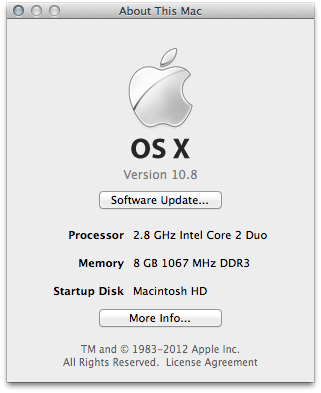
However, the processor information is just a few clicks away in the “About This Mac” window, under the Apple menu.

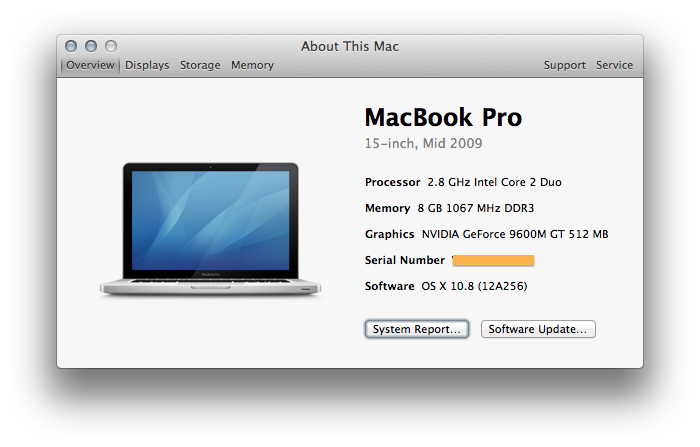
The model name is hidden behind the “More Info…” button:

Back when Apple sold OS discs in its Stores, we used to have customers come in all the time, wanting a refund after they discovered the OS they had purchased wouldn’t run on their Mac. With the Mac App Store, what sort of recourse is there? Sure, Mountain Lion’s installer checks that it can run, but only after its been downloaded.

I’d love to see the Mac App Store run a check on the system before downloading the Mountain Lion installer, alerting consumers before a purchase if it could not be run on that particular system. Doing so might save a lot of heartache, since Mountain Lion won’t run on as many machines as Lion did.

Update: It seems some people have had the App Store balk at downloading 10.8 betas on machines that don’t meet requirements. Hopefully this continues with the public release.