
512 Pixels
‘In the Meantime’
T-Mobile chief marketing officer Cole Brodman:
We’ve heard from many customers who love their T-Mobile service, but are disappointed that we don’t carry the iPhone. To these customers, first, thank you for your business. Please know that we think the iPhone is a great device and Apple knows that we’d like to add it to our line-up. Today, there are over a million T-Mobile customers using unlocked iPhones on our network. We are interested in offering all of our customers a no-compromise iPhone experience on our network.
In the meantime, we continue to bring to market some of the most advanced, cutting-edge Android devices. Today, I had the chance to take the stage at the Mobilize event in San Francisco and introduce our fastest 4G smartphones ever, the Samsung Galaxy S II and the HTC Amaze. We’re very confident that these Android smartphones rival or beat any smartphone out there in terms of functionality, speed, overall experience and features – including the iPhone.
It doesn’t sound like T-Mobile is getting the iPhone in a few weeks. If Sprint gets it, the boys in magenta will be the only ones without Apple’s device on their network.
A Modern Docking Station
James Galbraith at Macword, in his review of Apple’s 27-inch Thunderbolt Display:
For owners of the 2011 MacBook Air, the Thunderbolt Display is a fantastic way to get iMac-like features while still being able to walk away with one of the lightest laptops available. If your Mac has Thunderbolt, FireWire 800, and gigabit ethernet, the case for buying the comparatively inflexible Thunderbolt display is a little less interesting.
This setup is very attractive to me, but it isn’t new. Thomas Brand at Egg Freckles points this out:
The Thunderbolt Display is Apple’s first attempt at a laptop dock since the DuoDock was discontinued in July of 95. With it you can leave all of your peripherals at home and reconnect them to your laptop at the end of the day with a single cable. A Thunderbolt Display is more than an outstanding high-resolution monitor, it will change the way you use your computer.
The PowerBook Duo line was Apple’s first round of sub-notebook computers. From 1992 to 1997, Apple released seven models, starting with the Duo 210. It’s specs were hard to believe for 1992:
- 4.1 pounds
- 10.9 × 8.5 inches
- 1.4" thick
The lineup included color (!!) screens on the 270c, 280c and 2300c. The 2300c was also the only PowerPC model — the previous versions were all powered by Motorola 68030 or 68LC040 processors. As such, the 2300c can run up anything from System 7.5.2 to Mac OS 9.1. It also was the last machine from Apple to be built using the Snow White design language.
Versatile little guy, that one was.
Like the first MacBook Air, the Duos lacked most normal ports. Apple included a 156-pin Processor Direct Slot port, giving access to the machines’ processor and data busses.
That slot gave birth to the Duo Docking Stations.
Apple sold three docking solutions for the Duos.
The first — the “Duo Dock” — was the most ambitious. It included a CRT with a slot underneath for the notebook to slide into. When docked, the notebook could be used on AC power, and gained a floppy drives and expansion slots of a second hard drive, more VRAM, an optional FPU and two NuBus expansion slots.
In short, the Duo Dock took a tiny notebook computer and turned it into a screamer of a desktop computer.
Apple was pretty proud of this, as this ad shows:
The Mini Dock allowed users to use the Duo’s internal display and battery, but added connections for ADB, Ethernet and more. The Mini Dock did not include NuBus expansion slots, however.
The Micro Dock was kind of boring compared to the other two. It was a breakout box that created additional ports for users, including SCSI, ADB, Ethernet and video ports. They were cheap, but popular.
Clearly, Thunderbolt is today’s equivalent in many ways. Lots of peripherals can be driven by its single port — even external GPUs are possible with it, as Thunderbolt is basically PCI Express over a cable.
With its new display, Apple has created a desktop setup that a user can simply drop a MacBook Air into and keep working. While it isn’t as crazy as the Duo Docks — or the iMac-like docking station rumored back in 2010, in many ways, it’s the same thing. With Thunderbolt adding optical support next year, things are just looking better and better for notebook users looking for a desktop-class expereince.
Capture Form Updated
Based on some feedback, I’ve created an alternative version(right-click to download) of the Capture Form, with an expanded Notes section and no Reference Information section.
‘Kindle Fire’
I’m excited for this. Except for the name.
Positioning

This image is from AT&T’s page describing Internet speeds available to home users in my neighborhood. I know the descriptions are marketing BS, but to the average consumer, its confusing. AT&T is trying to position that middle options as the lowest possible connection speed required for Facebook. Terrible.
‘Can you sign up for Spotify without Facebook?’
No.
Eat at Chili’s on September 26, Help St. Jude Save Lives
 Our son is a patient at St. Jude Children’s Research Hospital here in Memphis.
When he was six months old, he was diagnosed with an extremely rare form of brain cancer. He’s received over a dozen rounds of chemotherapy, numerous operations, countless MRIs and hours of physically, occupational and speech therapy at St. Jude.
Josiah will never be “out of the woods” with his cancer, but today, he’s basically a normal almost-three year old. He’s a picky eater, loves Hot Wheels cars and just about every Pixar movie.1 He’s legally handicapped, but the way he plays with his little sister, you might not notice that he limps and doesn’t have good use of his left hand.
All of his progress is thanks to the tireless doctors, nurses, researchers, fundraisers, teachers, janitors, cooks, tour guides and volunteers at St. Jude. This is the hospital’s mission:
The mission of St. Jude Children’s Research Hospital is to advance cures, and means of prevention, for pediatric catastrophic diseases through research and treatment. Consistent with the vision of our founder Danny Thomas, no child is denied treatment based on race, religion or a family’s ability to pay.
That “ability to pay” phrase is shockingly meaningful to families like ours. Josiah’s care has cost over $2 million to date, and thanks to that care, he is doing very well.
St. Jude has an entire organization of people raising money for the hospital, to pay for treatment and research for kids like Josiah. Countless individuals, families and companies make it possible for me to enjoy watching my son run around our apartment.
Without this support, St. Jude couldn’t be saving lives. Without it, I could never afford this level of care and treatment for Josiah.
Chili’s is probably one of the most-recognized examples. On St. Jude’s campus, there is an entire building named the Chili’s Care Center, built from the kindness of the restaurant chain’s leadership and customers.
This Monday — September 26 — the restaurant is donating 100% of its profits to St. Jude. So, go fight the crowds and eat out Monday night. Raise a margarita to St. Jude, and to Josiah. Both are miracles.
-
Except The Incredibles, which he doesn’t seem to care for. ↩︎
‘Not with a Bang but a Whimper’
Darren Murph at Engadget, reviewing a phone that was cancelled before it went on sale:
The harsh reality is this: even if HP would’ve gone ahead with the Pre 3’s launch on AT&T, moving ’em would’ve been tough. The company showed minimal interest in moving the TouchPad (well, until they showed nothing but interest in moving the TouchPad), and attempting to hawk a tired, understated design for an on-contract price that aligns with the iPhone 4 and a vertible plethora of tremendous Android phones would’ve probably led to even more tears. HP stepped it up with the Pre 3’s processor and panel, but almost everything else looks like it was directly ripped from a phone that first launched over two years ago. When you’re the underdog, those kind of tactics don’t do anything to further your cause.
So, even with the Pre 3’s hardware, webOS wasn’t quite there yet. Sadly, that’s the legacy this OS will leave. I don’t see it having a future. Which just makes me sadder.
Oh, CNET...
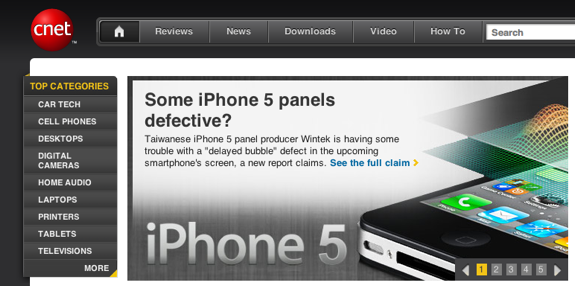 Sigh.
Amazon Announces NYC Event
Embarrassing
Neil Armstrong isn’t thrilled with the state of NASA. In a talk to the House Committee on Science, Space, and Technology, the first man on the moon said:
We will have no American access to, and return from, low Earth orbit and the International Space Station for an unpredictable length of time in the future.
For a country that has invested so much for so long to achieve a leadership position in space exploration and exploitation, this condition is viewed by many as lamentably embarrassing and unacceptable.
A lead, however earnestly and expensively won, once lost, is nearly impossible to regain.
Eugene Cernan, the last man to walk on the moon said in the same meeting:
Get the shuttle out of the garage down there at Kennedy (Space Center), crank up the motors and put it back in service.
You want a launch vehicle today that will service the ISS? We’ve got it sitting down there. So before we put it in a museum, let’s make use of it. It’s in the prime of its life, how could we just put it away.
While NASA’s shuttle program may not have been everything it as supposed to be, it is hard to disagree with these guys that the shuttle is better than nothing.
NASA seems set on Mars. The “let’s go back to the moon” mission got canceled in chase of the red planet. While I am excited about Mars, I am doubtful I will have the experience my parents did, watching images, beamed from space, of man walking on another surface.