512 Pixels

Apple Online Stores in Indonesia and Vietnam Decommissioned

From a new service article:

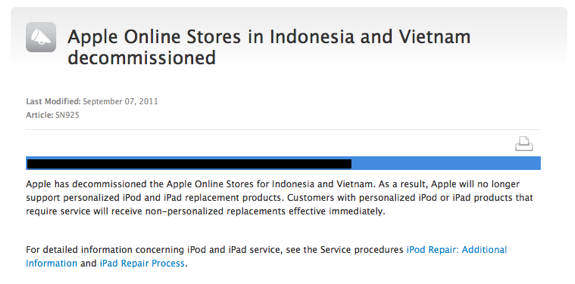
Apple has decommissioned the Apple Online Stores for Indonesia and Vietnam. As a result, Apple will no longer support personalized iPod and iPad replacement products. Customers with personalized iPod or iPad products that require service will receive non-personalized replacements effective immediately.

Screen Shot 2011 09 09 at 4 45 21 PMThanks, Nameless Source!

YahAOL

Bloomberg:

AOL Inc. Chief Executive Officer Tim Armstrong is talking with advisers to Yahoo! Inc. to gauge its interest in combining the companies after the ouster of CEO Carol Bartz, according to two people familiar with the matter.

I can’t wait to see what quality products will be brought to fruition from this.

Apple Launches Charitable Matching Program for Employees

Tim Cook, in an email posted by Mac Rumors:

I am very happy to announce that we are kicking off a matching gift program for charitable donations. We are all really inspired by the generosity of our co-workers who give back to the community and this program is going to help that individual giving go even farther.

Starting September 15, when you give money to a non-profit 501(c)(3) organization, Apple will match your gift dollar-for-dollar, up to $10,000 annually. This program will be for full-time employees in the US at first, and we’ll expand it to other parts of the world over time.

Five Bucks

Read trust

Value and worth are something we nerds spend a lot of time assessing. We make lists, compare specs and plan out entire projects in our heads and in software like OmniFocus before making choices. We make decisions on not only price, but feature sets and the enjoyment or productivity we will derive from it.

In this age of self-publishing, value and worth have taken somewhat of a hit. People don’t want to pay more than a buck — or two, at the most — for an app. We have come to expect free WiFi and ad-free RSS feeds.

The thing is, content and creations take time. And they cost money.

Many of us in the Read & Trust network don’t make our livings from our sites.

If you want to support writers you appreciate and enjoy some good, members-only content, check out the Read & Trust newsletter. Every Tuesday, you’ll get something valuable in your Inbox. It’s five bucks a month.

Your mother would be proud of you.

The Rift

In recent weeks, there have been numerous conversations about what Apple will be like without Steve Jobs at the helm.

It is a perfectly justifiable question. The first time Steve left, the company went in the crapper.

The key here is simple: when Apple’s board ousted Jobs back in 1987, he wasn’t the leader he is today.

The most obvious example of this to me is the feud the started between the Macintosh team and the rest of Apple.

In 1983, Apple released the Lisa, an all-new type of machine, complete with GUI and a mouse.

The Lisa didn’t do well for many reasons. The price was too high, and it had issues with … well … working correctly. The Lisa’s biggest problem wasn’t technical, however, as I wrote last year:

The biggest problem for the Lisa was Apple itself. In January 1984, the Macintosh was released at a shockingly-low $2,500. The Mac had many more features than the Lisa and a larger software library. The Macintosh outsold the Lisa very quickly, and was soon the system of choice for Apple customers.

The reason the Lisa had so much competition internally was Steve Jobs. In 1982, after being removed from the Lisa team, Jobs gathered Apple’s brightest engineers and designers1 and holed up in an office off-campus to build the Macintosh.

Brian Lam at Gizmodo, in a lengthy piece on Jobs’ career explains what the relationship2 was like:

Steve Capps of the Macintosh team hoists a pirate flag above their building. The Lisa team steals it, but it is retrieved and stands for over a year.

This rift was also present with the Apple II team. The Apple II line of computers was Apple’s cash cow. Its baby. With the Macintosh’s GUI and ease of use, the II quickly felt outdated, and Jobs pulled no punches about the fact he believed the Macintosh was the way forward.

The Steve Jobs of today still has the vision and foresight when it comes to products as he did in the 1980s. But instead of tearing Apple apart, since his return, Jobs has worked to pull Apple together, as a united front of products and ideas, set against the world. John Gruber may have said it best:

Jobs’s greatest creation isn’t any Apple product. It is Apple itself.

Since his return, Jobs has been hard at work, building a leadership team that can move forward in a cohesive, positive way. The Jobs of the mid-1980s was just as concerned with seeing his vision fleshed out, but his tactics were far from what’s needed to run a company.

The Macintosh, the iPad and the iPhone are all parts of a bigger machine that marches on. If there are any rifts inside Apple, the public doesn’t see them. In place of a pirate flag, there’s a gleaming, white-walled fortress.

  1. Jobs’ arrival forced Jef Raskin off the project. The Mac ended up being more of a mini-Lisa than anything Raskin had designed as a result. ↩︎

  2. To really get a good look at this time frame in Apple history, check out the book West of Eden: The End of Innocence at Apple Computer on Amazon. ↩︎

Lobbying

Kelly Hodgkins at TUAW:

In the second quarter of 2011, Apple spent a whopping US$790,000 on lobbying. This is more than double what the company spent in the same quarter of 2010 and up $230,000 from the first quarter of 2011.

While $790,000 is a lot of money, it’s hardly “whopping” compared to the money Google spent in the same time frame —  $2.06 million, a 54 percent increase from the same period in 2010.

Yahoo Fires CEO

The AP:

Carol Bartz was fired Tuesday as Yahoo Inc.’s CEO by the Web portal’s board of directors.

The company says Bartz will be replaced by Chief Financial officer Timothy Morse on an interim basis.

When Apple needed someone to fill in for Steve Jobs, it chose COO Tim Cook. Any company that puts the CFO in charge feels like it is in trouble.

Best. Playground. Ever.

Jonathon Ramsey:

There are driving and flying experiences for all kinds of wheeled and winged machines, but what’s been missing? Obviously, a place to play with heavy machinery to relive the sandbox fantasies of one’s youth. Leave it to Las Vegas to fill the void with Dig This, a giant dirt pit where anyone at least 14 years old and 48 inches tall can pay a fee to spend hours pretending to do the kind of job many people would rather avoid.

At your disposal are some of Caterpillar’s finest: three 15-ton excavators and two 10-ton bulldozers. After a bit of classroom instruction, you’ll be led to your workhorse for some in-cab instruction. Then, depending on which of the three ‘experiences’ you’ve purchased, you have anywhere from 1.5 to 3 hours to perfect your earthmoving technique.’

RIM Shareholders Push to Sell

Jim Dalrymple at the Loop:

Noting its poor stock performance, lack of innovation and loss of market share, Jaguar Financial is leading the charge to have something done at RIM.

In a statement on Tuesday, Jaguar Chairman and CEO Vic Alboini called on RIM’s Directors to maximize shareholder value. This includes putting the company up for sale and selling off the patent portfolio.

With an 80 percent decline in stock value since 2008, I think stockholders are probably ready for something to change.