
512 Pixels
Paul Thurrott Reviews OS X Lion
I can see no reason why anyone with a Snow Leopard-based Mac wouldn’t upgrade to Lion. This upgrade features a ton of new features and is priced to sell. It’s a no brainer.
For Microsoft and, to a lesser degree, Windows users, Lion represents Apple throwing down the gauntlet. The company already dominates the mobile space with its iPhones, iPods, and iPads, and by taking the best and most appropriate ideas from iOS and applying them to the Mac, the company is announcing its intention to continue this success in Microsoft’s core market of PCs.
Those iOS-to-OS X changes are a mixed bag, of course. Some are very well intentioned–all the apps improvements, the quick resume and so on–while others, especially Launchpad, are misguided because they’re not necessarily efficient, even on iOS. But I think Apple’s doing the right thing by bringing the two product lines together where it makes sense, at least from a user experience standpoint. I may not agree with each design decision, but Apple will tinker with this and get it right over time, as they always do.
But Lion, overall, is in great shape. Where I’ve generally derided Apple for overpimping its largely evolutionary OS X updates over the years, Lion shows that there’s some life left yet in the Mac OS X side of the house. This isn’t just a collection of minor updates and refinishes. It’s a step away from the norm, finally, after a decade of steady and largely boring minor revisions. I’m excited to see where they take OS X next.
This blows my mind for a few reasons. (A) Lion isn’t out yet and (B) Paul Thurrott wrote something about Apple that wasn’t unabashed fanboyism for Microsoft.
Apple Launches App Store Volume Purchase Program for Business Clients
It looks like a pretty good program, but there are still no such options for Mac App Store customers.
Inside RIM
The three-year roadmap for RIM products focused on refining the technology in phones had already been released, rather than looking at where to add major new component or trying to identify or even shape future trends. “One of the main reasons RIM missed the mark with the browser was because they were always proud of how little data usage a user would use,” a former executive said. “There was no three-year plan at RIM.” RIM would be proud of the fact that someone would only use 1MB of data in a month in 2005, and as a result, there wasn’t ever any extensive R&D done within the browser space. Over time, that misstep affected BlackBerry tremendously as competing devices began to deliver desktop-like Web experiences.
A lack of vision, for sure.
The More Things Change...
Dave Feldman, unveiling the TechCrunch redesign:
TechCrunch is bold. It’s raw. It’s fast-paced. With 50 articles crossing the home page daily we couldn’t simply redesign the reader-facing site; we had to think about the CMS too. We wanted to support you, the readers, because you read every article we post. We wanted to give you better context across posts and topics, new ways to slice and dice content so you can dig into what interests you. We get a huge amount of RSS traffic and wanted to keep providing a full experience to those readers too.
Good to see the staff members are still full of themselves, too.
‘The Dark Knight Rises’
I can’t wait for this film. Is there any doubt this is the best Batman series ever?
[via Justin Blanton]
The Shortening Distance Between Thought and Action
One thing I actively work on, and have been actively working on for sometime, is maintaining a non-reactive mode of working. Fortunately, or unfortunately, as technology continues its steady advance promising “convenience”, I believe it’s not really a convenience which it delivers. Rather, it’s a shortening of a distance between thought and action. If I’m not careful, this can lead to a more reactive way of working - checking email, twitter, and the like reflexively.
This is one reason I’m working so hard to get over the hump with my notebook. I need this distance to be longer, not shorter, than it is today.
[via Minimal Mac]
David Pogue, Public Relations Appearances and the Independents
New York Times tech writer David Pogue is in the news, but not as usual.
NYT Public Editor Arthur S. Brisbane:
Journalists are accustomed to seeing public relations pitches in their inbox. I was surprised, though, when I recently got one on June 8 touting tech columnist David Pogue’s speech to PR professionals in which he credits PR with providing most of his ideas.
The pitch revealed that for $159 I could view a video of Pogue’s “Pitch Me, Baby” speech set for an online airing on July 11. The speech is derived from an earlier appearance at a public relations conference called the Media Relations Summit, staged by Ragan Communications.
Even to those not super familiar with the way newsrooms work, this should seem abnormal.
People working in public relations have a sole job — to get their company or product in the media. Of course, lots of little things go into this, like media packets, trying to schedule interviews and demos, providing review units and more.
In journalism school, a good bit of time is given to having proper relationships with PR professionals. If journalists get too close to the PR realm, the risk of tainted stories becomes a very real danger. In the better newsrooms, the mere appearance of this can get a journalist in trouble.
Of course, there is balance. PR people do help create stories about products, especially in the technology sector. But stories should be far more encompassing than just passing along some PR copy.
What About the Little Guys?
It’s a little different for those of us who write in the indie scene. Most of us with moderately popular websites get dozens of emails a week from PR firms about new websites, ad opportunities and more. For me, these are fairly easy to ignore.
It is much harder to ignore emails from individual developers. Many developers will offer App Store promo codes in exchange for a review.
Now, I don’t write many app reviews here or at Macgasm. I just don’t like reviewing software.1
Any hardware reviews are of devices I’ve purchased myself.
Some writers — especially inexperienced ones — struggle with publishing negative2 reviews. People don’t want to write something that could potentially hurt the business of independent developers.
The reality is that if a PR professional or developer reaches out for a coverage or a review, they should be prepared to receive the writer’s honest opinion.3
Writing a positive review out of guilt is stepping over the line for a journalist — but so is getting too close to PR people or developers.
But these problems aren’t just stumbling blocks for small publishers. Here’s Brisbane again:
Times readers deserve to be assured that journalists don’t get too cozy with the P.R. professionals who strive to influence coverage. A virtual army of publicists, media specialists and others stands ready every day to infiltrate the news with stories that help their employers.
[via Daring Fireball]
-
The one exception is OS X releases. ↩︎
-
Of course, some people complain about every single thing they review or discuss. I tend to tone that sort of writing out. ↩︎
-
And not blacklist the writer’s publication. ↩︎
Preparing for John Siracusa’s Review of OS X Lion
Pat Dryburgh is a genius.
New OmniFocus Theme
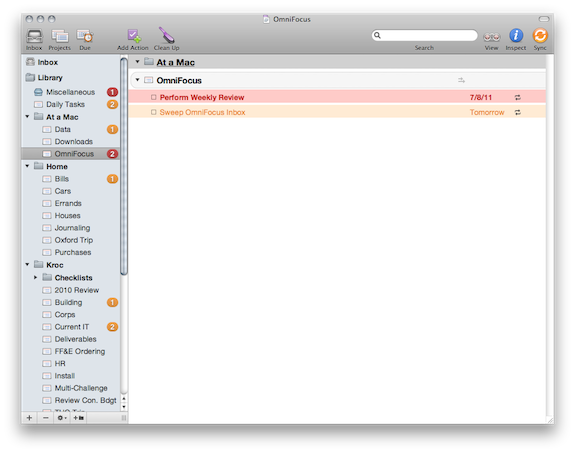 I love OmniFocus, but the Mac app lacks a certain amount of polish. Thankfully, creating themes for OmniFocus is quite easy.
I’ve created one that I have been using for a while, and decided it was time to share it. It uses Helvetica Neue all over the place, with red background and red type for overdue items, with orange for upcoming items, like the default theme.
You can download the .zip file here. To install, unzip and load it using the Style section of OmniFocus’ preference pane.
‘Nothing Doesn’t Go in Here’
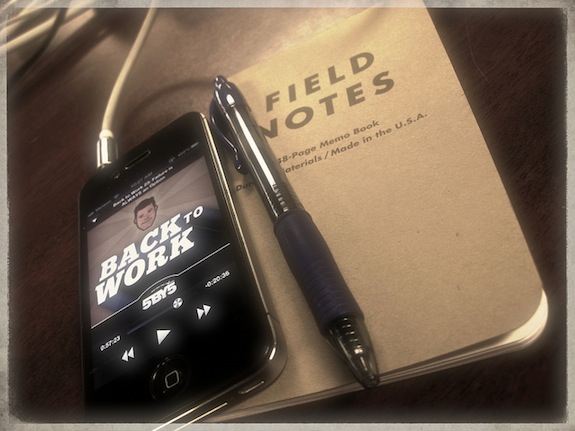
I have a pair of failed notebooks on my nightstand.
Both are Moleskines. Both have about eight pages of writing, in blue ink.
Both are failed attempts at writing for my own good.
Recently, I’ve been realizing that writing for me would be a healthy thing.
(Read: my doctor told me to do it.)
I got my first batch of Field Notes notebooks in the mail last week. Being so much smaller, my thought was that I would be more likely to carry one with me at all times.
I’ve written less than a page.
I’m not really sure why. Part of me still feels nervous about writing personal things in a non-digital format, even though I plan on scanning my notebooks when filled. I am fearful of losing valuable words (and time, maybe) if something were to happen to the notebook before it is a scanned PDF, safe and sound, on my iMac, Time Capsule and offsite backup drive.
Part of doesn’t like the messy feeling of handwriting and bent pages. I always have my iPhone, but I don’t always have a pen. Despite all of this, however, I’m drawn back to writing in a notebook.
I was thinking about this all week, then I heard the latest episode of Merlin Mann and Dan Benjamin’s show Back to Work.
In it, Merlin has some great advice about writing in a notebook. I can’t give it justice by quoting just part of it — just go listen to the first half of this show.
The point of a notebook shouldn’t be the point of a .txt file, at least for me. I need to start feeling more free to jot down ideas, quotes and thoughts, without worrying so much about my page margins being even or my writing being neat enough. I want to be free enough I can tape things into it, tear out parts of pages and maybe even spill a little coffee on it.
But, alas, even typing that makes me somewhat apprehensive. I really wish it didn’t.
Atlantis
I am truly sad we won’t see this again.