
My buddy Myke launched two new podcasts this week, one with Josh from Macgasm.
512 Pixels
Window Phone 7 ‘Mango’ Gets Previewed
On Typos and Quality Writing
In this week’s Read and Trust newsletter, Ben Brooks asked this question:
Are typos and quality writing mutually exclusive?
I would say that while these two aren’t mutually exclusive, typos and poor grammar can severely damage one’s writing. For many people — myself included — a writer’s message is damaged if it is hampered by comma splices, poorly-chosen words and simple typos.
Of course, everyone has issues with grammar and typos. They are inevitable, but if these errors are consistent and widespread, it makes me wonder how much time a writer is really putting into their work.
In short, if something is worth writing, it should be worth writing well.
12,500 Cores
One of the keys to Pixar’s ability to do what it does is the giant, powerful render farm located in its main headquarters building here. This is serious computing power, and on “Cars 2,” it required an average of 11.5 hours to render each frame.
But some sequences were especially complex, particularly those involving ray tracing–which involves simulating light hitting surfaces, essentially “trying to simulate photons.” And as a result, a huge amount of computing power was needed to process frames that took as much as 80 or 90 hours to render, Shah said. And that meant that the studio “bulked up our render farm.”
He said that Pixar had to triple its size, and today, the render farm features 12,500 cores on Dell render blades. As well, the file servers, network backbone, and every other piece of the computing puzzle was boosted in order to handle the making of “Cars 2.”
I can’t wait to see this film.
‘You’re Insane’
I really think Jon Stewart has a more accurate understanding of modern media than almost anyone else out there. Regardless of your political positions, this video is worth a watch.
Tilt-Shift AND Fast Driving?
Update: My wife chimes in.
Tolerable
Ryan Paul, reviewing the new Samsung Galaxy Tab 10.1:
The single biggest problem with Honeycomb at launch was the platform-wide instability. Many applications, including Google’s own first-party software, crashed repeatedly during use. The number of force-closes that we encountered while testing the Xoom made it look like the software was pushed out the door without enough testing.
Stability has fortunately gotten a boost in Android 3.1. Application crashes still cropped up during our week of testing the Tab 10.1, but these were well within tolerable boundaries. The software is finally stable enough for comfortable day-to-day use, and this is frankly the level of quality that should have been in place for the Xoom at launch.
I’m not sure Apple would be willing to ship something that even after an update had a “tolerable” number of crashes.
While Samsung may have iPad-quality hardware, Android is still trying to catch iOS in many areas.
How to Use Time Machine for Updating an Offsite Backup Drive
There are lots of great tools for backing up data, but none are as simple as the built-in Time Machine.
With a little work, Time Machine can be used with an alternative drive for offsite backups. It is pretty simple, but I’ve created a PDF to make it even simpler.
Instacast and Air Server: Podcasts at Home, Over Wi-Fi
I’m a big fan of podcasts.
I use Instacast to subscribe and listen to podcasts on my iPhone 4. I can listen to shows in my truck or at my desk easily. I also don’t have to deal with syncing my iPhone all the time for new episodes, since Instacast download shows right to the device.
At work, I usually have my headphones on. I plug my iPhone into my MacBook Pro’s audio-in jack, and launch the excellent (and free) LineIn application, which allows me to patch audio from the audio-in jack right to the headphone jack.
At home, however, I don’t use headphones while at our iMac. Nor do I keep an audio cable handy for use with LineIn, as I rarely listen to podcasts at home.
But when I do, I use AirServer.
AirServer makes any Mac an AirPlay device, like the AppleTV. With AirServer on, my iPhone sees the iMac as an AirPlay destination. I can start up Instacast, go to the lock screen, and select my iMac as the AirPlay destination:
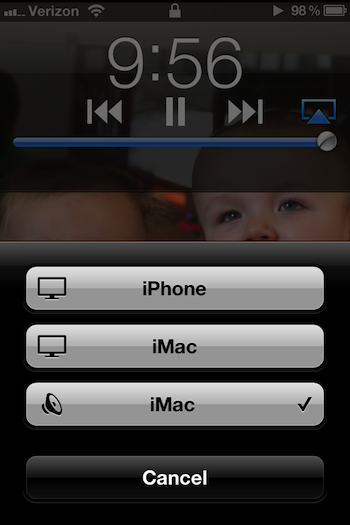
With this setup, I can start up a podcast, sit my iPhone on my desk, and enjoy listening to a show with the iMac’s great built-in speakers.
The 21st century is like magic, isn’t it?
The White House Learns About Its Social Media Followers
This is great stuff, and I hate social media crap most of the time.
AOL Hell
Some people struggle to write for their whole lives, and only dream of ever getting paid for it. And here was I was, Mr. Big-Shot-Razor-Blade-Man, getting paid a real salary. I could sit at home and write in my pajamas while eating take-out food; and that’s what I did. I was so grateful.
But this was part of the problem. We — by which I mean me and my fellow employees — were all so grateful. Which allowed us to ignore — or willfully overlook — certain problems. Such as the fact that AOL editors forced us to work relentless hours. Or the fact that we were paid to lie, actually instructed to lie by our bosses.
The AOL Way really sounds like a home run.1
-
Oh wait, I lied. ↩︎
Home is Where the Text Files Are
Several months ago I started using nvALT and Simplenote as a portable electronic notebook. Both apps are easy to use and offer near ubiquitous access to my stuff. Today, that combo is my Great Database of Everything, from reference emails to post ideas and driving directions.
I have the same setup going on my machines. nvALT is a great little app, and with Simplenote syncing, I’ve got my notes and files on my phone and on the web. The two sync perfectly and quickly with each other.
Like Dave, I organize my notes — all 121 of them — by subject. For example, freelance notes all start with the prefix “Freelance- ” followed by the name of the client. This makes looking for all of my clients easy and reliable.
nvALT has become my personal database, as it has for many. Because it works so well and fits so neatly into my workflow, just about everything I do lives in there — my journal, work projects, freelance notes, information on oddball hobbies and more.
nvALT has an option to make the app store its data as plain text files. I’ve got it set to store these files in my Dropbox folder as an additional safety net. Plain text files are exactly the sort of thing I like. They are small, easy to use, and can be opened on just about any platform. My data is future-proofed. Can you imagine having stored this type of data in WordPerfect?