
After I wrote about the possibility of programmable Mac ROM SIMMs in Quadras a couple of months ago, I suspected that there had been a way for developers at Apple in the 68k Mac era to reflash the ROM in their Macs during development, just like BIOS updates on PCs. The reason I believed this is because the ROM SIMM socket in the Quadras brought out pins for 12V (VPP) and write enable (/WE). I had verified that the write enable pin was going into the memory controller chip in several Mac models, so I was pretty confident that in-system programming was possible.
Category: Apple History
The Great iMac Realignment
It’s the stuff of lore now, but Steve Jobs’ “Grid of Four” took a messy Mac lineup and made it simple enough for anyone to understand:

Trying to cram the Apple of today into something like the Grid of Four doesn’t make much sense. In fact, Apple only used it for a handful of years, but even when the Grid of Four was the product strategy at Apple, the iMac began to creep toward the professional column.
Word Turns 40⇢
From its humble beginnings, Word has gone on to become one of the most popular office tools in the world, and pretty much everyone is familiar with it in one way or another. So, to celebrate its 40th birthday, we decided to take a look at how we got here and also share where we’re going.
Tonya and I have a long history with Word. Although we primarily used WriteNow at Cornell University during our undergraduate years from 1985 through 1989, we often helped users with Word while working in Cornell University’s public computer rooms. Two years after we graduated, a college friend of Tonya’s encouraged her to apply for a job at Microsoft. She was hired and spent the next two years doing phone and online support for Word 4 and Word 5. (So many people considered Word 5 to be the pinnacle of the app’s history that Tonya later penned two April Fools’ spoof articles about it: “ Microsoft Word 5.1 for Mac OS X,” 1 April 2003, and “ Microsoft Word 5.1 Returns… to the iPad,” 1 April 2011.) She also helped edit the manual for Word 6, Microsoft’s first attempt at a cross-platform version. I applied for a position as a Word program manager and got an interview but was not offered the job due to my lack of design skills, a rejection I took as a compliment, given my low opinion of Word’s interface.
That Time Apple Gave Mac OS X Jaguar Away to Teachers⇢
Apple today announced its “X for Teachers” program that gives a free copy of Mac OS X version 10.2 “Jaguar” to every K-12 teacher in the U.S. “Jaguar” combines a stable and robust UNIX-based foundation with Macintosh’s legendary ease-of-use to create the world’s most advanced operating system for teaching, learning and administration. The free copy of “Jaguar” is accompanied by free copies of Apple’s Digital Hub applications–iMovie for digital video editing, iPhoto for organizing and sharing digital photos and iTunes for building a digital audio library.
Teaching Cyberdog New Tricks⇢
Cameron Kaiser has written the most in-depth article I’ve ever read about Apple’s long-defunct Cyberdog product. The dive into OpenDoc is just a sweet bonus.
The History of Cover Flow
Over the last decade or so, Apple has been hard at work in simplifying the user interfaces that power its myriad platforms. I’ve welcomed most of that work, but it’s hard to deny that we’ve all lost some things along the way.
Today, we look at a UI element that started life in iTunes, but spread to the iPod, iPhone and Mac over time: Cover Flow.
Cover Flow’s Early Days
We’ll get to that in a moment, but first we should recognize Andrew Coulter Enright, the inventor of Cover Flow. In December 2004, he published a blog post proposing a new way to skim media in iTunes:
Michael Steeber, on Gary Allen⇢
Michael Steeber, writing something you should take the time to read:
October marks eight years since the death of Gary Allen, a legendary figure in the Apple community. Over the span of 14 years, Gary visited more than 140 Apple Stores and meticulously documented every detail of Apple Retail design and operations on his website, ifoAppleStore.com. I’ve never taken a moment to properly recognize Gary’s contributions to the community and his impact on my life, so today I’m going to fix that.
The Iconfactory Celebrates 25 Years of the iMac⇢
I am loving these icons, and look forward to seeing a Flower Power version in a few years.
iTunes Movie Trailers Taken Offline⇢
As noted by Chance Miller at 9to5Mac, Apple has pulled the plug on its iTunes Movie Trailers website and app after starting the process earlier in August.
This website had been around a long time. It made big news back in the late 1990s when it hosted the trailer for STAR WARS: Episode I. Here’s a press release from that era:
The popularity of the STAR WARS: Episode I trailer has set an Internet record with over 3.5 million downloads since it first premiered on the joint Lucasfilm/Apple web site (reachable through www.starwars.com or www.apple.com) last Thursday, March 11.
The Case For — and Against — Apple Shipping a Larger iMac
There’s been a lot of discussion about the iMac recently, and the thing I was struck by this time around was the place the iMac holds in Apple’s product line.
I’ve shown this chart a lot over the years, but it highlights that when it was launched, the iMac was squarely on the consumer side of the grid:
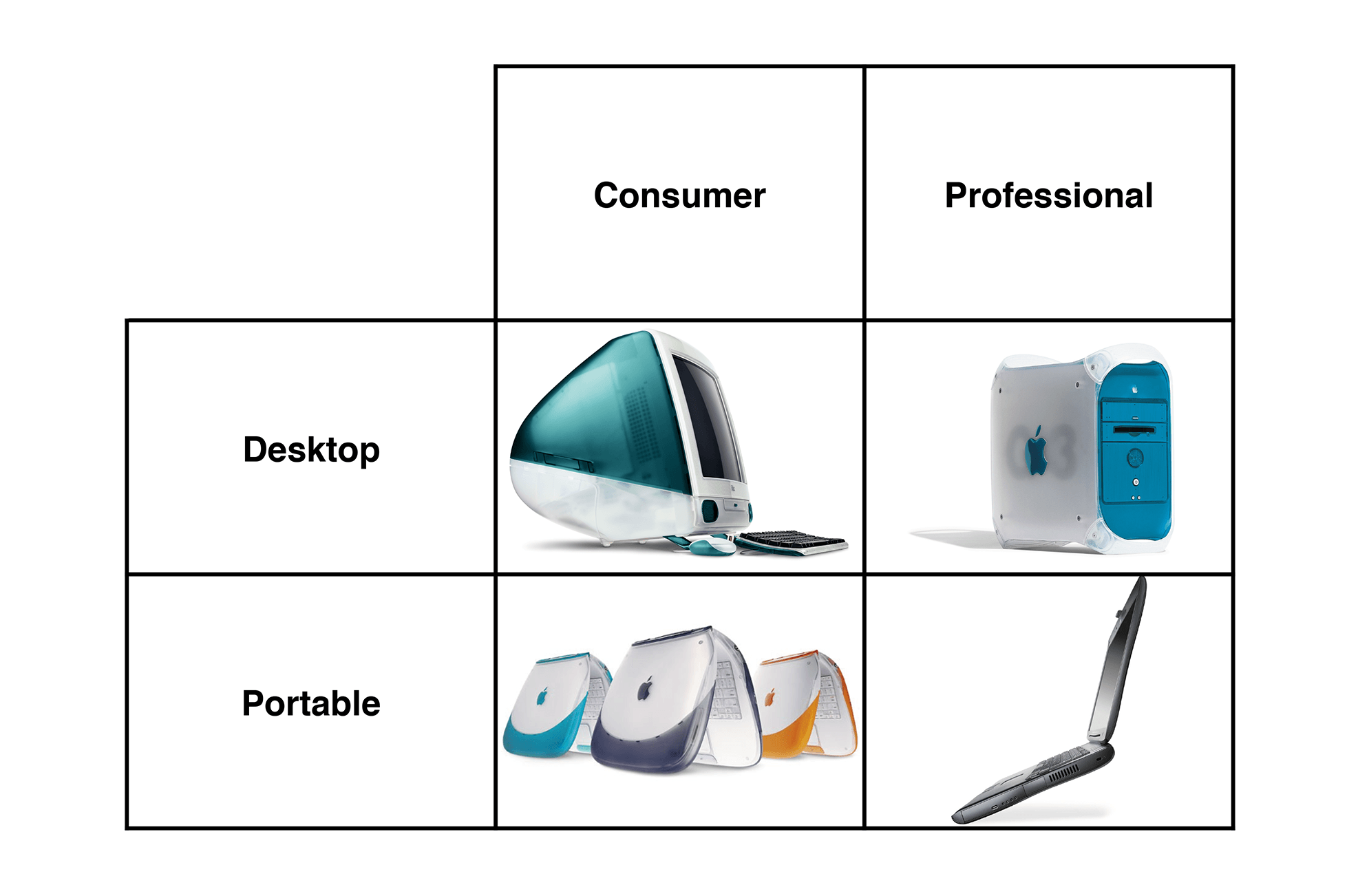
Apple blew away the Grid of 4 a long time ago — first breaking it with the G4 Cube — and over time, the iMac slowly creeped up to encroach on the professional side of things.
What Happens to the iMac Now?⇢
…Apple hasn’t updated the iMac in well over 800 days — which is the longest gap in recent memory and double the average gap between updates over its history. And that conspicuous hole in the M2 lineup has been making me wonder: in a future where MacBooks rule the market and most of the desktops Apple produces are niche, enthusiast products, where will the iMac fit?
The iMac at 25
Today marks 25 years since the original iMac was introduced. It saved Apple and changed the world.1 We live in a Notebook World today, but if Apple was going to reinvent itself in 1998, it was going to be with a desktop:

In a world of beige boxes, the iMac was new and different. Sure, it ran the same old (and kinda busted) Mac OS, but the design — and the move to USB — made huge waves, some of which are still felt today.