
Announced in October 2001, the original iPod may have been simple, but it launched what would become a revolution.
Category: Apple History
On the Mac’s Stale System Sounds⇢
Jason Snell, arguing that the Mac’s system sounds deserve some attention:
The Mac comes with 14 built-in alert sounds, all available from the Sound Effects tab of the Sound preference pane. One of them, Sosumi, dates from System 7. Three more—Glass, Purr, and Submarine—date from Mac OS 9. Six others (Basso, Frog, Funk, Ping, Pop, Tink) are from the earliest days of OS X. The newest ones seem to be Blow, Bottle, Hero, and Morse—and they’ve been around since at least Snow Leopard in 2009.
Xserves Still in Use⇢
Apple put the final nail in the Xserve’s coffin in January 2011 when it officially stopped selling rack-mounted servers. Instead, the company started pushing server customers toward Mac Pros and Minis. On Sept. 20 of this year, Apple lowered that coffin into the ground when macOS Sierra dropped software support for the systems. And while Xserves running El Capitan will keep getting security updates for a couple of years and the current build of the macOS Server software still runs on El Capitan, the hardware will soon be completely buried.
Ken Segall Visits Prague Apple Museum⇢
So, yes, I did visit the Apple Museum on my first day in the Czech Republic last week. (Do I get any points if I walked across the Charles Bridge to get there?) I even sat down with the museum’s manager days later to learn a bit more.
Now that I’m back in New York, here are some photos and observations from my little adventure.
Drang Drafts Macs⇢
Dr. Drang has some excellent follow-up for the Mac draft I held earlier this week.
Back in Black(book)⇢
This month at iMore, I wrote about everyone’s favorite notebook:
Like its predecessor, the MacBook’s case was plastic: The two lower-end models used an outer shell that was glossy like the iBook; the screen bezel, trackpad and keyboard were in a nice, matte white.
But the most expensive MacBook model, which cost $200 more at launch, came in black.
Harry Potter iPod Follow-Up
Back in January, I wrote about the Harry Potter Collector’s iPod:
The iPod was engraved with the Hogwarts crest on the back, and was revved to a 30 GB, 5th-generation iPod shortly after release.
It could only be purchased with the audiobooks, for a combined cost of $548, and there were some special terms and conditions that applied to the offer. It’s important to note that the iPod didn’t come pre-loaded with the audiobooks; this was a digital purchase alongside an iPod. Customers had to download the files and sync them over themselves.
1999’s Artwork and Guidelines for the Mac Logo
512 reader Marc Robinson mailed me me a bunch of Apple marketing materials from the late 90s and early 00s. There was a ton of good stuff in his package, but there was one that I thought I should share first: a CD containing artwork and guidelines on how to use the then-new Mac logo.
A lot of companies publish style guides on how their logos should and shouldn’t be used.1
In the late 90s, Apple made a push for developers to standardize how they showed the Mac logo.
Remembering MECC⇢
This month in my column on iMore, I revisited MECC, the company behind some great software titles like Oregon Trail and Number Munchers:
My earliest memories of technology came from my first year of grade school: It was 1992, and our teacher had installed some variant of an Apple II in the classroom. The students were only able to use it a few times, but each time I got to put a disk in the machine, I was able to escape to another world.
A Final Tour of Tekserve⇢
Darren Orf at Gizmodo has posted a video that all Apple nerds should watch.
Looking Back at iOS Accessibility’s Biggest Milestones
Editor’s Note: This is a guest post by my friend Steven Aquino. He is a freelance tech journalist based in San Francisco, CA, where he covers all things Apple accessibility. His work has appeared in iMore, TechCrunch, Macworld, and more.
The iPhone has been such a revolutionary, life-changing device that remembering what life was like before it existed feels almost like trying to imagine the Stone Age. The advent of the iPhone in 2007 was a seminal moment in technology history; it’s truly a once-in-a-lifetime product that redefined not only smartphones but computers in general. Almost ten years later, it still never ceases to amaze me that everyone nowadays carries with them a lightweight, always-connected supercomputer everywhere they go. A supercomputer, to paraphrase John Gruber, in our freaking pockets!
The Mac OS Watch
To mark the release of System 7.5 — and to incentivize people to upgrade — Apple launched a gift program:
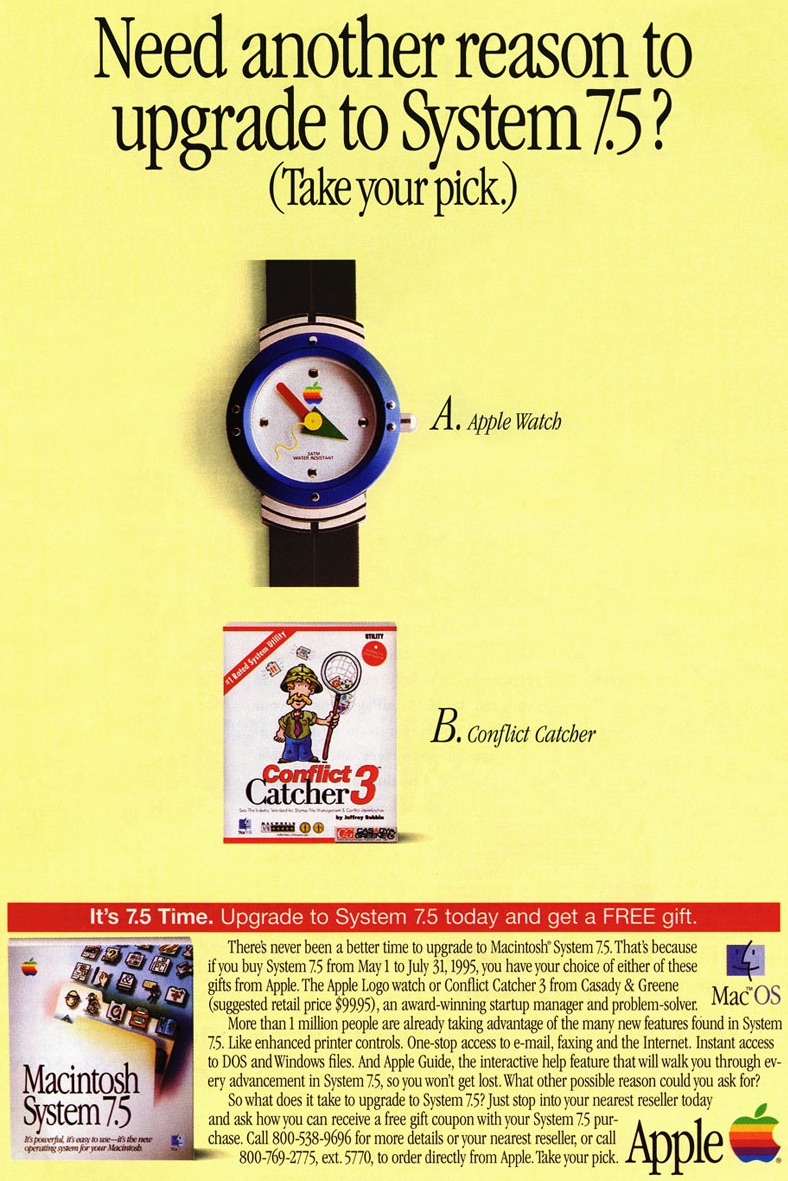
From May 1 to July 31, 1995 users who upgraded to System 7.5 could choose between an Apple watch or a copy of Conflict Catcher 3.