This is going to be great. I’ve had a lot of issues with Flux on my iMac:
Night Shift preference for automatically shifting the colors of your display to the warmer end of the spectrum after dark.

This is going to be great. I’ve had a lot of issues with Flux on my iMac:
Night Shift preference for automatically shifting the colors of your display to the warmer end of the spectrum after dark.
I think at the core of a lot of the angst felt in the Mac community right now is the realization that the Mac is no longer the crown jewel of Apple’s product lines.
Of course, this isn’t new. The iPhone took over the grunt work of being Apple’s cash cow years ago.
With that in mind, consider how Apple introduced the iMac G5:
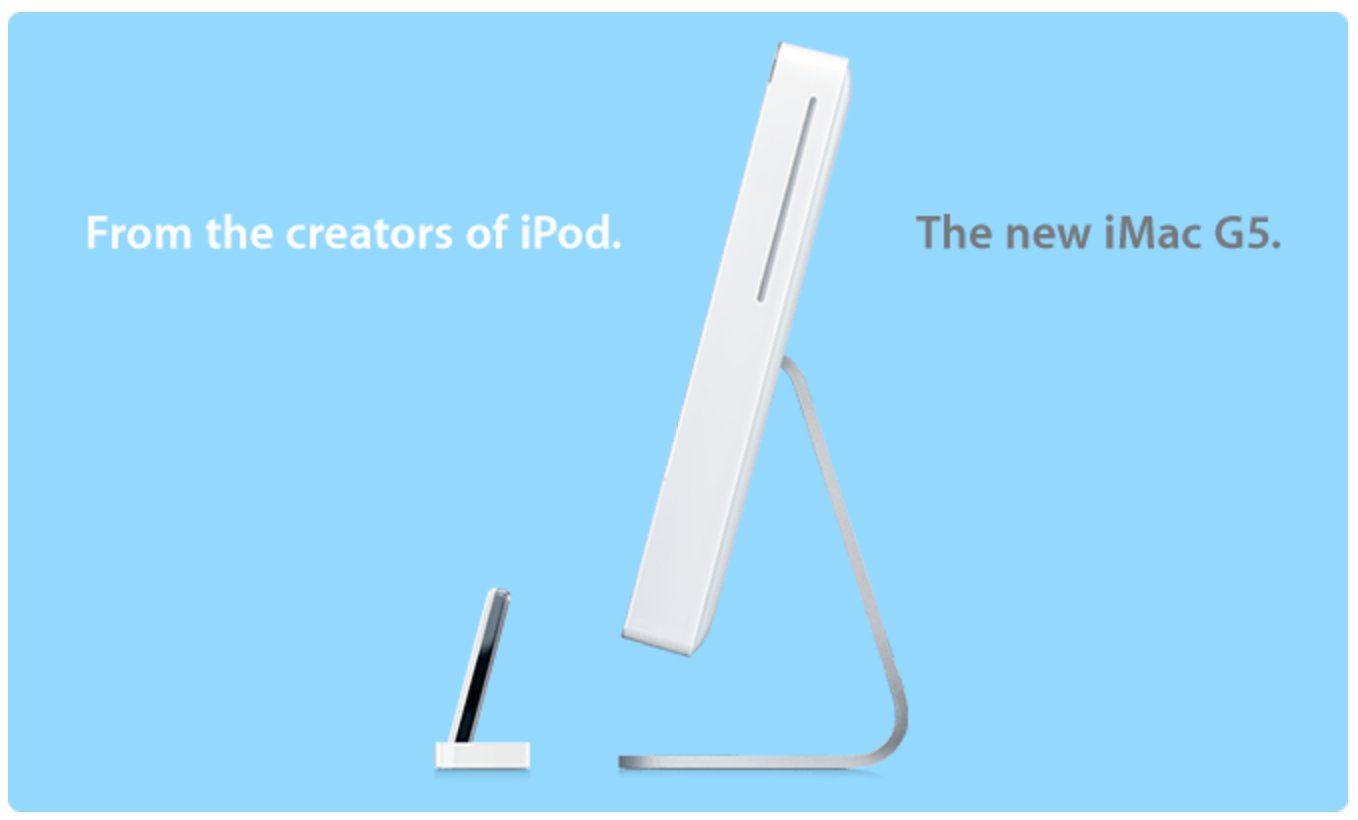
Even the product video opens with shots of an iPod, not the new iMac:
Over the weekend, a story broke that Apple is working create a next-generation version of Touch ID. At the bottom of the story about it on MacRumors, this paragraph appears:
Kuo’s latest report builds on previous predictions regarding this year’s “10th anniversary” iPhone, which is expected to feature a radical redesign with an embedded home button in an edge-to-edge display, a glass body, and potentially wireless charging. Previous rumors suggesting the iPhone 8 could include advanced biometric features like facial recognition or iris scanning have pointed to the possibility that they could also power augmented reality camera functions.
Earlier this week, the United States Federal Trade Commission claimed that chip giant Qualcomm forced Apple into using its LTE chipsets, as Aaron Tilley writes at Forbes:
Qualcomm is the dominant supplier of modem chips that enable phones to hook up to cellular networks, but the company also extracts licensing fees for nearly every modern phone in the world. The agency’s complaint, filed in the U.S. District Court in the Northern District of California, said the San Diego-based chipmaker used its dominant position to maintain an illegal monopoly over its phone partners like Apple.
The FTC said Qualcomm established an exclusivity agreement with Apple from 2011 until 2016. Qualcomm provided “billions” in rebates to Apple for the arrangement. But if Apple bought modem chips from another chip supplier during that time, the FTC said Apple would face large penalties by losing out on Qualcomm’s rebate payments.
Chris Lattner, in an interview with Joe Rossignol at MacRumors:
This was a very difficult decision, because I care deeply about the technology and people at Apple and because I could see myself staying there for many more years. In the end though, the opportunity to dive into a completely new area and work with the amazing Tesla Autopilot team was irresistible.
I believe him, but I still can’t help but wonder what the hell is happening with Project Titan.
On the latest macOS Sierra beta, when a Mac’s display is set above 75% brightness—or at least 13 out of 16 notches—a new item called “Display Brightness” is listed under the battery menu.
Clicking on “Display Brightness” lowers the Mac’s brightness to 75%. Likewise, when we updated a new MacBook Pro to the fourth beta of macOS Sierra 10.12.3, the display’s brightness was automatically lowered to 75%. This is the same brightness level as Apple used during its latest MacBook Pro battery tests.
As we close the door on 2016, I thought it would be useful to look back at the year gone by and ask a panel of my peers who pay attention to Apple and related markets to take a moment and reflect on Apple’s performance in the past year.
I love being part of this every year.
Dan Provost has been doing math concerning the rumored new iPad size:
When the original iPad Pro 12.9" was introduced in September 2015, Phil Schiller demonstrated the reasoning for that sizing by illustrating that the width of the new iPad is the exact same dimension as the height of the 9.7" iPad.
This has the advantage of essentially having two full height iPad apps, side by side.
Now, imagine Apple doing the exact same thing, but with the iPad mini.
Here’s a thought experiment. Let’s imagine that Apple decided to combine their engineering resources to form app teams that delivered both iOS and macOS versions of applications.
In such a scenario it may seem logical to retain application features common to both platforms and to remove those that were perceived to require extra resources. Certainly Automation would be something examined in that regard, and the idea might be posited that: “App Extensions are equivalent to, or could be a replacement for, User Automation in macOS.” And by User Automation, I’m referring to Apple Event scripting, Automator, Services, the UNIX command line utilities, etc.
Let’s examine the validity of that conjecture, beginning with overviews of App Extensions and User Automation.
Earlier today, Chris Lattner announced that he is leaving Apple:
I’m happy to announce that Ted Kremenek will be taking over for me as “Project Lead” for the Swift project, managing the administrative and leadership responsibility for Swift.org. This recognizes the incredible effort he has already been putting into the project, and reflects a decision I’ve made to leave Apple later this month to pursue an opportunity in another space. This decision wasn’t made lightly, and I want you all to know that I’m still completely committed to Swift. I plan to remain an active member of the Swift Core Team, as well as a contributor to the swift-evolution mailing list.
Working with many phenomenal teams at Apple to launch Swift has been a unique life experience. Apple is a truly amazing place to be able to assemble the skills, imagination, and discipline to pull something like this off. Swift is in great shape today, and Swift 4 will be a really strong release with Ted as the Project Lead.
Rene Ritchie has the statement:
We learned that when testing battery life on Mac notebooks, Consumer Reports uses a hidden Safari setting for developing web sites which turns off the browser cache. This is not a setting used by customers and does not reflect real-world usage. Their use of this developer setting also triggered an obscure and intermittent bug reloading icons which created inconsistent results in their lab. After we asked Consumer Reports to run the same test using normal user settings, they told us their MacBook Pro systems consistently delivered the expected battery life. We have also fixed the bug uncovered in this test. This is the best pro notebook we’ve ever made, we respect Consumer Reports and we’re glad they decided to revisit their findings on the MacBook Pro.