
The Golden Gate Bridge was an engineering marvel. The site alone — buffeted by high winds and split by the swirling currents of the Golden Gate — made construction treacherous. The sheer size of the bridge (the longest suspension bridge in the world until the Verrazano-Narrows Bridge opened in 1964) required several innovations in bridge-building technology, especially when it came to constructing the two colossal towers in — and under — turbulent water.
Category: General Tech
On the Amazon Mac Downloads Store
Shawn Blanc interviewed Chad Sellers, who runs Useful Fruit Software, the maker of Pearnote. The software is available on Amazon’s store as well as Apple’s. Here’s an interesting look into Amazon’s processes for developers getting their software to the company from Sellers:
Currently, I email it to them. They are working on an online submission system, but it doesn’t exist yet. It’s non-ideal, but they processed my latest update very quickly.
Looking for a Pen
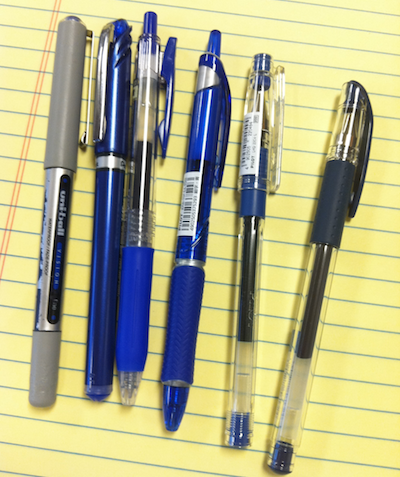
I don’t write much by hand anymore, but when a guy at JetPens.com offered me some pens, I couldn’t turn him down.
Check out my notes on each pen here, as a hand-written PDF.
The Army’s AT-AT
Years before the Star Wars franchise lit up the eyes of adults and children alike, the US Army was working with General Electric on the “Walking Truck” project, basically a large walker which was controlled by a lever-pushing operator.
Called the Cybernetic Anthropomorphous Machine (or CAM for short), the walker may not have been used by the US Army in combat on rough terrains, but the idea was certainly explored by them in 1965.
Is the Cloud Just the new Mainframe?
If you think about it, cloud computing is a lot like the old centralized IT processing model of the past embodied by the mainframe. Computing power is moved away from the end users and into a centralized entity that’s managed by someone else. To be fair, the cloud isn’t really centralized the way mainframes of the past were (and are). However, the cloud and mainframes are alike in that they both move the computing power and infrastructure governance farther from the users of those platforms.
Dell Really Likes the MacBook Pro
I just don’t get what kind of company would be okay with producing such a blatant rip-off.
Eighty Percent of Mobile Video Views on iOS
FreeWheel reported that four-fifths of all mobile video views happen on Apple iOS devices. The iPhone and iPod touch each account for about 30 percent of all video views that happen on mobile devices, with the remaining 20 percent being attributed to Android devices, according to the report. Other devices account for less than one percent of all video views on mobile devices, according to FreeWheel.
Man, the lack of Flash is really holding Apple’s devices back.
Maybe Size Does Matter
Casey Johnston at Ars, on the HP Veer:
While webOS remains a promising platform with many desirable features, we ultimately found that the Veer, both in terms of physique and power, is not sufficient for anyone performing more than very light and infrequent tasks on their smartphones. The inclusion of a physical keyboard makes the phone decent for messaging (though its keys are quite small) but the size of the screen and the underpowered processor can make moderate to heavy use a chore. The Veer is targeted at those who want latitude in the capabilities of their communication device, but have only a light reliance on the various functions a smartphone can perform.
Music Files and the Cloud
Shawn Blanc, comparing cloud music services like Rdio to Netflix:
However, I have a different attitude towards movies than I do towards music. I will maybe watch my favorite movies once or twice a year, at the most. A great album that I love I will listen to every day for months and months.
Movies are entertaining. Music is personal.
And so I don’t know if the paradigm that access is better than ownership has the same effect on our music library as it does for our DVD collection. The music we listen to, in many ways, is a definition and extension of who we are.
Kindle Books Take Over Print Sales at Amazon
The Kindle has been a huge success, no doubt about that, but we are continually amazed at just how big a success it has become. Amazon too, apparently. The company just issued a press release to announce that digital book sales have now exceeded sales of all print titles, both hardcover and paperback combined. As of April 1st, for every 100 print books that Amazon has sold (of any kind) the company moved 105 Kindle books, and no that doesn’t include downloads of free titles.
Long Live Adobe FreeHand
On the Ubiquitous Capture Tool
Your choice of UCT doesn’t matter. At all. Trust does. If a granite tablet and a chisel works for you, use it. Fancy notebook, iPhone, whatever. Just ensure that you know beyond a doubt that it will be available if and when you need it, 100% of the time. Floating on top of my mess is a ubiquitous capture tool. Thanks to some hard core behavior modification, I always know where it is.