
John Kraus shares some of my favorite rocket launch photos, and one of his most recent ones was shot on an iPhone XS Max.
Category: Space
A Trip to Johnson Space Center
A few weeks ago, my Liftoff co-host 1 and all-around-cool-guy Jason Snell told me he was going to be in Houston, Texas and asked a question I couldn’t say no to:
Do you want to visit Johnson?
Johnson Space Center is a key hub in NASA’s web of centers across the nation. Anytime an astronaut calls to the ground with the prefix “Houston,” Johnson is home to whoever answers.
Today, Johnson is home to much more than mission control. It’s Ground Zero for astronaut training thanks to two International Space Station facilities, and is critical in NASA’s Commercial Crew program. That program will be putting US astronauts into orbit from US soil for the first time since the shuttle program ended in 2011, and is taking shape thank to partners like SpaceX and Boeing, who are building crew-rated capsules for trips to and from the Space Station.
The Mac Observatory⇢
Andrew Burwell has put together an amazing site of his astrophotography, a collection of images he has created with a series of telescopes and the Mac. He has some truly beautiful photos posted.
Today Marks the 50th Anniversary of Apollo 11
Five decades ago, Neil Armstrong, Buzz Aldrin and Michael Collins’s massive Saturn V rocket lifted off in Florida, propelling the three men toward the moon, and into history. I’ll be collecting some links here today marking the occasion:
- CBS’ livestream of their original Apollo 11 coverage
- NASA’s collection of media marking the day
- @apollo_50th on Twitter, which is covering major events in the Apollo program in real time
- Super awesome limited version of Studio Neat’s Mark One pen, designed to honor Apollo 11
- The Atlantic: “The Moment That Made Neil Armstrong’s Heart Rate Spike” and “The Watch That Went to the Moon”
- The Verge on YouTube: “How the Apollo legacy is holding NASA back”
- First Men on the Moon: A minute-by-minute reliving of the mission through the use of archival tapes
- Linus Tech Tips and Destin Sandlin of Smarter Every Day have posted a video about the Saturn V Instrument Unit
- Our episode of Liftoff, on which we discuss three aspects of the mission that aren’t as well known, including Neil Armstrong’s brush with death in a training exercise, the science performed by the crew during their lunar EVA, and the astronauts’ less-than-glamorous welcome back to Earth.
Restored Apollo Mission Control⇢
Lee Hutchinson, writing at Ars Technica about a huge project in Houston:
For the past two years, historians and engineers from the Kansas Cosmosphere’s Spaceworks team have been lovingly restoring and detailing the 1,200-pound (544kg) historic sage green Ford-Philco consoles that populated the control room—repairing damage from decades of casual neglect and also adding in the correct control panels so that each console now correctly mirrors how it would have been configured for an Apollo flight.
Artemis’ Pending Battles
Artemis — the new name for NASA’s initiative to put humans back on the moon by the end of 2024 — may be defined by its new, flashy goal, but as Loren Grush writes, it has an up-hill battle to even have a shot at the lunar surface:
NASA’s first big hurdle is a political one. Over the next few months, the space agency must sell this initiative to Congress, which controls the government’s budget. Lawmakers may like the idea of putting women on the Moon, but they may not want to raid the budgets of other federal programs to help NASA achieve its goal. Plus, Congress has to buy into NASA’s blueprint for this lunar return mission, and lawmakers will be taking a close look at how the space agency plans to get there.
Moving Black Hole Data⇢
Jason Snell has written about today’s black hole news:
To capture this image, the EHT used seven different radio telescopes all around the world in order to use something called interferometry, which combines data from telescopes spread out over a wide distance to essentially create a virtual telescope the size of the distance between the telescopes. The result is a telescope that’s basically the size of Earth. (Among the telescopes used is one at the South Pole, which needed to be retrofitted to make these measurements.)
Scientists Share First Photo of a Black Hole⇢
This morning, the National Science Foundation and the team behind the Event Horizon Telescope project announced a things-will-never-be-the-same bit of news:
Today, in coordinated press conferences across the globe, EHT researchers reveal that they have succeeded, unveiling the first direct visual evidence of a supermassive black hole and its shadow.
This breakthrough was announced in a series of six papers published in a special issue of The Astrophysical Journal Letters. The image reveals the black hole at the center of Messier 87, a massive galaxy in the nearby Virgo galaxy cluster. This black hole resides 55 million light-years from Earth and has a mass 6.5-billion times that of the Sun.
The Best of Bill Ingalls⇢
NASA’s official photographer has been on the job for 30 years, and to celebrate, some of his best shots have been curated over on the National Geographic website.
Goodnight, Opportunity⇢
Today marks the end of Opportunity’s mission. One of two identical Martian rovers, Opportunity landed on the Red Planet just over 15 years ago to start what was supposed to last 90 Martian days and travel 1,100 yards.
It covered 28 miles before a dust storm coated its solar panels last year, leaving the rover unable to charge it batteries.
Here’s a bit from NASA:
“For more than a decade, Opportunity has been an icon in the field of planetary exploration, teaching us about Mars’ ancient past as a wet, potentially habitable planet, and revealing uncharted Martian landscapes,” said Thomas Zurbuchen, associate administrator for NASA’s Science Mission Directorate. “Whatever loss we feel now must be tempered with the knowledge that the legacy of Opportunity continues – both on the surface of Mars with the Curiosity rover and InSight lander – and in the clean rooms of JPL, where the upcoming Mars 2020 rover is taking shape.”
Earthrise⇢
Fifty years ago, while aboard Apollo 8, William Anders took what is perhaps the most iconic photo of the 20th century:
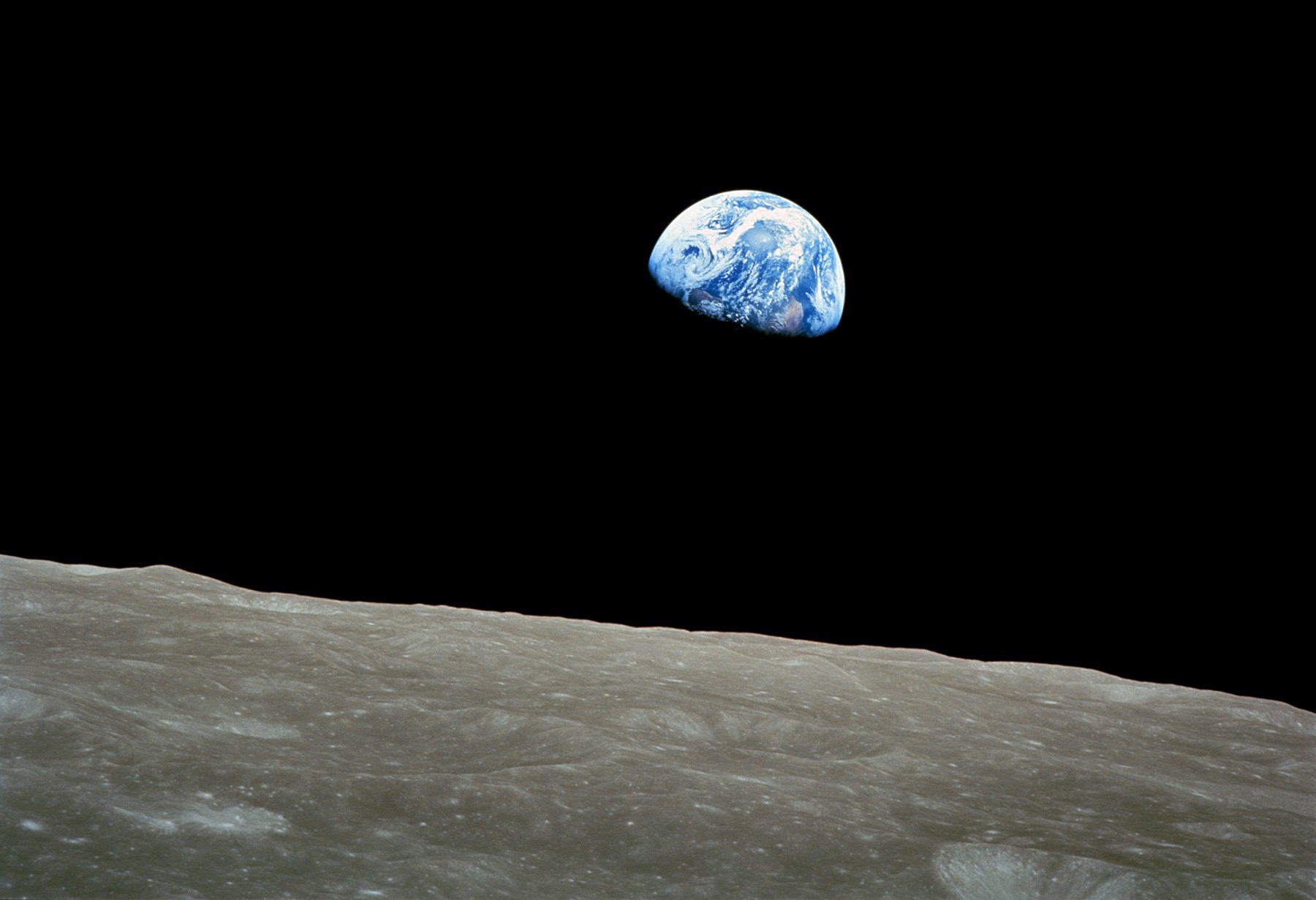
Dubbed Earthrise, it was the first image of our entire planet taken by someone not on it.
Anders has written about the image over on Space.com:
One of my assignments was to photograph the lunar surface to facilitate the evaluation of potential landing sites. I brought a 250 mm lens to bring that alien terrain into better view. On our fourth orbit, the spacecraft was oriented in a different direction. A startling image captivated the three of us.
Voyager 2 in Interstellar Space⇢
Dwayne Brown and Karen Fox at NASA:
Comparing data from different instruments aboard the trailblazing spacecraft, mission scientists determined the probe crossed the outer edge of the heliosphere on Nov. 5. This boundary, called the heliopause, is where the tenuous, hot solar wind meets the cold, dense interstellar medium. Its twin, Voyager 1, crossed this boundary in 2012, but Voyager 2 carries a working instrument that will provide first-of-its-kind observations of the nature of this gateway into interstellar space.