512 Pixels

These Stickers Are Very Good

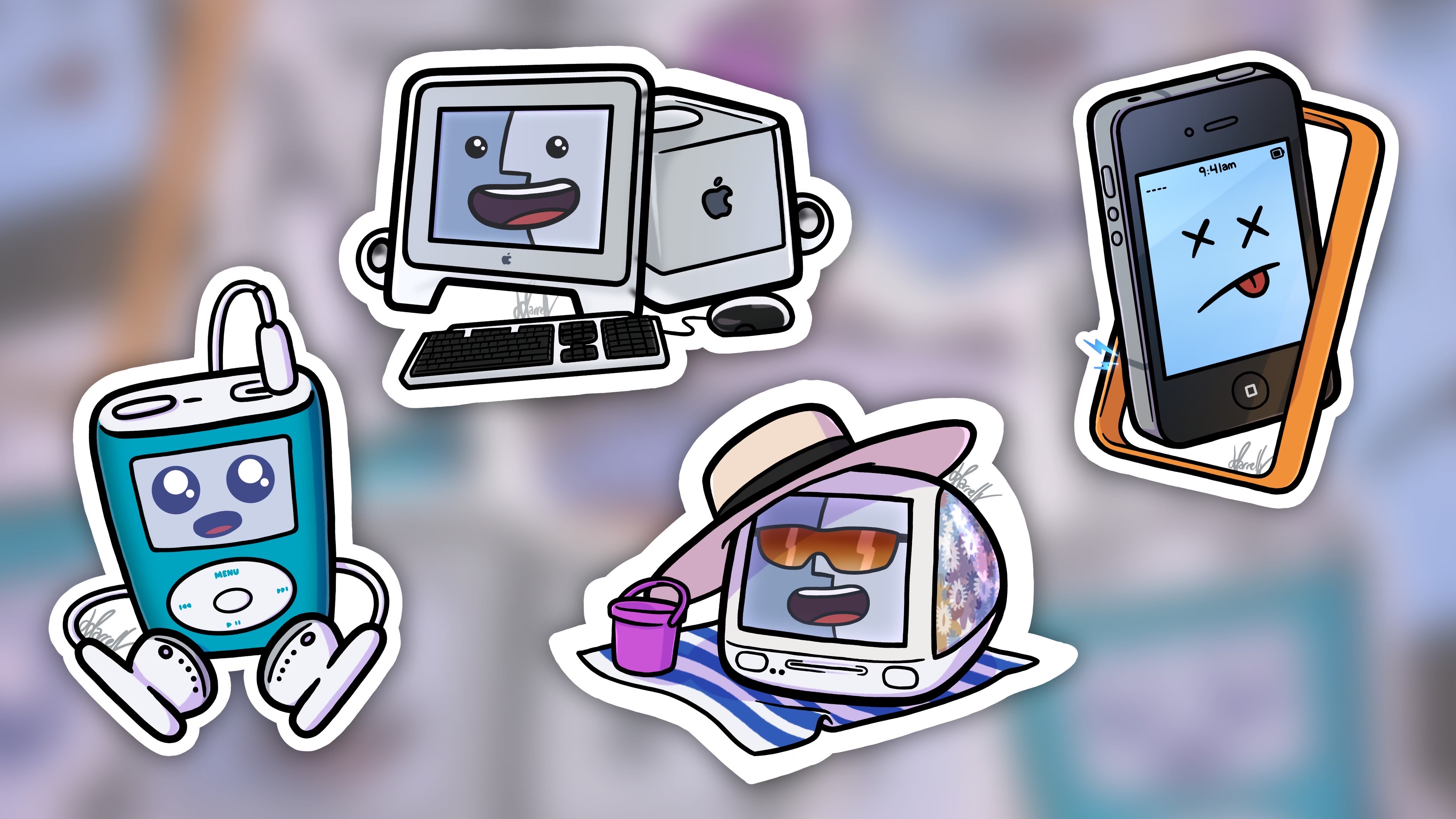
For each of the Apple History Calendars, my pal Jelly has created a set of fun, unique stickers. This year’s project is no different:

2024 Stickers

Here’s my headcanon for each sticker:

  • The blue iPod mini is trying to win back your love as you unbox a new iPod nano.
  • The G4 Cube has no idea what’s coming for him, and is just loving life as Steve Jobs’ favorite Mac.
  • The iPhone 4 is mocking Antennagate to her friends, years later.
  • Flower Power is enjoying retirement like few older Macs can: hanging out at Bondi Beach.

These stickers are available to backers at the “Get It All” level on this year’s Kickstarter.

Maybe Zuck is Winning the Fight With Elon Anyway

A few fun stories this month today in The Social Media Apocalypse:

So as Twitter continues to evolve into the Internet’s silliest island, Meta is ready to come in and build a mansion right on the beach. I don’t often root for Meta to win, but I think if anyone could replace Twitter for the masses, it’s going to be them with Threads.

Kbase Article of the Week: Remove iTunes Gift Album ‘Songs of Innocence’ from your iTunes Music Library and Purchases⇢

Apple Support, on a page first published just a week after U2’s album was forced upon given away to all iTunes users:

Follow these instructions to remove U2’s “Songs of Innocence” from your iTunes music library and iTunes purchases. Once the album has been removed from your account, it will no longer be available for you to redownload as a previous purchase. If you later decide you want the album, you will need to get it again. The album is free to everyone until October 13, 2014, and will be available for purchase after that date.

To remove this album:

  1. Go to https://itunes.com/soi-remove.
  2. Click Remove Album to confirm you’d like to remove the album from your account.
  3. Sign in with the Apple ID and password you use to buy from the iTunes Store.
  4. You’ll see a confirmation message that the album has been removed from your account.
  5. If you downloaded the songs to iTunes on your Mac or PC or to the Music app on your iPhone, iPad, or iPod touch, you’ll need to delete them manually.

Thankfully, the Wayback Machine has a grab of that “SOI Removal” page. However, it seems that “Songs of Innocence” never really dies.

Sponsor: TextExpander⇢

TextExpander’s customizable and shareable snippets of text allow your team to fly through repetitive tasks quickly by expanding the things you type regularly — all you have to do is type a short abbreviation and TextExpander does the rest of the work for you.

Here’s How It Works:

  • Create It: Collect your most commonly used emails, phrases, messaging, URLs, and more to create snippets and templates in TextExpander that are always accessible with a quick search or abbreviation.
  • Share It: Give your team or different departments across your company access to the content they need to use every day.
  • Use It: Expand the content you need with just a few keystrokes on any device, across any app you use — no APIs or integrations needed.
  • Optimize It: Add customizations like fill-ins and optional sections to keep that human touch. Anytime you make changes to snippets they update everywhere so your team is always on the same page.

It’s that easy!

Check out TextExpander and say goodbye to repetitive typing.

Twitter Pulls Redditesque Move That Itself Was Inspired by Reddit Wanting to be Like Twitter⇢

Over at The Verge, Wes Davis and Richard Lawler are reporting on the new paywall that has been erected around Twitter:

Elon Musk continues to blame Twitter’s new limitations on AI companies scraping “vast amounts of data” as he announced new “temporary” limits on how many posts people can read.

Now unverified accounts will only be able to see 600 posts per day, and for “new” unverified accounts, just 300 in a day. The limits for verified accounts (presumably whether they’re bought as a part of the Twitter Blue subscription, granted through an organization, or verification Elon forced on people like Stephen King, LeBron James, and anyone else with more than a million followers) still allow reading only a maximum of 6,000 posts per day.

Shortly after that, Musk tweeted that the rate limits would “soon” increase to 8,000 tweets for verified users, 800 for unverified, and 400 for new unverified accounts.

Ah yes, the classic “AI is digesting our data so we should punish our best users” move.

This comes on the heels of Twitter cutting off all access to people who are not logged into the site, but there is probably even more to this 4D chess move by Musk. A few weeks ago, it came out that Twitter had stopped paying it Google Cloud bills. As today is the first of the month, it’s not hard to assume that the paywall changes — in addition to the outages being reported by users — are at least in part because of Google pulling the plug1 on something important.

Or maybe the DDOS is coming from inside the house. It’s hard to tell.

Humane Teases Its ‘Ai Pin’⇢

David Pierce:

Humane, the buzzy company started by former Apple employees that has been making big promises about an AI-first and post-smartphone future, announced today that its first gadget will be called the Humane Ai Pin. It’ll be powered by “an advanced Snapdragon platform” in partnership with Qualcomm, and it’s coming later this year.

That’s really all we know so far. Humane continues to be mysterious about how the Ai Pin works, what exactly it will do, and even what it looks like. (Most mysterious of all: why in the world is “AI” not capitalized? What is “Ai?” Am I supposed to pronounce it like “eye?” I am confident this will infuriate The Verge’s copy desk and me in equal measure for years to come.)

For a company whose only product so far has been hype, announcing this on a news-filled Friday ahead of a holiday weekend strikes me as very odd.

Or maybe they just want me to think it is very odd and the Humane Hype Train is still firmly on the tracks. Who can even tell anymore?

10 Years After Google Reader⇢

David Pierce, writing at The Verge:

There was a sign in the Google Reader team’s workspace at the company’s headquarters in Mountain View, California. “Days Since Cancellation,” it read, with a number below: zero. It was always zero.

This was in 2006 or so, back when Google Reader was still growing. Back when it still existed at all. Google’s feed-reading tool offered a powerful way to curate and read the internet and was beloved by its users. Reader launched in 2005, right as the blogging era went mainstream; it made a suddenly huge and sprawling web feel small and accessible and helped a generation of news obsessives and super-commenters feel like they weren’t missing anything. It wasn’t Google’s most popular app, not by a long shot, but it was one of its most beloved.

Within the company, though, Reader’s future always felt precarious. “It felt so incongruent,” says Dolapo Falola, a former engineer on the Reader team. “Literally, it felt like the entire time I was on the project, various people were trying to kill it.”

‘I Found Exactly One’⇢

Monica Chin, writing at The Verge:

Apple’s latest Mac Pro was finally revealed at this year’s Worldwide Developers Conference as a machine for the most power user of power users. The video discussed audio engineering, color grading, and video transcoding. Apple’s product page mentions code compiling, animation, compositing 8K scenes, 3D rendering, and “analyzing enormous datasets.” This isn’t just for pros, Apple seems to claim; it’s for capital-P Pros.

I wanted to know whether Apple’s purported target demographic — people who spend their days animating, making visual effects, and doing various other tasks generally associated with big, powerful computers — were actually interested in purchasing this machine. So I asked a bunch of them, and the answer, basically across the board, was no. Not because the Mac Pro is bad but because Apple’s other computers, namely its laptops, have just gotten too good.