512 Pixels

Using Loopback to Play Audio Through a Pair of Studio Displays

I recently sold my Pro Display XDR and moved to a pair of Studio Displays.

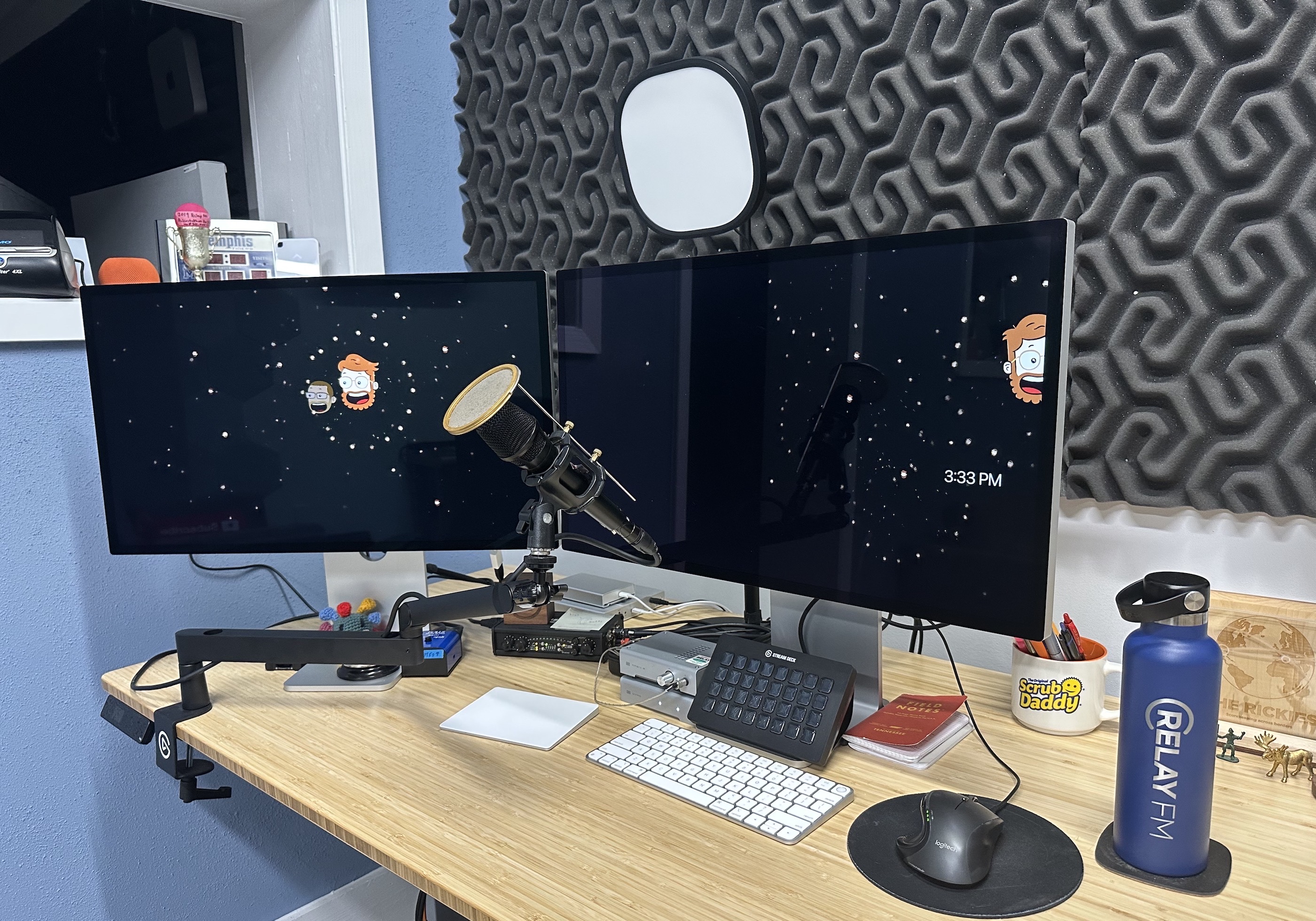
The Studio Display is pretty great, especially with the optional height-adjustable stand. I didn’t use any of the high-end features of the XDR, and after just a few weeks, I’ve fallen in love with this setup, minus some cables that still need tidying:

My desk

As the Studio Display comes with a better-than-expected set of internal speakers, this has marked the retirement of the pair of SoundSticks that I’ve been using as my speakers basically forever. As one of them had hot glue holding it together, it felt like it was time.

You know what’s better than one set of Studio Display speakers, though? Having two sets play at the same time. Yesterday, I was wondering how to do this, and then it hit me:

Loopback!

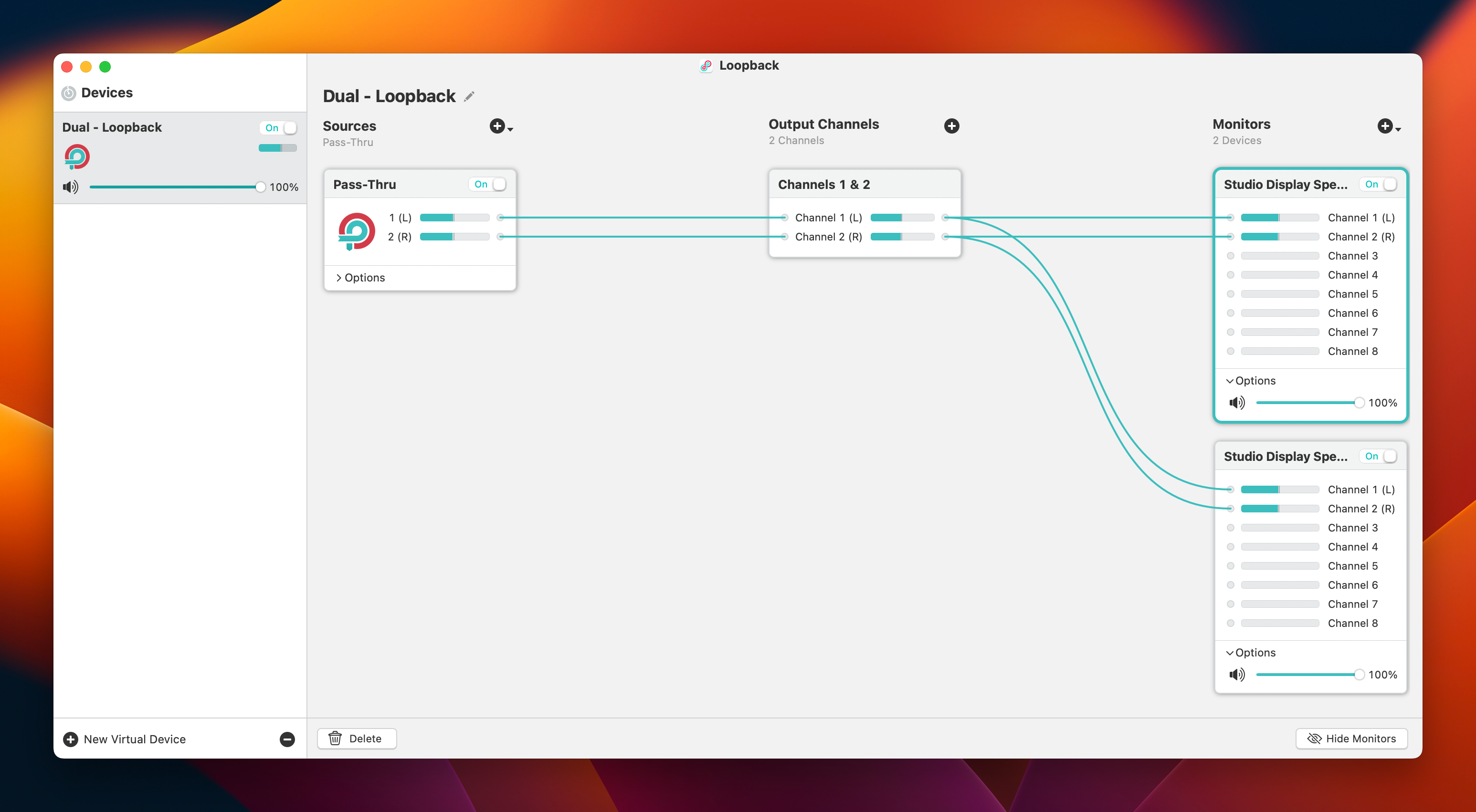
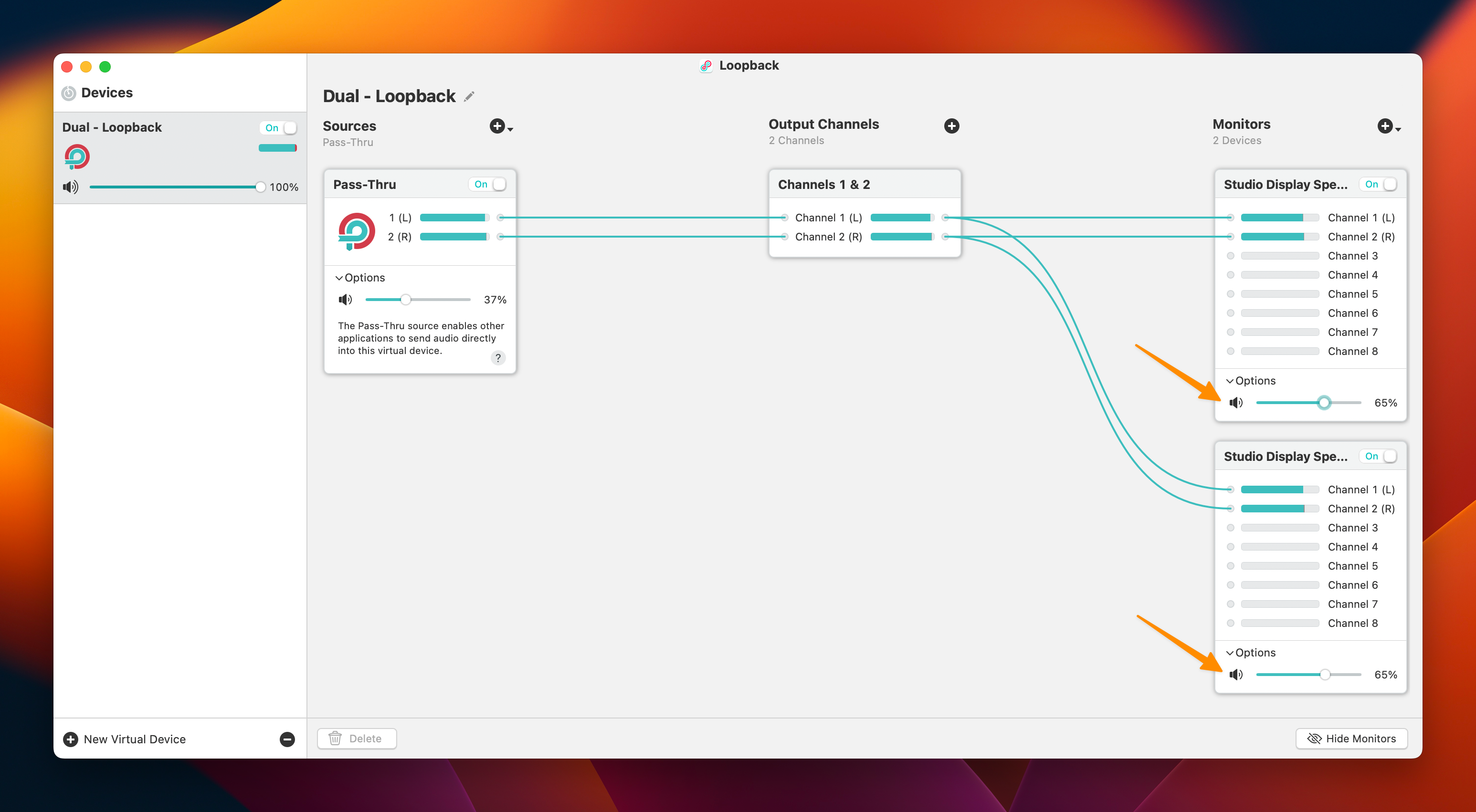
The full extent of what this application can do is far beyond the scope of this blog post, but in just a few minutes, I had all system audio passing through Loopback to both Studio Displays:

Loopback Screenshot

In this setup, the same audio is piped to both displays, so audio on the left channel plays through the left speaker on both displays. This means that the two speakers are playing the exact same thing.

As I sit in front of one display, with the other to my left, this works best for me. However, if I wanted the left display to play just the left channel, and the right one to play just the right, then Loopback would look like this:

Loopback Screenshot

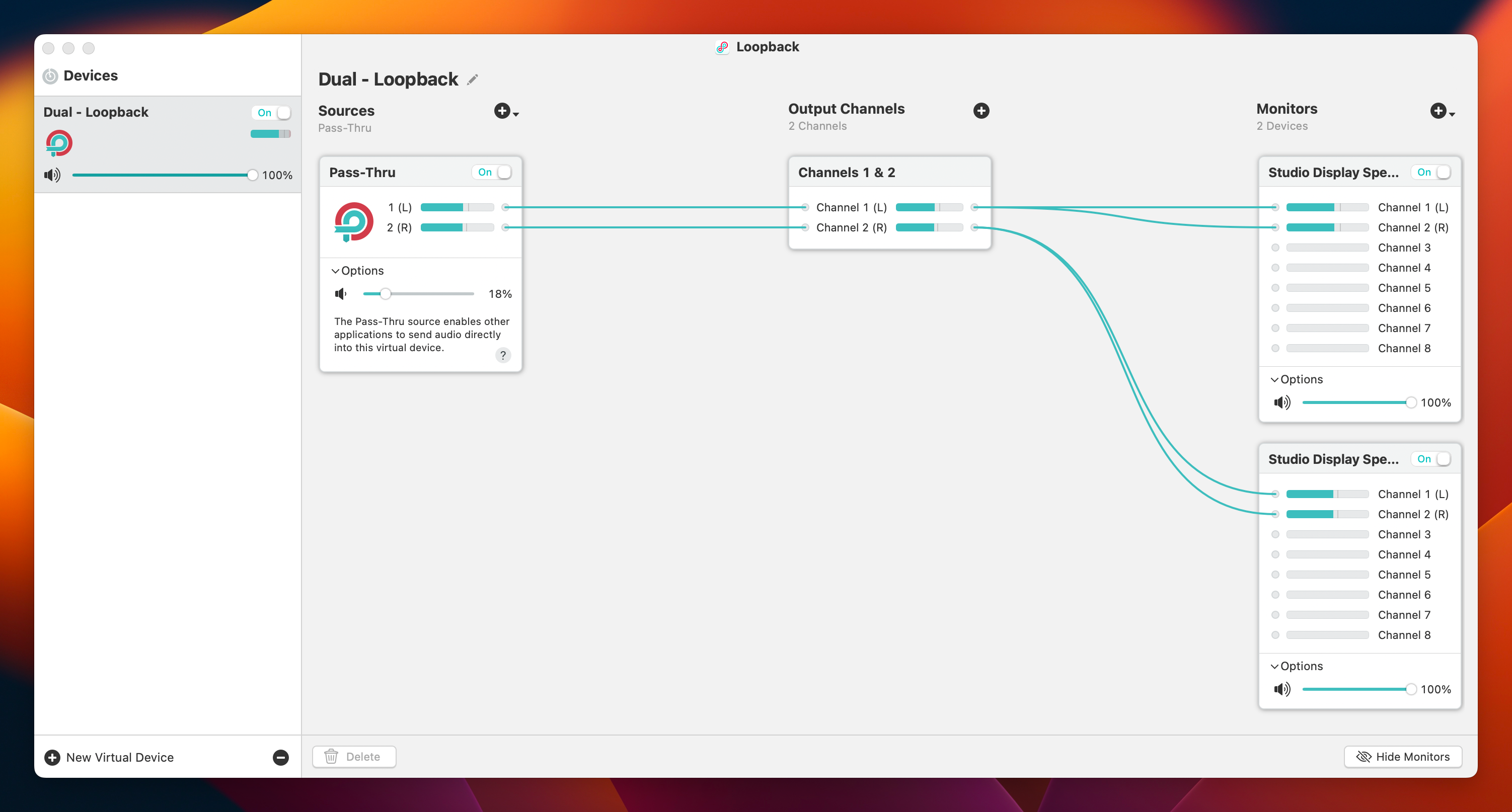
One side effect of this is that a pair of Studio Displays is way louder than one Studio Display. Thankfully, Loopback makes it easy bump down the maximum volume on a per-device basis. Knocking them back to 65% each is working well for me.

Loopback Screenshot

This sort of thing is what makes being a macOS user so much fun.

My Evolving Setup

Last week, I was putting things together for an upcoming episode of Mac Power Users1 and came across a few old posts in which I shared my Apple setups. I thought it would be fun to put them all in one place:

  • October 2009: This was my desk in the first apartment my wife and I lived in after getting married. It was about a year after I started this blog and our oldest son was 11 months old. Now he’s 14.
  • September 2010: That was a very good iPad wallpaper.
  • December 2011: I believe this was my first home screen post over on David Sparks’ site. The images seem lost to time.
  • October 2012: I have no idea why I didn’t take any photos for this one. One star.
  • March 2014: The desk featured in this article was at the last company I worked for. We would launch Relay FM about six months later.
  • September 2014: Sparks’ site does have these images! I look so young.
  • September 2015: After I quit my job to go indie, I split my time between a home office (shown below) and this space, which I rented with my brother’s non-profit.
  • August 2016: This setup was outlined right before I moved into my current studio. This desk was shoved into what was a spare bedroom in our house that is now home to our youngest son.
  • September 2018: I was really excited about this one and I love that photo.
  • March 2020: It’s amazing how little my homescreen has changed over the last three years.

If you want a much more updated accounting of things, check out my Gear & Studio page.


  1. It will be published on Sunday, January 8. ↩︎

Kbase Article of the Week: Use Gigabit Ethernet on Mac ⇢

Apple Support:

If your Mac supports it, you can use Gigabit Ethernet, which requires a special Gigabit Ethernet cable.

If you don’t have a Gigabit Ethernet cable, you can still connect to a Gigabit Ethernet network by adjusting the Ethernet speed of your computer.

Amazingly, the ability to manually set network speed is still present in macOS Ventura.

Another Year in the Books

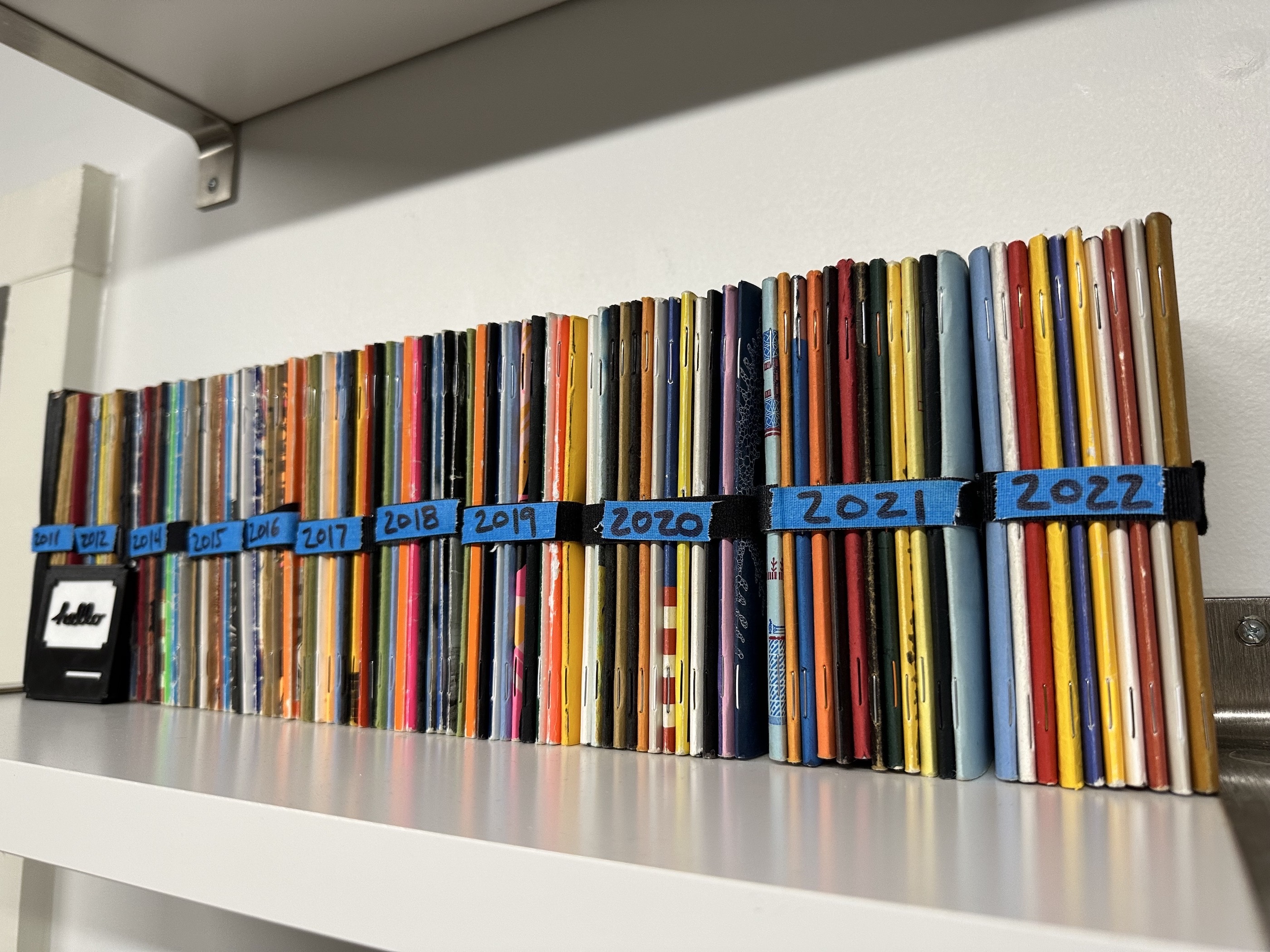
It’s hard to believe it is January again. The new year means I get to put another bundle of used Field Notes on my shelf:

A collection of Field Notes

Long time readers — and viewers — will know that I’ve done this for over a decade, but I carry a notebook with me just about all the time. Their contents range widely and I can’t imagine life without them.

Flipping through my 2022 notebooks, I spotted everything from Podcastathon planning and meeting notes to questions for my therapist and grocery lists. When one gets filled up, I scan it, toss the PDF on Dropbox and put the notebook on the shelf.

Mac Power Users #673: Apple’s New Freeform App ⇢

It’s a big start to the new year on Mac Power Users:

It’s not every day that Apple releases a new productivity app, but with iOS 16.2 and macOS Ventura 13.1, the company launched Freeform, an infinite canvas app for sketching, organizing and sharing information. David and Stephen have been using it extensively and break it all down this week.

We did all of out show prep in Freeform itself:

MPU 673 Notes in Freeform

There are some very 1.0-feeling things in Freeform, but overall, it’s already a great tool and if Apple doesn’t let it wither on the vine, I think it has a bright future.

Apple Guiding Dark Sky Users to Apple Weather ⇢

Apple Support:

Dark Sky’s features have been integrated into Apple Weather. Apple Weather offers hyperlocal forecasts for your current location, including next-hour precipitation, hourly forecasts for the next 10 days, high-resolution radar, and notifications.

Apple Weather is available on devices running iOS 16, iPadOS 16, and macOS 13 Ventura. If you’re new to Apple Weather, here are some tips to get started.

What’s Left in the Apple Silicon Transition

Over at MacRumors, Hartley Charlton pointed out something that hadn’t crossed my mind:

Historically, Apple released at least one new Mac model every year in the fourth quarter that runs between October and December, starting in 2001 with the launch of the iBook G3. This means that there has been a new Mac toward the end of the year for the entire lifespan of product lines including the iPod, iPhone, iPad, and Apple Watch. The last Mac that Apple released is the M2 MacBook Air, which launched on July 15. Depending on how long Apple waits to launch its next Mac, the time following the launch of the MacBook Air could be among the longest periods with no new Mac models at all.

When announced back in June 2020, the transition was promised to take two years. Whether you started counting at WWDC 2020, or when the M1 was unveiled in November, Apple has missed its deadline.

There are several reasons for this, ranging from the loss of key individuals on the Apple silicon team to the on-going global supply chain and economic uncertainty. While many of us know that the Mac keeps going forever, it’s clear that something has made the transition from Intel to Apple silicon take more time than planned.1

Given that we now live in this Already-But-Not-Yet Phase, let’s think about what could be left on Johny Srouji’s “Transition” list in Reminders:

Order 66 Those Intel Macs

Here at the end of 2022, there are two Intel Macs still for sale that need to be murdered in cold blood taken care of:

Apple doesn’t want to be selling Intel Macs anymore. The more time goes on, the longer Apple is going to have to support Intel machines with new versions of macOS and its other applications.2

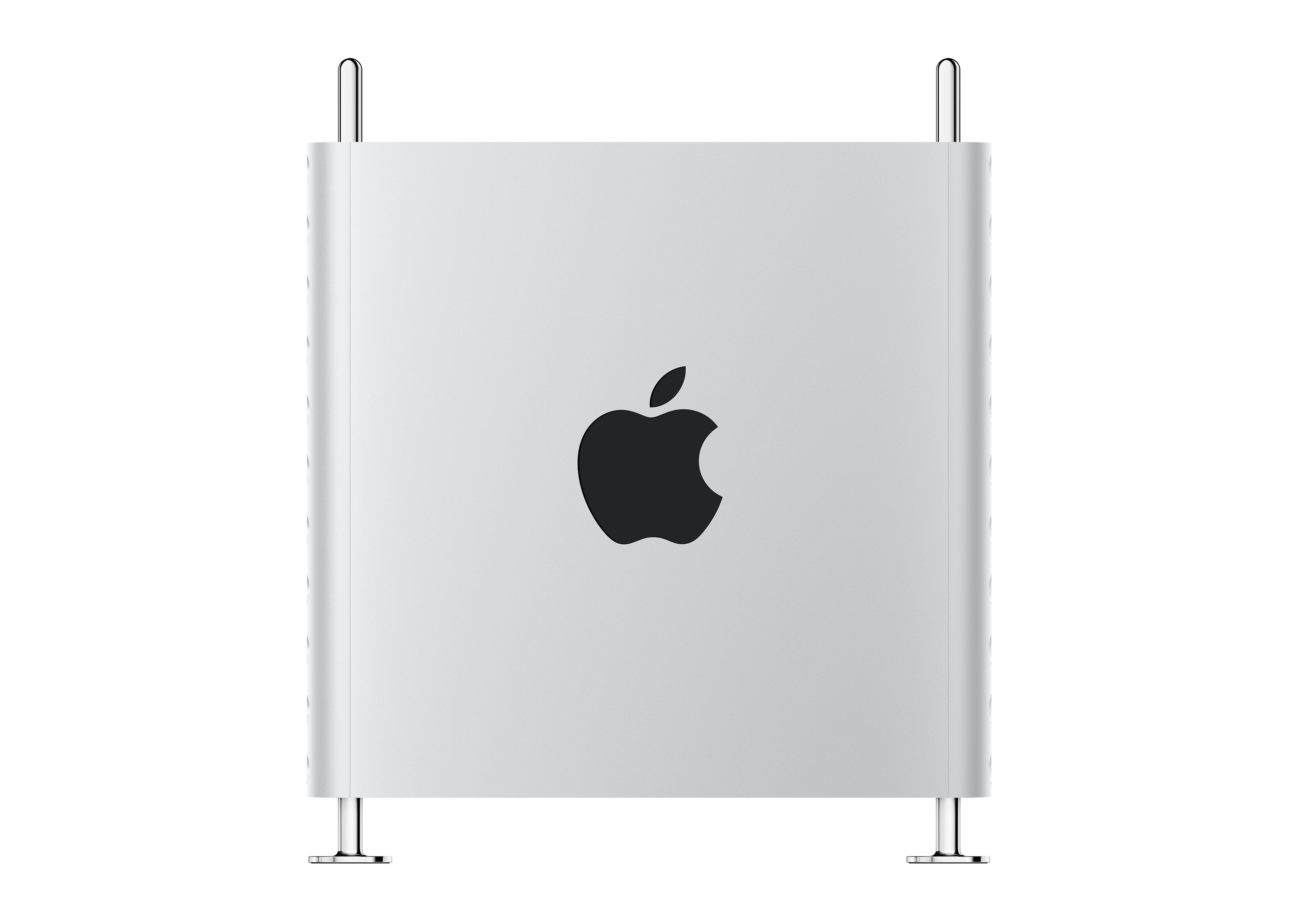
The Mac Pro

2019 Mac Pro

In its transition to Intel, Apple replaced the iMac G5 and PowerBook G4 first, with the Intel iMac and the initial MacBook Pro. They were both announced in January 2006, with the Intel Xserve and the Mac Pro bringing up the rear in August of that year.

We’ll circle back to the Mac mini, but assuming that is sorted out quickly, the Mac Pro will once again be the final Mac to cross into this new era. This isn’t too surprising, as it just makes sense to start with the more mainline product lines and eventually making it to the more obscure models. Unique to our current transition, Apple is working up to whatever will power the new Mac Pro. Back in the day, the Xeon wasn’t new to Intel.

As long as there has been a Mac Pro, there has been handwringing about the next Mac Pro, and today is no different. As recent as a couple of weeks ago, Mark Gurman reported that work on a custom high-end “M2 Extreme” chip had been called off.

Regardless of what SoC Apple uses in the new Mac Pro, there are many unanswered questions about how Apple silicon will scale up to the Mac Pro.3 The biggest is what comes of the Mac Pro’s many PCI ports and the MPX Modules that debuted in the 2019 model.

From the first A4 to the M2 Ultra, Apple’s SoCs use GPUs integrated in the package itself, to impressive results so far. However, there are users — from gamers to artists to scientists to Siracusas — who want or need more than what any on-die graphics hardware can do. Is Apple willing to spend the engineering effort to extend what its chips can do for one low-volume machine? The 2019 Mac Pro says yes, but it’s a different ballgame now.

Beyond GPUs, PCI slots are great for expanding I/O, increasing internal storage and more. I am assuming the new Mac Pro will retain some number of PCI slots and I’m hopeful that those slots will support at least a selection of third-party GPUs.

Unveil the Timeline

We are still too early into the Apple silicon transition to really understand how often Macs are likely to get updated. So far, we have only seen two computers receive updates — the MacBook Air and the 13-inch MacBook Pro with … checks notes … Touch Bar. The M1 Mac mini was introduced at the same time as those two machines but was not bumped to the M2 at WWDC 2022 like its siblings.

The M1 iMac’s two-year anniversary will arrive in April 2023, with the 14 and 16-inch MacBook Pros’ following in October. Will Apple take a full two years to update these machines to the M2, if it does at all?

I assume Apple thought they’d be further along by now, but once the COVID dust settles, I hope that the company finds a regular pace for updates that it can keep up in the long run.

Make it the Mac many

As mentioned above, the Mac mini is having a hard time. The 2020 M1 machine starts at $699, but can’t escape the literal shadow of the 2018 Intel model, which offers a much higher RAM limit and is still attractive to a small set of customers.
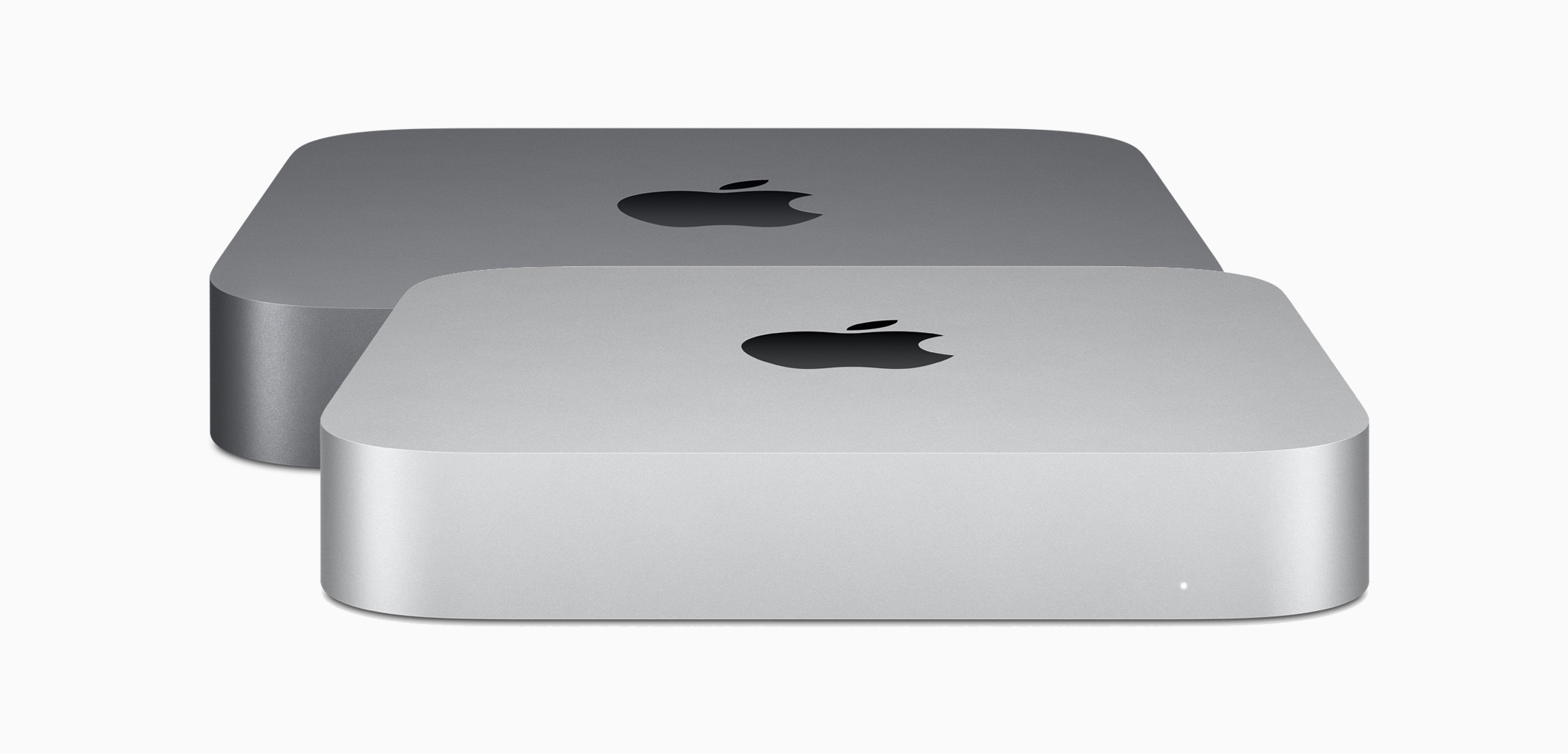
Theoretical Mac mini family

I don’t know why the Mac mini didn’t get the M2, but my suspicion is that Apple is planning two Mac minis that would launch simultaneously — a standard model with the same M2 as in my MacBook Air, and a higher-end model powered by the M2 Pro. I find it very interesting that the M1 Pro didn’t end up in anything other than the two larger MacBook Pros. I can’t help but think that fact is one side of a coin, with the Intel Mac mini on the other.

Chart a Course for the Future

Despite these hiccups, the transition to Apple silicon has been remarkably smooth. Apple is probably the best company on the planet when it comes to being willing and able to pull off large-scale technical shifts in existing product lines. Even if it is taking longer than initially promised, the results of this work already speak for themselves. The Apple silicon machines are a huge hit and have breathed new life into the Mac line. I think the delays we currently see will be forgotten soon enough.4


  1. Whereas the transition from PowerPC to Intel took less time than planned. ↩︎

  2. This of course raises the question of how long Apple may support Intel Macs once they have stopped shipping. In June 2009, Snow Leopard was announced to be the first release of Mac OS X not to support PowerPC machines, a mere thee years since the transition wrapped up in August 2006. ↩︎

  3. If the M2 Extreme is indeed DOA, some of those questions are answered in the Mac Studio’s M1 Ultra chipset, I suppose. ↩︎

  4. I couldn’t find a place for it, but I’d like to see the return of the larger iMac, too. But that’s not quite a requirement to complete the transition to Apple silicon. ↩︎

iPod Socks Wallpaper ⇢

Basic Apple Guy:

Confession: I have a disproportionate, bordering on irrational, adoration for iPod Socks! I couldn’t really explain to you why. Maybe the iPod Socks got wrapped up in the halo of the early days of owning my first iPod, with all the nostalgia and delight of discovering & enjoying new music while having all my favourite tracks all on one beautiful device. Or maybe they’re just cute, and I’m obsessively weird about it. Who knows? There are loads of cute things in the world, but few are on par with iPod socks.

I totally get that, and these wallpapers are a lot of fun.

1Password for Families PSA ⇢

Did you know that 1Password Business comes with free 1Password Family memberships for employees? This came up in the Discord for Relay FM Members today:

When you’re part of a team that uses 1Password Business, you get a complimentary 1Password Families membership, which you can share with up to 5 family members.

To redeem your free membership, link your family account to your business account. Only your subscription status will be linked. No other information is shared.

I had forgotten about this, so logged in to see what I needed to do to take advantage of this feature:

To apply your free membership to an existing account, click “Apply to existing account”. Then sign in to your family account and click Apply. If you sign in to an individual account, you’ll be asked if you want to convert it to a family account.

It took me about three seconds to link my existing Family plan to Relay FM’s business account.