512 Pixels

Sponsor: Unite 4 for macOS ⇢

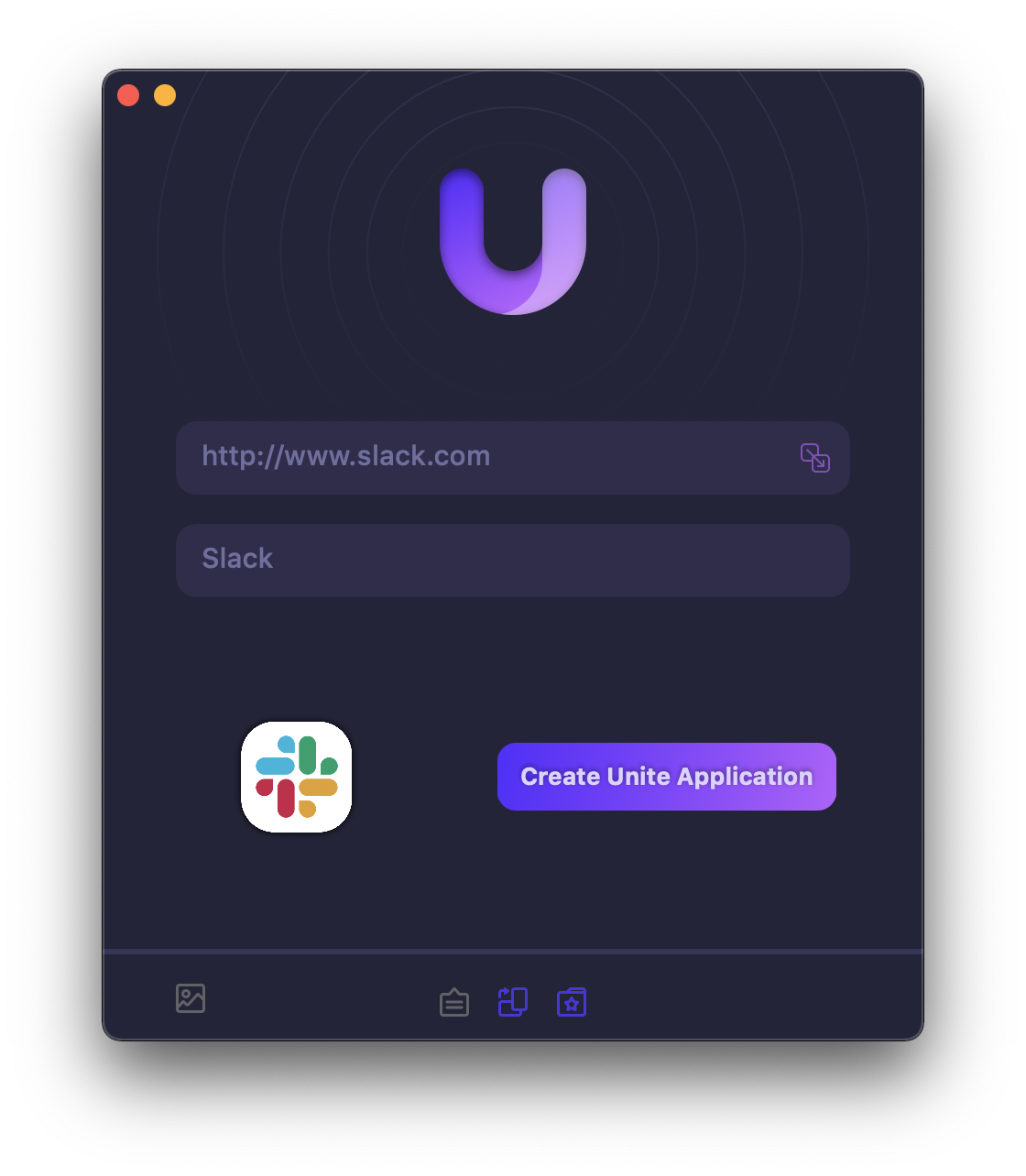
Unite 4 for macOS allows you to turn any website into an app on your Mac. Using a lightweight, WebKit powered browser as a backend, you can easily create isolated, customizable apps from any site.

Unite 4 includes dozens of new features, including support for native notifications, new customization options, and much more. Unite apps also serve as a great alternative for resource hogging Electron apps or half-baked Catalyst apps.

Some examples of apps you could create in mere minutes with Unite:

  • A Gmail web client that behaves like a native mail client.
  • A status bar app for Apple Music or Overcast
  • An isolated workspace for apps that may track you like Facebook
  • A Google Meet app that works efficiently without using Chrome
  • A fully featured Instagram app that has a resizable window, unlike the M1 version.
  • A Robinhood, Figma, or Roam Research app for your desktop.

512 Pixels readers get 20% off this week when you purchase Unite 4 at bzgapps.com/unite512 or when you use the promo code ‘512Pixels’ at checkout.

You can also try Unite for 14 days absolutely free or use it as part of your subscription if you’re a Setapp subscriber!

Sunday Rumor Sunday

With Apple’s spring event just around the corner, there’s a lot going on in the rumor world:

Analyst Ming-Chi Kuo says that he expects to see a more powerful Mac mini this week, alongside a new “more affordable” 27-inch external display.

Mark Gurman reported today that the display in question has been ready for months. This display seems to be much more mainstream display than the Pro Display XDR, and will lack mini-LED to keep the cost “down” to around $2,500.

That may not be the only display in the works at Apple, though. Filipe Espósito at 9to5Mac reported on Friday that Apple is working on a replacement for the Pro Display XDR. According to Espósito, this is dubbed the “Apple Studio Display,”1 and clocks in at an even-nicer-than-the-XDR 7k resolution.

Back to Ming-Chi Kuo for a moment, though. He also says that the Mac Pro and iMac Pro are now coming in 2023. This is beyond the end of the “2 year transition” Apple announced for Apple silicon, but COVID-19 continues to wreck havoc on supply chains and working conditions around the world.

At 9to5Mac, Espósito also commented on future Mac hardware:

Based on information seen by 9to5Mac, the new Mac Studio is primarily based on the Mac mini, but with much more powerful hardware. Apple has two versions of Mac Studio under development. One features the M1 Max chip (the same as the 2021 MacBook Pro) and the other a variant of the Apple Silicon chip that is even more powerful than the current M1 Max.

I think it may be safe to assume something “more powerful than the current M1 Max” would end up in 2023’s iMac Pro or Mac Pro, but basing machine like this on the Mac mini is interesting.

At first, I thought this seemed like a bit of a miss, but then I remembered that Gurman and others have reported that a “half-sized” Mac Pro is in the works. Could the “Mac Studio” be this machine, slated to slot between the Mac mini and a larger Mac Pro that is more akin to what we have today?

Even with the half-sized Mac Pro smoke, all of this feels a bit weird to me. Would Apple launch a fourth desktop model, joining the Mac mini, iMac and Mac Pro?2 That seems like dividing a pretty small pie into an unnecessary number of pieces, but as a desktop Mac user, it is certainly exciting to consider.

I struggle with the “Studio” name a bit here. I think it would be fun to see it return to the display lineup, but would Apple brand this new mid-range headless Mac3 with name of its new high-end display? If I had to guess, whatever this more-than-a-Mac-mini-but-not-a-Mac-Pro-either machine is, it won’t have Studio in the name.

But no one really knows, and that’s what makes all of this so much fun.


  1. A name that comes with quite a history. ↩︎

  2. Or a fifth if the iMac Pro rises from the dead… ↩︎

  3. Oh no. ↩︎

StopTheMadness ⇢

StopTheMadness is a Safari extension for iOS and Mac that stops websites from making your browser harder to use, and it has my thanks for sponsoring 512 Pixels this week.

Many web sites deliberately disable user interface features in your browser that you normally expect to work. It is sold separately in the iOS App Store and Mac App Store. The iOS App Store version supports Safari, and the Mac App Store version supports all major web browsers including Safari, Firefox, and Google Chrome.

Apple Heading Back to the Office ⇢

Mark Gurman:

Apple Inc. has set an April 11 deadline for corporate employees to return to in-person work, marking a key test of whether the tech giant can reestablish office life in the Zoom era.

Employees will be required to work from the office at least one day per week by that date, according to a memo sent by Chief Executive Officer Tim Cook on Friday. By three weeks after April 11, employees will be expected in the office twice per week. And on May 23, employees will need to be in the office at least three days a week – on Mondays, Tuesdays and Thursdays.

MaskerAid ⇢

Relay FM podcaster 1 and all-around nice human Casey Liss has a new app out today. It’s called MaskerAid, and it’s pretty darn clever. Here’s a bit from his announcement blog post:

In short, MaskerAid allows you to quickly and easily add emoji to images. Plus, thanks to the magic of machine learning, MaskerAid will automatically place emoji over any faces it detects.

Like Casey outlines in his post, I have become increasingly uncomfortable with using social media to share photos or details about my children and their lives.

Obscuring faces — or adding emoji to an image just for fun — is super simple with MaskerAid. It takes mere moments to learn the app’s interface and you’ll be off to the races. I was impressed with it the first time I opened the TestFlight invite months ago, and if it sounds like it scratches an itch you have, you should check it out on the App Store.

Here’s a photo I edited with it, featuring the app’s creator and yours truly on one of those annoying pedal-powered pub crawl group bicycle things in Texas. We were there for Myke Hurley’s bachelor party, so I’m pretty pleased with my emoji usage here:

Made with MaskerAidMaskerAid is a free download for the iPhone and iPad. The free version lets you add the smiley face emoji to your photos; a one-time $3 in-app purchase unlocks the full emoji library.


  1. He’s also on some other show that I hear is pretty good. ↩︎

The Mini Mac mini ⇢

Speaking of Quinn Nelson, he has published a video in which he took an M1 Mac mini and built it into a tiny 3D-printed case:

The result is a machine much smaller than the existing M1 Mac mini, which uses the same design that first debuted back in 2010.

I wrote about this design in 2013, hoping to see a smaller Mac mini even then. I would like to see Apple reinvent this machine, but even if they do, I don’t think it would be as radical as what Quinn ended up with.

Electric Truck Maker Rivian Announces Major Price Increase (Updated) ⇢

Fred Lambert, writing at Electrek:

Rivian today announced several significant price increases for its R1T electric pickup truck and R1S electric SUV that have resulted in the cost of many reservation holders’ configurations rising by more than $12,000. The price increases come as Rivian is trying to ramp production and make its electric vehicle profitable while adding lower component tiers that will arrive as early as 2024.

The news was sent to reservation holders via email yesterday. I first saw it via a series of tweets from Quinn Nelson. I’d encourage you to go read the thread, as in it, he outlines his communication with the company over the last several months.

Price increases have happened all across the car market over the last two years. COVID, supply shortages and inflation have all wrecked havoc on auto manufacturing. Staying within the EV world, Tesla has marked up its models several times over the last 24 months, but only for new orders, not existing ones like Rivian did. Neither situations are ideal, but the latter looks far worse than the former.

Update: A day later, on March 3, Rivian reversed the decision. Here’s a bit from CEO RJ Scaringe’s letter to customers:

The costs of the components and materials that go into building our vehicles have risen considerably. Everything from semiconductors to sheet metal to seats has become more expensive and with this we have seen average new vehicle pricing across the U.S. rise more than 30% since 2018. Given our build lead up times, we need to plan production costs not only for today, but also for the future.

As we worked to update pricing to reflect these cost increases, we wrongly decided to make these changes apply to all future deliveries, including pre-existing configured preorders. We failed to appreciate how you viewed your configuration as price locked, and we wrongly assumed the announced Dual-Motor and Standard battery pack would provide configurations that would deliver price points similar to your original configuration. While this was the logic, it was wrong and we broke your trust in Rivian.

No kidding.

Here’s a bit more:

For anyone with a Rivian preorder as of the March 1 pricing announcement, your original configured price will be honored. If you canceled your preorder on or after March 1 and would like to reinstate it, we will restore your original configuration, pricing and delivery timing. Our team will be sending an email in the next few days with more details.

My guess is that a chunk of those preorders are gone forever.

Sponsor: StopTheMadness — Take Back Your Web Browser ⇢

StopTheMadness is a web browser extension for iOS and macOS that stops websites from making your browser harder to use. And it protects your privacy on the web!

Many web sites deliberately disable user interface features in your browser that you normally expect to work. StopTheMadness re-enables those features for you in your browser:

  • ⌘-click to open a link in a new tab
  • ⌘-key keyboard shortcuts
  • selecting, copying, cutting, and pasting of text
  • drag and drop
  • opening contextual menus
  • autofill/autocomplete of passwords and emails

StopTheMadness also protects your privacy on the web by eliminating common tracking methods:

  • URL parameters such as utm_source, gclid, and fbclid
  • link shorteners such as bit.ly, tinyurl.com, l.facebook.com, and t.co
  • Google AMP (Accelerated Mobile Pages)
  • clickjacking in Google Search, Gmail, Facebook, and DuckDuckGo
  • hyperlink auditing (anchor “ping”)
  • beacons (Navigator.sendBeacon)

There are many more features, too many to list! Here are a few:

  • Stop videos from autoplaying. This works even on sites where the browser’s autoplay preferences don’t work, such as YouTube.
  • Show native video controls. Use AirPlay or Picture-in-Picture from Safari on sites that don’t normally support it, including YouTube.
  • Add your own site-specific CSS and JavaScript to web pages.
  • Hide the annoying iOS popup banners prompting you to get the App Store app on Google, DuckDuckGo, Reddit, Tumblr, and Instagram.

StopTheMadness is sold separately in the iOS App Store and Mac App Store. The iOS App Store version supports Safari, and the Mac App Store version supports all major web browsers including Safari, Firefox, and Google Chrome.