As part of WWDC this week, Apple introduced a new MailKit framework for macOS Monterey that enables developers to create Mail app extensions that block content, perform message and composing actions, and help with security.
These new plug-ins have to fall into four categories:
Compose: Extensions that provide new workflows when composing emails
Actions: Extensions that apply custom rules to incoming emails, such as an email being color coded, moved to a separate inbox, marked as read, or flagged
Content Blocking: Extensions that serve as WebKit content blockers for emails based on specific criteria in an email’s HTML code
Message Security: Extensions that sign, encrypt, and decrypt emails when sending and receiving mail, with signed and encrypted icons below emails
Older mail plug-ins are still supported in macOS Monterey, but will stop being supported in a future release of macOS.
Joe Rossignol has spotted a list of macOS 12 features that will only work on M1 Macs. I’m a little surprised at this, but I suppose that the benefits of having new Macs and iOS devices using the same architecture are already in play when planning future OS features.
Over the last several years, there has been a lot of hand-wringing about what Shortcuts would mean for old-school Mac automation. It is clear to me that Apple thought about this, and has designed Shortcuts for the Mac to be able to support the old and new, all at the same time. That’s not always Apple’s modus operandi, but it was the right move in this case.
I am impressed at how much Apple has done with Shortcuts to make a great Mac utility.
Today at WWDC, Apple announced the next version of the Mac operating system, macOS Monterey.1 It doesn’t bring as much change as Big Sur did, but I think most Mac users will be just fine with that. However, I don’t think Monterey is a release worth sleeping on; there is a lot here this year.
All Children are Loved the Same
My initial impression, right after the keynote, is that I am pleased that the almost all of the headlining features in iOS and iPadOS are coming to the Mac this year as well.
Safari’s new design and Tab Groups are present across all three platforms. Quick Notes can be created on both the Mac and iPad, and are editable on the iPhone. Notes can be tagged across platforms and their edit history reviewed.
Live Text — the ability to search for and interact with text inside of photos isn’t locked away to mobile devices, something I figured would be.
I am very interested in how SharePlay turns out in practice. Coming from a year of trying several different watch-along evening with family members, if this works, it’ll be like magic. And AirPlay to the Mac? That’s just overdue by years.
FaceTime is getting so much-needed love this year too, but I can’t help but feels like it’s too little too late to truly take on Zoom.
There’s also a new Low Power Mode! I can’t wait to dig into that.
A New Era of Automation
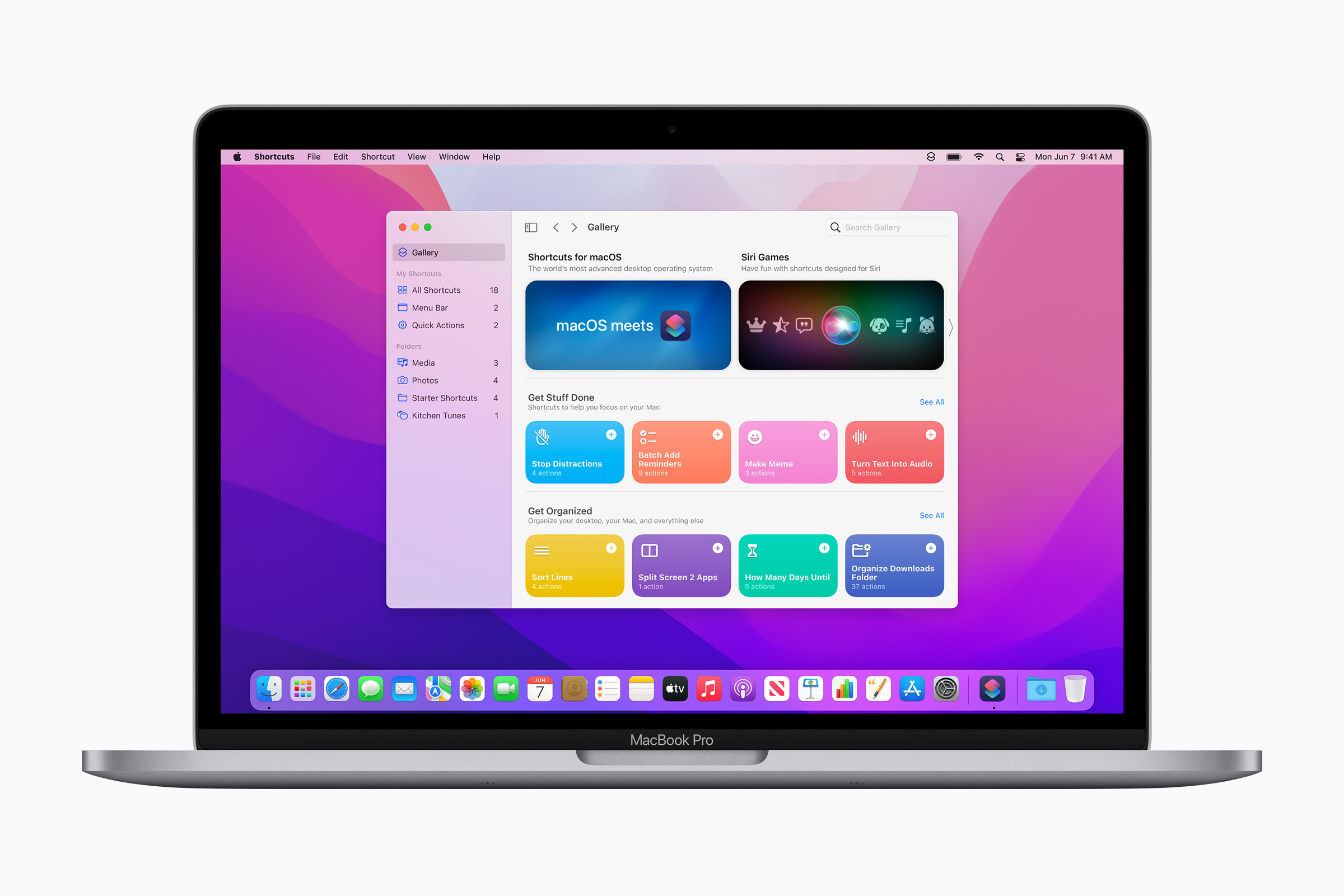
As has been rumored for a couple of years, Shortcuts is set to make its debut on the Mac later this year.
The UI looks very much like the iPad version, which means it should be easier to create automations and edit others in this app than compared to something like Automator or AppleScript.
I gotta be honest: the writing is on the wall for Automator. Shortcuts can import Automator workflows, and Craig mentioned that “Shortcuts is the future of automation on the Mac,” so I don’t think it looks good for our little robotic friend in the long run. For now, however, it remains, being able to handle workflows that Shortcuts may not be ready for.
Individual Shortcuts can be run from from the Dock, menu bar, the Finder, Spotlight, or with Siri, making them even more flexible than Automator’s workflows, which gained a foothold in Finder a few years ago as “Quick Actions.”
Meanwhile, according to Apple, AppleScript and shell scripts can be run within Shortcuts. This was of course possible in Automator, and is another blow to that application. That said, as a professional Macintosh User, I am thrilled that scripting seems to be safe in the Shortcut-infused future.
Out of everything announced for macOS today, I honestly think this is the biggest deal when considering the future of the Mac.
System Requirements
macOS 12 brings with it new system requirements, dropping all 2013 and 2014 Macs except for the 2013 Mac Pro and late 2014 Mac mini. The initial 2015 MacBook has been left behind as well. Here’s the complete list of supported systems:
I think Monterey is a bigger deal than it seems, mainly for what it says about the Mac’s place in Apple’s overall strategy. It’s getting major features in step with iOS and iPadOS, but is still unique, even with its version of Shortcuts. I know 2021 is the Year of Mac Hardware, but I like where macOS 12 is going.
Why doesn’t the Macintosh IIvx support monitors larger than 14 inches?
The Macintosh IIvx (Performa 600) has internal video support for the 12-inch, 13-inch, 14-inch, and VGA (Video Graphics Array) displays. However, the internal video doesn’t support monitors greater than 14 inches.
Macintosh IIvx video logic is based on the Macintosh LC II. Time to market urgency made major alterations of the Macintosh LC ASIC impossible.
Customers must purchase an appropriate NuBus Card such as the Macintosh Display Card 8*24 to drive their larger monitors.
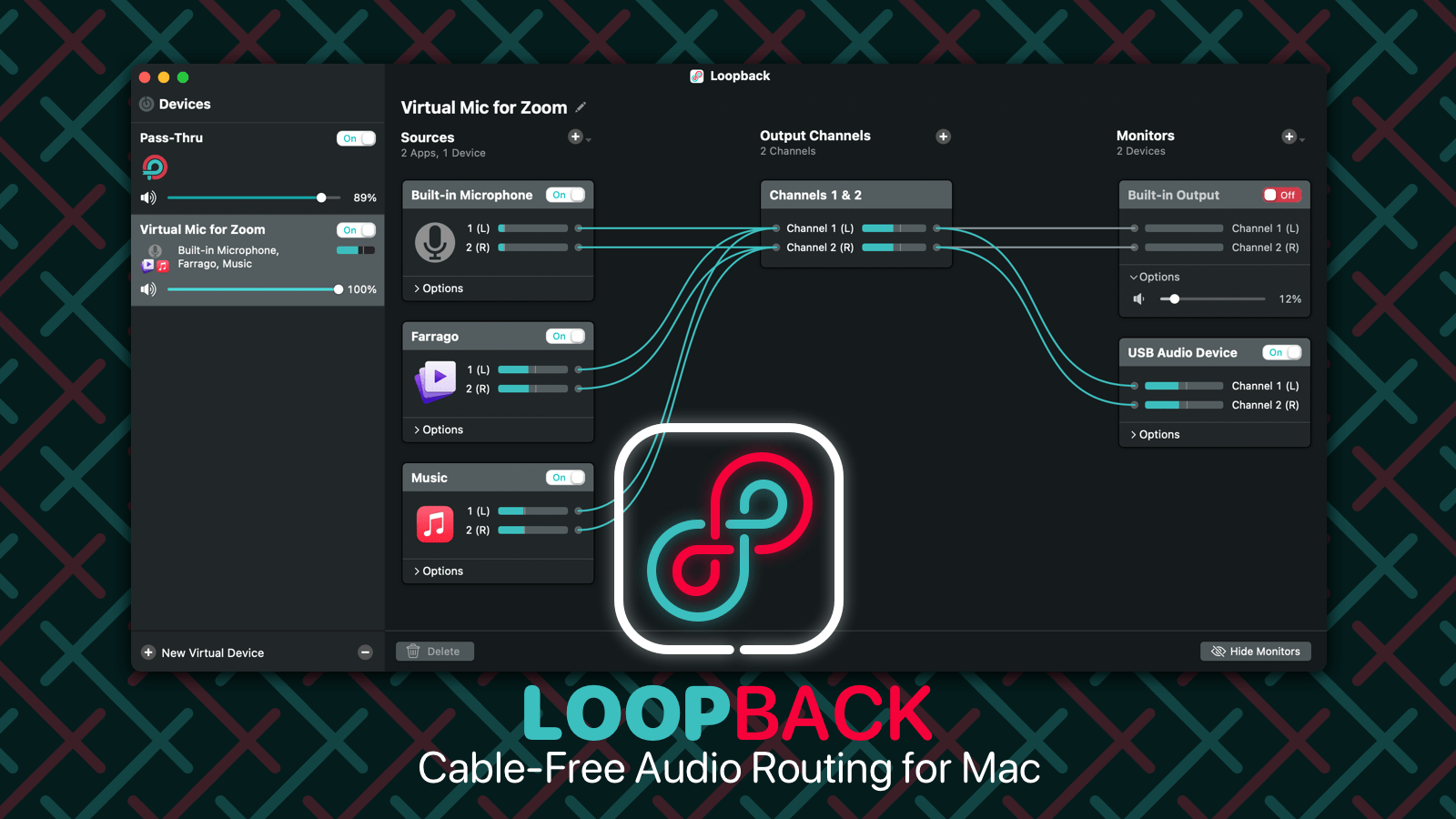
With Loopback, it’s trivial to pass audio from one application to another on your Mac. Need to play a recording into Zoom? Add sound effects into a podcast? Include music in a streamed event? Loopback gives you the power to do just that with just a few clicks. It’s like a high-end mixing board, right inside your Mac.
Loopback creates virtual audio devices, which merge audio from multiple applications and input devices into a single source. These virtual devices appear on your Mac just like a real, physical device, and can be selected for use in any audio app on your Mac. It’s incredibly powerful.
Fortunately, it’s also incredibly easy to use. Loopback’s intuitive wire-based setup makes it easy and obvious to understand exactly how your virtual devices work. Configure, adjust, and experiment, just by clicking and dragging.
Assuming Mind is being announced tomorrow as part of watchOS 8, I have some wishes for the app, as someone who uses Breathe more than most probably do.
I’d love to Mind be more expansive than Breathe in terms of the types of mindfulness exercises it offers. For the last couple of years, I’ve used the uber-popular Headspace app on my phone and like the variety of guided sessions it offers, especially the ones designed to be used while trying to go to sleep.
Naturally, this type of application would be more useful if it was also on the iPhone, where Breathe hasn’t shown up yet.
Currently, Apple Health can track “mindful minutes,” including those sent to Health via third-party apps like Headspace. However, this data is buried in the Health application. I’d like to see the Apple Watch gain the ability to have customized sets of rings. The Stand/Move/Activity set we’ve had since the beginning is great, but I’d love to have additional rings for things like mindful minutes or even water intake.
I don’t love my Apple Watch like I once did, but what keeps it on my wrist is its ability to track my fitness. This is particularly important to me right now as I continue to recover from surgery on my right foot that took place in the fall. It’s been a helpful partner during this time, but if Apple could make the Apple Watch more useful in terms of my mental health as well, it’d become all that much more valuable.
With over 30 years of history, TidBITs is the longest-running tech publication covering Apple in the world. This week, one of its founders, Adam Engst, drops by the show to talk about his writing workflow, unusual input devices and how WWDC has changed over the years.
My thanks to HomeControl for sponsoring 512 Pixels this week. With it, you can control HomeKit devices and scenes, view sensor measurements and automate actions with HomeControl — right from your Mac’s menu bar.
The Cupertino, California-based company is planning to release the new iPad Pro in 2022 and the iPad mini later this year, according to people with knowledge of the matter. The main design change in testing for the iPad Pro is a switch to a glass back from the current aluminum enclosure. The updated iPad mini is planned to have narrower screen borders while the removal of its home button has also been tested