512 Pixels

Make Your Own Brushed Metal

Got a logo you like, but want to make way better? Add some Brushed Metal to it.

Here’s how to do it in Photoshop, courtesy of Brian Ashe:

  1. Filter –> Noise –> Add Noise: 100%, uniform, monochromatic
  2. Filter –> Blur –> Motion Blur: 30px

And, poof: it’s the early 2000s, all over again:

Dropbox for Mac and PC Gets Overhaul⇢

Alex Wilhelm:

Today Dropbox announced upgrades to its desktop client to allow for quick sharing of files with others, and improved updates that will help users keep up with the service. The most significant update involves an easier way to share files with a link – not a new capability – directly from the Dropbox desktop menu, which cuts down on the steps needed to send content to others.

In keeping with that change, the Dropbox menu has been improved to also accept files more simply, with access to shared files – in the new link form – in the menu itself. The notifications will be sent out in real-time, according to the firm.

Dropbox is the backbone of many of my workflows, and this update looks great.

Read and Trust: March 2013⇢

In this month’s Read and Trust magazine, Matt Alexander, Dave Caolo, David Chartier and Federico Viticci discuss mobile computing devices. It’s a great edition.

On Stamina Mode⇢

Vlad Savov, explaining a feature of the new Sony Xperia Z Android phone:

What Sony does is as simple as it is effective: all background apps and data transfers are disabled when the screen is turned off, thereby eliminating the vampiric power draw of running processes you don’t need while the phone idles. You still receive phone calls and messages as usual, plus you can whitelist apps that you don’t want affected by Stamina mode, meaning that after a bit of tailoring you can run this as your phone’s default setting. Sony claims that enabling Stamina mode can quadruple the Xperia Z’s standby time, and my experience with the phone confirmed this feature is no gimmick. Leaving the phone to mostly idle for one day, I found it barely consumed 15 percent of its charge, and even that power consumption was primarily down to the few occasions when I turned it on and used it. Stamina mode will do little to help power users or avid mobile photographers, but for the vast majority of people — with whom the phone spends most of its time inactive — it can have a definite positive impact.

I really don’t want full-on, anything-goes multitasking to come to the iPhone. Props to Sony for this, but this seems like something the operating system should be able to do.

An “open” system gives users enough rope to hang themselves, I suppose.

Drang, on DST⇢

The Good Doctor:

I like Daylight Saving Time, and the advantages it brings more than make up for the slight disruption in my schedule. In fact, the most annoying thing to me about the DST changeovers is hearing people complain about them. The “lost hour of sleep” is especially rich. Who are these hothouse flowers who always get exactly the same amount of sleep except for that terrible day in March? To hear them talk, you’d think they never stay up late watching a movie or reading a book. Only prisoners have such regimented lives.

Microsoft, Mozilla and iOS: Pouting Isn’t Fun for Anyone

Philip Elmer-DeWitt:

Two and a half billion dollars.

That’s how much Morgan Stanley’s Adam Holt estimates Microsoft (MSFT) may be leaving on the table by not offering a full version of its Office suite (Word, Excel, etc.) on Apple’s (AAPL) iPads.

But Microsoft hasn’t released Office for iPad. While the usefulness of such a suite of applications is lost on users like me, there’s no doubt the company is leaving (what the kids call) a metric shit ton of money on the table, even with Apple taking 30 percent off the top.

(Elmer-DeWitt notes that Microsoft could make more from selling software on the iPad than on the software bundled on all Windows-based tablets in 2014. That’s crazy.)

Now, let’s turn to Jennifer Van Grove, over at the CBS hostage-held CNET:

Mozilla’s Firefox browser will have no place on Apple devices so long as Apple continues its unfriendly attitude toward third-party browsers, Jay Sullivan, vice president of product at Mozilla, said today.

[…]

The sticking point for Mozilla is not being able to carry over its sophisticated rendering and javascript engines to iOS. Essentially, the organization doesn’t feel like it can build the browser it wants to for Apple’s platform, Sullivan told CNET.

The decision is a risky one. Sure, Mozilla now has Firefox OS and can attack the mobile browser market with low-end smartphones equipped with its browser, but as it stands, Mozilla holds less than 1 percent of the market, according to NetMarketShare. Apple, meanwhile, commands more than 55 percent of the mobile browser market with Safari.

Mozilla’s complaint is mostly a technical one. All third-party and in-app browsers on iOS have to use the Apple-supplied WebKit rendering engine and a slower javascript engine than what Safari enjoys. Sounds crappy, right?

Wrong. Chrome for iOS is still great, despite the fact that it runs on what Mozilla calls a “closed environment.” While it’s not as fast as Safari, as while it can’t be set as the default app, I like the layout of the UI and how it syncs with Chrome on my Mac and PC. Since it’s using Apple’s built-in WebKit tools, pages load quickly and look good.

I think it’s a mistake for Mozilla to whine about not being able to execute its Javascript rendering the way it wants to. In a world where Firefox is increasingly less important, moving to WebKit and building unique and strong features seems like one of Mozilla’s only options.

If Mozilla wants to get in the race, it needs to realize that Apple isn’t going to be changing its rules any time soon and build something worth using. Time’s running out. Complaining about another’s company’s platform rules as your marketshare is shrinking is not a winning strategy.

Let’s take a moment to look at another browser: Opera. For years, the company used a propriety rendering engine, but now Opera is moving to WebKit across the board. While Opera Mini renders things on the company’s servers and pushes weird (albeit tiny) web views to the users, the company’s WebKit-based iOS browser is due any time now.

Microsoft and Mozilla are keeping its products away from iOS because it doesn’t like how Apple does business or runs its platform. In the face of the success that Apple is enjoying with iOS, both of these other companies just look silly at this point.

Pouting children often do.

The Brushed Metal Diaries: An Introduction, a Trojan Horse and a History of Abuse

While most people think of Mac OS X 10.3 Panther or some drunken loser when they hear the term “brushed metal” in the context of UI design, the interface is far older than either of those two things.

Think back to the summer of 1999. People were canning fruits and vegetables in preparation of Y2K, Cher was on the radio everywhere, and people could walk around in denim vests without living in fear of being punched in the face.

1999 was a very interesting time to be an Apple fan. The Five Flavors were the machines of choice for many, and the Newton had been dead for little over a year. Mac OS 8.6 has just shipped, with OS 9 still several months away.

In these days, Apple released Brushed Metal in to the world. While eventually the UI would take over just about everything, its beginnings were quite humble: QuickTime 4.0.

From the technical perspective, QuickTime 4 seems basic now, but at the time, it was a nice little update. Here are the features added in the update:

  • Graphics exporter components, which could write some of the same formats that the previously introduced importers could read. (GIF support was omitted, possibly because of the LZW patent.)
  • Support for the QDesign Music 2 and MPEG–1 Layer 3 audio (MP3)
  • QuickTime 4 was the first version to support streaming. It was accompanied by the release of the free QuickTime Streaming Server version 1.0.
  • QuickTime 4 Player introduced brushed metal to the Macintosh user interface.
  • Support for files larger than 2.0 GB in Mac OS 9.
  • Variable bit rate (VBR) support for MPEG–1 Layer 3 (MP3) audio
  • Support for Synchronized Multimedia Integration Language (SMIL)
  • Introduction of AppleScript support in Mac OS

Additionally, QuickTime 4.1 dropped support for Motorola 68k Macintosh systems. Many users complained that the new application was slow, but with some fancy footwork, QuickTime 2.5 users could use all of the above features.

The feature that’s most remembered, of course, is its UI. Gone was the Platinum look that graced almost every single window in MacOS, replaced with a slick UI with embedded buttons, dials and more:
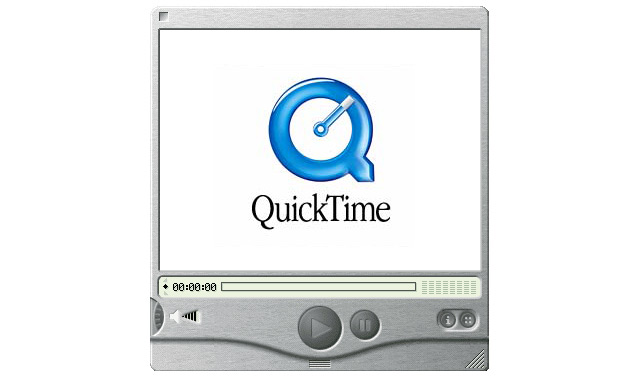
Image via Daily Apple Quiz

In hindsight, QuickTime 4 might be one of the best trojan horses Apple ever released. Everyone was so distracted by the new look, no one noticed when it crept in and killed everyone.

To be fair, mass murder was never Apple’s plan when it came to Brushed Metal. In its Human Interface Guidelines, Apple laid out its expectations when it came to Brushed Metal:

Windows have two distinct looks in Mac OS X. There is the standard default look of windows, as shown in the examples so far. There is also a brushed metal look available, shown in Figure 8–11. You can use a brushed metal window if your application:

  • Provides an interface for a digital peripheral, such as a camera, or an interface for managing data shared with digital peripherals — iPhoto or iSync, for example
  • Strives to re-create a familiar physical device — Calculator or DVD Player, for example
  • Provides a source list to navigate information — for example, iTunes or the Finder

Don’t use the brushed metal look indiscriminately. Although it works well for some types of applications, some applications appear too heavy when using this look. For example, it works well for the iSync application window, but it does not work very well for the TextEdit document window.

Of course, over time, developers — and Apple itself — ignored the HIG and went crazy with the stuff. I mean, just look at this screenshot of Panther:

Over the coming months (years), I’ll be looking at the growth of Brushed Metal, as well as its eventual demise. It should be fun. Hopefully, we won’t re-popularize the look.

Apple’s Not A Parent⇢

Jim Dalrymple:

The simple fact is, as parents, it’s up to us to monitor what our kids do with technology or any toy. If you choose not to use the included controls because they are a hassle, then that’s your choice. You made that decision.

This.